India Discrete Power Semiconductor and Power Modules Market Size & Share Analysis - Trends, Drivers, Competitive Landscape, and Forecasts (2026 - 2032)
This Report Provides In-Depth Analysis of the India Discrete Power Semiconductor and Power Modules Market Report Prepared by P&S Intelligence, Segmented by Type (Discrete Power, Power Modules), Material Type (Silicon, Silicon Carbide, Gallium Nitride), and Geographical Outlook for the Period of 2021 to 2032
India Discrete Power Semiconductor and Power Modules Market Size Forecast
Key Highlights
Study Period
2021 - 2032
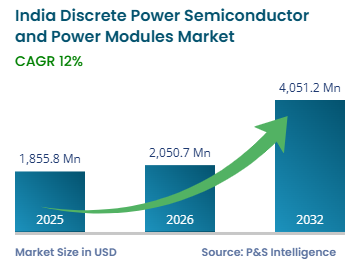
Market Size in 2025
USD 1855.8 Million
Market Size in 2026
USD 2050.7 Million
Market Size by 2032
USD 4051.2 Million
Projected CAGR
12%
Fastest Growing Type Category
Power Modules
Largest Material Type Category
Silicon
Market Structure
Fragmented
Market Size
Explore the market potential with our data-driven report
India Discrete Power Semiconductor and Power Modules Market Key Insights
The discrete power category holds the larger market share, of 75%, in 2025, driven by its widespread usage across consumer electronics, industrial systems, and automotive applications.
The power modules category will have the higher CAGR, of 16.0%, supported by increasing adoption in EVs, rail traction systems, and renewable energy inverters.
Silicon holds the largest market share of 45% in 2025, driven by its cost-effectiveness and mature manufacturing ecosystem.
Silicon carbide (SiC) will have the highest CAGR, of 12.7%, driven by its superior performance characteristics, including higher efficiency, better thermal conductivity, and higher voltage handling capability.
India Discrete Power Semiconductor and Power Modules Market Future Outlook
The India discrete power semiconductor and power modules market size was USD 1855.8 million in 2025, and it will grow by 12.0% during 2026–2032, to reach USD 4051.2 million by 2032.
The market is driven by the increasing electrification of mobility, rising renewable energy installations, and the expanding use of power electronics across industrial and digital infrastructure. Government initiatives such as Make in India, the Production Linked Incentive (PLI) scheme for semiconductors, and national programs supporting electric mobility and solar deployment are strengthening domestic demand for advanced power semiconductor devices and modules. The growing adoption of efficient power conversion technologies across transportation systems, telecom networks, and data centers is further supporting market expansion.
According to the Ministry of Electronics and Information Technology, India’s semiconductor mission aims to establish a strong domestic manufacturing ecosystem, with significant investments being directed toward fabrication and design capabilities, supported by a government incentive outlay of INR 76,000 crore (approximately USD 10 billion), while approved semiconductor projects have attracted investments of around INR 1.6 lakh crore.
India Discrete Power Semiconductor and Power Modules Market Trends and Drivers
Wide Bandgap Semiconductor Adoption and Electrification Is Key Trend
A defining trend reshaping the India discrete power semiconductor and power modules market is the transition from conventional silicon-based devices toward wide bandgap materials such as silicon carbide (SiC) and gallium nitride (GaN). These materials enable higher efficiency, faster switching speeds, and improved thermal performance, making them suitable for high-voltage and high-frequency applications. Increasing deployment of SiC MOSFETs in electric vehicles and renewable energy systems, along with GaN devices in telecom and consumer electronics, is transforming power electronics design across industries, a shift further reflected in industry activity such as STMicroelectronics showcasing advanced semiconductor technologies for power, energy, smart mobility, and battery management systems at electronica India 2025 in Bengaluru.
Government-backed semiconductor ecosystem development and investments in fabrication facilities, along with initiatives such as the Faster Adoption and Manufacturing of Electric Vehicles (FAME) scheme supporting electric mobility adoption, are further supporting this shift. The India Semiconductor Mission is actively promoting domestic manufacturing and design capabilities, encouraging global and local players to invest in advanced semiconductor technologies. As device efficiency becomes a critical parameter, wide bandgap semiconductors are becoming a core enabler of next-generation power electronics systems.
Rapid EV Adoption and Renewable Energy Expansion Are Biggest Drivers
The rapid expansion of electric mobility and renewable energy infrastructure represents the most consequential external force driving market growth. Electric vehicles require advanced power semiconductor components such as IGBTs, MOSFETs, and SiC devices for powertrain, charging, and battery management systems. Simultaneously, solar inverters, wind turbines, and energy storage systems rely heavily on power modules for efficient energy conversion. The NITI Aayog projects that electric vehicles could account for 30% of total vehicle sales in India by 2030, significantly increasing demand for power semiconductors.
India’s renewable energy expansion, supported by national targets and policy incentives, is generating sustained demand for high-efficiency power modules across grid and off-grid applications. Supporting this demand, companies are actively introducing advanced power solutions tailored for high-efficiency applications. For instance, in August 2025, Hitachi Energy India announced an investment of INR 300 crore to expand its Mysuru facility to increase manufacturing capacity for transformer insulation materials, supporting India’s power infrastructure development and energy transition. Additionally, the International Energy Agency indicates that India is among the fastest-growing energy markets globally, with renewable energy capacity projected to exceed 500 GW by 2030. This ongoing energy transition is increasing the need for efficient power semiconductor devices and modules across grid infrastructure, energy storage, and power conversion applications.
Supply Chain Dependence and High Capital Requirements Are Biggest Restraints
Dependence on imported semiconductor components continues to limit the growth of India’s discrete power semiconductor and power modules market, as domestic fabrication capacity for power semiconductors remains limited and largely at an early stage of development. Despite government initiatives to promote local manufacturing, commercial-scale facilities for advanced power technologies such as silicon carbide (SiC) and gallium nitride (GaN) remain absent. This gap restricts the country’s ability to meet increasing demand from electric vehicles and renewable energy systems, where reliable and high-efficiency power devices are critical for operations, while supply-side vulnerabilities and constrained access to components persist across high-growth industrial applications.
Establishing semiconductor fabrication units in India requires substantial capital investment, access to advanced process technologies, and long development timelines, which collectively act as barriers to new entrants and slow the pace of localization. Additionally, supply-side imbalances and pricing fluctuations in the global semiconductor ecosystem affect procurement planning and cost structures for Indian manufacturers. The limited availability of advanced fabrication, testing, and packaging infrastructure within India further constrains the domestic production of high-performance power semiconductor devices and delays the development of a fully integrated local value chain.
Localization and Government Incentives Are Key Opportunities
The push toward domestic semiconductor manufacturing and localization presents a significant opportunity for market expansion. Government incentives under schemes such as the Semiconductor PLI and infrastructure support programs are encouraging global semiconductor companies to establish manufacturing and assembly units in India. India’s electronics manufacturing sector is projected to reach USD 300 billion by 2026, creating strong downstream demand for power semiconductor components across multiple industries. India’s total installed power generation capacity reached 520.51 GW as of January 2026, significantly increasing the need for efficient power electronics and semiconductor devices in transmission, distribution, and grid management systems. This growing emphasis on domestic capacity expansion is reflected in initiatives such as Toshiba Transmission & Distribution Systems (India) Pvt Ltd, which in August 2025 signed an MoU to invest INR 562 crore to expand its manufacturing base in Telangana, directly strengthening local production capabilities and supporting India’s localization objectives.
The Ministry of Power emphasizes the need for efficient power electronics in grid modernization and renewable integration, further supporting demand for locally produced semiconductor devices. Strategic collaborations, joint ventures, and technology transfers are expected to accelerate the development of a domestic ecosystem, reducing import dependency and strengthening long-term market growth. This opportunity is further reinforced by ecosystem development initiatives, such as Microchip Technology, which in November 2025 expanded its India footprint by establishing a new facility in Bengaluru, contributing to the growth of local engineering and design capabilities.
India Discrete Power Semiconductor and Power Modules Market Segmentation Analysis
Type Analysis
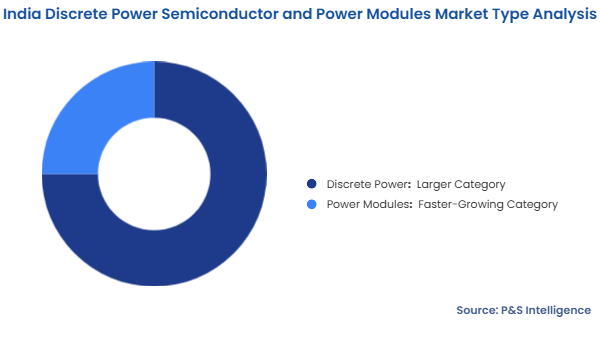
The discrete power category holds the larger market share, of 75%, in 2025, driven by discrete devices including MOSFETs, IGBTs, rectifiers, and bipolar transistors serving power management, switching, and signal amplification functions across consumer electronics, automotive, and industrial equipment. Cost-effectiveness and compatibility with existing electronic systems have cemented their position across high-volume applications in consumer electronics and industrial automation. This is further reflected in industry developments such as Renesas Electronics India showcasing automotive and embedded semiconductor solutions at electronica India 2025 in September 2025. This demonstration reflects the sustained commercial relevance of discrete and power management components across these application areas.
The power modules category will have the higher CAGR, of 16.0%, driven by increasing adoption in high-power and high-efficiency applications such as electric vehicles, rail traction systems, renewable energy inverters, and energy storage systems. Power modules integrate multiple semiconductor components into compact packages, enabling improved thermal performance, higher reliability, and reduced system complexity compared to discrete components.
The types analyzed in this report are:
Discrete Power (Larger Category)
By Type
SiC rectifier
Si rectifier
Bipolar discrete
GaN HEMT
SiC MOSFET discrete
Si MOSFET discrete
IGBT discrete
Others
By Application
Automotive
Rail
Renewable energy
Power generation & storage
Telecom & infrastructure
Consumer electronics
Industrial
Others
Power Modules (Faster-Growing Category)
By Type
IGBT modules
SiC MOSFET
Thyristor modules
By Application
Automotive
Rail
Renewable energy
Power generation & storage
Telecom & infrastructure
Consumer electronics
Industrial
Others
Material Type Analysis
Silicon holds the largest market share of 45% in 2025, driven by its cost-effectiveness and mature manufacturing ecosystem. It remains the preferred substrate for low- and medium-power applications across consumer electronics and industrial equipment due to its proven performance and reliability. This is also reflected in industry developments such as STMicroelectronics showcasing semiconductor solutions for power, energy, and industrial applications at electronica India 2025 in September 2025.
Silicon carbide (SiC) will have the highest CAGR, of approximately 12.7%, during the forecast period, driven by its superior performance characteristics, including higher efficiency, better thermal conductivity, and higher voltage handling capability. SiC devices are increasingly used in EVs, renewable energy systems, and high-power industrial applications, while GaN devices are gaining traction in high-frequency applications. The International Renewable Energy Agency highlights the growing need for efficient power conversion technologies in renewable energy systems, supporting the adoption of advanced semiconductor materials such as SiC and GaN.
The material types analyzed in this report are:
Silicon (Largest Category)
Silicon Carbide (SiC) (Fastest-Growing Category)
Gallium Nitride (GaN)
Others
Drive strategic growth with comprehensive market analysis
India Discrete Power Semiconductor and Power Modules Market Share
The market is fragmented, with the presence of multiple global and domestic players operating across different segments of the value chain. Leading companies such as Infineon Technologies, STMicroelectronics, ON Semiconductor, Mitsubishi Electric, and Toshiba Corporation operate alongside emerging domestic players like Tata Electronics and Sahasra Semiconductor. The absence of a single dominant player, combined with varied product portfolios and increasing participation driven by government incentives, reinforces the fragmented nature of the market. High capital requirements and technological complexity create entry barriers, yet policy support and rising demand continue to attract new investments. Companies are increasingly focusing on partnerships, localization strategies, and capacity expansion to strengthen their presence in the evolving Indian semiconductor ecosystem.
Leading Companies in the India Discrete Power Semiconductor and Power Modules Market:
Infineon Technologies India Pvt. Ltd.
STMicroelectronics Pvt. Ltd.
ON Semiconductor Technology India Pvt. Ltd.
Mitsubishi Electric India Pvt. Ltd.
Toshiba India Private Limited
Renesas Electronics India Pvt. Ltd.
Texas Instruments (India) Pvt. Ltd.
ROHM Semiconductor India Pvt. Ltd.
Vishay Components India Pvt. Ltd.
Nexperia B.V.
Wolfspeed Inc.
Microchip Technology Private Limited
Fuji Electric India Pvt. Ltd.
Semikron Danfoss Electronics Pvt. Ltd.
Littelfuse Operations India Private Limited
India Discrete Power Semiconductor and Power Modules Market News
In August 2025, Infineon India signed an MoU with the Department for Promotion of Industry and Internal Trade (DPIIT) to strengthen India’s semiconductor and tech startup ecosystem by supporting engineering students, startups and entrepreneurs via design challenges and innovation programs.
In May 2025, Ather Energy and Infineon Technologies Asia Pacific Pte. Ltd. signed an MoU to enhance semiconductor technologies to support light electric vehicles (LEVs), charging infrastructure, and safety in India. The collaboration seeks to utilize advanced semiconductor solutions from Infineon, including microcontrollers, and automotive-related sensors; in Ather’s LEVs.
In December 2024, Fuji Electric India Pvt. Ltd. signed an MoU with Dhanalakshmi Srinivasan College of Engineering and Technology (DSCET) for collaboration, supporting workforce/skills development for industrial electronics and manufacturing in India.
Frequently Asked Questions About This Report
What is driving the growth of power semiconductor demand in India?+
The growth is driven by increasing electrification, rising adoption of electric vehicles, expansion of renewable energy capacity, and growing demand for energy-efficient power electronics across industrial and consumer applications.
Why is demand for power modules increasing in India?+
Demand for power modules is increasing due to their use in high-power applications such as electric vehicles, rail systems, renewable energy systems, and energy storage, where efficiency, thermal performance, and reliability are critical.
Why does India rely on semiconductor imports?+
India relies on semiconductor imports due to limited domestic fabrication capacity, high capital requirements for setting up fabs, and the lack of advanced manufacturing infrastructure and ecosystem.
Which material type is growing fastest in India+
Silicon carbide (SiC) is the fastest-growing material due to its superior efficiency, high voltage handling capability, and suitability for electric vehicles, renewable energy systems, and high-power industrial applications.
How is EV adoption influencing semiconductor demand in India?+
Increasing EV adoption is driving demand for power semiconductors used in powertrain systems, battery management systems, and charging infrastructure, significantly boosting overall market growth.
What opportunities exist in India+
Government incentives, infrastructure development, and policy support are encouraging domestic manufacturing, attracting global investments, and creating opportunities for local ecosystem development and supply chain strengthening.
Want a report tailored exactly to your business need?
Leading companies across industries trust us to deliver data-driven insights and innovative solutions for their most critical decisions. From data-driven strategies to actionable insights, we empower the decision-makers who shape industries and define the future. From Fortune 500 companies to innovative startups, we are proud to partner with organisations that drive progress in their industries.
Client Testimonials
Working with P&S Intelligence and their team was an absolute pleasure – their awareness of timelines and commitment to value greatly contributed to our project's success. Eagerly anticipating future collaborations.
McKinsey & Company
India
Unmatched Standards
Our insights into the minutest levels of the markets, including the latest trends and competitive landscape, give you all the answers you need to take your business to new heights
Complete Data Security
We take a cautious approach to protecting your personal and confidential information. Trust is the strongest bond that connects us and our clients, and trust we build by complying with all international and domestic data protection and privacy laws