India Compound Semiconductor Market Size & Opportunities Analysis - Growth Strategies, Competitiveness, and Forecasts (2026 - 2032)
This Report Provides In-Depth Analysis of the India Compound Semiconductor Market Report Prepared by P&S Intelligence, Segmented by Atomic Layer Deposition (ALD), Type (Gallium Nitride (GaN), Gallium Arsenide (GAAS), Silicon Carbide (SiC), Indium Phosphide (InP), Silicon Germanium (SiGe), Gallium Phosphide (GaP)), Product (LED, Optoelectronics, RF Devices, Power Electronics), Application (Telecommunications & Networking Infrastructure, Automotive, Defense Aerospace and Military Systems, General & Architectural Lighting, Power Electronics & Grid Infrastructure, Consumer Electronics & Displays, Industrial & Commercial Systems), and Geographical Outlook for the Period of 2019 to 2032
Explore the market potential with our data-driven report
India Compound Semiconductor Market Future Outlook
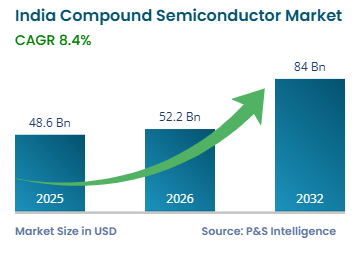
The Indian compound semiconductor market value is estimated at USD 48.6 billion in 2025, and it is projected to grow at a CAGR of 8.4% during 2026–2032, to reach USD 84.0 billion by 2032. The key factors propelling the market expansion include growing adoption of electric vehicles, rapid deployment of 5G infrastructure, government initiatives supporting domestic semiconductor manufacturing, and increasing demand for energy-efficient power electronics across industrial applications.
India's compound semiconductor landscape is witnessing transformative developments with the establishment of the country's first commercial facilities. SiCSem Private Limited's compound semiconductor unit in Infovalley, Jatni, Bhubaneswar, marks a pivotal moment in India's technological journey. This facility, designed to process 60,000 SiC wafers annually with packaging capacity of around 96 million units of MOSFETs and diodes, positions India strategically in the global compound semiconductor value chain.
The surge in demand is driven by multiple high-growth sectors. The gallium nitride semiconductor device market generated a revenue of USD 26.7 billion in 2024, and it is anticipated to grow at a CAGR of 18.2% from 2024 to 2030, ultimately reaching USD 72.8 billion by the year 2030.
The automotive sector's transition toward electric vehicles creates substantial demand for SiC and GaN-based power electronics. Additionally, the proliferation of LED lighting underscores the critical role of compound semiconductors in enabling energy-efficient illumination solutions.
India Compound Semiconductor Market Dynamics
Wide-Band-Gap Semiconductors Are Biggest Trend in Market
A growing trend in India’s wide-band-gap (WBG) semiconductor space is the localization of SiC and GaN manufacturing for high-efficiency power and RF applications.
GaN is increasingly deployed in sub-650 V domains such as USB-C fast chargers, onboard EV chargers, telecom power supplies, and solar inverters, thanks to its high switching speed and low losses.
SiC devices, suited for >1,200 V systems, are finding use in EV traction inverters and high‑power grid converters.
In the telecommunications sector, GaN HEMTs are being explored for 5G base-station amplifiers and RF modules.
India’s abundant bauxite reserves, a by-product source for gallium, are being leveraged to strengthen the domestic GaN supply chain, reducing reliance on imports.
To accelerate this trend, several industry and government initiatives have been launched.
SiCSem, in partnership with the U.K.’s Clas‑SiC Wafer Fab, has broken ground on India’s first commercial SiC fab in Odisha under the ISM framework.
The Defence Research & Development Organisation (DRDO) has developed indigenous GaN HEMTs and 4-inch SiC wafers for radar, electronic warfare, and other defense applications.
Collectively, these initiatives are driving domestic WBG semiconductor adoption, enabling energy-efficient, high-frequency, and strategically critical electronics across India.
Growing Demand across End-Use Sectors Drives Market
The electric vehicle revolution represents the most significant driver for compound semiconductor adoption in India.
As per the India Brand Equity Foundation, India recorded sales of 1.97 million units, compared to 1.75 million units in FY24, increasing 16.9%.
This rapid growth creates unprecedented demand for silicon carbide-based power electronics, which are essential for EV inverters, onboard chargers, and DC-DC converters.
Tesla adopted SiC in its inverters and remains the market leader in this category. More OEMs have launched high-volume shipment BEVs, such as BYD and Hyundai in the past few years.
The trend of 800-V fast-charging systems particularly drives SiC adoption, as these semiconductors offer superior efficiency and thermal management compared to traditional silicon.
With the FAME-India and ambitious targets of 30% EV penetration by 2030, the automotive sector's demand for compound semiconductors is set to accelerate exponentially.
The nationwide rollout of 5G networks creates massive demand for gallium nitride-based RF power amplifiers and front-end modules.
As per the Press Information Bureau, India has seen the fastest rollout of 5G services in the world, with 4,62,084 BTS deployed across 779 districts, as of December 2024.
These stations incorporate RF front-end modules, GaN power amplifiers, and beam-forming ASICs.
This infrastructure expansion requires high-frequency, high-power semiconductors that only compound materials can effectively deliver.
GaN's superior electron mobility and power density make it indispensable for 5G base stations, where efficiency and thermal management are critical.
The technology enables smaller, more efficient amplifiers that reduce operational costs and carbon footprint, aligning with India's sustainability goals while supporting the digital transformation agenda.
Government initiatives promoting energy efficiency create substantial demand across multiple compound semiconductor applications.
Programs like UJALA and the Street Lighting National Programme have catalyzed widespread LED adoption, with compound semiconductors forming the core of these lighting solutions.
Under the UJALA scheme, 36,87,05,643 LED lights had been distributed across India by mid-November 2025.
These are worth 47,883 million kWh in annual energy savings, INR 19,153 crore in yearly electricity bill reduction, 9,586 MW less in peak energy demand, and 3,87,84,984 tonnes of CO2 emission reduction each year.
India Compound Semiconductor Market Segmentation Analysis
Deposition Technique Analysis
Chemical vapor deposition (CVD) is the largest and fastest-growing deposition technique, with 35% share in 2025 and it is experiencing the highest growth rate, during 2026–2032, respectively. CVD is widely used for producing high-quality GaN, SiC, and GaAs layers, essential for power electronics, LEDs, and RF devices. Its scalability, reproducibility, and compatibility with various substrates make it ideal for both wide-bandgap and traditional semiconductors. With the rapid expansion of EVs, renewable energy systems, and 5G infrastructure in India, demand for high-efficiency, high-frequency components is rising, driving growth in CVD-based epitaxy. Government initiatives under the India Semiconductor Mission further accelerate domestic CVD adoption and local fab development.
The deposition techniques analyzed here are:
Chemical Vapor Deposition (CVD) (Largest and Fastest-Growing Category)
Molecular Beam Epitaxy
Hydride Vapor Phase Epitaxy (HVPE)
Ammonothermal
Liquid Phase Epitaxy
Atomic Layer Deposition (ALD)
Others
Type Analysis
Gallium nitride (GaN) dominates the Indian compound semiconductor market in 2025 with 30% market share, driven by its versatility across power electronics, RF devices, and optoelectronics applications. GaN's exceptional power handling capabilities are driving innovations in high-power electronics, RF amplifiers, and 5G infrastructure. The material's wide bandgap and high electron mobility enable superior performance in both power conversion and high-frequency applications, making it indispensable for India's 5G rollout and data center expansion.
Silicon carbide (SiC) is experiencing the highest growth rate, during 2026–2032, primarily fueled by electric vehicle adoption and renewable energy applications. SiC's high thermal conductivity and breakdown voltage enhance energy conversion in EVs, renewable energy systems, and industrial equipment. The material's ability to operate at higher temperatures and voltages with lower losses makes it ideal for EV inverters, solar inverters, and industrial motor drives.
Types covered include:
Gallium Nitride (GaN) (Largest Category)
Aluminum–Gallium Nitride (AlGaN)
Indium–Gallium Nitride (InGaN)
Silicon Carbide (SiC) (Fastest-Growing Category)
Gallium Arsenide (GaAs)
Aluminum–Gallium Arsenide (AlGaAs)
Others
Indium Phosphide (InP)
Silicon Germanium (SiGe)
Gallium Phosphide (GaP)
Aluminum–Gallium Phosphide (AlGaP)
Others
Product Analysis
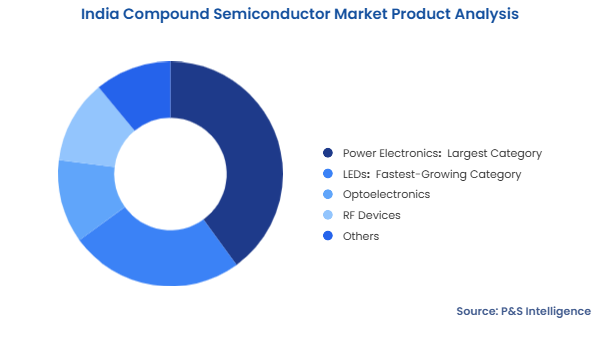
Power electronics hold the largest share, of 40% in 2025, as they encompass discrete devices, diodes, bare die, and modules used across automotive, industrial, and renewable energy sectors. The category benefits from the dual drivers of EV adoption and industrial automation, with SiC MOSFETs and GaN transistors replacing silicon counterparts in high-efficiency applications.
LED products are the fastest-growing category, supported by massive government-led lighting transformation programs. The combination of energy savings mandate and declining LED prices has created a virtuous cycle of adoption across residential, commercial, and public lighting applications.
Products covered include:
Power Electronics (Largest Category)
Discretes
Diodes
Bare Dies
Modules
Others
LEDs (Fastest-Growing Category)
Optoelectronics
RF Devices
RF Power
RF Switching
Others
Others
Application Analysis
Automotive applications command 30% market share in 2025, driven by the electric vehicle revolution and increasing semiconductor content per vehicle. The category encompasses EV powertrains, charging infrastructure, and advanced driver assistance systems, all requiring compound semiconductors for optimal performance.
General & architectural lighting is witnessing the fastest growth, propelled by nationwide LED adoption programs and smart city initiatives. The transition from conventional lighting to LED across streets, homes, and commercial spaces represents one of the largest addressable markets for compound semiconductors in India.
Applications covered include:
Telecommunication & Networking Infrastructure
Automotive (Largest Category)
Defense, Aerospace, and Military Systems
General & Architectural Lighting (Fastest-Growing Category)
Power Electronics & Grid Infrastructure
Consumer Electronics & Displays
Industrial & Commercial Systems
Others
Drive strategic growth with comprehensive market analysis
India Compound Semiconductor Market Geographical Analysis
Gujarat Compound Semiconductor Market Size
Gujarat emerged as the largest state market with 40% share in 2025, establishing itself as India's compound semiconductor manufacturing hub. The state benefits from existing semiconductor ecosystem development, with multiple OSAT facilities creating synergies for compound semiconductor manufacturing. Gujarat's proactive industrial policies, port connectivity for raw material imports, and skilled workforce from engineering institutions provide competitive advantages for compound semiconductor investments.
Karnataka Compound Semiconductor Market Growth
Karnataka is experiencing the fastest growth with a CAGR of approx. 9.0% during 2026–2032, leveraging its position as India's technology capital. Bengaluru's concentration of R&D centers, design houses, and technology companies creates natural demand for compound semiconductor applications. The state's focus on electric mobility, with several EV manufacturers establishing operations, drives demand for power semiconductors. Additionally, Karnataka's strong IT infrastructure supports data center expansion requiring GaN-based power supplies.
States covered include:
Gujarat (Largest State Market)
Karnataka (Fastest-Growing State Market)
Tamil Nadu
Assam
Uttar Pradesh
Maharashtra
Rest of India
India Compound Semiconductor Market Share
The Indian compound semiconductor market is in its nascent stage with limited domestic manufacturing but rapidly evolving through technology partnerships and government support. The market structure is currently fragmented with a mix of global suppliers, domestic assemblers, and emerging local manufacturers. International players dominate technology and materials supply, while Indian companies focus on assembly, packaging, and system integration.
The competitive landscape is characterized by high capital requirements, technology barriers, and the critical need for international partnerships. SiCSem Private Limited's compound semiconductor unit, a subsidiary of Archean Chemical Industries Ltd. in collaboration with Clas-SiC Wafer Fab Ltd., UK, exemplifies the joint venture model adopted for technology transfer and capability building. Companies are pursuing vertical integration strategies, from substrate manufacturing to device fabrication and module assembly.
Strategic activities include capacity building, technology licensing, and focus on specific applications like automotive and telecommunications. The emphasis on localization under government schemes creates opportunities for domestic players while attracting global companies to establish Indian operations.
Key India Compound Semiconductor Companies:
SiCSem Private Limited
Wolfspeed Inc.
STMicroelectronics N.V.
Infineon Technologies AG
ROHM Co. Ltd.
Wolfspeed Inc.
Infineon Technologies AG
Mitsubishi Electric Corporation
Toshiba Corporation
NXP Semiconductors N.V.
Texas Instruments Inc.
ON Semiconductor Corporation
Analog Devices Inc.
MACOM Technology Solutions Inc.
Wingtech Technology Co. Ltd.
India Compound Semiconductor Market News
In November 2025, SiCSem Private Limited commenced the construction of its compound semiconductor fabrication facility in Odisha with an INR 2,067-crore investment. The company targets 60,000 SiC wafers annual processing capacity.
In September 2024, NXP Semiconductors NV announced an investment exceeding USD 1 billion to bolster its research and development efforts in India, focusing on compound semiconductor applications for automotive and industrial sectors.
In June 2024, ROHM Co. Ltd. introduced the EcoSiC brand, expanding its Power Eco Family to include silicon carbide (SiC) products. The move targets the Indian electric vehicle and renewable energy markets.
In March 2024, India Semiconductor Mission approved multiple compound semiconductor projects under the Modified Scheme, extending 50% capital expenditure support for GaN and SiC fab facilities.
In January 2024, Infineon Technologies AG announced plans to establish GaN power semiconductor assembly and test facilities in India, targeting data center and 5G infrastructure applications.
Want a report tailored exactly to your business need?
Leading companies across industries trust us to deliver data-driven insights and innovative solutions for their most critical decisions. From data-driven strategies to actionable insights, we empower the decision-makers who shape industries and define the future. From Fortune 500 companies to innovative startups, we are proud to partner with organisations that drive progress in their industries.
Client Testimonials
Working with P&S Intelligence and their team was an absolute pleasure – their awareness of timelines and commitment to value greatly contributed to our project's success. Eagerly anticipating future collaborations.
McKinsey & Company
India
Unmatched Standards
Our insights into the minutest levels of the markets, including the latest trends and competitive landscape, give you all the answers you need to take your business to new heights
Complete Data Security
We take a cautious approach to protecting your personal and confidential information. Trust is the strongest bond that connects us and our clients, and trust we build by complying with all international and domestic data protection and privacy laws