India Automotive Actuator Market Size & Share Analysis - Trends, Drivers, Competitive Landscape, and Forecasts (2025 - 2032)
This Report Provides In-Depth Analysis of the India Automotive Actuator Market Report Prepared by P&S Intelligence, Segmented by Type (Hydraulic, Electric, Pneumatic), Application (Throttle, Fuel Injection, Brake), Vehicle Type (Passenger Vehicles, Commercial Vehicles), Motion (Linear, Rotary), and Geographical Outlook for the Period of 2019 to 2032
Explore the market potential with our data-driven report
India Automotive Actuator Market Overview
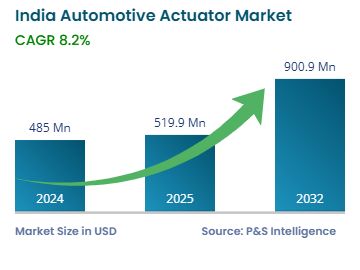
The Indian automotive actuator market size was worth USD 485 million in 2024, and it will grow by 8.2% during 2025–2032, to reach USD 900.9 million by 2032.
The market expansion is primarily driven by the rapid growth of the Indian automotive industry, increasing vehicle electrification, and rising demand for ADAS and comfort features in vehicles. The adoption of stricter emission standards, such as BS-VI, and the rising government shift towards electric mobility through schemes like FAME II are driving to integration of advanced technologies for accurate management of multiple vehicle operations.
As per the Society of Indian Automobile Manufacturers (SIAM), in FY 2024–25, India’s total automotive production reached approximately 31 million units, up from 28.4 million units the previous year, marking around 9% growth. This includes about 5 million passenger vehicles, 1 million commercial vehicles, 1.05 million three-wheelers, and nearly 24 million two-wheelers. Monthly production peaked near 2.48 million units in March 2025. Growth is driven by increased domestic demand, rising exports, and higher capacity utilization by OEMs. The two-wheeler segment leads production volumes, reflecting strong rural demand and urban mobility needs. These figures are based on official data from the.
The increasing localization of automotive component manufacturing, integrated with favorable government policies, such as the Production Linked Incentive scheme for the automotive sector, has attracted major actuator manufacturers to establish production facilities in the country. Furthermore, the growing middle-class population and rising disposable incomes are driving demand for vehicles equipped with advanced comfort and safety features, which require multiple actuator systems for operation.
India Automotive Actuator Market Dynamics
Rising Vehicle Electrification and Advanced Feature Integration Are Key Trends
The accelerating shift toward electric vehicles in India represents a key trend for the automotive actuator market.
EV sales in India reached 1.5 million units in 2023, marking a 50% year-on-year growth.
These vehicles used specialized actuators for battery thermal management, electronic throttle control, and regenerative braking systems.
According to the Ministry of Heavy Industries, India is targeting 30% EV penetration by 2030, which has prompted automakers to invest heavily in electric powertrains.
The FAME II scheme promotes the utilization of EVs by providing subsidies ranging from INR 10,000–15,000 per kWh for different EV categories, such as e-buses, e-four-wheelers.
Electric actuators provide precise control, energy efficiency, and integration with vehicle electronics.
Tamil Nadu is emerging as a leading hub for electric vehicle charger manufacturing, with major players such as Delta Electronics India and Eaton expanding their solutions featuring fast charge technology.
According to the reports, these policies have resulted in a 180% increase in pubic charging points between 2022 and 2024.
Implementation of Stringent Emission Norms Is Biggest Driver
India’s automotive emissions reached approximately 147 million tonnes of COâ‚‚ equivalent in 2023, up from about 145 million tonnes in 2022.
This increase is driven by higher fuel consumption, more vehicles on the road, and slower adoption of cleaner technologies.
The total number of operational vehicles in India grew to around 226 million in 2023, spanning two-wheelers, cars, commercial vehicles, and others.
This number is projected to more than double by 2050, reaching nearly 494 million, with two-wheelers dominating the fleet.
The enforcement of Bharat Stage VI emission standards across India has necessitated the utilization of advanced actuator systems for precise fuel injection and exhaust gas recirculation control.
As per the Ministry of Road Transport and Highways, all vehicles manufactured after April 2020 must follow BS-VI norms, which require a precision actuation system for efficient combustion and emission reduction.
They aim to lower NOx limits for diesel cars by 68%, PM by 82%, and require particulate filters and onboard diagnostics.
The limits on sulfur content in fuel have been reduced from 50 ppm (BS-IV) to 10 ppm (BS-VI), aiming to target emission reductions by 16.4 MtCO₂e yearly.
Automotive manufacturers are increasingly incorporating electronic throttle control actuators, variable valve timing actuators, and exhaust gas recirculation actuators to fulfil the strict requirements.
The transition has benefited the electric actuator segment, as these devices provide superior precision and responsiveness compared to traditional mechanical linkages.
The adoption of strict emission standards includes upgrades in fuel injection, cylinder pressure regulation, and calibration, which helps manufacturers to shift from traditional to electronic control systems.
Technologies such as diesel particulate filters and selective catalytic reduction systems are crucial for emissions control.
These systems depend on actuators for managing urea injection, exhaust gas flow, and temperature regulation to meet BS-VI standards.
India Automotive Actuator Market Segmentation Analysis
Type Analysis
The hydraulic category held the largest market share, of 55%, in 2024, due to the growing commercial vehicle sector and rising utilization of smart braking systems. The development of the logistics and e-commerce sector has increased the demand for commercial vehicles integrated with hydraulic brakes and power steering systems. According to the Ministry of Commerce and Industry, India's logistics sector is expected to reach USD 380 billion by 2025, which creates a strong demand for these vehicles. Moreover, the mandate for anti-lock braking systems in all commercial vehicles has increased the need for these actuators.
The electric category will have the highest CAGR of approx. 8.5%, due to the rapid shift toward electric vehicles, along with the enhanced energy efficiency, modulation, and responsiveness provided by these actuators. The shift towards electric power steering in all passenger vehicles and the integration of electric actuators in HVAC systems, throttle control, and various body control applications also increases the demand for the market. Major automotive OEMs in India have standardized electric actuators for applications such as variable valve timing and turbocharger control to meet BS-VI emission requirements.
The types analyzed in this report are:
Hydraulic (Largest Category)
Electric (Fastest-Growing Category)
Pneumatic
Application Analysis
The throttle category held the largest market share, of 45%, in 2024, due to the rising adoption of electronic throttle control systems in next-generation vehicles. They are widely used as they manage the air–fuel ratio and have been replaced by older cable-based systems following the deployment of BS-VI emission norms. Every new vehicle integrated with throttle systems offers fuel efficiency, reduced emissions, and enhanced drivability. Moreover, the alignment of the throttle system with the engine management system supports key features, such as cruise control, traction control, and various driving modes, establishing them as essential systems in next-generation vehicles.
The brake category will have the highest CAGR, due to the mandatory adoption of ABS in all vehicles and the increasing adoption of electronic stability control systems. The Ministry of Road Transport and Highways made ABS compulsory in all next-generation passenger vehicles from April 2019. Moreover, as per the PIB, the government is committed to reducing road accident fatalities and injuries by 50% by 2030, which drives the adoption of smart braking systems.
The applications analyzed in this report are:
Throttle (Largest Category)
Fuel Injection
Brake (Fastest-Growing Category)
Others
Vehicle Type Analysis
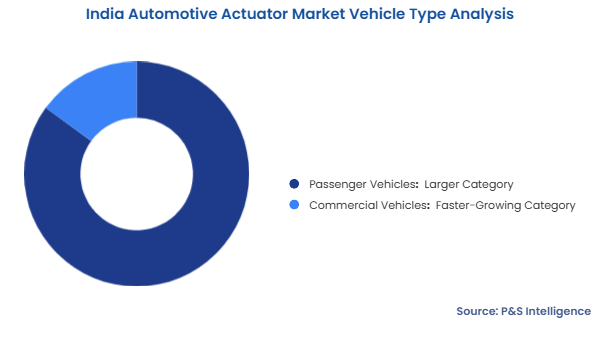
The passenger category held the larger market share, of 85%, in 2024, due to the strong growth of India's passenger car market and increasing consumer preference for feature-rich vehicles. As per the SIAM report, passenger vehicle sales reached a new high of 4.3 million units in FY 2024−25, a 2% increase compared to the previous year. The average number of actuators per passenger vehicle increased from 15–20 in 2015 to 30–40 in 2024, due to the integration of features such as ADAS systems, self-climate control systems, and power seats. Moreover, the rising popularity of high-end hatchbacks and entry-level SUVs with numerous comfort and user-friendly features has also contributes to the demand.
The commercial category will have the greater CAGR, due to the advancements in commercial vehicle technologies and strict vehicle safety standards. The MoRTH targets 70% electric vehicle adoption in the commercial vehicle sector by 2030. Moreover, the increasing adoption of AMT in these vehicles, which require multiple actuators for gear shifting and clutch operation, further boosts the market demand
The vehicle types analyzed in this report are:
Passenger Vehicles (Larger Category)
Commercial Vehicles (Faster-Growing Category)
Motion Analysis
The rotatory category held the larger market share, of 70% in 2024, due to the growing applications in HVAC systems, active grille shutters, and variable valve timing mechanisms. The rising focus on aerodynamic efficiency contributes to the implementation of active grille shutters in modern vehicles, which use rotary actuators for actuation. Additionally, the implementation of variable geometry turbochargers in diesel engines to meet BS-VI norms requires precise rotary actuators for vane position control.
The linear category will have the higher CAGR, of approx. 9%, because of its extensive application in throttle control, fuel injection, brake systems, and various body control functions. Linear actuators are used for applications that require precise positional control and direct force transmission, making them ideal for critical powertrain and safety applications. The transition to direct injection systems in petrol engines and common rail diesel engines has significantly increased the demand for linear actuators that control fuel injector operation with microsecond precision.
The motions analyzed in this report are:
Linear (Faster-Growing Category)
Rotary (Larger Category)
Drive strategic growth with comprehensive market analysis
India Automotive Actuator Market Regional Outlook
The Western category held the largest market share, of 40% in 2024, due to the concentration of major automotive manufacturing hubs in Maharashtra and Gujarat. Gujarat has emerged as a key automotive hub, with Suzuki, Honda, and Ford operating major facilities; meanwhile, the upcoming Suzuki–Toyota plant in Gujarat further strengthens the region's position.
This region also benefits from well-developed automotive component ecosystems, with more than 700 Tier-1 and Tier-2 suppliers operating in automotive clusters around Pune, Mumbai, Aurangabad, and Ahmedabad. The Rajasthan government is actively promoting EV manufacturing by building five industrial corridors as part of the EV policy 2022. This EV focus is creating new opportunities for actuator manufacturers, especially for specialized applications in battery management and electric powertrain systems.
The Southern category will have the highest CAGR, driven by the rapidly expanding automotive manufacturing base in Tamil Nadu, Karnataka, and Telangana. According to the Tamil Nadu Industrial Development Corporation, Tamil Nadu has emerged as India's largest automotive exporter, contributing 40% of the country's automotive exports. The state hosts manufacturing facilities of Hyundai, Renault-Nissan, BMW, and Daimler, creating constant demand for locally sourced actuators. Chennai, often called the Detroit of India, has developed a robust automotive component ecosystem with over 500 auto component manufacturers.
Karnataka's emergence as an EV manufacturing hub is significantly contributing to the actuator market growth in the region. Major EV manufacturers, such as Ola Electric, Ather Energy, and Mahindra Electric, have established production facilities in the state. Telangana and Andhra Pradesh are also attracting significant automotive investments, with companies like Kia Motors and Isuzu establishing large manufacturing facilities.
The regions analyzed in this report are:
East
West (Largest Category)
North
South (Fastest-Growing Category)
India Automotive Actuator Market Share
The market is moderately consolidated due to the presence of both global actuator manufacturers and domestic players who have developed strong relationships with Indian OEMs. Global companies dominate high-tech segments such as electronic throttle bodies and ADAS actuators, while domestic firms have a strong foothold in conventional applications. The competitive landscape is evolving rapidly with increasing localization requirements under the government's Make in India initiative and Atmanirbhar Bharat vision.
Johnson Electric Industrial Manufactory India Private Limited
Varroc Engineering Limited
Rockman Industries Limited
India Automotive Actuator Market News
In April 2025, Standard Motor Products Inc. expanded its Electronic Parking Brake Actuator program with coverage for millions of both late-model import and domestic vehicles. The new applications encompass Ford models, such as the 2023–22 Escape, Bronco Sport, and Maverick; in addition to the 2024–23 Super Duty trucks. Coverage has also been extended to include the 2024–22 Jeep Grand Cherokee and the 2024–22 Ram ProMaster, along with Mercedes-Benz vehicles up to 2023 and Subaru vehicles through 2024. Additional new coverage has been introduced for popular vehicles from Mazda, Audi, Volkswagen, and General Motors.
In November 2024, Robert Bosch GmbH announced an investment of INR 1,200 crore to expand its manufacturing facility in Bangalore for producing next-generation actuators for electric and hybrid vehicles, targeting 50% localization by 2026.
In September 2024, Minda Corporation and a European actuator manufacturer partnered to develop and produce advanced brake actuators for electronic stability control systems at its Chennai facility.
Want a report tailored exactly to your business need?
Leading companies across industries trust us to deliver data-driven insights and innovative solutions for their most critical decisions. From data-driven strategies to actionable insights, we empower the decision-makers who shape industries and define the future. From Fortune 500 companies to innovative startups, we are proud to partner with organisations that drive progress in their industries.
Client Testimonials
Working with P&S Intelligence and their team was an absolute pleasure – their awareness of timelines and commitment to value greatly contributed to our project's success. Eagerly anticipating future collaborations.
McKinsey & Company
India
Unmatched Standards
Our insights into the minutest levels of the markets, including the latest trends and competitive landscape, give you all the answers you need to take your business to new heights
Complete Data Security
We take a cautious approach to protecting your personal and confidential information. Trust is the strongest bond that connects us and our clients, and trust we build by complying with all international and domestic data protection and privacy laws