India Agrochemicals Market Size & Share Analysis - Emerging Trends, Growth Opportunities, Competitive Landscape, and Forecasts (2026 - 2032)
This Report Provides In-Depth Analysis of the India Agrochemicals Market Report Prepared by P&S Intelligence, Segmented by Product Type (Fertilizers, Pesticides, Plant Growth Regulators, Bio-Stimulants), Crop Type (Cereals & Grains, Fruits & Vegetables, Oilseeds & Pulses, Turf & Ornamentals), Modes of Application (Soil Treatment, Foliar Application, Seed Treatment, Post-Harvest Treatment), Form (Liquid, Solid, Gaseous), Composition (Conventional, Organic), and Geographical Outlook for the Period of 2021 to 2032
Explore the market potential with our data-driven report
India Agrochemicals Market Outlook
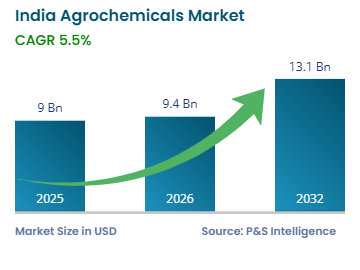
The Indian agrochemicals market size will be an estimated USD 9.0 billion for 2025, and it will grow by 5.5% during 2026–2032, to reach USD 13.1 billion by 2032.
The major factors responsible for the growth of the market include rising population driving food demand, increasing agricultural intensification needs, growing export opportunities, and government support for modern farming practices.
India ranks as the fourth-largest global producer of agrochemicals and has emerged as the third-largest exporter worldwide, with agrochemical exports reaching USD 3.3 billion in FY25, nearly tripling from USD 1.3 billion in 2014–15. The growing population, expected to reach 1.5 billion by 2030, necessitates enhanced agricultural productivity to meet food security requirements.
The market benefits from increasing awareness about integrated farming practices and precision agriculture adoption. About 25% of India's potential crop production is lost annually due to pests, weeds, and diseases, underscoring the critical role of agrochemicals in protecting yields and ensuring food security for the country's agricultural sector.
India Agrochemicals Market Emerging Trends
Government Policy Support and Subsidy ProgramAre Key Trends
Government initiatives are a key trend shaping agrochemical adoption patterns in India.
For instance, the Programme for Restoration, Awareness, Nourishment and Amelioration of Mother Earth (PM-PRANAM) scheme, launched in 2023, incentivizes balanced fertilizer use by rewarding states that reduce chemical fertilizer consumption.
States receive 50% of subsidy savings as grants, with 70% allocated for alternative fertilizer technology adoption and 30% for farmer incentives.
The government committed about INR 3.68 lakh crore for the urea subsidy scheme till March 2025, ensuring that urea continues to be sold to farmers at a subsidized price of Rs 242 per 45 kg.
Additional support includes Rs 1,451 crore subsidy for organic manure promotion through the GOBARdhan initiative, encouraging sustainable farming practices.
These policy frameworks maintain input affordability while gradually shifting toward bio-based alternatives.
Digital infrastructure integration connects land records, soil health cards, and credit facilities, enabling input companies to expand distribution reach.
The National Mission on Natural Farming, launched in 2024, aims to promote chemical-free farming among 10 million farmers, establishing 10,000 bio-input resource centers supported by a total outlay of around INR 2,481 crore.
Rising Food Demand and Agricultural Intensification Are Biggest Drivers
The key driver for the Indian agrochemicals market is the surging population and corresponding need for enhanced agricultural output.
India's population continues to expand, placing immense pressure on the agricultural sector to produce more food from limited arable land resources.
With the country's population projected to reach 1.5 billion by 2030, food grain demand is expected to grow substantially to meet nutritional requirements.
India must enhance food grain production significantly to ensure food security for its growing population.
The demand for total food grain is projected to reach 311 million tonnes, which includes substantial volumes of rice, wheat, pulses, and other cereals.
Agricultural intensification has become necessary as arable land per capita continues to decline due to urbanization and industrialization pressures.
Crop yield losses from pests, diseases, and weeds remain a persistent challenge, with annual losses valued at USD 10.1–15.7 billion.
Climate change is exacerbating pest pressures, as warmer temperatures and erratic rainfall patterns allow insects and pathogens to survive longer and expand into new regions.
This increases the frequency and severity of pest attacks, making agrochemical applications essential for crop protection.
Labor shortages in rural areas are transforming weed control practices, as manual weeding requires 8–10 hours of labor per acre.
Herbicides offer an efficient alternative, reducing labor dependency while ensuring effective weed management.
These converging factors drive sustained adoption of fertilizers, pesticides, and plant growth regulators across India's agricultural landscape.
India Agrochemicals Market Segmentation Analysis
Product Type Analysis
The fertilizers category holds the largest market share, of 60%, in 2025, driven by the sustained use of conventional nutrients, including urea, diammonium phosphate, and complex fertilizers, across major cropping systems. The government’s subsidy programs ensure fertilizer affordability, maintaining consistent demand even during sub-normal monsoon years.
The pesticides category will have the highest CAGR, of 5.8%, owing to the increasing pest pressures from climate change, growing awareness of crop protection benefits, and rising adoption of modern pest management practices. Labor shortages make chemical pest control more economical than manual methods. Herbicides show particularly strong growth as farmers seek efficient alternatives to labor-intensive manual weeding. The shift toward high-value horticulture crops in greenhouse clusters around Pune, Bengaluru, and Nashik drives demand for residue-compliant fungicides and biorational insecticides.
The product types analyzed in this report are:
Fertilizers (Largest Category)
Nitrogenous
Phosphatic
Potassic
Secondary
Pesticides (Fastest-Growing Category)
Insecticides
Herbicides
Nematicides
Fungicides
Plant Growth Regulators
Bio-Stimulants
Others
Crop Type Analysis
The cereals & grains category holds the largest market share, of 50%, in 2025, reflecting the massive acreage dedicated to paddy, wheat, and maize cultivation across the Indo-Gangetic plain. Government procurement price floors insulate grain growers from market volatility, sustaining consistent input demand. These staple crops receive priority in government agricultural programs, ensuring steady agrochemical consumption. Rice production was around 225 million tonnes in 2024/25, rising to roughly 228 million tonnes in 2025/26, as per the USDA.
The fruits & vegetables category will have the highest CAGR, driven by the expansion of export-focused horticulture and a shift toward high-value crops. Export-class mangoes, grapes, and bananas increasingly utilize trellis systems, fertigation, and climate-controlled environments that require higher input intensity. Growing domestic demand for fresh produce from urban consumers and expanding organized retail channels support this segment's growth. Greenhouse cultivation in specialized zones demands specialized agrochemical formulations with stricter residue compliance standards.
The crop types analyzed in this report are:
Cereals & Grains (Largest Category)
Fruits & Vegetables (Fastest-Growing Category)
Oilseeds & Pulses
Turf & Ornamentals
Mode of Application Analysis
The soil treatment category holds the largest market share in 2025, as it serves as the primary nutrient delivery method for fertilizers and pre-emergent pesticides. Most granular and liquid fertilizers are applied through soil incorporation or banding techniques. Soil-applied pesticides provide long-lasting pest control, particularly for root pests and soil-borne diseases. Drip irrigation systems enable precise soil-based nutrient and pesticide delivery, improving efficiency.
The foliar application category will have the highest CAGR, during the forecast period, owing to the increasing adoption of precision spraying equipment, growing use of water-soluble fertilizers, and rising awareness of foliar nutrition benefits. Foliar sprays deliver quick nutrient correction for deficiency symptoms and enable targeted pest control with lower chemical volumes. Government subsidies of up to 40% on drone purchases accelerate the adoption of precision aerial application technologies, particularly for foliar spraying in large commercial farms and plantation crops.
The modes of application analyzed in this report are:
Soil Treatment (Largest Category)
Foliar Application (Fastest-Growing Category)
Seed Treatment
Post-Harvest Treatment
Form Analysis
The liquid category holds the largest market share, of 55%, in 2025, driven by ease of application, better dissolution properties, and compatibility with modern irrigation systems. Water-soluble fertilizers and emulsifiable pesticide concentrates are consumed in high volumes in the country. Liquid formulations enable uniform distribution through sprayers and drip systems, improving application efficiency. Nano-nutrient liquids and water-dispersible granules gain farmer acceptance due to reduced dosage rates and improved field safety.
The solid category will have the highest CAGR, of 5.7%, owing to longer shelf life, reduced transportation costs, and suitability for broadcast application methods. Granular fertilizers remain popular for basal applications in field crops. Solid pesticide formulations like wettable powders and water-dispersible granules offer cost advantages for price-sensitive farmers. Recent innovations in granule coating technology improve nutrient release patterns and reduce environmental losses.
The forms analyzed in this report are:
Liquid (Largest Category)
Solid (Fastest-Growing Category)
Gaseous
Composition Analysis
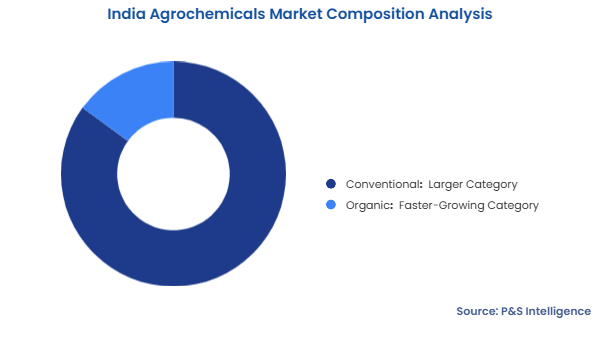
The conventional category holds the larger market share, of 85%, in 2025, driven by the extensive use of chemical fertilizers and synthetic pesticides across major crops such as cereals, pulses, oilseeds, and fruits and vegetables. High yield requirements, large cultivated areas, and well-established distribution networks continue to support strong demand for conventional agrochemical products.
The organic category will have the higher CAGR, of 5.9%, driven by rising awareness of sustainable farming, government initiatives promoting organic and natural inputs, and increasing adoption of biopesticides, biofertilizers, and biostimulants. Concerns over soil health, environmental impact, and residue-free produce are accelerating the shift toward bio-based agricultural solutions. This growth is further reinforced by government initiatives such as the Paramparagat Krishi Vikas Yojana (PKVY) and the National Mission for Sustainable Agriculture, which promote reduced reliance on chemical inputs and long-term soil sustainability.
The compositions analyzed in this report are:
Conventional (Larger Category)
Organic (Faster-Growing Category)
Drive strategic growth with comprehensive market analysis
India Agrochemicals Market Geographical Analysis
North India Agrochemicals Market Size
North India holds the largest market share, of 40%, in 2025, driven by the extensive agricultural acreage across Punjab, Haryana, Uttar Pradesh, and Madhya Pradesh, which together form India’s key food-grain-producing belt. The Indo-Gangetic plain supports intensive rice-wheat cropping systems requiring substantial fertilizer and pesticide inputs.
According to government data, Punjab and Haryana achieve some of the highest crop yields in India through intensive agrochemical use. These states lead in agricultural mechanization and modern farming practice adoption, driving higher per-hectare agrochemical consumption. Strong agricultural extension networks and well-developed distribution channels ensure agrochemical availability even in remote farming areas. Government procurement operations for wheat and rice maintain input demand stability across seasons.
Uttar Pradesh represents North India's largest agrochemical consumer due to its massive agricultural area and diverse cropping patterns. The state cultivates extensive sugarcane acreage alongside food grains, requiring specialized nutrient and pest management solutions. Growing horticulture sectors in Uttar Pradesh and Himachal Pradesh create additional demand for high-value crop protection products. Water scarcity challenges in parts of Rajasthan and Madhya Pradesh drive the adoption of fertigation and precision application technologies to optimize input efficiency.
South India Agrochemicals Market Size
South India will have the highest CAGR, of 5.6%, supported by the expansion of high-value horticulture in the states of Karnataka, Andhra Pradesh, and Tamil Nadu. The region specializes in commercial crops, including cotton, spices, plantation crops, and export-oriented fruits and vegetables, which require intensive agrochemical management. Karnataka's Bengaluru region serves as a major hub for greenhouse cultivation and protected agriculture, demanding high-quality residue-compliant pesticides. Andhra Pradesh hosts major agrochemical manufacturing facilities, providing proximity advantages for distribution.
Coffee and spice plantations in Karnataka and Kerala require specialized pest and disease management programs throughout the year. Tamil Nadu's diversified agricultural base, spanning rice, sugarcane, cotton, and banana cultivation, supports steady agrochemical demand. Telangana's government initiatives promoting cotton cultivation and modern farming practices accelerate agrochemical adoption. The region benefits from higher farmer awareness, better access to agricultural credit, and stronger linkages with organized marketing channels that facilitate premium agrochemical product adoption.
The regions of the market are as follows:
North India (Largest Regional Market)
South India (Fastest-Growing Regional Market)
West India
East India
India Agrochemicals Market Share
The market is fragmented due to the presence of numerous players ranging from large multinational corporations to regional manufacturers. The market structure reflects a mix of global agrochemical giants with extensive R&D capabilities and local companies with strong distribution networks and market understanding. This fragmentation creates competitive intensity across product categories, pricing segments, and geographic regions. Major multinational corporations like Bayer CropScience, Syngenta, BASF, and Corteva Agriscience leverage advanced R&D capabilities to introduce patented molecules and innovative formulations. These companies focus on high-value crop protection solutions and premium-priced specialty products. Indian companies, including UPL Limited, PI Industries, Coromandel International, and Rallis India, combine manufacturing scale with extensive domestic distribution reach spanning thousands of retail touchpoints.
Recent competitive strategies emphasize sustainability and biological solutions. Companies invest in biopesticide development, precision application technologies, and digital farmer engagement platforms. Partnerships between agrochemical companies and drone service providers expand precision spraying capabilities. Strategic acquisitions and licensing agreements enable portfolio expansion and technology access. Export-focused manufacturers pursue international registrations to access high-value markets in Latin America, Africa, and Southeast Asia.
Key India Agrochemicals Companies:
UPL Limited
PI Industries Limited
Bayer AG
Syngenta AG
BASF SE
Sumitomo Chemical Corporation
Dhanuka Agritech Limited
Rallis India Limited
Coromandel International Limited
Bharat Rasayan Limited
Insecticides (India) Limited
FMC India Private Limited
Gujarat State Fertilizers & Chemicals Limited
Indian Farmers Fertiliser Cooperative Limited
India Agrochemicals Market News
In September 2024, FMC Corporation launched three advanced crop protection solutions in India, including new herbicides and fungicides, strengthening its insecticides.
In August 2024, Crystal Crop Protection Limited launched Proclaim XTRA, a contact, systemic, and translaminar insecticide for maize and soybean crops, offering fast and long-lasting control against caterpillar infestations.
In June 2024, PI Industries Limited announced the acquisition of Plant Health Care Plc for GBP 32.8 million, enabling the integration of plant immune-induction technology to create a dual engine of biotechnology and innovative chemical products for Indian and international markets.
In May 2024, BASF SE launched Efficon pesticide in India, a new pesticide formulation designed to control piercing and sucking pests, making India among the first nations globally to acquire this innovative chemistry for controlling difficult-to-manage pest species.
In April 2024, Godrej Agrovet Limited launched Hanabi, a targeted pesticide solution for mite control in apple orchards, specifically targeting the Kashmir and Himachal Pradesh regions, where apple cultivation forms a major portion of the agricultural economy.
In February 2024, Corteva Agriscience expanded its Indian crop protection portfolio with the launch of Salibro, a nematicide developed to manage soil-borne nematode infestations across multiple crops.
In December 2023, Sumitomo Chemical Company Limited announced plans for an investment exceeding USD 35 million to set up a 50-acre agrochemical manufacturing facility in Gujarat, aimed at increasing capacity to meet rising domestic and export demand.
Want a report tailored exactly to your business need?
Leading companies across industries trust us to deliver data-driven insights and innovative solutions for their most critical decisions. From data-driven strategies to actionable insights, we empower the decision-makers who shape industries and define the future. From Fortune 500 companies to innovative startups, we are proud to partner with organisations that drive progress in their industries.
Client Testimonials
Working with P&S Intelligence and their team was an absolute pleasure – their awareness of timelines and commitment to value greatly contributed to our project's success. Eagerly anticipating future collaborations.
McKinsey & Company
India
Unmatched Standards
Our insights into the minutest levels of the markets, including the latest trends and competitive landscape, give you all the answers you need to take your business to new heights
Complete Data Security
We take a cautious approach to protecting your personal and confidential information. Trust is the strongest bond that connects us and our clients, and trust we build by complying with all international and domestic data protection and privacy laws