In-Dash Navigation System Market Size & Share Analysis - Trends, Drivers, Competitive Landscape, and Forecasts (2026 - 2032)
This Report Provides In-Depth Analysis of the In-Dash Navigation System Market Report Prepared by P&S Intelligence, Segmented by Component (Display Unit, Control Module, Antenna Module, Wiring Harness), Technology (2D Maps, 3D Maps), Vehicle Type (Passenger Cars, Light Commercial Vehicles, Heavy Commercial Vehicles), Sales Channel (Original Equipment Manufacturer (OEM), Aftermarket), Connected Navigation Service (Real-Time Traffic and Direction Information Services, Fleet Management Services), Propulsion Type (Internal Combustion Engine (ICE) Vehicles, Electric Vehicles (EVs), Hybrid Vehicles), Screen Size (Less than 6 inches, 6 inches to 11 inches, Greater than 11 inches), Display Type (Liquid Crystal Display (LCD), Organic Light Emitting Diode (OLED), Thin-Film Transistor LCD (TFT-LCD), LED Display), Connectivity Technology (Embedded Cellular Connectivity, Tethered Connectivity, Integrated Smartphone Mirroring, Wi-Fi Connectivity, Vehicle-to-Everything (V2X)/Telematics Communication, GNSS/Satellite Positioning & Antenna Modules), and Geographical Outlook for the Period of 2019 to 2032
Explore the market potential with our data-driven report
In-Dash Navigation System Market Outlook
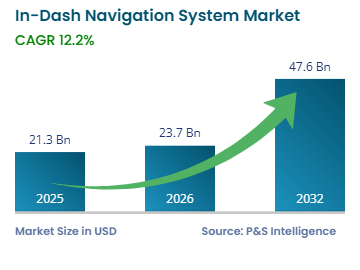
The global in-dash navigation system market size will be an estimated USD 21.3 billion in 2025, which is predicted to reach USD 47.6 billion by 2032, growing at a CAGR of 12.2% during 2026–2032.
The robust market expansion is primarily driven by the convergence of multiple technological and consumer trends including the rapid adoption of connected vehicles, integration of artificial intelligence in navigation systems, and growing demand for enhanced driver safety features. The transformation of in-dash navigation systems from simple GPS-based direction tools to comprehensive intelligent driving companions represents a fundamental shift in automotive technology. These advanced systems now incorporate real-time traffic management, predictive route optimization, and seamless integration with vehicle-to-everything (V2X) communication networks.
Leading automotive manufacturers are increasingly adopting AR-based head-up displays that project navigation information directly onto the windshield, enabling drivers to maintain focus on the road, while receiving turn-by-turn directions. This technological advancement has gained traction in premium vehicle segments, where consumers prioritize cutting-edge safety and convenience features. Furthermore, the expansion of 5G networks globally has enabled ultra-low latency communication between vehicles and infrastructure, facilitating real-time updates on traffic conditions, road hazards, and optimal routing alternatives.
In-Dash Navigation System Market Growth Factors
Rising Demand for Connected Vehicle Technologies Is a Key Trend
Increasing adoption of advanced driver-assistance systems (ADAS) and smart infotainment solutions is driving the integration of connected technologies in in-dash navigation systems.
Global connected car sales could value USD 328.45 billion by 2032.
The U.S. Department of Transportation (USDOT)’s USD 40-million grant opportunity, titled Saving Lives with Connectivity, Accelerating V2X Deployment via its Federal Highway Administration (FHWA), promotes the deployment of V2X technologies.
Real-time traffic updates, route optimization, and predictive navigation features rely on constant internet connectivity, enhancing the driving experience.
Consumers prefer vehicles with seamless smartphone integration through platforms like Android Auto and Apple CarPlay, boosting demand for connected navigation systems.
Automakers are increasingly equipping vehicles with built-in connectivity features, enabling over-the-air map and software updates for in-dash systems.
The rise of electric and autonomous vehicles further fuels the need for intelligent, connected navigation solutions that can display charging stations, vehicle range, and system diagnostics.
Growing demand for data-driven insights and telematics services encourages collaboration between navigation system providers and cloud service companies.
Governments and transport authorities are supporting connected vehicle infrastructure, promoting safer and more efficient traffic management.
Increasing Focus on Road Safety is Major Driver for Market
Globally, road traffic crashes remain a major safety concern and a key driver for this market.
Every 24 seconds, an individual loses their life in a traffic accident.
This amounts to 1.35 million fatalities annually, as per the United Nations.
Vulnerable road users—pedestrians, cyclists, and motorcyclists—account for more than half of these fatalities.
In response, governments worldwide are enacting tighter vehicle‑safety and road‑safety regulations.
Laws are being implemented to mandate advanced driver‑assistance systems (ADAS), speed‑limit alerts, and integrated in‑car navigation features, to support safe routing and avoid high‑risk areas.
These regulatory developments increase demand for in‑dash navigation systems that can integrate with ADAS, deliver real‑time hazard alerts, and enable safer driving behavior.
The EU adopted Regulation (EU) 2019/2144 (General Safety Regulation) requiring features like intelligent speed assistance (ISA), driver‑drowsiness warning, and advanced emergency braking in all new vehicles from July 2024.
The NHTSA announced that nearly all new passenger cars and trucks sold in the U.S. must have automatic emergency braking (AEB) systems by September 2029.
China’s Ministry of Industry and Information Technology (MIIT) has proposed mandatory national standards titled “Safety Requirements for Combined Driving Assistance Systems of Intelligent and Connected Vehicles” incorporating LiDAR and other technologies for light‑duty vehicles.
The Ministry of Road Transport and Highways has issued a draft notification that from April 2026, all new passenger vehicles (more than eight seats) and commercial vehicles will require advanced emergency braking systems, drowsiness/attention warning systems, and lane‑departure warning systems.
In-Dash Navigation System Market Segmentation Analysis
Component Analysis
The display unit category commands the largest market share in 2025, of 45%, driven by consumer demand for larger, high-resolution touchscreens that serve as the primary interface for navigation and infotainment functions. These display units have evolved from simple LCD screens to sophisticated OLED and TFT-LCD panels featuring multi-touch capabilities, anti-glare coatings, and customizable layouts that adapt to different driving conditions and user preferences.
Control modules have the highest CAGR, as control modules in in‑dash navigation systems are crucial for managing data flow between sensors, GPS, displays, and vehicle networks. They ensure real‑time processing, accurate route guidance, and seamless integration with infotainment and driver‑assistance features, enhancing safety, reliability, and user experience while supporting advanced functionalities like ADAS and connectivity.
These components are covered:
Display Unit (Largest Category)
Control Module (Fastest-Growing Category)
Antenna Module
Wiring Harness
Map Type Analysis
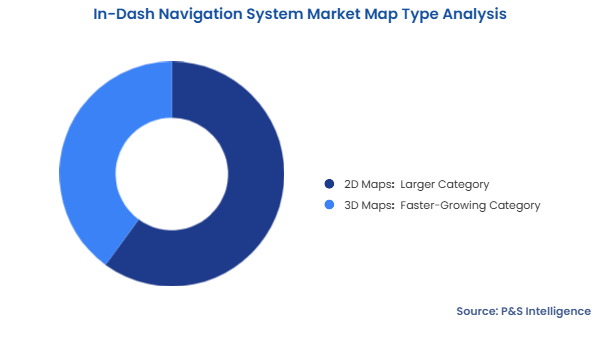
The 2D maps category has the larger share, as 2D navigational maps remain popular in cars due to their simplicity, clarity, and low processing requirements. Drivers can quickly interpret routes without distraction, making them ideal for everyday commuting. Their compatibility with most in‑dash systems and lower cost compared to 3D maps ensures widespread adoption in entry- and mid-level vehicles.
The 3D maps segment is projected to exhibit remarkable growth with a CAGR of 12.6% during the forecast period, driven by increasing consumer expectations for realistic, immersive navigation experiences that mirror smartphone navigation applications. 3D mapping technology provides enhanced spatial awareness through realistic terrain modeling, building representations, and landmark visualization that significantly improves navigation accuracy in complex urban environments.
The integration of augmented reality overlays with 3D maps creates an intuitive navigation experience where virtual route indicators appear to float above the actual road, reducing cognitive load and improving driver safety. Advanced 3D mapping systems also incorporate real-time updates on construction zones, temporary road closures, and dynamic lane guidance that adapts to current traffic conditions.
These map types are analyzed:
2D Maps (Larger Category)
3D Maps (Faster-Growing Category)
Vehicle Type Analysis
The passenger cars segment dominates the in-dash navigation system market in 2025, with 65% share, reflecting the massive volume of personal vehicles and increasing consumer expectations for advanced navigation features as standard equipment. This dominance stems from the competitive dynamics in the passenger car market, where manufacturers differentiate their offerings through technology features, with navigation systems becoming a key selling point even in mid-range vehicle segments. The proliferation of electric passenger vehicles has further accelerated adoption, as these vehicles require specialized navigation features for charging infrastructure management and range optimization.
LCVs have the highest CAGR, driven by fleet operators’ pursuit of improved route optimization, fuel efficiency, and real‑time tracking. With online retail and last‑mile delivery booming, built‑in dashboard systems are increasingly standard in LCVs to enable live traffic updates, geofencing, and fleet‑management integration. Manufacturers of LCVs now view navigation features as key differentiators, helping logistics firms meet delivery‑time targets and reduce operational costs.
The original equipment manufacturer (OEM) segment dominates the market in 2025 with 70% share, as automotive manufacturers increasingly integrate navigation systems as standard or optional equipment during vehicle production. This dominance reflects the strategic advantages OEMs possess in terms of system integration, where navigation functions are seamlessly embedded into the vehicle's electrical architecture and user interface, providing superior reliability and user experience compared to aftermarket solutions. OEM systems benefit from direct access to vehicle data such as fuel levels, tire pressure, and engine diagnostics, enabling more sophisticated navigation features that account for vehicle-specific parameters.
The aftermarket is growing faster as vehicle owners upgrade older cars lacking built‑in navigation and infotainment features. Demand is especially strong in regions with high older vehicle stocks and among tech‑savvy buyers seeking larger touchscreens, smartphone integration and wireless CarPlay/Android Auto support. Emerging markets and regions with less OEM penetration for advanced systems present significant retrofit opportunities. Aftermarket installers profit from lower unit costs and broader compatibility, making retrofit navigation one of the fastest‑growing sales channels in the in‑dash navigation sector.
These sales channels are analyzed:
Original Equipment Manufacturer (OEM) (Larger Category)
Aftermarket (Faster-Growing Category)
Connected Navigation Service Analysis
The real-time traffic and direction information services segment dominates the market in 2025 with 60% share, because it represents the core function of any in-dash navigation system. Most car buyers expect built-in navigation to offer live route guidance, turn-by-turn directions, traffic congestion updates, and estimated arrival times. Automakers bundle these services across almost all vehicle trims, so they have the broadest consumer reach.
Fleet management is the fastest-growing category as it enables real‑time route optimization and live traffic updates for commercial vehicles. A majority of large fleets now use GPS‑tracking and telematics solutions for operational oversight. This integration helps reduce fuel consumption, cut idle time, enhance delivery punctuality, and improve driver safety—making embedded navigation a key productivity tool in logistics and transport fleets.
These connected navigation services are analyzed:
Real-Time Traffic and Direction Information Services (Largest Category)
ICE vehicles dominate the market due to established infrastructure, lower upfront costs, and widespread fuel availability. Familiarity among consumers, extensive service networks, and decades of technological refinement in performance and reliability continue to make ICE vehicles the preferred choice, especially in regions where electric vehicle adoption is still emerging. EVs currently cost about 25–30% more than comparable ICE vehicles, discouraging the masses from buying the former.
The electric vehicles (EVs) segment is projected to exhibit remarkable growth with a CAGR of 12.5% during the forecast period, because they rely heavily on navigation systems to manage range, locate charging stations, and optimize battery usage. Automakers developing EVs are also focusing on large digital displays and connected infotainment dashboards, which increases the rate at which EVs adopt advanced in-dash navigation. Rising EV sales globally further accelerate this growth trend.
According to the International Energy Agency (IEA), global electric car sales reached 17.8 million units in 2024, with projections indicating over 20 million units in 2025, creating substantial demand for sophisticated navigation solutions that optimize charging station routes and battery range management. The integration of augmented reality technology into navigation displays has emerged as a game-changing development in the market.
Electric Vehicles (EVs) (Fastest-Growing Category)
Hybrid Vehicles
Screen Size Analysis
The 6–11 inches category is the largest because they strike the right balance between readability and dashboard integration. The size offers sufficient screen area for maps, route info and widgets without overwhelming the dashboard layout. Compatibility with standard vehicle designs makes this format widely adopted across mainstream vehicle segments.
The greater than 11 inches segment is projected to exhibit a CAGR of 12.4% during the forecast period, The market is rapidly moving toward bigger and more immersive screens. Luxury automakers and even mainstream brands are introducing wide cockpit displays, curved screens, and tablet-like central touch panels larger than 11 inches. These displays support split-screen maps, media, navigation overlays, and vehicle controls driving their demand faster than other screen categories.
These screen sizes are analyzed:
Less than 6 inches
6 inches to 11 inches (Largest Category)
Greater than 11 inches (Fastest-Growing Category)
Display Type Analysis
The thin-film transistor LCD (TFT-LCD) segment dominates the market in 2025 with 55% share, they offer a strong balance of cost, durability, and performance, making them highly suitable for automotive environments. Automakers prefer technologies that are reliable under varying temperatures, sunlight exposure, vibrations, and long-term use, and TFT-LCD screens have been tested and proven for these conditions over many years. Their manufacturing ecosystem is also well-established, meaning production costs are lower and supply chains are stable, which allows car manufacturers to install these displays across a wide range of vehicle models from entry-level to mid-range cars without significantly increasing the vehicle’s price.
OLED screens have the highest revenue CAGR due to their superior contrast, faster response times, and slimmer form factors compared with traditional LCDs. The automotive OLED display market is projected to grow robustly—driven by these advantages and increasing adoption in digital cockpits across vehicle segments.
The embedded cellular connectivity segment dominates the market in 2025 with 40% share, as automotive manufacturers increasingly integrate navigation systems as standard or optional equipment during vehicle production. This dominance reflects the strategic advantages OEMs possess in terms of system integration, where navigation functions are seamlessly embedded into the vehicle's electrical architecture and user interface, providing superior reliability and user experience compared to aftermarket solutions.
OEM systems benefit from direct access to vehicle data such as fuel levels, tire pressure, and engine diagnostics, enabling more sophisticated navigation features that account for vehicle-specific parameters. The ongoing shift from 4G to 5G and V2X communication, which allows vehicles to exchange data with other cars, road infrastructure, and cloud systems in real time. These capabilities are increasingly important for advanced driver assistance, predictive routing, connected infotainment, and autonomous driving features, which are priorities for new vehicle development, especially electric and smart vehicles.
These connectivity technologies are analyzed:
Embedded Cellular Connectivity (Largest and Fastest-Growing Category)
Tethered Connectivity
Integrated Smartphone Mirroring
Wi-Fi Connectivity
Vehicle-to-Everything (V2X)/Telematics Communication
GNSS/Satellite Positioning & Antenna Modules
Drive strategic growth with comprehensive market analysis
In-Dash Navigation System Market Geographical Analysis
Asia-Pacific In-Dash Navigation System Market Growth
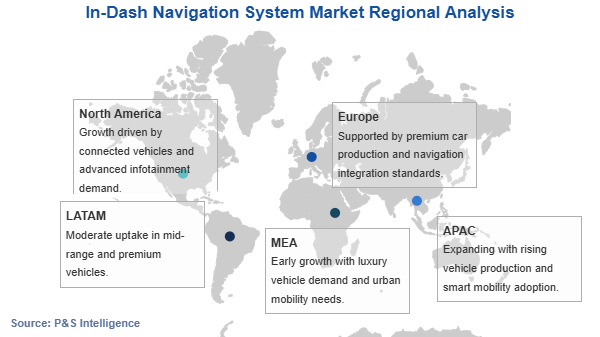
Asia-Pacific emerged as the largest regional market for in-dash navigation systems in 2025, commanding a market share of 35%, and continuing its trajectory as the global manufacturing hub for automotive electronics. The region's dominance is underpinned by the presence of major automotive manufacturers in Japan, South Korea, and China, combined with rapidly expanding vehicle production capabilities and increasing consumer purchasing power.
According to the India Brand Equity Foundation (IBEF), India’s EV sales grew 26.5% in 2024 to 1.94 million units, up from 1.50 million in 2023, while the electric car segment rose 20%, with Tata Motors maintaining market leadership.
China In-Dash Navigation System Market Growth
China has emerged as a global hub for smart mobility and navigation system innovation, supported by strong government initiatives promoting intelligent transportation and the rapid rollout of 5G infrastructure that enables real-time navigation and vehicle connectivity. According to official reports, the Chinese government has issued around 16,000 test licenses for driverless vehicles and opened approximately 32,000 kilometers (about 20,000 miles) of public roads for autonomous vehicle testing, driving demand for advanced, high-precision navigation technologies. Meanwhile, Japanese manufacturers remain key players in the field, integrating artificial intelligence and machine learning into navigation systems to enhance route prediction accuracy and traffic management efficiency.
Europe In-Dash Navigation System Market Outlook
Europe is projected to grow at a CAGR of 12.3% during the forecast period, driven by stringent environmental regulations promoting electric vehicle adoption and comprehensive safety mandates requiring advanced navigation-enabled driver assistance features. The European Union's Vision Zero initiative, targeting zero road deaths by 2050, has placed navigation systems at the center of vehicle safety strategies. German automotive manufacturers continue to pioneer augmented reality navigation systems, with companies like Mercedes-Benz and BMW introducing advanced head-up displays that project navigation information directly onto the windshield.
The regions and countries analyzed in this report are:
North America
U.S. (Larger Country Market)
Canada (Faster-Growing Country Market)
Europe (Fastest-Growing Regional Market)
Germany (Largest Country Market)
U.K. (Fastest-Growing Country Market)
France
Italy
Spain
Rest of Europe
Asia-Pacific (Largest Regional Market)
Japan
China (Largest Country Market)
India (Fastest-Growing Country Market)
South Korea
Australia
Rest of APAC
Latin America
Brazil (Largest Country Market)
Mexico (Fastest-Growing Country Market)
Rest of LATAM
Middle East and Africa
Saudi Arabia (Largest Country Market)
South Africa
U.A.E. (Fastest-Growing Country Market)
Rest of MEA
In-Dash Navigation System Market Share
The global in-dash navigation system market exhibits a moderately consolidated structure, this market composition reflects a balance between established automotive technology giants and innovative startups, creating a dynamic competitive environment characterized by continuous technological advancement and strategic partnerships. The presence of multiple players across different segments of the value chain, from software developers to hardware manufacturers and system integrators, has fostered healthy competition while preventing monopolistic control. The market has witnessed intensified competition from technology companies traditionally focused on smartphone navigation applications. Strategic collaborations between traditional automotive suppliers and technology startups have become increasingly common as companies seek to combine hardware expertise with software innovation.
Key In-Dash Navigation System Companies:
Robert Bosch GmbH
Continental AG
DENSO Corporation
Harman International Industries, Inc.
Garmin Ltd.
TomTom N.V.
Alps Alpine Co., Ltd.
Pioneer Corporation
JVCKENWOOD Corporation
Panasonic Automotive Systems Co., Ltd.
Faurecia Clarion Electronics
Aisin Corporation
Mitsubishi Electric Corporation
HERE Global B.V.
Aptiv PLC
In-Dash Navigation System Market News
In January 2025, HERE Technologies and AWS announced a 10-year cloud infrastructure agreement worth approximately USD 1 billion, aimed at enabling AI-powered, live-streaming map and location services for automotive, transportation, logistics and mobility companies globally.
In February 2024, Harman International launched its Ready Connect 5G Telematics Control Unit in collaboration with Qualcomm, enabling automotive manufacturers to deliver enhanced navigation experiences with real-time traffic updates and over-the-air map updates through 5G connectivity.
In October 2023, Continental AG announced that its “eHorizon” connected-map platform will be supplied to a major European OEM starting in 2025, enabling features like dynamic road-event detection and route anticipation.
Want a report tailored exactly to your business need?
Leading companies across industries trust us to deliver data-driven insights and innovative solutions for their most critical decisions. From data-driven strategies to actionable insights, we empower the decision-makers who shape industries and define the future. From Fortune 500 companies to innovative startups, we are proud to partner with organisations that drive progress in their industries.
Client Testimonials
Working with P&S Intelligence and their team was an absolute pleasure – their awareness of timelines and commitment to value greatly contributed to our project's success. Eagerly anticipating future collaborations.
McKinsey & Company
India
Unmatched Standards
Our insights into the minutest levels of the markets, including the latest trends and competitive landscape, give you all the answers you need to take your business to new heights
Complete Data Security
We take a cautious approach to protecting your personal and confidential information. Trust is the strongest bond that connects us and our clients, and trust we build by complying with all international and domestic data protection and privacy laws