This Report Provides In-Depth Analysis of the Immersion Cooling Heat Exchanger Market Report Prepared by P&S Intelligence, Segmented by Heat exchanger type (Liquid-to-liquid, Liquid-to-air, Two-phase condenser), Immersion cooling type (Single-phase, Two-phase), Cooling capacity (Up to 100 kW, 100, Above 500 kW), Application (Data centers, High-performance computing, Artificial intelligence, Edge computing, Cryptocurrency mining, Other applications), and Geographical Outlook for the Period of 2021 to 2032
Explore the market potential with our data-driven report
Immersion Cooling Heat Exchanger Market Overview
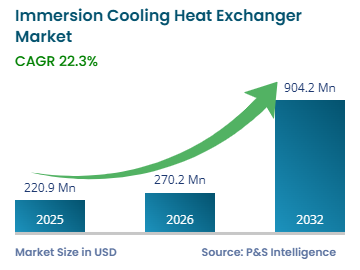
Immersion Cooling Heat Exchanger Market size reached USD 220.9 million in 2025, and revenue is set to rise to USD 270.2 million in 2026 and USD 904.2 million by 2032, a 22.3% CAGR across 2026 to 2032.
Buyers in the global market for immersion cooling heat exchangers are really specifying a temperature difference. The exchanger fixes how closely the dielectric loop tracks the facility water or the outside air, and that gap decides whether a site keeps mechanical chilling. Narrow it, and the loop runs warm enough to shed heat through dry coolers wherever ambient conditions allow, which takes a chiller out of the capital plan and its compressor load off the power bill. Widen it, and the chiller stays.
The load behind that decision is compounding. Data center electricity consumption reached 485 TWh in 2025 and is set to roughly double to 950 TWh by 2030, around 3% of global electricity demand by then, in International Energy Agency projections that also put 2025 growth at 17% and the increase at AI-focused facilities at 50%. U.S. data center electricity use climbed from 58 TWh in 2014 to 176 TWh in 2023 and could reach between 325 and 580 TWh by 2028, Lawrence Berkeley National Laboratory estimates.
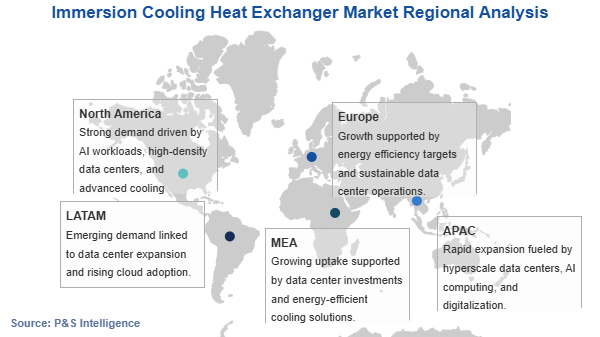
North America holds the largest Immersion Cooling Heat Exchanger Market share at 39.0% in 2025, where tank deployments went in early and the load they serve is already installed. Asia-Pacific grows fastest at 25.40% during 2026 to 2032, on capacity specified at design time instead of retrofitted into halls built for air.
Key Market Insights
Heat exchanger type, liquid-to-liquid units held 57.0% of revenue in 2025, and liquid-to-air units advance at a 24.6% CAGR during 2026 to 2032.
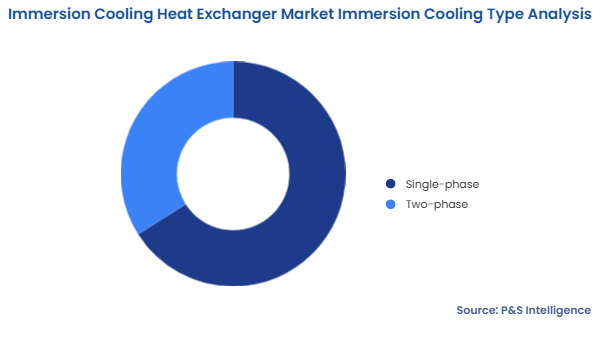
Immersion cooling type, single-phase systems held 66.0% of revenue in 2025, and two-phase systems advance at a 23.9% CAGR during 2026 to 2032.
Cooling capacity, the 100–500 kW band held 42.0% of revenue in 2025, and units above 500 kW advance at a 26.3% CAGR during 2026 to 2032.
Application, data centers held 33.0% of revenue in 2025, and artificial intelligence advances at a 28.6% CAGR during 2026 to 2032.
Geography, North America held 39.0% of revenue in 2025, and Asia-Pacific advances at a 25.40% CAGR during 2026 to 2032.
Immersion Cooling Heat Exchanger Market Trends and Growth Drivers
Rack power density outruns what air can carry
Air cooling fails at a definable point, and accelerator design has pushed past it. The power density of AI servers rose elevenfold between 2020 and 2025 and is set to climb a further fourfold by 2027, International Energy Agency analysis finds, against world data center installed capacity that doubles from 114 GW in 2025 to 226 GW in 2030. Two consequences follow for Immersion Cooling Heat Exchanger Market growth. Every watt that once left on a stream of air now has to cross into a liquid, and the crossing happens inside an exchanger. Because that duty scales with installed capacity and not with the number of operators, a doubling of capacity doubles the thermal work even if no new site adopts the architecture. A supplier sizing production against site counts will read the demand curve wrong.
Heat reuse duties turn rejection into a compliance test
An opportunity opens where waste heat stops being waste in law. Germany's Energy Efficiency Act requires data centers starting operation on or after July 1, 2026 to reach an energy reuse factor of at least 10%, rising to 15% for those beginning from July 1, 2027 and 20% for those beginning from July 1, 2028. A 2026 draft amendment would relax the related efficiency tests while keeping that reuse framework intact. Meeting a reuse factor is not achieved by capturing heat. It is achieved by delivering heat at a temperature a district network will accept, and the exchanger sets that delivery temperature. For the immersion cooling heat exchanger industry, this turns a component once chosen on price into one chosen on approach temperature, since the unit that gives away the least usable grade is the unit that keeps a site inside its statutory factor.
Reported water use redirects heat rejection
Water has become a number an operator publishes. Commission Delegated Regulation (EU) 2024/1364 obliges operators of data centers with an information technology energy demand of at least 500 kW to report to the European database, first by September 15, 2024 and then by May 15, 2025 and every year after. Under that same regulation, power usage effectiveness, water usage effectiveness, energy reuse factor, and renewable energy factor are among the indicators drawn from the filing. Once consumption is visible and comparable across operators, an evaporative rejection path carries a reportable cost that a dry path avoids. Immersion cooling heat exchanger industry trends follow that arithmetic toward closed loops and air-side rejection, and toward units specified to hold performance at summer ambient conditions instead of at a design-day water temperature.
Fluid rules constrain the fastest architecture
The binding constraint on two-phase immersion is chemical. Five national authorities submitted a universal restriction proposal under REACH covering about 10,000 PFAS substances. The European Chemicals Agency's Risk Assessment Committee adopted its opinion on March 2, 2026, supporting the restriction with a single derogation, and the agency's socio-economic committee ran a consultation on its draft opinion that closed on May 25, 2026. No restriction is in force, and a committee opinion is not the Commission's decision. What the process does is price uncertainty into a design choice. An operator standardizing a fleet on an architecture whose working fluid sits inside that scope accepts a supply question with no resolution date, and the exchanger engineered around that fluid inherits the same question.
Liquid-to-liquid units took 57.0% of revenue in 2025, and the reason is structural. Buildings reject heat through water, and ASHRAE's facility water classes set entering temperature limits at 17, 27, 32, 40, and 45 degrees Celsius for equipment running unthrottled, with a further class above that. A dielectric loop obliged to hand off inside those limits hands off through a liquid-to-liquid device, whatever the site does downstream of it.
Liquid-to-air units grow fastest, at a 24.6% CAGR during 2026 to 2032. World data center power usage effectiveness falls from 1.38 in 2025 to 1.29 in 2030 under the International Energy Agency's Base Case, and reaching an average that low means removing compressor work, not tuning it. Dry rejection takes the compressor out of the loop entirely, which is why any Immersion Cooling Heat Exchanger Market analysis that assumes a chilled-water default will understate the air-side line.
Immersion Cooling Type
Single-phase systems held 66.0% of revenue in 2025. International Energy Agency figures put current accelerator racks at 1,000 W per chip across 72 chips, and a bath that absorbs that load without changing state lets an operator keep standard server hardware and standard service procedures. The path of least requalification wins the installed base.
A 23.9% CAGR during 2026 to 2032 makes two-phase the fastest-growing architecture. International Energy Agency analysis puts a rack the size of a household fridge at a peak draw equal to around 65 households by 2027, and heat concentrated at that density is where latent transfer stops being an elegance and becomes the practical route. The forward case for the architecture is thermal. Its open question is regulatory.
Cooling Capacity
Above 500 kW is where the growth sits, at a 26.3% CAGR during 2026 to 2032. The announced next accelerator architecture reaches 600 kW per rack and opens a path toward 1 MW per rack, on the International Energy Agency's reading, which lifts one rack above the mid band on its own. Heat rejection then consolidates into fewer and larger units, and the procurement conversation moves from row-level equipment to plant-level equipment.
Revenue today concentrates lower down the range. The 100–500 kW band took 42.0% in 2025, because rack power density climbed from around 13 kW in 2020, on 32 chips of around 400 W each, to 130 kW on the current architecture, according to International Energy Agency analysis, which places one to four contemporary racks inside a single unit. Sites buy in that shape to match how a tank row is actually built out.
Application
Data centers held 33.0% of revenue in 2025, which is the installed base talking. World IT installed capacity inside data centers runs from 82 GW in 2025 to 174 GW in 2030 under the International Energy Agency's Base Case, and that equipment sits in general-purpose halls where immersion arrives as a retrofit into powered white space. Retrofit demand is bounded by the white space a site has already powered, which is why the largest application is not the fastest one.
The fastest position belongs to artificial intelligence, at a 28.6% CAGR during 2026 to 2032. Electricity consumption at AI-focused facilities surged 50% in 2025 and triples again by 2030, International Energy Agency projections indicate, and thermal equipment is bought against that load curve.
Heat exchanger type
Liquid-to-liquid
Liquid-to-air
Two-phase condenser
Immersion cooling type
Single-phase
Two-phase
Cooling capacity
Up to 100 kW
100–500 kW
Above 500 kW
Application
Data centers
High-performance computing
Artificial intelligence
Edge computing
Cryptocurrency mining
Other applications
Drive strategic growth with comprehensive market analysis
North America holds 39.0% of revenue in 2025, and the position rests on load that is already installed. Regional data center electricity consumption runs from 229 TWh in 2025 to 434 TWh in 2030 while installed capacity moves from 53 GW to 102 GW, International Energy Agency Base Case figures show, with the U.S. carrying 224 TWh of that 2025 regional total. The two halves of the figure matter differently. Existing load is where immersion retrofits compete for white space that is already powered and already connected. Added capacity is where tank rows get designed in from the beginning, and where the exchanger is chosen before the facility loop is fixed.
Growth of 20.60% during 2026 to 2032 sits below the global rate, which is what maturity looks like when the base is this large. Demand is not the condition that would change the position. Interconnection is. A campus that cannot energize on schedule pushes its thermal equipment order to the right along with everything else, and the added-capacity half of the regional position is the half exposed to that delay.
Asia-Pacific grows fastest at 25.40% during 2026 to 2032 from 28.0% of revenue in 2025, and Immersion Cooling Heat Exchanger Market growth here concerns capacity that does not exist yet. Regional data center electricity consumption climbs from 173 TWh in 2025 to 378 TWh in 2030, installed capacity from 41 GW to 92 GW, and regional power usage effectiveness improves from 1.46 to 1.35, on the International Energy Agency's Base Case. Capacity that more than doubles while efficiency improves is capacity being specified at design time.
Design-time specification decides where the exchanger sits in the purchase. In a retrofit, it is a component added to a building whose water temperatures were fixed years earlier. In a new build, its approach temperature becomes an input to how the facility loop is designed, which lets a specifier choose warmer water and a smaller mechanical plant. Slippage in the construction pipeline is the clear risk to the position, because a design-time market has nothing to sell into once the design stops.
China accounts for 42.0% of the Asia-Pacific market in 2025, and its mechanism is a gap. National data center power usage effectiveness stands at 1.47 in 2025 against a world average of 1.38 in the International Energy Agency's Base Case, which also moves Chinese data center electricity consumption from 117 TWh to 277 TWh by 2030. In its Special Action Plan for Green and Low-Carbon Development of Data Centers, China's National Development and Reform Commission set an end-2025 ceiling of 1.3 for newly built large-scale and above data centers and 1.25 for facilities inside national computing hub nodes. The same plan puts national data center rack utilization at a minimum of 60%. The distance between a 1.47 average and a 1.25 ceiling does not close through better chiller control.
Two conditions would move that position. A shift of the same compliance budget toward direct-to-chip equipment would answer the ceiling without immersion. Any relaxation of hub-node enforcement would remove the forcing function altogether.
India carries a 30.2% CAGR during 2026 to 2032, and it starts from a base small enough for that rate to be arithmetically ordinary. Installed data center capacity reached around 1,500 MW in 2025 against 375 MW in 2020, India's Ministry of Electronics and Information Technology told parliament. What lengthens the runway is fiscal. India's Union Budget 2026-27 granted eligible foreign cloud service providers a tax exemption on income from serving customers outside the country through Indian data center services, running from tax year 2026-27 through tax year 2046-47, which gives an operator a two-decade horizon to underwrite equipment that repays on energy.
Climate decides the equipment mix underneath that horizon. Where outside air is warm for much of the year, a site either accepts mechanical cooling or raises its loop temperature, and the second route puts the specification back on the exchanger. Power availability is the condition that would change the trajectory, since a tax horizon does not energize a campus.
The supply base is fragmented, and it splits along a seam. On one side sit diversified heat transfer manufacturers whose plate and coil products enter data center duty alongside other industrial work. On the other sit immersion system builders that integrate their own heat-exchange modules into tanks, pods, and chassis. Neither group controls the other's route to the buyer, and packaged units on the market are built around cores bought from the first group by firms in the second.
For an entrant, that seam is both the opportunity and the obstacle. Selling a core into someone else's package is a components business decided on thermal performance per unit of pressure drop, on manufacturing capacity, and on lead time, and it needs no channel of its own. Selling a complete unit requires field service, fluid handling competence, and a reference installation, which takes far longer to assemble. Consolidation pressure therefore runs along the seam in one direction, because a component maker can extend forward into packaged units on capacity it already owns, while an integrator that wants its own cores has to acquire a plant.
What fragmentation gives the buyer is genuine optionality. An operator that wants a warmer facility loop can specify the exchanger independently and hold the integrator to that specification, instead of accepting whatever core arrived inside the package. Separate sourcing is what makes the optionality real. In the immersion cooling heat exchanger industry, an operator buying at the top of the capacity range should expect to negotiate on lead time before it negotiates on price.
Leading Companies in the Immersion Cooling Heat Exchanger Market:
In August 2026, SLB agreed to Kelvion for USD 4.1 billion, USD 3.4 billion of it in cash, with closing expected in the first half of 2027. The transaction places exchanger capacity under plant-scale ownership.
In May 2026, Modine signed a long-term capacity agreement worth about USD 4 billion covering calendar years 2027 through 2029 with a data center customer, receiving USD 165 million upfront to fund capacity investment. Committed volume is not committed immersion duty.
In February 2026, Alfa Laval committed a multi-year investment to double plate heat exchanger output at a U.S. plant by mid-2028, adding automation and re-laying out the factory floor.
In February 2026, Danfoss launched a brazed plate heat exchanger rated to 1 MW and optimized for a log mean temperature difference of about 2 K in coolant distribution duty. The launch adds an option at the top of the capacity range.
In November 2025, Vertiv introduced an immersion cooling system in configurations from 25 kW to 240 kW with an integrated coolant distribution unit, variable-speed pumps, and piping, available across Europe, the Middle East, and Africa. Availability is not adoption.
Frequently Asked Questions About This Report
How big is the immersion cooling heat exchanger market?+
Immersion cooling heat exchanger market size reached USD 220.9 million in 2025, and revenue is set to rise to USD 270.2 million in 2026 and USD 904.2 million by 2032.
Which region holds the largest immersion cooling heat exchanger market share?+
North America holds the largest immersion cooling heat exchanger market share at 39.0% in 2025, where tank deployments went in early and the load they serve is already installed.
Why is Asia-Pacific the fastest-growing region?+
Asia-Pacific grows fastest at 25.40% during 2026 to 2032, on capacity specified at design time instead of retrofitted into halls built for air.
What does the heat exchanger actually decide for a site?+
The exchanger fixes how closely the dielectric loop tracks the facility water or the outside air, and that gap decides whether a site keeps mechanical chilling.
Why is the largest application not the fastest-growing one?+
Retrofit demand is bounded by the white space a site has already powered, which is why the largest application is not the fastest one.
How is the supply base structured?+
The supply base is fragmented, and it splits along a seam. On one side sit diversified heat transfer manufacturers whose plate and coil products enter data center duty alongside other industrial work.
What should a buyer of the largest units expect to negotiate first?+
In the immersion cooling heat exchanger industry, an operator buying at the top of the capacity range should expect to negotiate on lead time before it negotiates on price.
Want a report tailored exactly to your business need?
Leading companies across industries trust us to deliver data-driven insights and innovative solutions for their most critical decisions. From data-driven strategies to actionable insights, we empower the decision-makers who shape industries and define the future. From Fortune 500 companies to innovative startups, we are proud to partner with organisations that drive progress in their industries.
Client Testimonials
Working with P&S Intelligence and their team was an absolute pleasure – their awareness of timelines and commitment to value greatly contributed to our project's success. Eagerly anticipating future collaborations.
McKinsey & Company
India
Unmatched Standards
Our insights into the minutest levels of the markets, including the latest trends and competitive landscape, give you all the answers you need to take your business to new heights
Complete Data Security
We take a cautious approach to protecting your personal and confidential information. Trust is the strongest bond that connects us and our clients, and trust we build by complying with all international and domestic data protection and privacy laws