Key Highlights
| Study Period | 2021 - 2032 |
| Market Size in 2025 | USD 1.11 Billion |
| Market Size in 2026 | USD 1.20 Billion |
| Market Size by 2032 | USD 1.92 Billion |
| Projected CAGR | 8.2% |
| Asia-Pacific | 39.00% |
| Europe | 9.30% |
| Market Structure | gray-zone |

| Study Period | 2021 - 2032 |
| Market Size in 2025 | USD 1.11 Billion |
| Market Size in 2026 | USD 1.20 Billion |
| Market Size by 2032 | USD 1.92 Billion |
| Projected CAGR | 8.2% |
| Asia-Pacific | 39.00% |
| Europe | 9.30% |
| Market Structure | gray-zone |
Explore the market potential with our data-driven report
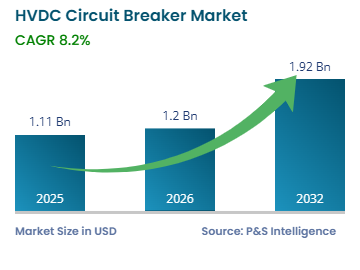
The global HVDC Circuit Breaker Market size was USD 1.11 billion in 2025 and is projected to rise to USD 1.20 billion in 2026 and USD 1.92 billion by 2032, advancing at an 8.2% CAGR from 2026 to 2032. Procurement centers on equipment that can clear a DC fault rapidly enough to protect converters and preserve service on unaffected sections of a transmission network.
Utility investment is moving the commercial conversation beyond isolated point-to-point links. Selective interruption becomes more valuable when a network has several paths because operators can remove a damaged branch while keeping healthy sections energized. Existing field experience is limited, which keeps specification and qualification work central to purchasing decisions.
Asia-Pacific held 39.0% of the global HVDC Circuit Breaker Market share in 2025. Europe is projected to expand at a 9.3% CAGR from 2026 to 2032 as offshore links and multi-vendor grid programs move toward validation. The European Commission reported that InterOPERA had advanced from framework design into practical demonstrator execution by 2026.
The market remains sensitive to a small number of high-value projects. Qualification schedules, fault-current requirements, system architecture, and the decision to use a breaker or converter-based fault blocking can shift annual orders even when the long-term transmission pipeline remains intact.
Long-distance transfer of renewable electricity is the main driver of HVDC Circuit Breaker Market growth. Large generation zones are frequently remote from load centers, which favors HVDC corridors that can carry bulk power over long distances. As those corridors become more interconnected, owners need faster and more selective fault isolation to protect converter equipment and prevent one damaged section from removing the full link from service.
China's State Council reported that the ±800 kV Hami-Chongqing line entered operation in June 2025 across 2,260 kilometers, supported by 14.2 GW of generation capacity, including 10.2 GW from wind, solar photovoltaic, and solar thermal resources. That project does not establish a breaker order, yet it illustrates the scale of power flows that makes protection performance commercially consequential. A larger corridor base increases the pool of new stations, reinforcements, and future network nodes where transmission owners can evaluate dedicated DC interruption.
Multi-terminal grids create the clearest expansion opportunity for the HVDC circuit breaker industry. A point-to-point link can often respond to a DC fault by blocking converters or opening AC-side breakers, even if that interrupts the whole connection. A network with several terminals and alternative paths places greater value on isolating only the faulted branch while healthy sections continue to carry power.
The European Commission reported that InterOPERA moved from framework design to practical execution of a 500 kV, 2 GW, five-terminal demonstrator for multi-vendor HVDC interoperability in 2026. The program covers converter stations, DC switching stations, and coordinated control and protection. Successful validation can reduce interface uncertainty for transmission operators and give suppliers clearer functional requirements. Commercial demand remains conditional on grid approvals and procurement, but a common technical framework can widen participation beyond proprietary single-vendor schemes.
Current HVDC circuit breaker industry trends concern faster interruption at transmission voltage, selective protection, and tighter coordination between power electronics and controls. Hybrid designs balance low conduction losses with rapid commutation, while solid-state concepts pursue still faster response and controllability. Buyers compare these gains against heat dissipation, semiconductor cost, energy absorption, redundancy, and the consequences of a failed switching element.
Hitachi Energy states that AxoniQ Protect can interrupt a DC fault in less than three milliseconds at up to 525 kV while disconnecting only the affected grid section. The specification is a supplier claim rather than field reliability evidence, but it shows how current development is joining speed, voltage, and network selectivity in one procurement proposition. Siemens Energy also presented an ultra-fast power-electronics-based DC breaker concept at CIGRE Paris 2026, indicating that alternative architectures are progressing alongside hybrid platforms.
Cost, qualification, and limited system-level standardization restrain commercialization. DC fault current lacks the natural current zero available in AC systems, so a breaker must force commutation, absorb substantial energy, withstand recovery voltage, and coordinate with converter controls within milliseconds. The design must then reproduce those conditions in a test environment before a transmission owner can accept it for a high-consequence network.
The U.S. Department of Energy committed USD 8 million to HV DCCB research focused on technical standards and more cost-effective, efficient designs. Federal support targets an unresolved protection gap before procurement becomes routine. Testing also remains project-specific because voltage, fault rise rate, grounding, cable configuration, and converter behavior change the duty imposed on the breaker. These requirements lengthen engineering cycles, restrict qualified supply, and can lead owners to select converter-based fault blocking when its whole-system economics are more favorable.
Hybrid HVDC circuit breakers held 44.0% of the market in 2025. Their commercial position reflects a design compromise between the low steady-state losses of a mechanical path and the switching speed of power electronics. CIGRE identified 20 commissioned HVDC breakers in three Chinese multi-terminal projects and reported that all used high-voltage IGBTs with vacuum mechanical switching devices. Internal commutation took no more than 3 to 4 milliseconds in the reviewed systems, providing a quantified operating reference for hybrid-style architectures.
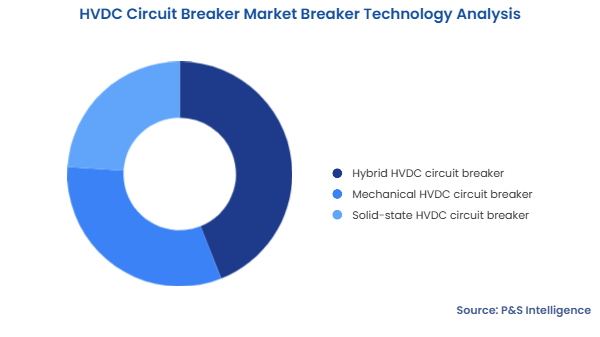
Solid-state HVDC circuit breakers are projected to grow at a 10.5% CAGR from 2026 to 2032. Their forward momentum comes from the pursuit of ultra-fast interruption, programmable control, and fewer moving components. Wider adoption still depends on reducing conduction losses, thermal load, and semiconductor cost at transmission voltage. Siemens Energy's 2026 presentation of a power-electronics-based DC breaker illustrates active development without establishing commercial deployment.
321–500 kV systems accounted for 39.0% of revenue in 2025. This range serves established interconnectors and bulk-power links while remaining compatible with a broad base of HVDC equipment. GE Vernova lists DC-switchgear references at 350 kV, 362 kV, 408 kV, 412 kV, and 450 kV. These references describe system and switchgear context without measuring dedicated breaker capacity, but they demonstrate a broad project base in the class.
Above 800 kV systems are projected to grow at a 10.0% CAGR from 2026 to 2032. Expansion is tied to very long corridors that use higher voltage to move more power with manageable losses. China's ±1,100 kV Zhundong-Wannan link had transmitted 300 billion kWh by January 2025, confirming continued utilization of the highest-voltage tier. Breaker demand remains conditional because not every UHVDC link uses line-side DC fault interruption.
Point-to-point HVDC transmission represented 47.0% of the market in 2025. It benefits from the largest installed pool of converter links and associated switching infrastructure.
Multi-terminal HVDC grids and DC switching stations are projected to advance at an 11.0% CAGR from 2026 to 2032. Growth follows the need to reroute power among several converters and isolate one faulted branch without collapsing the complete network. InterOPERA is moving the proposition toward multi-vendor demonstrator validation. Procurement will accelerate only if testing and interface rules translate into bankable projects.
Transmission system operators and utilities generated 68.0% of revenue in 2025. These buyers own the reliability obligation, define fault-clearing duty, and control procurement for switching stations and protected HVDC links. Germany's Bundesnetzagentur completed approvals for four major HVDC electricity highways during 2025 as part of roughly 2,000 kilometers of power-line approvals. The mileage includes AC projects, but the four named corridors demonstrate the utility-led pipeline behind equipment qualification and sourcing.
Renewable-project developers are projected to grow at a 9.8% CAGR from 2026 to 2032. Offshore hubs and remote generation zones need long export routes and can benefit from shared transmission assets. Germany's draft network development plan envisaged up to eight additional offshore links by 2037, although they remained proposals under consultation. Developer-led demand will depend on project awards, cost allocation, and coordination with transmission owners.
The complete segmentation hierarchy is as follows.
Drive strategic growth with comprehensive market analysis
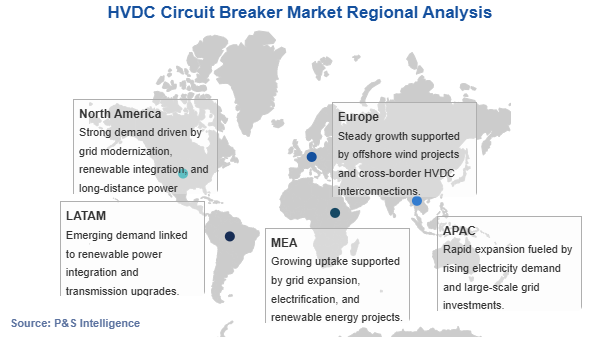
Asia-Pacific accounted for 39.0% of global revenue in 2025 and is projected to grow at an 8.0% CAGR from 2026 to 2032. China provides the region's deepest concentration of UHVDC corridors, while India, Japan, South Korea, and Australia add interconnector, renewable-transfer, and system-strengthening opportunities. CIGRE's operating review found all 20 installed HVDC breakers in its global sample across three multi-terminal projects in China. The national finding does not prove the regional revenue share, yet it shows the project environment that supports engineering and qualification capacity. Asia-Pacific's trajectory depends on whether new links add selective DC interruption or continue using converter blocking and AC-side isolation. Faster development of multi-terminal nodes would increase breaker content, while a point-to-point project mix would moderate it.
Europe is projected to record the fastest HVDC Circuit Breaker Market growth at a 9.3% CAGR from 2026 to 2032 after accounting for 31.0% of revenue in 2025. Offshore wind hubs, cross-border power exchange, and efforts to make multiple suppliers interoperable create a direct case for DC switching stations. Germany's Bundesnetzagentur said its draft network plan envisaged up to eight additional offshore transmission links by 2037 and another HVDC line. The proposals are under consultation and do not represent commercial orders. Germany's pipeline does not prove the European total, but it indicates one source of the network density that could support selective DC protection. Europe's trajectory strengthens as planned links become regulated projects and TSOs standardize fault-clearing requirements. Growth would slow if offshore schedules slip, national cost allocation remains unresolved, or converter-based protection proves more economical for early links.
China represented 56.0% of Asia-Pacific revenue in 2025. Current corridor construction extends the equipment base into higher voltages. The State Council reported that the ±800 kV Hami-Chongqing project entered operation in June 2025 across 2,260 kilometers and was supported by 10.2 GW of wind, solar photovoltaic, and solar thermal capacity. The project demonstrates network scale without identifying an in-scope breaker order, while the approved revenue position remains an owned estimate. China's trajectory favors local qualification, high-voltage testing, and project-specific integration. Its position could weaken if new UHVDC investment slows or if system designers avoid discrete line breakers in favor of fault-blocking converter configurations.
Germany held 24.0% of European revenue in 2025 and is projected to expand at a 10.2% CAGR from 2026 to 2032. The Bundesnetzagentur completed approval procedures for A-Nord, Ultranet, SuedLink, and SuedOstLink during 2025, moving major north-south HVDC corridors closer to construction. Separately, GE Vernova's agreement with four German TSOs covers development of a 525 kV DCCB for future multi-terminal infrastructure, with implementation scheduled from 2026. The R&D status must not be read as an equipment order, but it links German network planning to a specific protection requirement. Germany's trajectory improves if the new corridors evolve into connected DC hubs and common specifications reach procurement. Delays in permitting, offshore buildout, interoperability testing, or cost recovery would reduce the pace of breaker adoption.
Asia-Pacific
Europe
North America
Latin America
Middle East & Africa
Want a report tailored exactly to your business need?
Request CustomizationLeading companies across industries trust us to deliver data-driven insights and innovative solutions for their most critical decisions. From data-driven strategies to actionable insights, we empower the decision-makers who shape industries and define the future. From Fortune 500 companies to innovative startups, we are proud to partner with organisations that drive progress in their industries.

Working with P&S Intelligence and their team was an absolute pleasure – their awareness of timelines and commitment to value greatly contributed to our project's success. Eagerly anticipating future collaborations.
McKinsey & Company
India
Our insights into the minutest levels of the markets, including the latest trends and competitive landscape, give you all the answers you need to take your business to new heights

We take a cautious approach to protecting your personal and confidential information. Trust is the strongest bond that connects us and our clients, and trust we build by complying with all international and domestic data protection and privacy laws


Customize the Report to Align with Your Business Objectives

Request the Free Sample Pages