This Report Provides In-Depth Analysis of the Humidity Sensor Market Report Prepared by P&S Intelligence, Segmented by Type (Capacitive, Resistive, Thermal Conductivity, Optical, Other Sensor Types), Measurement Type (Relative Humidity, Absolute Humidity), Output (Analog, Digital), Application (HVAC & Building Automation, Automotive, Consumer Electronics, Industrial, Healthcare & Pharmaceutical, Food & Beverage, Agriculture, Environmental Monitoring, Other Applications), and Geographical Outlook for the Period of 2022 to 2033
Explore the market potential with our data-driven report
Humidity Sensor Market Overview
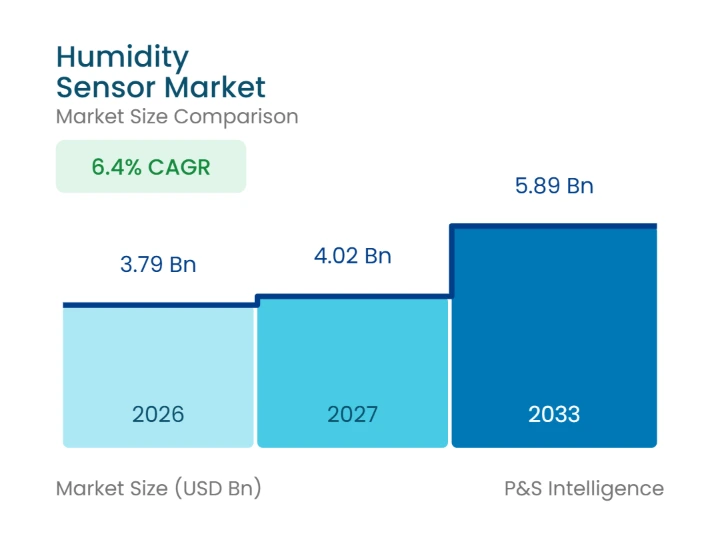
Global humidity sensor market revenue is estimated at USD 3.79 Billion in 2026, and sales are projected to climb to USD 4.02 Billion in 2027. By 2033 the humidity sensor market is projected to reach USD 5.89 Billion, a CAGR of 6.4% during 2027-2033, as HVAC, building-controls, and vehicle programs add sensing points. HVAC equipment makers, controls contractors, and automotive climate-system suppliers account for much of this spending, fitting calibrated sensors so ventilation and demisting respond to measured moisture. For sensor vendors, revenue depends on OEM design wins, because a qualified part often ships across several product generations.
Carmakers adding automatic demisting and heat-pump cabin climate control to electric models are opening the fastest-moving order stream in the humidity sensor market. According to the International Energy Agency's Global EV Outlook 2026, electric car sales grew 20% in 2025 to exceed 20 million, about a quarter of new cars sold. That figure sizes the vehicle platform base, not the number of cars fitted with humidity sensing. The commercial link is battery range, because demisting against a measured dew point can cut the heating load an electric cabin draws, which gives automotive-grade sensor suppliers an energy-saving argument with module integrators.
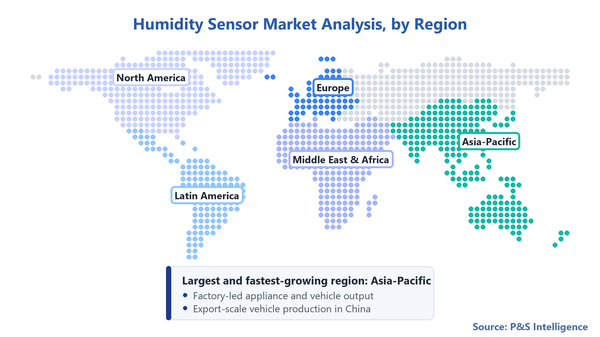
Asia-Pacific accounts for 35% of 2026 revenue and is set to post the fastest regional growth, a 7.4% CAGR during 2027-2033. Much of that demand comes from production lines in China, Japan, South Korea, and India that build air conditioners, vehicles, and consumer electronics, so sensor orders scale with factory output. North America and Europe rely more on equipment turnover and controls upgrades in existing buildings, which ties their demand to renovation budgets and building-code changes. Vendors compete mostly on OEM volume and price in Asia, and on accuracy, certification, and service in the two mature regions.
Key market insights
By type, capacitive accounts for 38% of 2026 revenue, while resistive is set to post the quickest growth during 2027-2033.
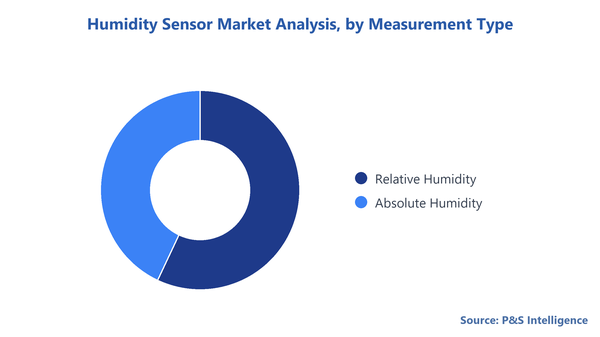
By measurement type, relative humidity holds 57% in 2026 and is projected to expand at an 8.2% CAGR during 2027-2033.
By output, digital holds 60% in 2026 and is forecast to advance at a 6.7% CAGR during 2027-2033.
By application, HVAC & building automation holds 28% in 2026, while automotive is projected to rise at an 8.1% CAGR during 2027-2033.
By geography, Asia-Pacific holds 35% in 2026 and is expected to expand at a 7.4% CAGR during 2027-2033.
Humidity Sensor Market Dynamics
Multi-sensor environmental chips are reshaping how humidity sensing is specified
Designers of wearables, smartphones, and smart-home devices often buy humidity sensing as one channel on a combined environmental chip that also reads pressure and temperature. That choice moves the purchase decision from a standalone humidity part to a sensor package selected for board space and power budget, and it brings MEMS pressure-sensor makers into direct competition with humidity specialists. Combination devices count toward this market only when a humidity channel is part of the device specification, so a pressure-and-temperature chip without one falls outside it.
Bosch Sensortec's product page for the BME280 lists relative humidity, barometric pressure, and temperature in one 2.5 x 2.5 x 0.93 mm package, developed for mobile and wearable devices where size and low power drive the design. For device makers, one component in place of two or three trims board area and assembly steps. For humidity-only suppliers, the same design logic narrows the consumer sockets they can win on accuracy alone, which pushes them toward applications where calibration stability matters more than footprint.
Indoor air quality mandates are driving sensor content in new commercial buildings
Building owners and controls contractors in Europe face rules that will require indoor air quality to be measured and regulated in new commercial buildings, and that shift adds sensing points to new commercial projects. Demand-controlled ventilation needs room or duct sensors in each controlled zone, and humidity is one of the parameters many controls designs read beside carbon dioxide and temperature. Each added zone becomes a line item for transmitters and room sensors in the controls package, usually bought through the HVAC or building-automation contractor.
Under the European Union's recast Energy Performance of Buildings Directive, non-residential zero-emission buildings must be fitted with devices that measure and regulate indoor air quality, a requirement that in practice covers new non-residential buildings from 2030. The directive is technology-neutral and does not name humidity sensing, so the humidity content of each building depends on the indoor environmental quality standards that member states set. Suppliers offering combined humidity, carbon dioxide, and temperature room sensors could be better positioned in those specifications, because one device can cover several monitored parameters.
Data center construction is opening a project-led channel for precision transmitters
Data center developers and the mechanical contractors who build their cooling plants buy humidity and dew point transmitters for the data halls, cooling units, and air handlers they install. Operators keep server rooms inside a set moisture band to limit both condensation and static discharge, so sensing is specified at the design stage and bought together with the cooling equipment. Because these purchases arrive as project orders, a single campus build can place sensors across every cooling unit in one purchase round, which gives transmitter makers large, irregular orders.
Figures from Associated Builders and Contractors put U.S. data center construction spending in August 2026 more than 73% above its level a year earlier, based on Census Bureau data. That measure tracks building work and says nothing directly about sensor purchases. It does show how quickly new data hall capacity is entering construction. Transmitter makers with proven dew point accuracy and supply ties to cooling-equipment OEMs are better positioned to benefit, since many cooling units leave the factory with sensors already fitted.
Swings in HVAC equipment output are limiting order visibility for OEM sensor suppliers
A large part of humidity sensing revenue ships inside HVAC equipment, so sensor makers inherit the production cycles of air-conditioner, heat-pump, and air-handler manufacturers. OEMs schedule sensor deliveries against their own build plans, and when equipment output drops, sensor call-offs fall in the same quarter, regardless of the installed base's long-term needs. Suppliers that depend on a few residential HVAC OEMs carry the most exposure, because a single customer's inventory correction can move their annual volume.
Air-Conditioning, Heating, and Refrigeration Institute data show combined U.S. shipments of central air conditioners and air-source heat pumps fell 20% in 2025 to 7,749,529 units, down from 9,681,770 in 2024. For sensor vendors serving that channel, a fall of that size can cut OEM orders well before end users change how much comfort control they want. Duct and room transmitters sold for retrofit projects follow renovation budgets on a different timetable, which gives suppliers with both OEM and retrofit channels a partial hedge against equipment cycles.
Segmentation Outlook
Type
Capacitive sensors account for 38% of 2026 revenue, the largest share of any sensing principle in the humidity sensor market. A polymer capacitive film can sit on the same die as signal conditioning and calibration memory, so one part can ship to appliance, HVAC, and vehicle lines as a ready-calibrated component. Amphenol's Telaire T9602, which pairs a capacitive polymer sensor chip with an ASIC, shows how vendors package the principle for OEM integration. That integration lowers the cost of each reading at volume, which keeps capacitive parts the usual starting point in new designs.
Resistive sensors are set to post the quickest growth among sensing types over 2027-2033. Polymer resistive elements are typically simple to read with low-cost circuitry, which suits price-sensitive humidifiers, room controllers, and household appliances where moderate accuracy is acceptable. High-volume appliance assembly can give resistive element makers a widening base of cost-led sockets, since each new appliance model needs only a basic humidity reading. Suppliers that can hold drift within appliance specifications at the lowest unit cost are the ones these buyers tend to shortlist.
Measurement Type
Relative humidity sensing holds 57% of 2026 revenue, because comfort limits, product-storage rules, and process recipes are usually written as a percentage of saturation at a given temperature. As per the International Council for Harmonisation's Q1A(R2) stability guideline, long-term drug storage studies run at 25°C ± 2°C and 60% relative humidity ± 5%, which requires stability chambers that hold and record relative humidity. Pharmaceutical manufacturers and other regulated buyers therefore pay for calibrated, traceable probes, which supports higher prices per sensing point than consumer parts command.
Relative humidity sensing is also projected to grow at the fastest pace, an 8.2% CAGR during 2027-2033. Most new sensor sockets in vehicles, smart-home devices, and building controls read relative humidity directly, since the control logic they feed is set in those terms. Absolute humidity measurement stays concentrated in drying, combustion, and process-gas applications, where thermal conductivity transmitters such as Delta OHM's HD3817T report grams of water per cubic meter. That concentration keeps absolute humidity sensing tied to a narrower set of industrial buyers.
Copyright P&S Intelligence. Reuse requires attribution under CC BY 4.0.
Output
Digital output devices account for 60% of 2026 revenue, as OEMs increasingly prefer a sensor that delivers a calibrated, linearized reading over a bus straight into the product's microcontroller. Buying a digital part moves the calibration step from the OEM's production line to the sensor maker's factory, which saves test time and removes an analog front end from the bill of materials. Renesas markets its HS401x devices as fully calibrated relative humidity and temperature sensors with an I2C interface, an example of vendors selling calibration as part of the component.
Digital output sensors are projected to expand at a 6.7% CAGR during 2027-2033. Connected thermostats, air purifiers, and vehicle climate modules all read their sensors through firmware, so each new connected design is most easily served by a digital part. Analog output keeps a place in legacy 0-10 V and 4-20 mA building and industrial transmitters, where installed controllers expect a voltage or current signal and replacement buyers match what is already wired. Vendors offering both interfaces in one product family can follow customers through that transition.
Application
HVAC and building automation holds 28% of 2026 revenue, making it the largest application. Room, duct, and outdoor sensing points feed the controls that decide when buildings humidify, dehumidify, or bring in outside air. Most air handlers and many thermostats carry at least one sensing point, and purchases recur through equipment replacement and controls upgrades. Controls contractors and HVAC OEMs typically specify sensors with long calibration stability, because a drifting reading raises energy bills and produces comfort complaints that land on the installer.
Automotive is projected to be the fastest-growing application, at an 8.1% CAGR during 2027-2033. Automatic demisting, heat-pump climate control, and moisture monitoring inside electronic control housings are adding humidity sensing to vehicle designs. Each of these uses requires parts qualified to automotive reliability standards, and that qualification work tends to lock in a supplier once a part is approved for a platform. Suppliers already holding qualified automotive parts are therefore better positioned in new sourcing rounds as carmakers launch models.
The following segments are analysed in this report.
Type
Capacitive
Resistive
Thermal Conductivity
Optical
Other Sensor Types
Measurement Type
Relative Humidity
Absolute Humidity
Output
Analog
Digital
Application
HVAC & Building Automation
Automotive
Consumer Electronics
Industrial
Healthcare & Pharmaceutical
Food & Beverage
Agriculture
Environmental Monitoring
Other Applications
Geographical Outlook
Asia-Pacific humidity sensor market outlook
Asia-Pacific holds 35% of global humidity sensor market revenue in 2026 and is projected to post the fastest growth of any region, at a 7.4% CAGR during 2027-2033. Regional demand is factory-led, because the companies assembling air conditioners, vehicles, phones, and appliances buy sensors as components, and a large part of that assembly takes place in China, Japan, South Korea, and India. China is the region's largest market, with sensor orders moving in step with domestic appliance, electronics, and vehicle production. OEM buyers order in very high volumes, so local and international sensor makers compete hardest on price here.
The China Association of Automobile Manufacturers recorded manufacturer sales of 34.4 million vehicles in 2025, a total that includes 7.098 million exports, so it measures output from Chinese plants rather than domestic registrations. The statistic sizes the platform base that climate-module suppliers serve and does not show how many of those vehicles carry humidity sensing. It does explain why sensor vendors with automotive qualifications and local application engineering in China can expect a deep pool of sourcing rounds, as carmakers refresh models for both home and export markets.
Copyright P&S Intelligence. Reuse requires attribution under CC BY 4.0.
North America market analysis
North America holds a mature position in global demand, built on an installed base of homes, offices, laboratories, and vehicles that already carry humidity sensing. In the U.S. and Canada, sensor orders arrive through HVAC equipment replacement at end of life, thermostat and building controls upgrades, and refits of pharmaceutical and laboratory spaces to tighter environmental specifications. Because many of these orders replace or upgrade sensing points that already exist, accuracy, certification, and compatibility with installed controls weigh more heavily in supplier choice than unit price.
The U.S. Energy Information Administration estimates from its 2020 Residential Energy Consumption Survey that 88% of U.S. households use air conditioning. With cooling already this widespread, new sensor volume in homes depends on equipment replacement and on connected thermostats that add humidity readings to existing systems. Suppliers with installer-friendly retrofit products and distribution through HVAC wholesalers are better placed in this region than those built around new-construction volume, and data center projects add a separate, project-led stream of transmitter orders.
Europe market analysis
Europe holds an established position in global revenue, with demand shaped more by building regulation and heat pump installations than by new factory output. Germany, France, Italy, the U.K., and Spain carry much of the regional activity, where renovation programs and ventilation upgrades in existing buildings generate steady orders for duct, room, and outdoor sensors. Heat pump installations matter because each one brings new controls and, in renovated homes with tighter envelopes, often a ventilation upgrade in which humidity readings can form part of the specification.
Heat pump sales rose 13% in 2025 to 2.9 million units across 21 European countries, lifting the installed stock to 29.3 million, according to the European Heat Pump Association. The figure counts heating equipment and does not measure sensor demand directly. It does show how quickly the stock of systems needing controls and ventilation support is growing. Controls vendors and sensor suppliers with Europe-wide distribution are positioned to benefit as member states write indoor environmental quality requirements into national building rules.
Latin America market analysis
Latin America contributes a smaller share of global revenue, with demand concentrated in Brazil and Mexico. Mexico's vehicle and appliance assembly plants, many of which build for the U.S. market, buy sensors as OEM components, so regional volume follows North American production schedules as much as local consumption. Brazil adds demand from its own vehicle industry and from agriculture and food processing, where grain storage, poultry housing, and cold chains use humidity monitoring to protect product quality.
Much of the region's sensor supply is imported, which exposes buyers to currency swings and longer lead times and gives distributors that hold local stock an advantage. Regional volume is likely to follow investment in Mexican manufacturing and capital spending in Brazilian agribusiness over 2027-2033. Suppliers with OEM relationships in Mexican plants and dealer networks that reach farm and food-processing customers are better positioned to add volume, while Argentina remains a smaller, more price-sensitive market served mainly through distributors.
Middle East & Africa market analysis
The Middle East & Africa contributes a modest share of global revenue, with demand centered on cooling-intensive construction in Saudi Arabia and the U.A.E. and on industrial and commercial sites in South Africa. Gulf cities combine extreme summer heat with coastal humidity, so commercial towers, hospitals, airports, and district cooling networks specify humidity control alongside temperature control from the design stage. Purchases therefore arrive in project batches tied to construction programs, and international consultants often write the sensor specification.
South Africa's demand comes mainly from food processing, pharmaceutical manufacturing, and commercial buildings, where humidity monitoring protects product quality and equipment. Across the region, suppliers that hold approvals with the main controls integrators and keep calibration support local can secure repeat orders once a project's specification lists their products. The pace of Gulf construction programs is the main swing factor for regional sensor volume over 2027-2033, which makes order timing less predictable than in North America and Europe.
The following geographies are analysed in this report.
Asia-Pacific
China
Japan
India
South Korea
Australia
Rest of Asia-Pacific
Europe
Germany
U.K.
France
Italy
Spain
Rest of Europe
Latin America
Brazil
Mexico
Argentina
Rest of Latin America
Middle East & Africa
Saudi Arabia
U.A.E.
South Africa
Rest of Middle East & Africa
North America
U.S.
Canada
Humidity Sensor Market Competition Analysis
The humidity sensor market is moderately fragmented. Sensing elements can be built on standard semiconductor processes, the application base runs from phones to pharmaceutical warehouses, and building and industrial buyers often prefer local service and calibration support, so no single supplier covers every channel. Building and industrial orders also pass through controls integrators and distributors that keep approved product lists, which lets regional instrumentation makers hold business against much larger chip suppliers. The structure is fairly stable, although acquisitions by sensor and connector groups have pulled several specialist humidity product lines into larger portfolios over the past decade.
Two broad groups compete for revenue. Semiconductor and sensor-component makers, including Sensirion Holding AG, Texas Instruments Incorporated, Renesas Electronics Corporation, STMicroelectronics N.V., and Robert Bosch GmbH, sell calibrated chips and combination devices to OEMs, competing on accuracy per unit cost, package size, power draw, and automotive qualification. Instrumentation specialists such as Vaisala Oyj, E+E Elektronik Ges.m.b.H., and Ralliant Corporation sell probes and transmitters into buildings, laboratories, and process plants, where calibration traceability and field service weigh heavily. TE Connectivity plc and Amphenol Corporation sell into both groups' customers.
For buyers, this structure keeps pricing competitive in high-volume consumer and appliance sockets, where several qualified sources usually exist for a standard footprint. Switching becomes much harder once a part is designed into a vehicle platform or a regulated pharmaceutical facility, because requalification takes validation time and documentation. Incumbents in those channels tend to keep business across product generations, and new entrants usually win their first orders in consumer and building products.
Major Companies in Humidity Sensor Market:
Sensirion Holding AG
Honeywell International Inc.
TE Connectivity plc
Texas Instruments Incorporated
Amphenol Corporation
Robert Bosch GmbH
Renesas Electronics Corporation
STMicroelectronics N.V.
Infineon Technologies AG
OMRON Corporation
Vaisala Oyj
E+E Elektronik Ges.m.b.H.
Ralliant Corporation
Siemens AG
Schneider Electric SE
Seiko Epson Corporation
Humidity Sensor Market News & Developments
In April 2026, Sensirion Holding AG announced global availability of the SEN62, a compact environmental sensing module that measures particulate matter, humidity, and temperature, sold through its worldwide network of channel partners for air purifiers, HVAC systems, smart home devices, and air quality monitors. The module lets appliance makers add indoor air monitoring, including a humidity reading, without designing their own sensor board.
In January 2026, E+E Elektronik Ges.m.b.H. launched the HTS401, a modular humidity and temperature transmitter that succeeds its EE210 and EE212, with factory pre-calibrated sensor modules that can be swapped tool-free in the field in 10 minutes and humidity accuracy of up to ±0.95% RH. Replacing a pre-calibrated module on site avoids removing the instrument for external calibration, which matters to data center, pharmaceutical cleanroom, and greenhouse operators that cannot pause monitoring.
Last Updated: October 2026
Frequently Asked Questions About This Report
How fast is the humidity sensor market growing?+
By 2033 the humidity sensor market is projected to reach USD 5.89 Billion, a CAGR of 6.4% during 2027-2033, as HVAC, building-controls, and vehicle programs add sensing points.
Which type of humidity sensor is most widely used?+
Capacitive sensors account for 38% of 2026 revenue, the largest share of any sensing principle in the humidity sensor market.
Which region leads the humidity sensor market?+
Asia-Pacific holds 35% of global humidity sensor market revenue in 2026 and is projected to post the fastest growth of any region, at a 7.4% CAGR during 2027-2033.
What is the largest application for humidity sensors?+
HVAC and building automation holds 28% of 2026 revenue, making it the largest application. Room, duct, and outdoor sensing points feed the controls that decide when buildings humidify, dehumidify, or bring in outside air.
Why are humidity sensors used in cars?+
Automotive is projected to be the fastest-growing application, at an 8.1% CAGR during 2027-2033. Automatic demisting, heat-pump climate control, and moisture monitoring inside electronic control housings are adding humidity sensing to vehicle designs.
Are digital or analog humidity sensors more common?+
Digital output devices account for 60% of 2026 revenue, as OEMs increasingly prefer a sensor that delivers a calibrated, linearized reading over a bus straight into the product's microcontroller.
Want a report tailored exactly to your business need?
Leading companies across industries trust us to deliver data-driven insights and innovative solutions for their most critical decisions. From data-driven strategies to actionable insights, we empower the decision-makers who shape industries and define the future. From Fortune 500 companies to innovative startups, we are proud to partner with organisations that drive progress in their industries.
Client Testimonials
Working with P&S Intelligence and their team was an absolute pleasure – their awareness of timelines and commitment to value greatly contributed to our project's success. Eagerly anticipating future collaborations.
McKinsey & Company
India
Unmatched Standards
Our insights into the minutest levels of the markets, including the latest trends and competitive landscape, give you all the answers you need to take your business to new heights
Complete Data Security
We take a cautious approach to protecting your personal and confidential information. Trust is the strongest bond that connects us and our clients, and trust we build by complying with all international and domestic data protection and privacy laws