Hot and Cold Therapy Packs Market Size & Share Analysis - Trends, Drivers, Competitive Landscape, and Forecasts (2026 - 2032)
This Report Provides In-Depth Analysis of the Hot and Cold Therapy Packs Market Report Prepared by P&S Intelligence, Segmented by Type (Cold Therapy Packs, Hot Therapy Packs), Application (Sports Injuries, Neuropathic Pain, Post-Surgical Pain), and Geographical Outlook for the Period of 2021 to 2032
Explore the market potential with our data-driven report
Hot and Cold Therapy Packs Market Future Outlook
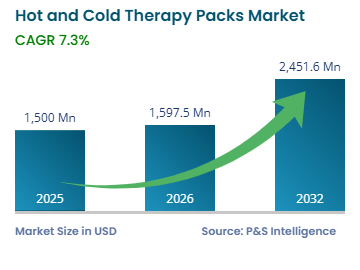
The hot and cold therapy packs market size was USD 1,500.0 million for 2025, and it will grow by 7.3% during 2026–2032, to reach USD 2,451.6 million by 2032.
This growth is supported by the rising global burden of musculoskeletal conditions and sports-related injuries, increasing preference for non-pharmacological pain management, and broader adoption of hot and cold therapy packs across hospitals, physiotherapy clinics, rehabilitation centers, and home-care settings. The growing need for accessible pain-management and rehabilitation solutions, together with increasing participation in sports and recreational physical activity, is further supporting demand for thermal therapy products. In addition, the expansion of home-based healthcare and rehabilitation is encouraging greater use of convenient, reusable, and portable therapy products for self-administered pain management and recovery.
According to the World Health Organization (WHO), low back pain affected an estimated 619 million people globally in 2020 and is projected to reach 843 million cases by 2050, driven largely by population growth and ageing. Low back pain is also identified by WHO as the leading cause of disability worldwide. This sustained burden supports demand for thermal therapy products for acute injuries, pain management, and rehabilitation. Reusable gel-based formats, along with moist and dry variants, are relevant product formats for both clinical and home-care use.
Key Market Insights
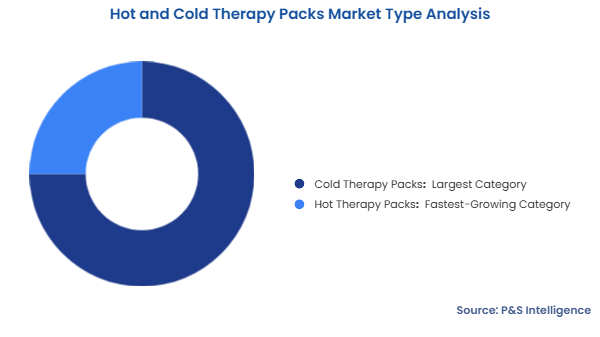
The cold therapy packs category holds the largest market share, of 75%, in 2025, driven by their affordability, versatility, and widespread use for acute injuries.
The hot therapy packs category will have the highest CAGR, of approximately 7.6%, supported by rising consumer adoption of non-pharmacological approaches to chronic pain management.
The sports injuries category holds the largest market share, of 60%, in 2025, driven by the high incidence of acute injuries from sports and physical activity.
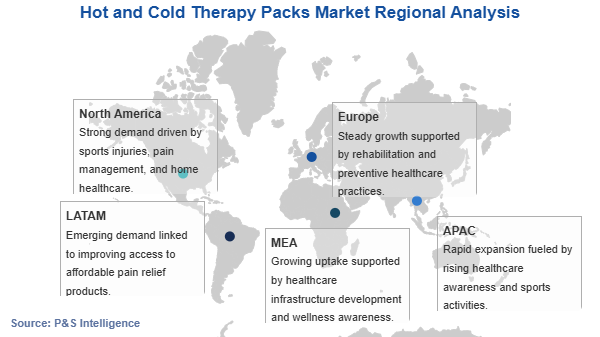
North America holds the largest market share, of 40%, in 2025, supported by its strong healthcare infrastructure and high sports participation.
Asia-Pacific will have the highest CAGR, of approximately 8.2%, driven by rising healthcare needs, a large population base, and expanding healthcare systems.
Hot and Cold Therapy Packs Market Trends and Drivers
Reusable and Product-Format Innovation Are Key Trends
Manufacturers are increasingly developing reusable and versatile hot and cold therapy products designed to improve convenience, repeat use, and user comfort. Reusable gel packs, wraps, and combination hot-and-cold formats provide users with greater flexibility than single-use products, while product innovation is focusing on ergonomic designs, adjustable fastening systems, insulation, and portable formats.
This broader shift toward product longevity and resource efficiency is also reflected in recent WHO guidance; in July 2026, WHO/Europe released guidance promoting repair, refurbishment, and recycling of assistive products to extend product life, reduce waste, minimize environmental impact, and lower procurement costs. Moist and dry heat formats continue to serve different user needs, with moist heat designed to deliver heat with moisture and dry formats offering greater portability and convenience. These developments indicate a broader movement toward durable, reusable, user-centred and resource-efficient therapeutic products. These innovations are expected to support market growth by increasing product convenience, extending repeat-use potential, and broadening the applicability of thermal therapy across clinical, sports, and home-care settings.
Rising Musculoskeletal Disorder Burden and Sports Participation Are Biggest Drivers
The growing global burden of musculoskeletal conditions, combined with population ageing and continued participation in sports and recreational physical activity, is supporting demand for accessible pain-management and rehabilitation solutions. Conditions such as osteoarthritis and low back pain are among the most prevalent musculoskeletal disorders and can require ongoing symptom management and rehabilitation. The World Health Organization estimates that approximately 1.71 billion people globally live with musculoskeletal conditions, which represent the largest contributor to the need for rehabilitation worldwide.
Thermal therapy, including heat and cold applications, is used as part of conservative pain-management and rehabilitation approaches for various musculoskeletal conditions and injuries. Sports and recreational activities can also create demand for acute injury-management and recovery products, including cold and heat therapy. The substantial and persistent burden of musculoskeletal conditions therefore provides a broad underlying demand base for accessible thermal therapy products across clinical and home-care settings.
Limited Consumer Awareness and Healthcare Workforce Shortages Are Key Restraints
Limited consumer awareness of correct application techniques, combined with uneven access to healthcare professionals and rehabilitation services, can constrain the broader adoption of hot and cold therapy packs in emerging markets. Incorrect application of thermal therapy, including excessive exposure time or inappropriate temperatures, can result in adverse effects such as burns or cold-related tissue injury. Limited access to healthcare professionals can also reduce opportunities for consumers to receive appropriate guidance on product selection, duration of use, and safe application, particularly in rural and lower-resource settings. The World Health Organization identifies shortages and maldistribution of health workers as persistent challenges to access to essential health services, particularly in low- and middle-income countries.
These constraints can make consistent patient education and rehabilitation support more difficult, particularly for self-administered products. Manufacturers can help reduce the awareness gap by providing clear safety instructions, pictorial guidance, multilingual labeling, defined temperature and application limits, and educational materials through pharmacies and community healthcare channels. Improving consumer education alongside the expansion of rehabilitation and primary-care services can gradually reduce safety concerns and support wider adoption of thermal therapy products in underserved markets.
E-Commerce Expansion and Home-Based Recovery Are Biggest Opportunities
The continued expansion of online retail is creating additional distribution opportunities for hot and cold therapy pack manufacturers, particularly through direct-to-consumer and online pharmacy channels. According to the U.S. Census Bureau, U.S. retail e-commerce sales reached approximately USD 1.23 trillion in 2025, representing 16.4% of total U.S. retail sales. The growing availability of consumer healthcare products through online platforms allows therapy-pack manufacturers to reach customers beyond traditional hospitals, pharmacies, physiotherapy clinics, and physical retail stores. Online purchasing also provides consumers with greater access to different pack formats, including reusable gel packs, hot and cold wraps, and portable therapy products, while product information and user reviews can support purchasing decisions.
At the same time, the expansion of home-based healthcare and rehabilitation is creating opportunities for products that can be incorporated into routine pain-management and recovery activities. The World Health Organization identifies rehabilitation as an essential health service and emphasizes the importance of integrating rehabilitation across health systems and levels of care, including community and home settings. This broader shift toward accessible rehabilitation can support demand for convenient thermal therapy products that complement professional care. Manufacturers can further strengthen online distribution by providing clear product-use information, offering multiple sizes and reusable formats, and developing packaging suited to home users. As digital retail and home-based care continue to develop, e-commerce is likely to remain an important channel for improving consumer access to hot and cold therapy products.
Hot and Cold Therapy Packs Market Segmentation Analysis
Type Analysis
The cold therapy packs category holds the largest market share, of 75%, in 2025, driven by its versatility, affordability, and widespread use in the management of acute soft-tissue injuries such as sprains, strains, and contusions. Cold therapy can help reduce pain and swelling following acute injuries, supporting continued use across clinical, sports, rehabilitation, and home-care settings. The broad prevalence of acute musculoskeletal injuries, particularly those associated with sports and physical activity, provides a strong underlying demand base for cold therapy products.
The hot therapy packs category will have the highest CAGR, of approximately 7.6%, supported by rising consumer adoption of non-pharmacological approaches to chronic pain management. Moist variants are gaining preference for deeper tissue penetration in muscle relaxation, while dry formats are valued for portability and convenience in daily use. Growing demand for convenient, reusable heat-therapy solutions for home-based pain management and rehabilitation is further supporting the segment's expansion.
The types analyzed in this report are:
Cold Therapy Packs (Largest Category)
Hot Therapy Packs (Fastest-Growing Category)
Moist Therapy Packs
Dry Therapy Packs
Application Analysis
The sports injuries category holds the largest market share, of 60%, in 2025, reflecting the substantial incidence of acute musculoskeletal injuries associated with organized sports, recreational fitness, and physical activity. Cold therapy is commonly used following acute injuries to help manage pain and swelling, while heat therapy can be incorporated during subsequent recovery and rehabilitation. Demand therefore extends across sports teams, rehabilitation facilities, athletic training environments, and home-care settings, where convenient and reusable therapy products can support injury-management and recovery routines.
The neuropathic pain category will have the highest CAGR, supported by the increasing prevalence of chronic pain conditions and the growing need for non-pharmacological pain-management approaches. A peer-reviewed review indexed in PubMed estimates that neuropathic pain affects approximately 7%–10% of the general population, highlighting the substantial patient population requiring pain-management strategies. Growing emphasis on multidisciplinary pain management and rehabilitation can further support the use of non-invasive therapeutic approaches alongside conventional medical treatment.
The applications analyzed in this report are:
Sports Injuries (Largest Category)
Neuropathic Pain (Fastest-Growing Category)
Post-Surgical Pain
Drive strategic growth with comprehensive market analysis
Hot and Cold Therapy Packs Market Regional Analysis
North America Hot and Cold Therapy Packs Market Size
North America holds the largest market share, of 40%, in 2025, supported by the region's large healthcare system, widespread participation in physical activity and sports, and established access to pain-management and rehabilitation products. Growing use of non-pharmacological approaches to pain management also supports demand for thermal therapy products. According to the U.S. CDC’s National Health Interview Survey, 24.3% of U.S. adults experienced chronic pain in 2023, while 8.5% experienced high-impact chronic pain that frequently limited life or work activities. The CDC also recommends nonpharmacologic and nonopioid therapies where appropriate and identifies ice and heat among nonpharmacologic options for acute pain, including musculoskeletal injuries.
U.S. Hot and Cold Therapy Packs Market Size
The United States represents a major market for hot and cold therapy packs, supported by its extensive healthcare infrastructure, established rehabilitation services, and substantial demand for pain-management products. The U.S. Census Bureau estimated the U.S. population at 341.8 million in July 2025, compared with 340.1 million in July 2024, providing a large and expanding consumer base for healthcare and home-care products. Growing use of non-pharmacological approaches to pain management also supports demand for thermal therapy products. Continued adoption of home-based rehabilitation and consumer healthcare products can further support accessibility of hot and cold therapy solutions across clinical and home-care settings.
Asia-Pacific Hot and Cold Therapy Packs Market Size
Asia-Pacific will have the highest CAGR, of approximately 8.2%, supported by increasing healthcare and rehabilitation needs, a large population base, and continued development of healthcare systems across the region. India's healthcare infrastructure continues to expand; as of August 2026, the Government of India reported 1,86,727 functional Ayushman Arogya Mandirs, including 1,34,546 Sub-Health Centres and 24,508 Primary Health Centres, delivering services that include rehabilitative care. This expansion of primary and community-level healthcare infrastructure can improve access to rehabilitation and pain-management services and support the use of accessible therapeutic products in clinical and home-care settings.
China Hot and Cold Therapy Packs Market Size
China represents a major market for hot and cold therapy packs in Asia Pacific, supported by its large and aging population, substantial burden of musculoskeletal conditions, and continued development of healthcare and rehabilitation services. Government efforts to strengthen rehabilitation capacity and improve access to healthcare services are supporting the broader availability of pain-management and rehabilitation solutions. A 2025 peer-reviewed analysis using Global Burden of Disease 2021 data found that China's age-standardized prevalence of musculoskeletal disorders increased from 16.97% in 1990 to 17.40% in 2021, highlighting the country's substantial and persistent musculoskeletal disease burden. This substantial disease burden, together with population ageing and increasing rehabilitation needs, supports the underlying demand for accessible pain-management and thermal therapy products.
The regions and countries analyzed in this report are:
North America (Largest Regional Market)
U.S. (Larger Country)
Canada (Faster-Growing Country)
Europe
Germany (Largest Country)
U.K.
France
Italy
Spain (Fastest-Growing Country)
Rest of Europe
Asia-Pacific (Fastest-Growing Regional Market)
China (Largest Country)
India (Fastest-Growing Country)
Japan
South Korea
Australia
Rest of APAC
Latin America
Brazil (Largest Country)
Mexico (Fastest-Growing Country)
Rest of LATAM
Middle East & Africa
Saudi Arabia (Largest Country)
South Africa
U.A.E. (Fastest-Growing Country)
Rest of MEA
Hot and Cold Therapy Packs Market Competitive Landscape
The market exhibits a fragmented competitive structure, with participation from diversified healthcare companies, specialized therapy-product manufacturers, and regional suppliers. The relatively standardized nature of basic therapy-pack products allows multiple manufacturers to compete, while differentiation is often based on product format, brand recognition, pricing, distribution reach, and product functionality. The market includes both large healthcare companies with broad medical-product portfolios and specialized manufacturers focused on thermal therapy products. Diversified players such as 3M Company, Cardinal Health, and Medline participate through their broader healthcare-product portfolios and established distribution networks. Specialized companies such as Koolpak and Rapid Aid have a more focused presence in hot and cold therapy products. Competition therefore occurs across product innovation, reusable and specialized formats, distribution capabilities, brand recognition, and pricing, rather than being dominated by a single product or technology platform.
Leading Companies in the Hot and Cold Therapy Packs Market:
3M Company
Cardinal Health, Inc.
Medline Industries, LP
Enovis Corporation
Caldera International, Inc.
Performance Health Holding, Inc.
Breg, Inc.
Core Products International, Inc.
Polar Products, Inc.
Bruder Healthcare Company
Rapid Aid Corporation
Beurer GmbH
Carex Health Brands
Kobayashi Pharmaceutical Co., Ltd.
Koolpak Ltd.
Hot and Cold Therapy Packs Market Developments
In April 2026, Caldera International, Inc. expanded its wellness portfolio with new recovery, travel, and pet-wellness solutions, including Pet Therapy Gel Packs, Pet Therapy Wraps, Cold Pack Ice Packs, and the Releaf Neck Rest. This expansion broadens the company's hot- and cold-therapy offering into pet wellness and active-lifestyle applications.
In May 2025, Enovis Corporation unveiled a unified brand identity across its DonJoy, Chattanooga, and Aircast product brands. The initiative brought approximately a dozen specialized brands under a cohesive visual identity while preserving their individual brand heritage, strengthening consistency and recognition across the company's portfolio.
In March 2023, Breg Inc. partnered with HealthMe to launch a patient direct-pay solution for orthopedic cold therapy products. The partnership was designed to streamline purchasing and improve patient access to Breg’s cold therapy devices through a digital payment platform.
Frequently Asked Questions About This Report
What are the major factors driving the Hot and Cold Therapy Packs Market?+
The market is driven by the rising prevalence of musculoskeletal disorders and chronic pain, increasing sports and physical activity participation, growing preference for non-pharmacological pain management, and expanding use of home-based recovery and rehabilitation solutions.
What are the key trends in the Hot and Cold Therapy Packs Market?+
Key trends include increasing demand for reusable and portable therapy products, development of ergonomic and anatomically designed wraps, growing adoption of home-based recovery solutions, product innovation, and increasing use of e-commerce for healthcare and wellness products.
What are the major challenges facing the Hot and Cold Therapy Packs Market?+
Major challenges include limited consumer awareness regarding the correct use of thermal therapy, risk of burns or cold-related tissue injury from improper application, price sensitivity in emerging markets, and competition from alternative pain-management and recovery products.
How is e-commerce influencing the Hot and Cold Therapy Packs Market?+
E-commerce is expanding manufacturers' access to consumers through direct-to-consumer websites, online pharmacies, and major online retail platforms, while improving product availability and enabling consumers to compare therapy products and access product information and reviews before purchasing.
How are technological and product innovations affecting the Hot and Cold Therapy Packs Market?+
Product innovation is increasingly focused on reusable materials, improved temperature retention, ergonomic designs, adjustable wraps, portable formats, and products that combine thermal therapy with compression or other recovery features.
How is the growing focus on home-based healthcare affecting the Hot and Cold Therapy Packs Market?+
The expansion of home-based healthcare and rehabilitation is creating demand for convenient, easy-to-use therapy products that consumers can incorporate into routine pain-management and recovery activities.
Want a report tailored exactly to your business need?
Leading companies across industries trust us to deliver data-driven insights and innovative solutions for their most critical decisions. From data-driven strategies to actionable insights, we empower the decision-makers who shape industries and define the future. From Fortune 500 companies to innovative startups, we are proud to partner with organisations that drive progress in their industries.
Client Testimonials
Working with P&S Intelligence and their team was an absolute pleasure – their awareness of timelines and commitment to value greatly contributed to our project's success. Eagerly anticipating future collaborations.
McKinsey & Company
India
Unmatched Standards
Our insights into the minutest levels of the markets, including the latest trends and competitive landscape, give you all the answers you need to take your business to new heights
Complete Data Security
We take a cautious approach to protecting your personal and confidential information. Trust is the strongest bond that connects us and our clients, and trust we build by complying with all international and domestic data protection and privacy laws