High Power LED Market Size Estimation
Key Highlights
| Study Period | 2021 - 2032 |
| Market Size in 2025 | USD 5.8 Billion |
| Market Size in 2026 | USD 6.1 Billion |
| Market Size by 2032 | USD 8.8 Billion |
| Projected CAGR | 6.2% |
| Largest Region | Asia-Pacific |
| Fastest-Growing Region | Asia-Pacific |
| Market Structure | Fragmented |
Market Size
Explore the market potential with our data-driven report
High Power LED Market Key Insights
- The 3-4.9 W category holds the largest market share, of 45%, in 2025, due to its balanced efficiency, brightness, and cost, driving widespread use in general lighting.
- The >10 W category will have the highest CAGR, of 6.5%, driven by rising demand in high-intensity industrial and outdoor lighting applications.
- The general lighting category holds the largest market share, of 40%, in 2025, driven by widespread use across sectors and large-scale infrastructure and upgrade projects.
- The automotive category will have the highest CAGR, of 6.3%, driven by increasing adoption of advanced vehicle lighting systems like headlights and DRLs.
- Asia-Pacific holds the largest market share, of 40%, in 2025, and it will have the highest CAGR, of 6.4%, driven by strong manufacturing, urbanization, and energy efficiency initiatives.
High Power LED Market Future Outlook
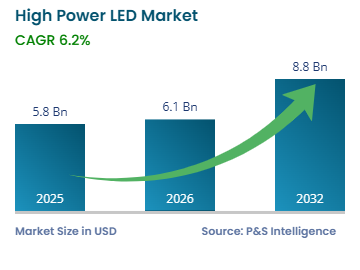
The high power LED market size was USD 5.8 billion for 2025, and it will grow by 6.2% during 2026–2032, to reach USD 8.8 billion by 2032.
The market is driven by the shift toward energy-efficient and long-lasting lighting solutions across residential, commercial, and industrial sectors. High power LEDs, typically operating above 1 watt, deliver superior brightness and greater longevity than traditional lighting technologies such as incandescent and fluorescent lamps. LEDs can consume up to 80% less energy than conventional lighting systems, and this efficiency advantage has driven their widespread adoption across high-lumen outdoor and industrial lighting, street lighting, and infrastructure projects. Supportive government initiatives promoting energy conservation and the phase-out of inefficient lighting systems are accelerating market adoption worldwide. India's Energy Efficiency Services Limited has distributed over 370 million LED bulbs. The program has delivered annual energy savings of approximately 47 billion kWh.
Advances in thermal management and optical efficiency are improving LED performance and broadening viable application areas. High power LEDs have seen increasing adoption in automotive lighting, signage, and signals. Their compact form factor and high luminous output suit precision lighting environments, and their operational durability reduces maintenance requirements in high-cycle applications. Smart lighting systems and IoT-enabled controls are extending the role of high power LEDs across modern lighting ecosystems. Smart city developments represent a growing deployment context for these integrated lighting solutions.
High Power LED Market Emerging Trends & Growth Drivers
Integration of Smart Lighting and Connected LED Systems Is Key Trend
A major trend shaping the high power LED market is the strong alignment between smart lighting adoption and government-led energy efficiency initiatives. Governments worldwide are implementing policies such as Minimum Energy Performance Standards (MEPS), energy labeling programs, and large-scale lighting replacement schemes to accelerate LED adoption. International Energy Agency data indicates that LEDs accounted for over 50% of global lighting sales by 2022. This reflects the pace of policy-driven adoption across major economies, particularly in leading markets such as India, where public programs and regulatory support have driven LED penetration to a substantial and growing share of the installed lighting base. The policy-driven push is sustaining demand for high power LEDs across infrastructure, outdoor and street lighting, and high-intensity commercial applications.
Moreover, in India, government initiatives such as the UJALA scheme and LED Street Lighting National Programme have played a transformative role in market expansion. Under these programs, over 1.3 crore LED streetlights have been installed, while large-scale bulb distribution efforts aim to replace hundreds of millions of traditional lamps, highlighting the rapid transition toward LED-based lighting across households and public infrastructure. These programs have reduced energy consumption and emissions and lowered LED prices.
Rapid Expansion of Infrastructure and Urban Development Are Biggest Drivers
The rapid growth of urban infrastructure and smart city projects is a major driver for the high power LED market, as governments and private sectors continue to prioritize energy-efficient lighting in large-scale developments. High power LEDs are increasingly deployed across large-scale infrastructure such as highways, industrial facilities, and commercial spaces due to their superior brightness, durability, and lower maintenance requirements. According to the International Energy Agency, lighting accounts for nearly 8% of global electricity consumption, reinforcing the need for more efficient lighting solutions such as high power LEDs in expanding infrastructure. The global urban population is expected to reach nearly 68% of the total population by 2050, according to the United Nations, driving sustained demand for efficient lighting infrastructure.
Additionally, rising investments in public infrastructure modernization and industrial development are significantly contributing to market growth. Governments across emerging economies are allocating substantial budgets for roadway lighting, urban redevelopment, and industrial corridors, where high power LEDs are becoming the preferred choice due to their long lifespan and energy savings. This is supported by data from the World Bank, which estimates that global infrastructure investment needs will reach around USD 3.7 trillion annually through 2035, further supporting demand for energy-efficient lighting solutions in large-scale projects. In India, initiatives under smart city development and infrastructure upgrades are driving large-scale LED deployment across public spaces and transportation networks. For instance, under the Smart Cities Mission, 8,067 projects valued at INR 1.64 lakh crore have been undertaken, including large-scale deployment of smart street lighting and connected LED infrastructure across 100 cities.
Expansion of High Power LEDs in Automotive and Advanced Applications Is Key Opportunity
The growing adoption of high power LEDs in automotive lighting and advanced applications presents a significant opportunity for market expansion. Modern vehicles are increasingly incorporating high power LEDs for headlights, daytime running lights (DRLs), and adaptive lighting systems due to their high intensity, energy efficiency, and longer lifespan. The shift toward electric and autonomous vehicles is further accelerating demand for advanced lighting technologies that improve visibility and safety. Leading manufacturers such as Cree LED are introducing advanced high-brightness LED technologies to enhance efficiency and performance across emerging applications. According to the International Energy Agency, global electric car sales reached approximately 14 million units in 2023, accounting for around 18% of total car sales, reflecting the rapid pace of vehicle electrification and its direct impact on LED adoption.
Additionally, high power LEDs are gaining traction in specialized applications such as horticulture lighting, UV-C disinfection, and industrial curing processes, creating new growth avenues beyond traditional lighting. These applications require high-intensity and precisely controlled light output, making high power LEDs a preferred solution. For example, UV-C LED systems are increasingly being adopted for water treatment applications, where they offer mercury-free operation and longer operational life compared to conventional UV lamps. The use of LED-based UV technologies has also increased in water purification and healthcare settings due to their efficiency and environmental benefits. This trend is further supported by the United Nations Environment Programme, which, through its United for Efficiency (U4E) and en.lighten initiatives, promotes the global transition toward energy-efficient lighting such as LEDs as a key strategy for reducing greenhouse gas emissions.
High Initial Cost and Price Sensitivity Are Key Restraints
The high initial cost of high power LED systems remains a key restraint for market growth, particularly in price-sensitive and developing regions. Although LEDs offer long-term energy savings and reduced maintenance costs, their upfront investment is still higher compared to conventional lighting technologies such as halogen and fluorescent lamps. This cost barrier limits adoption among small businesses, low-income households, and budget-constrained municipalities and small-scale infrastructure projects, especially in regions where awareness of lifecycle cost benefits is still developing.
Additionally, while governments worldwide are promoting LED adoption through large-scale initiatives, affordability challenges continue to persist in certain regions. For instance, government programs such as ESCO-based street lighting projects in India help reduce upfront investment through pay-as-you-save models, enabling wider adoption among budget-constrained municipalities.
High Power LED Market Segmentation Analysis
Wattage Analysis
The 3-4.9 W category holds the largest market share, of 45%, in 2025, due to its optimal balance of efficiency, brightness, and cost, making it widely used across general lighting applications. Its affordability and compatibility with existing fixtures have further supported adoption across a broad consumer base. According to the International Energy Agency, LED bulbs consume at least 75% less energy than traditional incandescent lighting.
The >10 W category will have the highest CAGR, of 6.5%, supported by increasing demand in high-intensity applications such as industrial facilities, outdoor lighting, and commercial infrastructure. These LEDs are suitable for applications requiring higher brightness, longer lifespan, and consistent performance under demanding conditions. The growing focus on energy-efficient public infrastructure is further supporting adoption, with the U.S. Department of Energy noting that LED street lighting can reduce energy consumption by 50–75% compared to conventional systems. High-power LED systems typically deliver 100–150 lumens per watt in industrial use, while advanced and automotive-grade LEDs achieve even higher efficiency levels.
The wattages analyzed in this report are:
- 1–2.9 W
- 3–4.9 W (Largest Category)
- 5–10 W
- >10 W (Fastest-Growing Category)
Application Analysis
The general lighting category holds the largest market share, of 40%, in 2025, driven by its extensive deployment across residential, commercial, and public infrastructure, supported by large-scale lighting upgrades and urban development projects. Its dominance is further reinforced by the widespread replacement of conventional lighting systems with energy-efficient LED solutions across both developed and emerging markets.
The automotive category will have the highest CAGR, of 6.3%, driven by the increasing integration of advanced lighting systems in modern vehicles, including headlights,and advanced exterior lighting systems such as adaptive headlights and DRLs. High power LEDs are increasingly preferred due to their compact size, higher brightness, and ability to support innovative vehicle designs and safety features. Moreover, the transition toward electric and energy-efficient mobility is further accelerating LED adoption in vehicles. The International Energy Agency reports that electric cars accounted for around 18% of total global car sales in 2023, supporting the growing demand for LED-based automotive lighting systems.
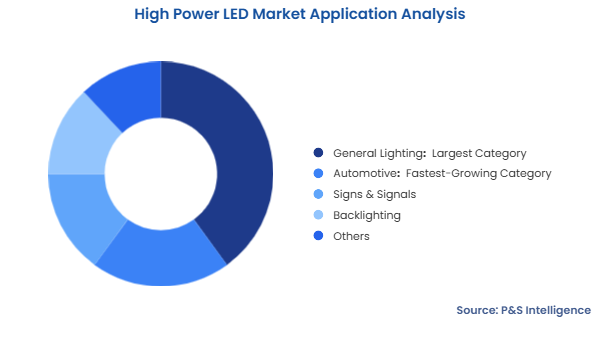
The applications analyzed in this report are:
- General Lighting (Largest Category)
- Automotive (Fastest-Growing Category)
- Signs & Signals
- Backlighting
- Others
Drive strategic growth with comprehensive market analysis
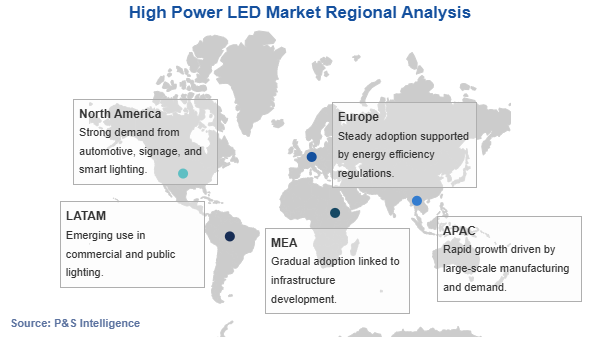
High Power LED Market Regional Outlook
Asia-Pacific High Power LED Market Size
Asia-Pacific holds the largest market share, of 40%, in 2025, and it will have the highest CAGR, of 6.4%, driven by its strong manufacturing base, rapid urbanization, and large-scale government-led energy efficiency initiatives. China plays a central role in this growth, supported by national green development policies and extensive lighting upgrades. Government-led energy efficiency programs have significantly contributed to electricity savings and reduced energy intensity across infrastructure and industrial sectors through widespread LED adoption.
In addition, supportive government policies and ongoing corporate innovation are accelerating market expansion across the region. In South Korea, national initiatives promoting high-efficiency equipment have encouraged broad LED adoption, with programs such as energy efficiency labeling and standards supporting reductions in overall energy consumption. Major companies such as Samsung Electronics continue to invest in next-generation LED technologies, particularly for automotive and display applications. Meanwhile, in Australia, the phase-out of inefficient lighting under initiatives led by the Australian Government Department of Climate Change, Energy, the Environment, and Water, including Minimum Energy Performance Standards (MEPS), has further accelerated LED adoption across residential and commercial sectors.
India High Power LED Market Size
India is one of the fastest-growing markets in the high power LED segment, driven by rapid urbanization, rising electricity demand, and strong policy support for energy efficiency and sustainable infrastructure. The country is steadily transitioning toward efficient lighting solutions through nationwide regulatory frameworks and electrification programs. High power LEDs are increasingly used across highways, industrial corridors, metro rail projects, and smart infrastructure where high-intensity and durable lighting is required.
In addition, several government-backed initiatives are accelerating LED adoption across multiple applications. Under the National Smart Grid Mission, investments are focused on modernizing power infrastructure and integrating energy-efficient technologies, including advanced lighting systems. The Saubhagya Scheme has achieved near-universal household electrification, connecting over 2.86 crore households and expanding the potential user base for LED lighting. Furthermore, energy efficiency measures under the Perform, Achieve and Trade Scheme have delivered cumulative energy savings of around 25.77 million tonnes of oil equivalent (Mtoe), reflecting the increasing focus on industrial efficiency and supporting the broader adoption of energy-efficient technologies. These initiatives, along with rising infrastructure investments, position India as a key high-growth market for high power LEDs.
Europe High Power LED Market Size
Europe holds a significant share in the high-power LED market, supported by stringent regulatory frameworks that promote energy efficiency and the ongoing replacement of conventional lighting systems across infrastructure and industrial sectors. The region also benefits from strong adoption in automotive and public infrastructure lighting, along with continuous advancements in high-performance LED technologies. In addition, increasing investments in smart city projects and sustainable urban development are accelerating the deployment of high-power LED lighting solutions across Europe. The European Union aims to achieve climate neutrality by 2050 under its Green Deal framework, as outlined by the European Commission, further accelerating the adoption of energy-efficient technologies such as LED lighting across member states.
According to the European Commission, lighting accounts for approximately 14% of total electricity consumption in the European Union, highlighting the strong regulatory focus on efficient lighting solutions. The EU’s Ecodesign and Energy Labelling regulations mandate the phase-out of inefficient lighting products, supporting the transition toward LED-based systems across member states. Furthermore, LED street lighting projects across European cities have demonstrated energy savings of up to 70% compared to conventional lighting, encouraging wider adoption in public infrastructure and smart city initiatives.
The regions and countries of the market are as follows:
- North America
- U.S. (Larger and Faster-Growing Country Market)
- Canada
- Europe
- Germany (Largest Country Market)
- U.K. (Fastest-Growing Country Market)
- France
- Italy
- Spain
- Rest of Europe
- Asia-Pacific (Largest and Fastest-Growing Regional Market)
- China (Largest Country Market)
- India (Fastest-Growing Country Market)
- Japan
- South Korea
- Australia
- Rest of APAC
- Latin America
- Brazil (Largest Country Market)
- Mexico (Fastest-Growing Country Market)
- Rest of LATAM
- Middle East and Africa
- Saudi Arabia (Largest Country Market)
- South Africa
- U.A.E. (Fastest-Growing Country Market)
- Rest of MEA
High Power LED Market Share
The market is fragmented, with a large number of global and regional players competing across key application areas such as outdoor lighting, automotive, and industrial use. The presence of multiple manufacturers offering differentiated products based on wattage, efficiency, and design contributes to intense competition. Continuous technological advancements and frequent product innovations further strengthen the competitive environment. Additionally, moderate entry barriers in high-power LED segments, particularly due to technological and thermal management requirements, still allow new players to enter the market, reinforcing its fragmented structure. While a few established companies hold notable shares, no single player dominates, resulting in a highly competitive and diverse industry landscape.
Top Companies in the High Power LED Market:
- Nichia Corporation
- Cree LED
- ams-OSRAM AG
- Samsung Electronics
- Lumileds Holding B.V.
- LG Innotek
- Seoul Semiconductor
- Everlight Electronics
- Ennostar Corporation
- Toyoda Gosei Co., Ltd.
- Stanley Electric Co., Ltd.
- Bridgelux, Inc.
High Power LED Market News
- In October 2025, ams-OSRAM AG and Nichia Corporation signed a comprehensive patent cross-license agreement covering thousands of innovations in LED and laser technologies, including advanced LED packages and modules such as matrix headlamp systems, strengthening collaboration in high-performance lighting solutions.
- In February 2025, Cree LED launched the XLamp XP-L Photo Red S Line LEDs, designed for high-efficiency horticulture lighting applications requiring high output and reliability.
- In February 2025, Lumileds Holding B.V. introduced the LUXEON HL2X-V LED, designed for high-output applications requiring improved brightness, thermal performance, and reliability.