Heavy-Duty EV Charging Infrastructure Market Size & Share Analysis - Trends, Drivers, Competitive Landscape, and Forecasts (2025 - 2032)
This Report Provides In-Depth Analysis of the Heavy-Duty EV Charging Infrastructure Market Report Prepared by P&S Intelligence, Segmented by Charger Type (DC Chargers, AC Chargers), Charging Speed (Fast Charging, Slow Charging), Power Output (Up to 350 kW, Above 350 kW), Charging Location (Private Depot Charging, Public/En-Route Charging), and Geographical Outlook for the Period of 2021 to 2032
Heavy-Duty EV Charging Infrastructure Market Size Estimation
Key Highlights
Study Period
2021 - 2032
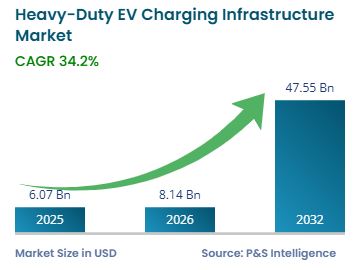
Market Size in 2025
USD 6.07 Billion
Market Size in 2026
USD 8.14 Billion
Market Size by 2032
USD 47.55 Billion
Projected CAGR
34.2%
Largest Region
Asia-Pacific
Fastest Growing Region
Asia-Pacific
Market Structure
Moderately Fragmented
Market Size
Explore the market potential with our data-driven report
Heavy-Duty EV Charging Infrastructure Market Overview
In 2025, the global heavy-duty EV charging infrastructure market size stood at USD 6.07 billion. The 2026 estimate is USD 8.14 billion, and revenue is projected to reach USD 47.55 billion by 2032 at a 34.2% CAGR for 2026-2032. Trucking companies, bus operators, ports, and logistics hubs are buying high-power charging systems to electrify vehicles without sacrificing route availability. This spending creates demand for chargers, controls, installation, and commissioning within a single site program.
Fleet electrification is moving charger purchases from small trials to network planning across depots and freight routes. The International Energy Agency reported that more than 70,000 public charging points could accommodate heavy-duty vehicles in 2025, although only 1,200 were verified as truck-dedicated. That gap directs near-term spending toward private sites while leaving room for specialized public stations. Suppliers that can coordinate power equipment, software, and construction can capture more value from each project and reduce commissioning risk for fleet buyers.
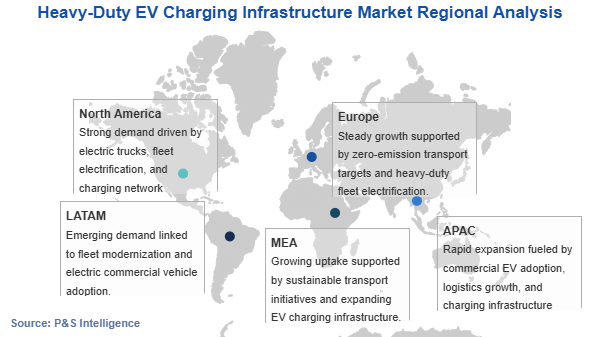
Asia-Pacific generated 42% of revenue in 2025. The region also has the fastest growth outlook through 2032. China anchors heavy-duty EV charging infrastructure demand through large electric truck and bus fleets, while India, Japan, South Korea, and Australia are adding depot and corridor projects. North America and Europe are concentrating more spending on fleet depots and freight corridors, while Latin America and the Middle East & Africa remain earlier-stage markets. Vendors with local grid partners and service coverage are best placed to convert policy support into installed sites.
Key market insights
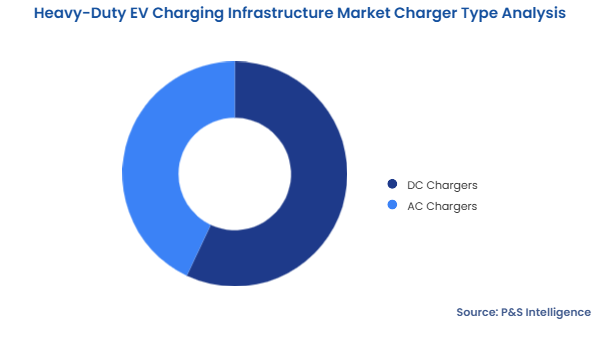
By charger type, DC chargers led the market in 2025, with a 38.1% CAGR forecast for 2026-2032.
By charging speed, fast charging held 57% of revenue in 2025, with a 38.5% CAGR forecast for 2026-2032.
By power output, up to 350 kW systems led revenue in 2025, while above 350 kW systems are projected to grow fastest during 2026-2032.
By charging location, private depot charging led revenue in 2025, while public/en-route charging is projected to grow fastest during 2026-2032.
By geography, Asia-Pacific held 42% of revenue in 2025 and has the fastest growth outlook for 2026-2032.
Heavy-Duty EV Charging Infrastructure Market Trends and Growth Drivers
Freight charging mandates are accelerating network investment
Governments are turning freight electrification goals into specific infrastructure buildouts, which gives charging operators and utilities deadlines for site acquisition, grid connections, and equipment orders. Heavy-Duty EV Charging Infrastructure Market growth follows because corridor rules require high-power assets in locations that private fleets may not fund alone. The direct buyers include service-area operators, energy companies, fleet consortia, and public authorities. Each mandated pool also creates demand for switchgear, charging controls, civil works, and long-term maintenance alongside the charger itself.
The Council of the European Union states that heavy-duty charging stations with at least 350 kW must be placed every 60 km on the core trans-European transport network and every 100 km on the comprehensive network, with full coverage due by 2030. Those spacing and power requirements convert policy into a measurable equipment pipeline. Suppliers that can secure suitable land and utility capacity early are more likely to win multi-site programs, while fleets gain confidence that electric trucks can move beyond closed depot routes.
Sparse freight corridors are opening a public charging opportunity
Long-haul fleets need charging sites where trucks can enter, park, and recharge during scheduled stops, yet large stretches of major freight routes still lack purpose-built facilities. This gap creates an opening for infrastructure suppliers to sell shared hubs that serve several carriers and improve equipment use compared with a single-fleet depot. Ports and distribution centers are attractive starting points because they concentrate vehicles, predictable dwell times, and freight customers within a small area. Developers that bundle land, power, and charging services can lower the commitment required from each fleet.
The U.S. Department of Energy announced USD 68 million in January 2025 for three high-power charging demonstrations near ports, distribution hubs, and major corridors. The selected concepts include pull-through truck stalls, megawatt-compatible charging, storage, on-site generation, and grid-management controls. These projects can give investors operating data for larger commercial networks, although demonstration funding alone does not guarantee broad deployment. Equipment makers that prove reliable performance under heavy daily use can use the results to shorten buyer qualification and attract private capital for repeat sites.
Megawatt charging is reshaping equipment design
Truck operators are asking for higher power so long-distance vehicles can add useful range within driver breaks instead of remaining idle for hours. Heavy-duty EV charging infrastructure industry trends are therefore shifting toward megawatt-class connectors, liquid-cooled cables, modular power cabinets, and site controls that can allocate capacity across several vehicles. The change expands supplier revenue per location, but it also raises expectations for thermal performance, interoperability, and uptime. Buyers increasingly favor systems that can begin with lower capacity and add power modules as vehicle volumes rise.
CharIN reports that the Megawatt Charging System is designed for Class 6, 7, and 8 commercial vehicles and supports charge rates above 1 MW. Its common connector and communication approach gives truck makers and charging suppliers a shared technical path, which reduces the risk of building incompatible sites. Standardized interfaces also make it easier for fleets to source vehicles and chargers from different vendors. Component suppliers that meet the required current, cooling, and safety demands can enter a higher-value portion of each charging installation.
Grid connection delays are constraining site deployment
High-power truck charging can add a large new electrical load at depots and corridor hubs, often before the local network has spare capacity. Developers may secure vehicles, land, and chargers but still postpone commissioning while utilities study connections, build substations, or reinforce feeders. The delay ties up capital and can force fleets to keep diesel vehicles longer than planned. It also favors well-funded developers that can manage multi-year power applications and pay for storage or on-site generation while waiting for a stronger grid connection.
The European Commission found that access to the electricity grid, including lengthy connection and permission procedures, is the primary barrier to a widespread heavy-duty charging network in the European Union. Its 2025 assessment also found that limited hosting capacity can restrict site size and slow both public hubs and private depots. Charging suppliers can reduce exposure by joining utility planning early and offering staged installations with active load management. Fleet buyers still face schedule risk when local network work falls outside the charging contractor's control.
Heavy-Duty EV Charging Infrastructure Market Segmentation Analysis
Charger Type
DC chargers led revenue in 2025 because heavy trucks and buses carry large batteries and operate against fixed route schedules. Moving conversion equipment off the vehicle allows the site to deliver more power than an onboard AC charger can typically accept. Fleet depots also prefer centralized equipment that can distribute power among several parking bays and support overnight charging plans. For suppliers, DC systems generate demand for power cabinets, cooling, switchgear, and energy controls as part of one installation.
DC chargers have the fastest growth outlook in this category through 2032. Electric truck deployments are expanding from short urban routes to regional and long-haul work, where charging time directly affects vehicle use. That shift raises orders for higher-current connectors and modular dispensers that can be upgraded without rebuilding an entire depot. AC chargers retain a role for buses and commercial vehicles with long dwell periods, but heavy-duty buyers direct most new capital toward DC equipment that can serve larger batteries.
Charging Speed
Fast charging led 2025 revenue because commercial fleets value vehicle availability more than the lowest possible charger rating. Buses, regional trucks, and coaches often return on schedules that leave limited time to replenish energy before the next duty cycle. Higher output lets operators serve more vehicles with each charging position and reduces the number of spare vehicles needed to cover charging time. Fast-charger spending therefore depends on fleet productivity, route adherence, and depot space.
Fast charging also has the highest growth outlook through 2032. Larger battery packs and longer routes increase the energy that vehicles must take on during a fixed break or depot window. Public hubs also need rapid turnover to earn revenue from expensive land and grid connections. Vendors that combine high output with power sharing can serve mixed arrival times without sizing every bay for peak demand, giving fleet operators a practical route to expand charging capacity as vehicle counts increase.
Power Output
Systems rated up to 350 kW led revenue in 2025 because they cover many bus, delivery, refuse, and regional-haul charging schedules with equipment already familiar to fleets and installers. This range can support overnight and mid-shift charging while keeping site demand below the levels associated with multiple megawatt-class bays. Buyers can also deploy more charging positions within a fixed utility connection by scheduling loads across the depot. Suppliers benefit from a broad addressable base that includes both early fleet conversions and larger phased rollouts.
Above 350 kW systems are expected to expand fastest through 2032 as electric trucks move into routes that cannot rely on long depot dwell times. The higher-output category includes equipment from 350 kW to 1 MW and systems above 1 MW, giving developers a path from current fast charging to megawatt-class service. Demand rises where drivers must add substantial range during regulated breaks or loading stops. Vendors that offer modular power blocks and upgradeable dispensers can sell initial capacity sooner and add output as compatible trucks enter the fleet.
Charging Location
Private depot charging generated the most revenue in 2025 because fleets can match charging to known routes, parking times, and vehicle assignments. Depot sites also let operators control access, electricity purchasing, maintenance, and charger availability without depending on a public network. Buses and return-to-base trucks are especially suited to scheduled overnight or opportunity charging. The commercial advantage goes to providers that can integrate chargers with fleet dispatch and load management, since buyers measure success through vehicles ready for service each day.
Public/en-route charging is set to grow fastest through 2032 as electric trucks take on longer routes and smaller fleets seek access without funding a dedicated depot. The European Alternative Fuels Observatory counted 373 operational European locations meeting the 350 kW heavy-duty criterion in April 2026, including mixed-use and truck-exclusive sites. Wider corridor coverage increases the value of electric trucks for irregular routes and multi-day work. Charging operators that offer pull-through layouts, reliable reservations, and space for trailers can attract recurring fleet use where depot-only charging cannot complete the journey.
The following categories have been analyzed in this report:
Charger Type
DC Chargers
AC Chargers
Charging Speed
Fast Charging
Slow Charging
Power Output
Up to 350 kW
Above 350 kW
Charging Location
Private Depot Charging
Public/En-Route Charging
Drive strategic growth with comprehensive market analysis
Heavy-Duty EV Charging Infrastructure Market Geographical Analysis
Asia-Pacific Heavy-Duty EV Charging Infrastructure Market growth
Asia-Pacific led global revenue in 2025. The region has the fastest growth outlook through 2032. China anchors demand through large electric truck and bus fleets, dense logistics clusters, and domestic suppliers of charging hardware and grid equipment. India is adding charging at ports and priority highways, while Japan, South Korea, and Australia are building around bus depots, urban freight, and early corridor projects. The regional advantage comes from pairing new vehicle deployments with charging sites instead of retrofitting every location later.
China's State Council reported that the country had nearly 17.35 million EV charging facilities by August 2025 and set a target of 28 million by the end of 2027. The plan covers all EV classes, yet its expressway upgrades, higher public capacity, and wider grid coverage provide a base for heavy-duty installations. Asia-Pacific's Heavy-Duty EV Charging Infrastructure Market share should stay elevated as Chinese fleet volumes support scale, while projects elsewhere diversify demand. Suppliers still need local service teams and utility partners to convert national plans into reliable truck and bus sites.
North America contributes a developed base of depot projects and an emerging network of public freight hubs. United States demand centers on ports, distribution corridors, school and transit bus depots, and large private fleets with predictable routes. Canada adds projects around urban transit and major freight lanes, where cold-weather performance and long distances shape equipment choices. Buyers commonly phase installations by fleet batch, which favors modular chargers and site designs that reserve electrical capacity for later expansion.
The Joint Office of Energy and Transportation set out a four-phase U.S. corridor strategy that begins with freight hubs, then connects hubs, expands corridor links, and finishes with a national network. This sequence directs early orders toward places with concentrated truck activity and better project economics. North American vendors can win by coordinating utilities, fleets, and property owners before vehicles arrive. Expansion could slow where interconnection timelines or policy changes delay public support, making private depot economics and repeat fleet orders especially important.
Europe combines regulated corridor deployment with a large need to electrify private truck and bus depots. Germany, the Netherlands, Sweden, and France are early centers for high-power public sites, while the United Kingdom, Spain, and Italy add national and fleet-led programs. Cross-border freight makes connector compatibility, payment access, and dependable uptime especially valuable. Suppliers must serve both scheduled depot charging and public stops designed around trailers, driver breaks, and limited parking space.
The European Automobile Manufacturers' Association reported in September 2025 that depot charging is central to heavy-duty electrification and cited one fleet's experience deploying more than 4,000 charging points. That installed experience encourages repeat purchasing, although grid access and capital needs still limit the speed of site delivery. Europe should remain a major equipment market as corridor requirements and fleet replacement work together. Vendors with scalable depot systems and local construction partners are positioned to benefit, provided they can manage grid applications and maintain chargers across multiple countries.
Latin America remains earlier in commercial fleet electrification, with bus programs providing the clearest route to charging orders. Brazil, Mexico, Chile, and Colombia have urban fleets that return to depots and can support centralized infrastructure before a public truck network develops. Electricity planning, financing, and imported-equipment costs influence project timing more than connector availability. Suppliers often need to combine charging hardware with engineering, training, and financing support so cities and fleet operators can place vehicles and infrastructure into service together.
Brazil's Energy Research Office projected 48,500 electrified buses and a fleet of 43,000 electric and hybrid trucks by 2035, while warning that charging demand must enter power-system and tariff planning. Those vehicle additions would create a growing base for depot equipment, controls, and grid connections. Regional growth is likely to advance city by city through bus renewals, delivery fleets, and port logistics. Providers that build local maintenance capability and work with development lenders can reduce the execution risk that otherwise separates vehicle awards from usable charging sites.
Middle East & Africa accounts for a smaller share of global revenue, with activity concentrated in Gulf cities and selected South African fleet projects. The U.A.E. and Saudi Arabia can support high-power sites through planned urban networks and logistics investment, while South Africa offers demand around municipal fleets, mines, ports, and regional freight. Egypt and Nigeria remain more dependent on pilot programs and power availability. Early buyers favor projects that combine chargers with energy management because site reliability can matter more than broad public coverage.
The Abu Dhabi Department of Energy launched an initiative in January 2026 to install more than 50 chargers rated at 360 kW across strategic locations. The program serves the wider EV base, but it demonstrates regional investment in high-power equipment, operating software, and regulated public charging. Heavy-duty demand can build from this foundation as buses and commercial fleets electrify. Suppliers that adapt systems for heat, dust, and variable grid conditions have a clearer path to repeat orders than vendors offering hardware without local service.
The following geographies have been analyzed in this report:
North America
U.S.
Canada
Asia-Pacific
China
India
Japan
South Korea
Australia
Rest of Asia-Pacific
Europe
Germany
U.K.
France
Netherlands
Sweden
Spain
Italy
Rest of Europe
Latin America
Brazil
Mexico
Argentina
Chile
Colombia
Rest of Latin America
Middle East & Africa
U.A.E.
Saudi Arabia
South Africa
Egypt
Nigeria
Rest of Middle East & Africa
Heavy-Duty EV Charging Infrastructure Market Competitive Landscape
The Heavy-Duty EV Charging Infrastructure Market is moderately fragmented because buyers need different combinations of power hardware, dispensers, software, installation, and site operation. Global electrical-equipment groups compete with charging specialists, vehicle makers, public-network operators, and regional engineering firms. No single supplier can address every depot, corridor, bus, and port use case with the same commercial model. The structure is evolving as megawatt charging raises qualification costs and large multi-site tenders reward vendors that can finance equipment, coordinate utilities, and support fleets across borders.
ABB Ltd., Siemens AG, and Schneider Electric SE sit within the electrical-equipment cluster, where buyers value power-distribution expertise and the ability to package chargers with site infrastructure. Kempower Oyj, ChargePoint Holdings Inc., and Blink Charging Co. represent charging-focused vendors that compete through modular systems, software, channel partners, and fleet relationships. Tesla, Inc. adds a vehicle-linked route to heavy-truck charging. Across these groups, suppliers compete on uptime, interoperability, usable power under sustained loads, commissioning speed, and service response.
Entry barriers rise sharply above the charger level because suppliers must prove connector safety, thermal performance, software reliability, and compatibility with vehicles from several manufacturers. Projects also require contractors, utility approvals, civil works, and financing, which gives established groups an advantage on large depot and corridor programs. Smaller specialists can still win by serving a narrow fleet type or region and partnering for power equipment and construction. Buyers benefit from vendor choice, but they must evaluate lifecycle support and expansion capacity alongside the initial hardware price.
Key Players in the Heavy-Duty EV Charging Infrastructure Market:
ABB Ltd.
Siemens AG
Kempower Oyj
Tesla Inc.
ChargePoint Holdings Inc.
Schneider Electric SE
Blink Charging Co.
EVgo Services LLC
Efacec Electric Mobility S.A.
State Grid Corporation of China
Qingdao TGOOD Electric Co. Ltd.
Heliox B.V.
Heavy-Duty EV Charging Infrastructure Market Developments
In July 2026, Kempower Oyj began customer deliveries of the Mega Satellite Flex, which supports up to 560 kW through CCS and 1.2 MW through MCS. The dual-connector dispenser lets operators serve current fleets while preparing the same charging position for megawatt-capable trucks.
In May 2026, ChargePoint Holdings Inc. partnered with a parts distributor to supply fast-charging hardware, software, and services to North American transit agencies operating E2 and ZX5 Phoenix electric buses. The agreement gives bus operators a combined route for charging equipment, telematics, replacement parts, and fleet support.
In April 2026, Tesla Inc. began deploying public Megachargers alongside its Semi production ramp, including its first public site in Southern California. The deployment extends truck charging beyond customer depots and creates an initial corridor asset for the company's battery-electric truck program.
In October 2025, Siemens AG launched the SICHARGE FLEX system at Busworld in Brussels with dynamic output from 80 kW to 1.68 MW per charging point. Support for CCS and MCS allows depot and public-site operators to serve buses, trucks, and passenger vehicles from one modular power platform.
Frequently Asked Questions About This Report
What is the heavy-duty EV charging infrastructure market size?+
The 2026 estimate is USD 8.14 billion, and revenue is projected to reach USD 47.55 billion by 2032 at a 34.2% CAGR for 2026-2032.
Why are freight charging mandates driving market growth?+
The direct buyers include service-area operators, energy companies, fleet consortia, and public authorities. Each mandated pool also creates demand for switchgear, charging controls, civil works, and long-term maintenance alongside the charger itself.
Which region leads the heavy-duty EV charging infrastructure market?+
Asia-Pacific has the fastest growth outlook through 2032. China anchors demand through large electric truck and bus fleets, dense logistics clusters, and domestic suppliers of charging hardware and grid equipment.
What is changing heavy-duty charging equipment design?+
Heavy-duty EV charging infrastructure industry trends are therefore shifting toward megawatt-class connectors, liquid-cooled cables, modular power cabinets, and site controls that can allocate capacity across several vehicles.
Want a report tailored exactly to your business need?
Leading companies across industries trust us to deliver data-driven insights and innovative solutions for their most critical decisions. From data-driven strategies to actionable insights, we empower the decision-makers who shape industries and define the future. From Fortune 500 companies to innovative startups, we are proud to partner with organisations that drive progress in their industries.
Client Testimonials
Working with P&S Intelligence and their team was an absolute pleasure – their awareness of timelines and commitment to value greatly contributed to our project's success. Eagerly anticipating future collaborations.
McKinsey & Company
India
Unmatched Standards
Our insights into the minutest levels of the markets, including the latest trends and competitive landscape, give you all the answers you need to take your business to new heights
Complete Data Security
We take a cautious approach to protecting your personal and confidential information. Trust is the strongest bond that connects us and our clients, and trust we build by complying with all international and domestic data protection and privacy laws