Healthcare Information System Market Size & Opportunities Analysis - Growth Strategies, Competitiveness, and Forecasts (2026 - 2032)
This Report Provides In-Depth Analysis of the Healthcare Information System Market Report Prepared by P&S Intelligence, Segmented by System Type (Revenue Cycle Management (RCM), Patient Information System (PIS), Laboratory Information System (LIS), Pharmacy Information System, Medical Imaging Information System, Clinical Decision Support Systems (CDSS), Electronic Prescribing Systems, Telehealth/Telemedicine Solutions), Component (Software, Hardware, Services), Deployment Mode (On-Premises, Cloud/ Web-Based), End User (Hospitals & Amulatory Services, Diagnostic Centers, Academic & Research Institutes), and Geographical Outlook for the Period of 2019 to 2032
Healthcare Information System Market Revenue Scope
Key Highlights
Study Period
2019 - 2032
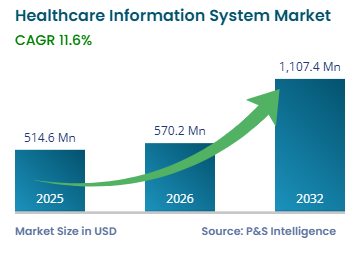
Market Size in 2025
USD 514.6 Million
Market Size in 2026
USD 570.2 Million
Market Size by 2032
USD 1107.4 Million
Projected CAGR
11.6%
Largest Region
North America
Fastest-Growing Region
Asia-Pacific
Market Structure
Semi-Consolidated
Market Size
Explore the market potential with our data-driven report
Healthcare Information System Market Outlook
The healthcare information systems market size will be an estimated USD 514.6 billion for 2025, and it will grow by 11.6% during 2026–2032, to reach USD 1,107.4 billion by 2032.
The growth of the market is driven by increasing adoption of digital healthcare solutions, rising burden of chronic diseases, and growing government initiatives to modernize healthcare infrastructure globally.
The surging prevalence of noncommunicable diseases is creating significant demand for healthcare information systems that enable better disease management and patient monitoring. According to the WHO, noncommunicable diseases kill at least 43 million people annually, equivalent to 75% of non-pandemic-related deaths globally. This massive disease burden necessitates efficient data management systems that can track patient information, facilitate coordinated care, and support clinical decision-making across healthcare settings.
The demographic shift toward aging populations is another major growth driver for the market. According to the WHO, by 2030, one in six people in the world will be aged 60 years or over, with the share of the population aged 60 years and over increasing from 1 billion in 2020 to 1.4 billion. Older populations require more complex and coordinated healthcare services, making integrated information systems essential for managing multi-morbidity, medication regimens, and long-term care needs effectively.
Furthermore, government policies and regulations worldwide are accelerating the adoption of healthcare information technology. Europe's creation of the European Health Data Space is enabling seamless cross-border use of electronic health records for care and research. Such initiatives are boosting the use of secure and connected healthcare IT systems that help hospitals and clinics share and manage patient data more efficiently.
Healthcare Information System Market Growth Factors
Rising Adoption of Cloud-Based Solutions Is Key Trend
Cloud-based deployment of healthcare information systems is witnessing rapid growth as healthcare organizations seek scalable, cost-effective, and accessible solutions.
Cloud technology enables healthcare organizations to store and manage vast amounts of patient data securely while improving accessibility and collaboration among healthcare professionals.
The flexibility of cloud infrastructure supports scalability, reducing the need for costly on-premise hardware and maintenance.
Healthcare providers can access critical patient information from any location with internet connectivity, fostering more agile and efficient workflows.
Cloud solutions also allow for seamless integration with electronic health records and telemedicine platforms, ensuring real-time data sharing among healthcare professionals.
For instance, in August 2021, Change Healthcare introduced its cloud-based software as a service solution, Change Healthcare Stratus Imaging PACS, tailored for radiological practices.
Globally, national health authorities are embedding cloud-native architectures into their digital health strategies to improve accessibility, interoperability, and resilience.
For example, Malawi’s Ministry of Health designated its National Digital Health Information System (NDHIS) as a cloud-native system to support universal health coverage.
The European Health Data Space initiative provides a legal and technical framework across EU Member States for secure, interoperable electronic health data exchange, which heavily relies on cloud-based infrastructures.
The lower infrastructure requirements compared to on-premise systems support faster adoption, particularly in emerging markets and among small to medium-sized healthcare facilities.
Additionally, cloud-based systems offer better disaster recovery capabilities and automatic updates, making them increasingly attractive to healthcare organizations seeking to modernize their IT infrastructure.
Government Support and Technological Advancements Propel Market Advance
The integration of artificial intelligence and machine learning into healthcare information systems, supported by government initiatives and digital health policies, is revolutionizing clinical decision-making and accelerating healthcare digitalization.
AI-driven tools embedded in HIS enable predictive analytics, early disease detection, and personalized treatment recommendations.
Natural language processing capabilities reduce documentation burden by automatically generating clinical notes, thereby decreasing administrative workload for healthcare providers.
AI-powered systems can analyze large datasets to forecast resource needs, optimize workflow efficiency, and identify patterns that improve patient outcomes.
For instance, in April 2023, Microsoft extended its strategic partnership with Epic to integrate and develop generative AI into healthcare through the combination of Azure OpenAI Service and Epic's advanced EHR software.
Clinical decision support systems enhanced with AI provide evidence-based recommendations at the point of care, helping clinicians make more informed decisions quickly.
This technological advancement is transforming patient care delivery with faster and more accurate diagnosis capabilities, thereby accelerating market growth.
The WHO Global Strategy on Digital Health (2020–2025) urges countries to develop national plans, allocate budgets, and build digital capacity, signaling that technology and data are now considered essential parts of healthcare systems.
As a result, many countries are aligning resources and long-term strategies with this direction, creating a durable foundation for market expansion.
National regulations are mandating the adoption of interoperable electronic health record systems and secure data exchange platforms.
These regulatory requirements create strong demand for compliant healthcare information systems that meet data privacy standards while enabling information sharing across the healthcare ecosystem.
In developing nations, ministries of health view digital transformation as essential for improving healthcare access and efficiency.
International organizations and development partners are channeling funds toward national digital health platforms, ensuring sustained market growth and global commitment to healthcare IT modernization.
Healthcare Information System Market Segmentation Analysis
System Type Analysis
The revenue cycle management category holds the largest market share, of 60%, in 2025. This dominance is attributed to the healthcare industry's rapid movement toward digitalization, creating strong demand for advanced RCM solutions. The growth in medical facilities is driven by increasing demand for workflow optimization through synchronized management software systems.
Healthcare organizations face complex challenges with data silos and unorganized workflows, leading to inefficiencies in billing and reimbursement processes. Revenue cycle management systems address these issues by streamlining financial operations from patient registration through final payment collection. The increasing number of payers, payment models, regulatory guidelines, and coding requirements necessitates sophisticated RCM solutions.
The patient information system category will have the highest CAGR, of 11.9%, as rising adoption in hospitals aims to boost operational efficiency, refine clinical workflows, and reduce overall healthcare expenditures. Hospital information systems integrate clinical, administrative, and financial data into unified platforms, enabling better coordination across departments. The rising awareness regarding advanced medical services and the need for enhanced patient care quality are key factors driving segment growth. Electronic health records, electronic medical records, and population health management capabilities within HIS are particularly in demand as healthcare systems transition toward patient-centric, value-based care delivery models. The global electronic health record market is set to generate USD 40.4 billion by 2030, hinting at a huge growth opportunity in this market category.
The system types analyzed in this report are:
Revenue Cycle Management (RCM) (Largest Category)
Patient Information System (PIS) (Fastest-Growing Category)
Electronic Health Records (EHR)
Electronic Medical Records (EMR)
Population Health Management
Patient Engagement Solutions
Others
Laboratory Information System (LIS)
Pharmacy Information System
Medication Dispensing System
Packaging & Labeling System
Storage & Retrieval System
Automated Medication Compounding System
Others
Medical Imaging Information System
Picture Archiving and Communication Systems (PACS)
Radiology Information Systems (RIS)
Others
Clinical Decision Support Systems (CDSS)
Electronic Prescribing Systems
Telehealth/Telemedicine Solutions
Component Analysis
The services category holds the largest market share, of 45%, in 2025. This dominance reflects the complex nature of HIS implementation and the ongoing support required to maintain system effectiveness. Healthcare organizations require extensive services, including system installation, data migration from legacy systems, staff training, and continuous technical support. The integration of new solutions such as population health management, genomics, and digital behavioral health platforms onto existing infrastructure requires specialized expertise that only service providers can deliver.
The software category will have the highest CAGR, of 11.8%, driven by the increasing need to reduce healthcare costs and improve data management capabilities across healthcare settings. The rising adoption of healthcare information systems, such as revenue cycle management and electronic health records, is increasing demand for advanced software solutions. Cloud-based software platforms are gaining particular traction due to their scalability, ease of updates, and lower upfront costs compared to traditional on-premise installations.
The components analyzed in this report are:
Software (Fastest-Growing Category)
Hardware
Services (Largest Category)
Deployment Mode Analysis
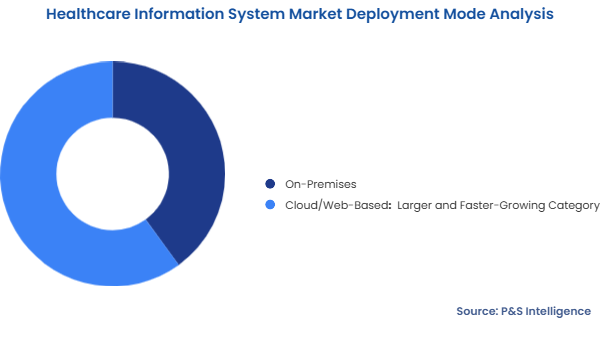
The cloud/web-based category holds the larger market share in 2025, and it will have the higher CAGR during the forecast period. Web-based and cloud-based systems are favored for their accessibility, cost efficiency, and scalability. They allow healthcare professionals to access patient data remotely, reducing hardware costs and enabling easy scalability as organizational needs grow. These deployment modes facilitate the integration of various healthcare technologies, enhancing operational efficiency and enabling real-time data sharing across facilities and care settings.
Small and medium healthcare organizations particularly favor web-based and cloud platforms to optimize overall workflow processes. Cost-effective development, the benefit of remote access based on internet availability, and simple installation and maintenance are important factors driving adoption. Cloud-based technology usage has surged in recent years due to improved security measures addressing previous concerns about data breaches. Healthcare organizations require secure, compliant platforms for handling sensitive patient information, and modern cloud providers now offer robust security features, including encryption, multi-factor authentication, and regular security audits.
The deployment modes analyzed in this report are:
On-Premises
Cloud/Web-Based (Larger and Faster-Growing Category)
End User Analysis
The hospitals & ambulatory services category holds the largest market share, of 75%, in 2025. This substantial dominance reflects the critical need for comprehensive information systems in hospital settings to manage high patient volumes and complex clinical workflows. Hospitals deploy electronic health records, clinical decision support systems, and revenue cycle management tools to streamline operations and improve care quality. Advanced interoperability solutions are increasingly adopted by hospitals to enable seamless data exchange between departments and across multi-facility health systems.
Moreover, the growing complexity of healthcare delivery, coupled with regulatory requirements for electronic documentation and reporting, makes sophisticated HIS essential for hospital operations.
The diagnostics centers category will have the highest CAGR, of 12.0%, driven by the rising demand for diagnostic services due to the increasing prevalence of chronic diseases among the global population. The growing need for automation and integration of healthcare information to enable efficient patient care is accelerating adoption in this segment. Laboratory information systems that optimize test processing, specimen handling, and result reporting are particularly in demand at diagnostic centers.
Drive strategic growth with comprehensive market analysis
Healthcare Information System Market Geographical Analysis
North America Healthcare Information Systems Market Size
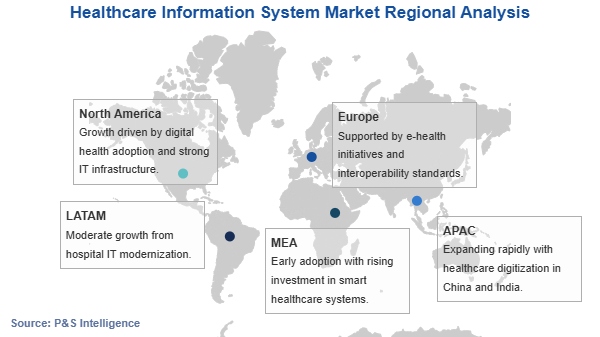
North America holds the largest market share, of 45%, in 2025. This leadership is primarily attributed to well-established healthcare IT infrastructure, high healthcare expenditure, and the presence of major technology vendors in the region. Robust government initiatives and regulatory frameworks are driving HIS adoption across North American healthcare facilities. Federal mandates such as the 21st Century Cures Act require healthcare providers to implement systems that enable secure data sharing and patient access to health information. Large-scale private investments and public-private collaborations have also triggered the adoption of innovative digital health solutions.
Healthcare organizations in the region are embracing consolidated platforms that integrate clinical, financial, and operational information. The swift adoption of artificial intelligence-powered solutions and advanced cybersecurity measures is particularly notable in North America. Major healthcare systems are partnering with technology companies to implement AI-driven clinical decision support and predictive analytics capabilities.
U.S. Healthcare Information Systems Market Size
The U.S. market has a significant market share in the North American healthcare information systems market. The U.S. healthcare system, valued at USD 4.9 trillion in 2023, corresponding to 17.6% of GDP, as per the Centers for Medicare and Medicaid Services (CMS), demonstrates the region's substantial capacity to invest in advanced HIS solutions. Additionally, the ongoing transition toward value-based care models and large-scale investments in healthcare IT infrastructure are expected to further accelerate market expansion across the U.S.
Asia-Pacific Healthcare Information Systems Market Size
Asia-Pacific will have the highest CAGR, of 11.7%, driven by increasing healthcare spending, large patient populations, and accelerating digitalization of healthcare infrastructure. Governments across Asia-Pacific countries are implementing national digital health strategies and investing in healthcare IT modernization to improve access and quality of care.
The rising burden of chronic diseases in Asia-Pacific is creating an urgent need for integrated healthcare information systems. Population growth combined with aging demographics is placing a significant strain on healthcare systems, necessitating efficient IT solutions for patient management and care coordination. Countries such as China, India, Japan, and South Korea are making substantial investments in healthcare infrastructure, including deployment of electronic health record systems, across public and private healthcare facilities.
Furthermore, the improving internet connectivity and smartphone penetration across the region are supporting the adoption of cloud-based HIS and telemedicine platforms. Many Asia-Pacific countries are leveraging mobile health applications to extend healthcare access to rural and underserved populations. International technology vendors are increasingly focusing on the Asia-Pacific market, establishing local partnerships and developing solutions tailored to regional needs.
Japan Healthcare Information Systems Market Size
Japan holds a significant share in the Asia-Pacific Healthcare Information Systems market, driven by its advanced healthcare infrastructure and strong government support for digitalization. The Ministry of Health, Labour and Welfare has implemented several initiatives, including the Medical Information System Development Guidelines and Japan Vision: Health Care 2035, to promote nationwide interoperability and data-driven healthcare. The country’s high adoption rate of electronic medical records (EMR) and hospital information systems reflects its mature healthcare IT environment.
The integration of artificial intelligence and cloud-based platforms is expanding rapidly, supported by Japan’s robust ICT infrastructure. In addition, collaborations between leading technology companies such as Fujitsu, NEC, and Microsoft Japan with healthcare institutions are strengthening the digital ecosystem, positioning Japan as one of the most advanced and influential HIS markets in the Asia-Pacific region.
The regions and countries analyzed in the market are as follows:
North America (Largest Regional Market)
U.S. (Larger and Faster-Growing Country)
Canada
Europe
Germany (Largest Country)
U.K. (Fastest-Growing Country)
France
Italy
Spain
Rest of Europe
Asia-Pacific (Fastest-Growing Regional Market)
China (Largest Country)
India (Fastest-Growing Country)
Japan
South Korea
Australia
Rest of APAC
Latin America
Brazil (Largest Country)
Mexico (Fastest-Growing Country)
Rest of LATAM
Middle East and Africa
Saudi Arabia (Largest Country)
South Africa
U.A.E. (Fastest-Growing Country)
Rest of MEA
Healthcare Information System Market Share
The market is semi-consolidated, characterized by the presence of several major players alongside numerous regional and specialized vendors. While the market remains competitive and diverse, leading companies are expanding their market presence through continuous product innovation, strategic partnerships, and mergers and acquisitions. Vendors are increasingly focusing on cloud-based platforms, artificial intelligence integration, and enhanced cybersecurity features to meet evolving customer demands. Additionally, the industry is witnessing both horizontal and vertical integration, as key players broaden their solution portfolios across multiple HIS categories, reflecting a gradual shift toward consolidation amid ongoing technological advancement.
Key Healthcare Information System Companies:
Epic Systems Corporation
Oracle Corporation
McKesson Corporation
GE HealthCare
Koninklijke Philips N.V.
Siemens Healthineers
Veradigm LLC
athenahealth Inc.
NextGen Healthcare Inc.
Medical Information Technology, Inc.
Agfa-Gevaert Group
Infor, Inc.
Dedalus Group
Optum, Inc.
eClinicalWorks
Healthcare Information System Market News
In January 2025, Sutter Health and GE HealthCare Technologies Inc. formed a seven-year strategic partnership in California to advance diagnostic imaging services using AI-powered technology, aiming to improve patient outcomes through better diagnostic accuracy.
In December 2024, Koninklijke Philips N.V. expanded its partnership with Sim&Cure S.A.S. to enhance brain aneurysm treatments by integrating Sim&Size software into its Azurion platform, enhancing procedure efficiency and precision for neurovascular specialists.
In October 2024, athenahealth Inc. introduced Ambient Notes, a new AI-powered solution designed for ambulatory practices that integrates seamlessly into clinical workflows, streamlining documentation and enhancing clinician-patient interactions.
In February 2024, Oracle Corporation launched the Identity Governance integration for Oracle Health HER, enabling healthcare organizations to manage user access, synchronize data, and enhance security and operational efficiency.
Want a report tailored exactly to your business need?
Leading companies across industries trust us to deliver data-driven insights and innovative solutions for their most critical decisions. From data-driven strategies to actionable insights, we empower the decision-makers who shape industries and define the future. From Fortune 500 companies to innovative startups, we are proud to partner with organisations that drive progress in their industries.
Client Testimonials
Working with P&S Intelligence and their team was an absolute pleasure – their awareness of timelines and commitment to value greatly contributed to our project's success. Eagerly anticipating future collaborations.
McKinsey & Company
India
Unmatched Standards
Our insights into the minutest levels of the markets, including the latest trends and competitive landscape, give you all the answers you need to take your business to new heights
Complete Data Security
We take a cautious approach to protecting your personal and confidential information. Trust is the strongest bond that connects us and our clients, and trust we build by complying with all international and domestic data protection and privacy laws