Healthcare Automation Market Size Forecast
Key Highlights
| Study Period | 2021 - 2032 |
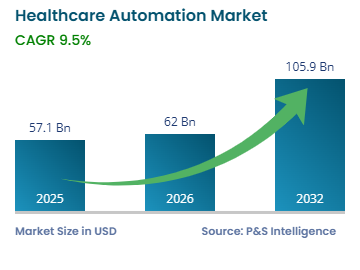
| Market Size in 2025 | USD 57.1 Billion |
| Market Size in 2026 | USD 62.0 Billion |
| Market Size by 2032 | USD 105.9 Billion |
| Projected CAGR | 9.5% |
| Largest Region | North America |
| Fastest-Growing Region | APAC |
| Market Structure | Fragmented |
Market Size
Explore the market potential with our data-driven report
Healthcare Automation Market Key Insights
- Solutions represent the larger component, holding a market share of 75%, used to administer clinical workflows.
- Robotic systems and service robots are the largest automation with 45% share, enhancing overall surgical precision.
- Diagnostics and monitoring are the largest application, holding 40% share for analysing complex imaging data.
- Hospitals and health systems represent the largest end user category, requiring extensive automation to coordinate diagnostics.
- North America holds the largest regional share, integrating automation into hospital operations, diagnostics, and pharmacy management.
Healthcare Automation Market Future Outlook
The healthcare automation market size was USD 57.1 billion for 2025, and it will grow by 9.5% during 2026–2032, to reach USD 105.9 billion by 2032.
The market is expanding as medical facilities face mounting pressure to manage rapidly increasing patient volumes. Hospitals require advanced automation technologies, including artificial intelligence and robotics, to streamline administrative tasks and optimise complex clinical workflows. According to the World Health Organisation, the global shortage of health workers stood at 14.7 million in 2023, exacerbating severe workload constraints. As a result, healthcare providers increasingly rely on connected devices and automated systems to maintain care delivery and improve overall operational efficiency.
Healthcare Automation Market Emerging Trends & Growth Drivers
Shift to AI-Driven Clinical and Administrative Automation Is Major Trend
Healthcare is evolving from simple task automation toward advanced decision-support systems that analyse complex clinical data and provide actionable insights for medical professionals. Hospitals increasingly deploy artificial intelligence for automated medical image reviews, patient triage, scheduling, and medical billing processes to improve efficiency and accuracy. According to the World Health Organisation, approximately 1.3 billion people worldwide lived with a significant disability in 2024, increasing the need for accessible and continuously monitored healthcare services. Consequently, providers are integrating automation platforms with electronic health records and remote monitoring devices to eliminate manual data entry and streamline clinical workflows. Vendors are therefore developing unified platforms combining robotic hardware, intelligent software, and connected healthcare devices.
Rising Pressure to Reduce Workload and Operational Costs Drives Market
Hospitals and clinics continuously expand their clinical services, while simultaneously facing severe staffing shortages and rising operational costs. Routine administrative functions, including patient registration, medical billing, and laboratory scheduling, require massive manual intervention from overwhelmed personnel. Furthermore, according to the Organisation for Economic Co-operation and Development, member nations spent 9.3% of their gross domestic product on healthcare in 2024. Consequently, administrators increasingly implement intelligent automation to successfully accelerate daily workflows, significantly control operational costs, and empower remaining medical staff.
Healthcare Automation Market Segmentation Analysis
Component Analysis
Solutions represent the larger category, holding a market share of 75%. Healthcare institutions increasingly utilise automation platforms to manage clinical workflows, diagnostics, pharmacy operations, and hospital logistics. These systems help healthcare providers process large volumes of diagnostic data and streamline routine clinical processes. According to the World Health Organisation, an estimated 10.8 million people fell ill with tuberculosis globally in 2023. The high burden of infectious diseases significantly increases diagnostic testing and case management workloads, encouraging healthcare facilities to adopt digital automation technologies to improve efficiency and reduce manual intervention.
Services represent the faster-growing category, during the forecast period. Healthcare entities require continuous assistance from external experts to properly implement and manage complex automation platforms. Many hospitals lack the internal technical expertise necessary to complete system integrations or maintain secure IT infrastructures. According to the World Health Organisation, 129 countries had officially implemented national digital health strategies by 2024. As governments increasingly mandate technological adoption, rising system complexity directly drives demand for professional consulting and managed services.
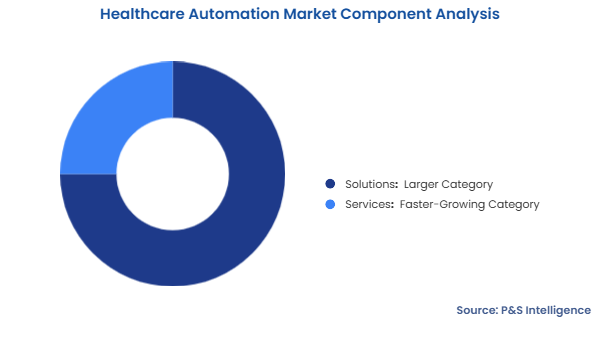
The components analysed in this report are:
- Solutions (Larger Category)
- Pharmacy Automation Systems
- Laboratory Automation Systems
- Medical Imaging and Diagnostic Automation
- Surgical and Therapeutic Automation Systems
- Clinical Workflow and Hospital Process Automation
- Healthcare Supply Chain and Logistics Automation
- Services (Faster-Growing Category)
- Consulting and Automation Strategy Services
- System Integration and Implementation
- Training and Education Services
- Maintenance and Technical Support
- Managed Automation Services
Automation Technology Analysis
Robotic systems and service robots are the largest category, holding a market share of 45%. Healthcare organisations increasingly utilise robotic technologies to enhance surgical precision, reduce human errors, and automate repetitive physical tasks. Hospitals also deploy robotic systems to streamline pharmacy dispensing and manage hospital logistics efficiently. According to the International Federation of Robotics, global sales of professional service robots exceeded 205,000 units in 2023. This proven clinical value continues to accelerate robotic automation adoption across hospitals and specialised healthcare facilities.
Artificial intelligence–driven automation is the fastest-growing category, during the forecast period. Healthcare organisations rapidly adopt AI-powered platforms to analyse large volumes of clinical data and assist with complex medical diagnostics. Medical professionals increasingly rely on these intelligent systems to automate decision support and optimise patient care pathways. According to the World Economic Forum, a typical hospital generated approximately 50 Petabytes of healthcare data in 2024. As medical data volumes continue to expand, healthcare facilities require AI-powered analytical tools to accelerate diagnosis and improve patient outcomes.
The automation technologies analysed in this report are:
- Robotic Systems and Service Robots (Largest Category)
- Artificial Intelligence–Driven Automation (Fastest-Growing Category)
- Robotic Process Automation (RPA)
- IoT-Enabled Healthcare Automation
Application Analysis
Diagnostics and monitoring are the largest category, holding a market share of 40%. Medical professionals increasingly utilise clinical automation to systematically analyse complex imaging data and continuous patient monitoring networks. Healthcare organisations deploy these advanced digital diagnostic tools to efficiently process massive volumes of vital medical information. According to the World Health Organisation, medical professionals conducted approximately 3.6 billion diagnostic imaging examinations globally in 2024. Consequently, hospital administrators actively implement intelligent automated laboratory and imaging systems to accelerate these overwhelming daily diagnostic workloads.
Administrative and operational workflows are the fastest-growing category, during the forecast period. Hospital administrators increasingly rely on digital automation to manage scheduling, medical billing, insurance claim processing, and electronic patient records. These systems significantly reduce the time staff spend on extensive documentation and administrative procedures. According to the World Health Organisation, medical professionals performed over 300 million major surgical procedures globally in 2023. Automating non-clinical workflows allows healthcare staff to efficiently manage this large care volume while improving operational productivity.
The applications analysed in this report are:
- Diagnostics and Monitoring (Largest Category)
- Administrative and Operational Workflows (Fastest-Growing Category)
- Therapeutics and Surgical Procedures
- Pharmacy Operations
- Laboratory and Research Processes
End User Analysis
Hospitals and health systems represent the largest category, holding a market share of 40%, as large healthcare institutions require extensive automation to coordinate diagnostics, pharmacy management, and patient administration. As clinical operations become increasingly complex, healthcare professionals face rising workloads and growing documentation requirements. According to the World Health Organisation, approximately 134 million adverse events occur globally in hospitals each year due to unsafe care and manual errors. Consequently, hospital administrators increasingly deploy automated technologies to manage patient volumes efficiently and maintain operational stability.
Home healthcare providers are the fastest-growing category, during the forecast period. A growing number of patients are receiving ongoing medical care outside traditional hospital environments. Healthcare professionals increasingly utilise automated medication management systems and connected health devices to remotely monitor patients. According to the World Health Organisation, approximately 1.4 billion individuals globally lived with hypertension in 2024. The increasing need for continuous monitoring of chronic conditions is accelerating the adoption of advanced home-based healthcare automation technologies.
The end users analysed in this report are:
- Hospitals and Health Systems (Largest Category)
- Home Healthcare Providers (Fastest-Growing Category)
- Diagnostic and Research Laboratories
- Pharmacies
- Ambulatory Surgical Centres
Drive strategic growth with comprehensive market analysis
Healthcare Automation Market Regional Outlook
North America Healthcare Automation Market Analysis
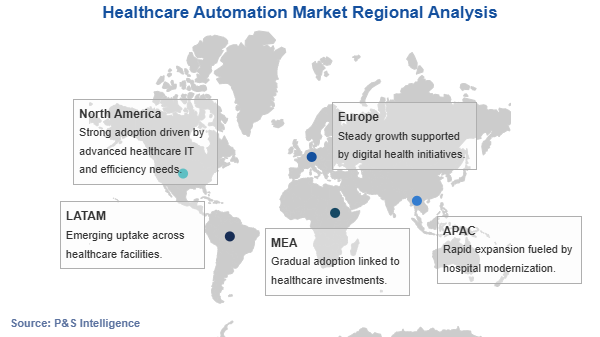
North America holds the largest share of 45%, because healthcare systems in the region have widely integrated automation into hospital operations, diagnostics, and pharmacy management. Many regional hospitals have invested millions in robots, digital health platforms, and AI-enabled clinical tools. Additionally, a strong healthcare IT infrastructure helps integrate various types of automation technologies. Many major medical centres in North America continue to evolve workflow efficiencies as they deal with rising patient numbers and employee workloads. Medical device and healthcare technology firms will continue to innovate new solutions to help this region remain the leader in hospital and health network automation adoption.
U.S. Healthcare Automation Market Analysis
The United States leads the regional healthcare automation market due to strong investments in advanced medical technologies. Large health systems increasingly utilise robotic surgery platforms, automated pharmacy dispensing systems, and artificial intelligence tools to streamline diagnostics and clinical workflows. Hospitals continue to optimise these technologies as patient volumes and administrative workloads rise nationwide. According to KFF, over 32.8 million beneficiaries were enrolled in Medicare Advantage plans in 2024. Additionally, according to the International Diabetes Federation, approximately 38.5 million adults in the United States lived with diabetes in 2024. These growing healthcare demands are accelerating automation adoption across medical facilities.
Canada Healthcare Automation Market Analysis
Canada continues to expand its healthcare automation sector through increasing investments in digital health technologies. Healthcare providers utilise automated laboratory systems, robotic pharmacy dispensers, and remote monitoring platforms to enhance clinical efficiency. Government initiatives supporting healthcare digitisation also aim to address workforce shortages and geographic healthcare access challenges. According to Immigration, Refugees and Citizenship Canada, more than 11,000 healthcare workers entered the country through immigration programs in 2024. Furthermore, according to the Canadian Institute for Health Information, approximately 5.7 million adults lacked a regular primary care provider in 2024. These healthcare system pressures are encouraging wider deployment of automation technologies.
Asia-Pacific Healthcare Automation Market Analysis
Asia-Pacific has the highest CAGR of 10.5%, because healthcare systems across the region are rapidly modernising and investing in digital hospital infrastructure. Many governments and private healthcare entities are building new hospital capacity and implementing automated labs, smart pharmacies, and AI-enabled diagnostic capabilities. Also, many hospitals in the Asia-Pacific region are looking to automate processes in order to better manage the increased demand resulting from population increases. Affordable automation solutions are becoming available to the region's large healthcare networks. With increasing access to healthcare and upgrading hospital infrastructure, the use of automation technologies is expected to grow at a rapid pace in this region.
China Healthcare Automation Market Analysis
China is rapidly integrating healthcare automation technologies across its large national healthcare system. Hospitals are increasingly deploying robotic surgical systems, automated diagnostics platforms, and intelligent pharmacy dispensing solutions. These technologies help medical institutions manage growing patient volumes while improving operational efficiency. According to the National Health Commission of China, Chinese healthcare institutions handled more than 10.15 billion patient visits in 2024. The immense scale of the country’s healthcare demand is accelerating the adoption of automation technologies across hospitals.
India Healthcare Automation Market Analysis
Healthcare automation adoption in India continues to expand as hospitals modernise their digital infrastructure and improve healthcare delivery efficiency. Medical providers increasingly deploy automated laboratory equipment, digital patient management systems, and AI-driven diagnostic tools. These technologies help healthcare professionals manage rising patient volumes across the country. According to the Ministry of Health and Family Welfare, India, more than 311 million teleconsultations were conducted across primary healthcare centres in 2024. The rapid expansion of digital health services is encouraging wider adoption of healthcare automation technologies across the national healthcare system.
Europe Healthcare Automation Market Analysis
Europe represents a mature healthcare automation market that has been influenced by its established public healthcare systems and advanced medical research infrastructure. Many hospitals in Europe are using automation to increase the accuracy of clinical decisions and to alleviate operational pressures. This region has also experienced significant growth in the adoption of digital health platforms and integrated hospital management systems. Manufacturers of medical devices and healthcare technology companies continue to develop automation products that provide value in the areas of diagnostics, pharmacy operations, and lab processes.
The regions and countries analysed in this report are:
- North America (Largest Regional Market)
- U.S. (Larger Country)
- Canada (Faster-Growing Country)
- Europe
- Germany (Largest Country)
- U.K. (Fastest-Growing Country)
- France
- Italy
- Spain
- Rest of Europe
- Asia-Pacific (Fastest-Growing Regional Market)
- China (Largest Country)
- India (Fastest-Growing Country)
- Japan
- South Korea
- Australia
- Rest of APAC
- Latin America
- Brazil (Largest Country)
- Mexico (Fastest-Growing Country)
- Rest of LATAM
- Middle East and Africa
- Saudi Arabia (Largest Country)
- South Africa
- U.A.E. (Fastest-Growing Country)
- Rest of MEA
Healthcare Automation Market Share
The market is fragmented, with many technology providers, medical device manufacturers, and healthcare IT companies offering automation solutions. Hospitals use different systems for diagnostics, pharmacy, administration, and logistics, which allows multiple vendors to compete in the same space. Large global companies supply advanced robotics and automation platforms, while smaller specialised firms focus on software tools, workflow automation, and AI applications. Continuous innovation and partnerships with healthcare providers keep the competitive landscape diverse.
Key Players in the Healthcare Automation Market:
- Intuitive Surgical
- Medtronic
- Johnson & Johnson
- Siemens Healthineers
- General Electric HealthCare
- Philips Healthcare
- Stryker Corporation
- Zimmer Biomet
- Omnicell
- Swisslog Healthcare
- Cerner
- UiPath
- Vecna Technologies
- Butterfly Network
- Becton, Dickinson and Company
Healthcare Automation Market News
- In December 2025, ASUS introduced an intelligent healthcare orchestration platform at the Healthcare+ Expo in Taiwan, coordinating hospital robots, virtual agents, and clinical data systems to automate patient guidance, documentation, and operational tasks within healthcare facilities.
- In November 2025, OTSAW signed a long-term service agreement with a public hospital in Singapore to deploy TransCar autonomous mobile robots for transporting meals, medical supplies, and equipment as part of automated hospital logistics. The 9-year robot-as-a-service (RaaS) agreement involves the deployment of the former’s next-generation Transcar 5 autonomous mobile robot.
- In October 2025, Arrive AI and Otonomy deployed robotic delivery automation at Hancock Regional Hospital in the United States, introducing autonomous delivery systems and smart storage units to move medical supplies between hospital departments.
- In June 2025, Primech AI deployed its HYTRON LITE autonomous cleaning robot at a major public hospital in Singapore under a 2-year lease agreement to perform automated sanitation tasks in high-traffic areas, supporting critical hygiene management.