Health and Fitness Club Market Size & Share Analysis - Emerging Trends, Growth Opportunities, Competitive Landscape, and Forecasts (2026 - 2032)
This Report Provides In-Depth Analysis of the Health and Fitness Club Market Report Prepared by P&S Intelligence, Segmented by Type (Personal Training, Group Training, Self-Training, Virtual/Online Training), Age Group (Up to 20 Years, 20 to 40 years, 40 to 55 Years, Over 55 Years), Service Type (Nutrition Counseling & Diet Planning, Wellness & Recovery, Group Classes, Personal Training & Instruction), Facility (Gym Equipment Zones, Swimming Pools, Group Exercise Studios, Functional Training Areas), End User (Individual Consumers, Corporate/Institutional Clients), Gender (Male, Female), and Geographical Outlook for the Period of 2021 to 2032
Explore the market potential with our data-driven report
Health and Fitness Club Market Key Insights
Personal training & instruction represented the largest category in 2025 with 40% share.
The group training category is expected to register the highest growth rate over the forecast period, of approximately 8.8%.
Individual consumers accounted for the larger share in 2025, of 75%.
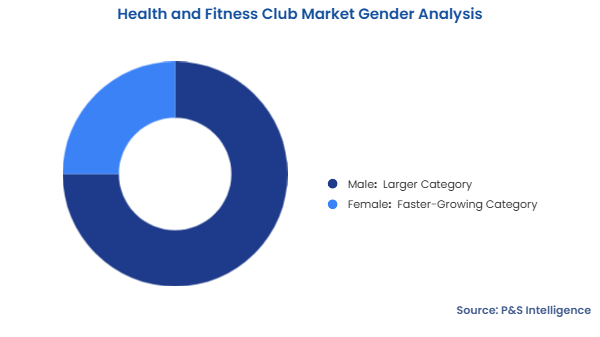
Females represent the faster-growing category, with approximately 8.7% CAGR.
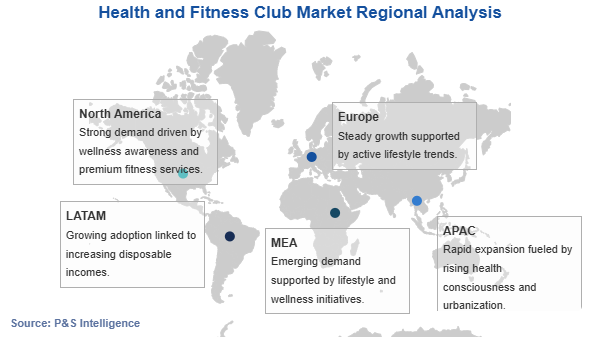
North America held 40% global health and fitness club market revenue share in 2025.
Asia-Pacific is the fastest-growing regional market, at a CAGR of approximately 9.5%, during 2026–2032.
Health and Fitness Club Market Analysis
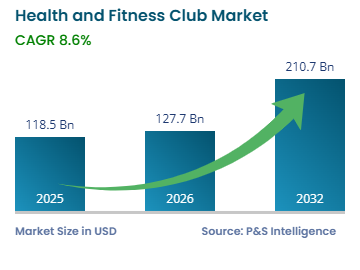
The global health and fitness club market valued USD 118.5 billion in 2025, and it is anticipated to expand at a CAGR of 8.6% during 2026–2032, reaching approximately USD 210.7 billion by 2032. This growth is driven by the accelerating health consciousness, rising prevalence of lifestyle-related chronic diseases, and surging consumer recognition of preventive wellness. Full-service gyms, boutique fitness studios, personal training facilities, and virtual training platforms are increasingly becoming essential components of preventive healthcare rather than discretionary lifestyle expenditure.
A critical driver for the market is the escalating global burden of physical inactivity and obesity. The World Health Organization (WHO) reports that approximately 1.8 billion adults—nearly one-third of the global adult population—failed to meet the recommended physical activity levels in 2022. This prevalence is projected to rise to 35% by 2030 if current trends continue. The World Obesity Federation’s 2025 Atlas projects that the number of obese adults will surpass 1.13 billion by 2030, more than doubling from 524 million in 2010. The compounding burden of lifestyle diseases will likely reinforce the demand for organized fitness services globally.
Market evolution is also being shaped by the convergence of digital technology and in-person fitness. The integration of AI-powered coaching, wearable biometric devices, virtual and hybrid training formats, and personalized nutrition planning is expanding the value proposition of health clubs beyond traditional equipment access. Corporate wellness partnerships, growing adoption among the 20–40-year-old demographic, and expansion of budget and boutique fitness formats into underserved markets also drive the market.
Health and Fitness Club Market Emerging Trends and Growth Drivers
Digital Technology and Hybrid Fitness Models Are Major Trends in Market
The proliferation of wearable biometric devices, AI-powered coaching platforms, real-time data analytics, and mobile fitness applications is enabling a shift from standardized, schedule-dependent gym experiences to continuous, personalized health engagement. The 2026 Worldwide Fitness Trends survey of the American College of Sports Medicine (ACSM) ranks wearable technology, mobile exercise apps, and data-driven training as the biggest fitness trends. Virtual and on-demand fitness formats, which found mainstream adoption during the COVID-19 pandemic, have become a permanent feature. Clubs that fail to develop coherent digital strategies risk membership erosion to pure-play digital competitors. The trajectory favors operators capable of delivering seamless omnichannel experiences, combining premium physical facilities with data-rich digital engagement layers.
Rising Chronic Disease Burden, Aging, and Physical Inactivity Propel Market
The escalating global prevalence of obesity, type 2 diabetes, cardiovascular disease, and hypertension is generating a sustained demand for organized fitness services. Health clubs are finding increasing acceptance among both individuals and healthcare systems as an approach to preventive medicine. The WHO reports that noncommunicable diseases kill approximately 43 million people per year—equivalent to 75% of all global deaths—with cardiovascular diseases alone claiming over 19 million lives annually. The majority are attributable to physical inactivity, poor diet, and metabolic risk factors, which structured exercise directly addresses.
Beyond the disease burden, gym and fitness club membership also addresses several economic concerns. As per the WHO, physical inactivity is projected to cost global public health systems approximately USD 300 billion between 2020 and 2030, which is roughly USD 27 billion per year. This is creating a measurable fiscal incentive for governments, insurers, and employers to fund fitness participation as a preventive investment. Health clubs are aligning their offerings explicitly within preventive care frameworks, through medically integrated fitness programs, rehabilitation-adjacent services, and chronic disease management partnerships.
Demographic aging across developed and developing economies is generating a high-growth, underserved market for health and fitness clubs in adults aged 55 and over. Older adults have the motivation to prevent chronic diseases, maintain mobility, and enhance the quality of their lives and, in many markets, the money to spend on fitness services. Regular physical activity reduces falls, hospitalizations, and functional decline in older adults, encouraging insurers, governments, and healthcare providers to offer reimbursement frameworks and wellness incentives. The WHO projects that the global population aged 60 years and older will increase from 1.1 billion in 2023 to 1.4 billion by 2030—representing 1 in 6 people worldwide.
The ACSM’s 2026 Worldwide Fitness Trends survey ranks fitness programs for older adults as the second biggest fitness trend globally. This reflects the market recognition of this opportunity and competitive differentiation for clubs that develop specialized senior wellness capabilities. Operators are investing in rehabilitation-adjacent programs, low-impact facility designs, and medically supervised fitness offerings for older adults.
Health and Fitness Club Market Segmentation Analysis
Type Analysis
Personal training accounted for the largest share of the global health and fitness club market in 2025, of 40%, driven by its structural pricing premium over all other service formats and its deep integration into institutional wellness programs. Personal training remains popular mainly because one-on-one sessions command the highest per-interaction rate within any club’s service portfolio. Moreover, established accountability mechanisms produce measurably superior retention outcomes than self-directed formats. Additionally, the growing formalization of fitness as preventive medicine has created employer-subsidized and insurer-reimbursed demand streams partially insulated from discretionary spending cycles. The ACSM’s Worldwide Fitness Trends survey consistently ranks personal training among the top sustained priorities in professional practice across all surveyed regions.
The group training category is expected to register the highest growth rate over the forecast period, of approximately 8.8%. It is propelled by the social community dimension of group-format fitness, cost accessibility advantage, and proliferation of branded boutique concepts across HIIT, yoga, Pilates, cycling, and functional fitness. ACSM’s 2026 survey confirms sustained consumer momentum toward group-based modalities, with multiple community and group formats appearing within the top 20 global fitness trends.
Globally, yoga is the most widely practiced, with roughly 300 to 350 million people engaging in it regularly. Zumba classes have approximately 15 million weekly participants in over 180 countries.
The market segments into the following types:
Personal Training (Largest Category)
Group Training (Fastest-Growing Category)
Self-Training
Virtual/Online Training
Others
Age Group Analysis
The 20–40 years category held the largest share in 2025, of 45%. These people join fitness clubs due to their high disposable income at career peak, health targets extending beyond disease prevention, and inclusion of fitness routines as a key lifestyle choice. Urban professionals in this age group conduct premium personal training purchases, join multi-format boutiques, and utilize corporate wellness benefits. The U.S. Bureau of Labor Statistics projects that the employment of fitness trainers and instructors will grow 14% from 2022 to 2032.
The over 55 years category is projected to demonstrate the highest growth rate over 2026–2032. The expansion of this demographic drives the demand for age-adapted fitness programs, such as low-impact cardio, balance training, mobility work, and medically supervised wellness. Older adults are increasingly going to the gym to maintain strength, mobility, and overall health. Regular exercise helps manage chronic conditions, improve balance, reduce injury risk, and support mental wellbeing. Many also seek social interaction and fitness programs tailored to active aging and long-term independence. The WHO projects that the share of the global population aged 60 years and older will nearly double—from 12% in 2015 to 22% by 2050.
The market segments into the following age groups:
Up to 20 Years
20 to 40 years (Largest Category)
40 to 55 Years
Over 55 Years (Fastest-Growing Category)
Service Type Analysis
Personal training & instruction represented the largest category in 2025. This is due to direct revenue generation through certified trainers, institutional demand from corporate wellness programs seeking evidence-based fitness interventions, and its measurable productivity and health management for employers. The deepening alignment between preventive healthcare frameworks and formalized training instruction drives insurers and large employers to subsidize personal training sessions as part of managed wellness programs. According to the U.S. Bureau of Labor Statistics, approximately 370,100 fitness trainers and instructors were employed in the United States in 2024, up from around 329,500 in 2022.
Wellness & recovery services are anticipated to experience the fastest growth over 2026–2032, at approximately 9.0% CAGR, driven by the expanding consumer adoption of recovery science and the industry-wide pivot toward holistic health management beyond physical performance. Cryotherapy, infrared sauna, physiotherapy, sleep optimization, and mental wellness programs are now mainstream at regular fitness clubs and not just an expensive novelty at high-end spas and five-star hotels.
The market segments into the following service types:
Nutrition Counseling & Diet Planning
Wellness & Recovery (Fastest-Growing Category)
Group Classes
Yoga
Zumba
HIIT
CrossFit
Personal Training & Instruction (Largest Category)
Others
Facility Analysis
Gym equipment zones commanded the largest share in 2025, of 40%, as they are the foundational physical infrastructure investment of health and fitness clubs globally. These zones house resistance machines, selectorized weight stations, free-weight areas, and multi-purpose training apparatus, thus constituting the primary daily usage environment for most member demographics. Equipment zones serve the broadest spectrum of members without format restrictions, from beginners to advanced athletes. Moreover, high-volume, low-price gym models are gaining rapid popularity globally. This market is driven by the deepening penetration of these zones across emerging markets in Asia-Pacific and Latin America.
Group exercise studios are projected to register the highest growth rate over the forecast period. This is credited to the proliferation of branded boutique fitness concepts, such as dedicated cycling, yoga, Pilates, HIIT, barre, and functional circuit formats. Full-service club operators are converting underutilized floor space into dedicated studio zones as a competitive differentiation strategy. ACSM’s 2026 Trends survey confirms the popularity of multiple group training modalities, including functional fitness training and balance-based programs.
The market segments into the following facility types:
Gym Equipment Zones (Largest Category)
Free Weights
Cardio Equipment
Swimming Pools
Group Exercise Studios (Fastest-Growing Category)
Functional Training Areas
Others
End User Analysis
Individual consumers accounted for the larger share in 2025, as they join health and fitness clubs across all formats, geographies, and price tiers. Direct consumer membership remains the primary commercial model for club operators globally, from entry-level budget gym subscriptions to ultra-premium full-service wellness club memberships. North America and Western Europe boast high consumer membership rates due to mature fitness infrastructure and high household spending on preventive health. CDC data says that only 24.2% of the U.S. adults meet the federal guidelines for aerobic and muscle-strengthening physical activity. This compliance gap underscores the magnitude of unconverted individual membership demand underpinning long-run market expansion.
Corporate/institutional clients are expected to record the higher growth rate over 2026–2032, of approximately 9.2%. Employers are expanding structured fitness benefits as part of corporate wellness investments, motivated by documented healthcare cost reduction, productivity gains, and the competitive deployment of wellness benefits as talent retention tools. The International Labour Organization (ILO) reports that poor occupational health costs economies 4–6% of the GDP annually through absenteeism, presenteeism, and treatment expenditure. This creates a direct fiscal incentive for employers to fund preventive fitness programming as part of managed workforce health strategies.
Males dominate the market with 75% revenue share, even though women account for the higher absolute health/fitness club membership, due to the rising male engagement with structured fitness and wellness culture. This is credited to rising social media influence, men’s health awareness campaigns, and rapid expansion of competitive fitness formats, such as HYROX, CrossFit, and strength-focused training. Many men are drawn to gyms and fitness clubs to build strength, improve physical appearance, and enhance confidence. The cultural ideals around masculinity, athletic performance, and discipline also play a role. Gyms provide structured environments for competition, goal-setting, and stress relief, making them appealing spaces for both physical development and mental wellbeing. ACSM’s 2026 Worldwide Fitness Trends survey identifies strength training with free weights as among the fastest-growing categories in professional fitness practice globally.
Females represent the faster-growing category, reflecting a rapid shift in health and fitness club participation patterns, which broadens participation beyond males. Women now account for the majority of the active health club members across North America and Western Europe. This is driven by the proliferation of women-inclusive fitness formats, such as yoga, Pilates, group cycling, barre, dance-fitness, and functional movement. The CDC’s national survey data consistently indicates that women report higher rates of health-motivated exercise engagement and greater responsiveness to preventive wellness programs.
The market segments into the following genders:
Male (Larger Category)
Female (Faster-Growing Category)
Drive strategic growth with comprehensive market analysis
Health and Fitness Club Market Geographical Analysis
North America Health and Fitness Club Market Outlook
North America held 40% global health and fitness club market revenue share in 2025. The United States anchors the region, supported by the world’s highest gym membership penetration rate. It also has a mature fitness infrastructure reinforced by decades of branded chain expansion, corporate wellness integration, and high consumer health spending. Canada’s market is propelled by the expanding provincial wellness investment, population health initiatives, and accelerating penetration of budget and boutique fitness formats across major urban centers.
Employer-sponsored wellness programs, federal recognition of fitness as a public health priority, and a highly digitally engaged consumer base elevate the sophistication and scale of fitness demand. Premium and boutique formats continue to expand alongside high-volume low-price clubs, sustaining revenue growth across income tiers. The U.S. Department of Health and Human Services (HHS)’s 2018 Physical Activity Guidelines for Americans explicitly link exercise to a reduced risk of cardiovascular disease, type 2 diabetes, and all-cause mortality.
United States Health and Fitness Club Market Analysis
The United States represents the largest country market globally, reflecting the scale and maturity of its fitness industry. As per the Health & Fitness Association, the U.S. had approximately 77 million fitness facility members in 2024, representing around 25% of the population aged six and older. The CDC reports that obesity affects more than 40% of U.S. adults, generating a sustained demand for preventive fitness solutions and health clubs.
The U.S. market is further characterized by deep corporate wellness integration, with employers increasingly leveraging fitness subsidies and onsite health club partnerships for productivity improvement and healthcare cost reduction. The proliferation of AI-driven coaching platforms, hybrid virtual–physical membership models, and strength-training-focused boutique studio formats reflects an increasingly sophisticated consumer demand profile.
Europe Health and Fitness Club Market Dynamics
Europe represents the second-largest regional market, led by Germany, the United Kingdom, and France. European operators are increasingly investing in recovery services, mental wellness programs, and sustainability-oriented facility design for competitive differentiation. The mature Western European markets are characterized by high penetration and premium wellness integration. In contrast, Eastern European markets, notably Poland and Czechia, which showcase lower membership, are driven by the rising disposable incomes and heightened health awareness.
The United Kingdom maintains a penetration rate of approximately 16.9%, supported by government public health programs and growth of budget chain models. The UK Government confirms that 69.2% of the men and 58.6% of the women in England were classified as overweight in 2023, reinforcing preventive fitness demand across the region’s most mature market.
Asia-Pacific Health and Fitness Club Market Growth
Asia-Pacific is the fastest-growing regional market, at a CAGR of approximately 9.5%, during 2026–2032, driven by the rapid urbanization, an expanding middle class, and accelerating health consciousness across China, India, Japan, South Korea, and Australia. The region’s market is defined by a vast addressable population with historically low gym penetration rates. As per the WHO, physical inactivity in the high-income Asia-Pacific region is around 48%, the highest of any global region. This signals both a severe public health challenge and a substantial demand stimulus for maintaining fitness. Operators are deploying a range of business models across the region, including ultra-budget 24-hour gyms in Japan, premium wellness clubs in Singapore and Shanghai, and app-integrated fitness ecosystems in India.
China Health and Fitness Club Market Analysis
China represents the largest country market within Asia-Pacific, driven by a population of 1.4 billion, rapidly rising urban disposable incomes, and government-led health promotion and fitness infrastructure development frameworks. The low gym penetration in China creates a huge potential membership base as urbanization accelerates and health consciousness deepens among working-age demographics.
The National Health Commission of China (NHC)’s Healthy China 2030 Initiative identifies physical fitness as a national priority, targeting regular physical exercise participation among more than 40% of the population by 2030. Fitness clubs and sports venues have been designated as critical delivery infrastructure for this national health goal.
Domestic operators, including Keep, Lefit, and SuperMonkey, have developed large-scale budget and technology-integrated fitness formats suited to China’s urban density and smartphone-native consumer base. Moreover, international chains are actively expanding through franchise and joint venture structures.
India Health and Fitness Club Market Expansion
India represents the fastest-growing market within Asia-Pacific, driven by a low organized fitness penetration base, a large young population, rapid urbanization, and increasing health consciousness. The rapid smartphone penetration accelerates the adoption of hybrid digital-physical fitness models, with app-based training platforms and affordable gym chains expanding into tier-2 and tier-3 cities. The Ministry of Health and Family Welfare has identified physical inactivity and obesity as priority public health concerns. National programs target chronic disease prevention via the expansion of organized fitness infrastructure. International fitness brands are actively accelerating market formalization. For instance, easyGym entered the Indian market in May 2025 through a franchise partnership with FranGlobal. This marked a significant milestone in the development of large-scale branded gym operations.
The regions and countries analyzed in this report include:
North America (Largest Region)
U.S. (Largest Country Market)
Canada (Fastest-Growing Country Market)
Europe
Germany (Largest Country Market)
U.K.
France
Italy
Spain
Rest of Europe
Asia-Pacific (Fastest-Growing Region)
China (Largest Country Market)
India (Fastest-Growing Country Market)
Japan
South Korea
Australia
Rest of APAC
Latin America
Brazil (Largest Country Market)
Mexico
Rest of LATAM
Middle East & Africa
Saudi Arabia (Largest Country Market)
U.A.E.
South Africa
Rest of MEA
Health and Fitness Club Market Share Analysis
The global health and fitness club market exhibits a highly fragmented competitive structure. This is due to the low barriers to entry for single-location operators, consumer preferences for community familiarity and geographical convenience, and absence of transformative technology. Further, the sheer diversity of service formats precludes any single operator from dominating across formats or geographies simultaneously. From budget 24-hour gyms and boutique functional training studios to luxury full-service health clubs and medically integrated wellness facilities, people have a multitude of options. The market, therefore, consists of layered competitive tiers with distinct strategic logics across different market segments and geographies.
At the top tier, a few internationally recognized chain operators compete through brand standardization, franchise-driven geographic expansion, and capital-intensive facility investment. Below this, a vast number of diverse regional chains, national operators, and independent single-location clubs dominate. These operators compete through localized expertise, community relationships, and pricing flexibility, which standardized chains cannot easily replicate. The competitive trajectory favors operators combining digital infrastructure investment with a differentiated physical experience, as pure commodity gym models face sustained pressure from low-cost app-based alternatives.
Top Companies in the Health and Fitness Club Market:
Planet Fitness Inc.
Equinox Holdings Inc.
Life Time Inc.
24 Hour Fitness USA LLC
Gold's Gym International Inc.
Self Esteem Brands LLC
Crunch Fitness LLC
LA Fitness International LLC
Basic-Fit N.V.
Virgin Active Limited
David Lloyd Leisure Limited
RSG Group GmbH
Health and Fitness Club Market News
In June 2025, Gold’s Gym International Inc. partnered with HYROX to open a HYROX Performance Center at its Little Elm facility in Dallas, Texas. It features dedicated HYROX training zones with official competition equipment, certified coaching programs, and specialized group fitness classes.
In May 2025, easyGym, a brand of easyGroup, entered India by opening its first outlet in Delhi, backed by a INR 250-crore (USD 29.9 million) investment through a strategic partnership with FranGlobal, the international business arm of Franchise India Group. The expansion targets 100 gyms across India within five years via a franchise-owned, franchise-operated model, with further plans for 300 outlets.
In April 2025, Crunch Holdings LLC announced that the private equity firm Leonard Green & Partners will acquire a majority interest in Crunch Fitness from TPG Growth and minority shareholders.
In April 2024, Orangetheory Fitness and Self Esteem Brands LLC merged to create a fitness, health, and wellness franchise operator with USD 3.5 billion in combined systemwide sales and approximately 7,000 franchise locations across 50 countries and all seven continents. The all-stock transaction, backed by Roark Capital, consolidates the Anytime Fitness, Orangetheory Fitness, Basecamp Fitness, The Bar Method, and Stronger U Nutrition brands under a single entity.
Frequently Asked Questions About This Report
What will be the health & fitness club market 2032 size?+
In 2032, the market for health & fitness club will value USD 210.7 billion.
Which type is the most popular in the health & fitness club industry?+
Personal training dominates the health & fitness club industry with 40% revenue.
Which is the most-productive region in the health & fitness club market?+
North America is the largest market for health & fitness club, with 40% share.
What are the key health & fitness club industry drivers?+
The health & fitness club industry is driven by accelerating health consciousness, rising prevalence of lifestyle-related chronic diseases, and surging consumer recognition of preventive wellness.
What is the health & fitness club market nature?+
The market for health & fitness club is fragmented.
Want a report tailored exactly to your business need?
Leading companies across industries trust us to deliver data-driven insights and innovative solutions for their most critical decisions. From data-driven strategies to actionable insights, we empower the decision-makers who shape industries and define the future. From Fortune 500 companies to innovative startups, we are proud to partner with organisations that drive progress in their industries.
Client Testimonials
Working with P&S Intelligence and their team was an absolute pleasure – their awareness of timelines and commitment to value greatly contributed to our project's success. Eagerly anticipating future collaborations.
McKinsey & Company
India
Unmatched Standards
Our insights into the minutest levels of the markets, including the latest trends and competitive landscape, give you all the answers you need to take your business to new heights
Complete Data Security
We take a cautious approach to protecting your personal and confidential information. Trust is the strongest bond that connects us and our clients, and trust we build by complying with all international and domestic data protection and privacy laws