Green Tires Market Size & Share Analysis - Trends, Drivers, Competitive Landscape, and Forecasts (2025 - 2032)
This Report Provides In-Depth Analysis of the Green Tires Market Report Prepared by P&S Intelligence, Segmented by Tire Size (15 inch, 16 inch, 17 inch, >18 inch), Distribution Channel (OEM, Aftermarket), Application (On-Road, Off-Road), Material Type (Silica-Based, Natural/Synthetic Rubber, Bio-based), Vehicle Type (Passenger Cars, Light Commercial Vehicles, Heavy Commercial Vehicles, Two/Three-Wheelers), and Geographical Outlook for the Period of 2019 to 2032
Explore the market potential with our data-driven report
Green Tires Market Overview
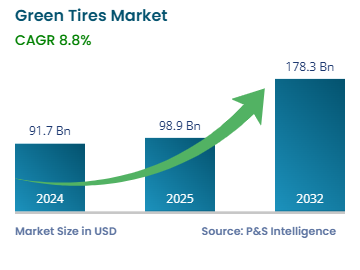
The green tires market size was USD 91.7 billion in 2024, and it will grow by 8.8% during 2025–2032, to reach USD 178.3 billion by 2032.
The market growth is primarily ascribed to the rising environmental awareness, strict laws on carbon emissions, expanding automotive sector, and increasing number of electric vehicles. Tire manufacturers are using environmentally safe materials, such as silica, to reduce rolling friction and improve fuel efficiency. As per studies, low rolling friction can minimize noise reduction by 10 dB on roads. The market also benefits from the increasing consumer demand for green products and technical advances in improving wear resistance.
The U.S. state and federal officials work with different groups, such as the Product Stewardship Institute and the U.S. Tire Manufacturers Association, to promote the use of recycled tires and clean tire manufacturing. Furthermore, in April 2024, Europe passed the Euro 7 regulation to reduce pollution, by encouraging companies to manufacture tires that emit fewer harmful emissions, such as microplastics.
The demand for green tires is rising in the general automotive sector as manufacturers and consumers seek ways to reduce vehicle emissions and improve fuel efficiency. Traditional tires contribute to up to 20% of a vehicle's total fuel consumption due to rolling resistance. Green tires, made with advanced materials like silica and natural rubber, reduce this resistance by up to 30%, leading to significant COâ‚‚ emission cuts. As transportation accounts for nearly 24% of global direct COâ‚‚ emissions from fuel combustion, the shift to eco-friendly components is critical. Additionally, green tires emit fewer microplastics, addressing growing concerns about non-exhaust particulate pollution.
Green Tires Market Dynamics
Integration of Smart Green Tires for Sustainable and Intelligent Mobility Is Key Trend
The integration of advanced clean tires, which drives the demand for eco-friendly materials and live safety monitoring, is a key trend in the market.
In the Vehicle industry, particularly EVs, the integration of environment-friendly smart tires boosts energy efficiency, increases range, and promotes features such as automatic braking.
The U.S. AEB rule and EU TPMS expansions are some government regulations that accelerate the adoption of smart tire systems.
According to the U.S. Department of Transportation, more than 600,000 crashes occur annually due to tire issues, which creates a strong demand for smart tire integration.
The regulations from UNECE and Euro 7 are shifting manufacturers to boost abrasion resistance and rolling efficiency, increasing advancement in eco-friendly tire technologies.
Gleet operators are also using smart tiers, especially in the logistics sector and EV taxis, to minimize carbon emissions.
Carbon Credit Incentives and ESG-Linked Tire Manufacturing Are Biggest Drivers
The integration of ESG goals and carbon credit trading systems into tire manufacturing is a key driver in the market.
Companies that reduce carbon emissions through bio-based materials, low-energy processes, and recycling are qualifying for carbon credits and green funding.
In 2025, the EU’s Emissions Trading System began recognizing sustainable tire production as part of carbon offsetting activities, creating new revenue streams.
According to India’s Bureau of Energy Efficiency, energy-efficient tire plants are now part of the Perform, Achieve and Trade scheme, earning tradable energy-saving certificates.
India’s Automotive Industry Standards (AIS-142) mandate tire labeling for rolling resistance and wet grip, encouraging the usage of eco-efficient tires by OEMs and the aftermarket.
Japan’s Joint Crediting Mechanism supports tire companies establishing green manufacturing in developing countries by offering emission reduction rewards.
These financial and policy-driven frameworks incentivize tire makers to accelerate green innovations and help meet national and global decarbonization goals.
Green Tires Market Segmentation Analysis
Tire Size Analysis
The 15 inches category held the largest market share, of 35%, in 2024, due to its cost-effectiveness, robust renewal demand, economical design, and urban ride comfort. According to reports, around green tires reduce noise by 3–4 dB, via improved vibration absorption, providing a smoother ride.
The >18 inches category will have the highest CAGR, of approx. 9%, due to the high demand for high-performance cars and rising preference for oversized wheels. The rising adoption of EVs and SUVs requires larger tires to handle higher torque and boost vehicle stability. The growing demand for buses for public transportation and trucks for freight transportation also propels the market in this category.
The tire sizes analyzed in this report are:
15 inches (Largest Category)
16 inches
17 inches
>18 inches (Fastest-Growing Category)
Distribution Channel Analysis
The OEM category held the larger market share, of 55%, in 2024, due to the growing eco-compliance of automakers and their efforts to improve fuel efficiency. Tire manufacturers and vehicle OEMs are partnering to install green tires on new vehicles, especially hybrid vehicles, to provide low rolling resistance, which reduces harmful emissions. The EPA has issued new source performance standards under the Clean Air Act in the U.S for the rubber tire industry, aiming to minimize hazardous air pollutants. As per OICA, global vehicle production stood at 92,504,338 units in 2024.
The aftermarket category will have the higher CAGR, in forecast period. Green tires are increasingly being sold through aftermarket channels, driven by eco-conscious vehicle owners replacing worn-out tires. As awareness grows, many choose low rolling resistance options to improve fuel economy and reduce emissions. Replacement decisions often occur every 3–5 years, presenting recurring opportunities for aftermarket green tire sales and environmental impact.
The distribution channels analyzed in this report are:
OEM (Larger Category)
Aftermarket (Faster-Growing Category)
Retail Tire Chains
Online Platforms
Independent Garages
Application Analysis
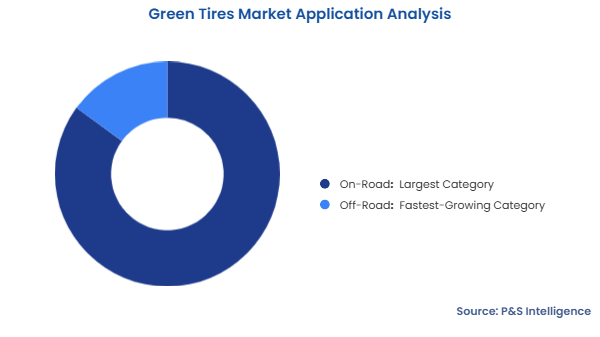
The on-road category held the larger market share, of 85%, in 2024, due to its broad usage on regular automobiles. Such vehicles are using green tires to reduce rolling resistance, improve daily driving fuel efficiency, decrease the overall environmental impact, and support global eco-development agendas. Many tier-1 automotive suppliers are creating eco-friendly tires for personal vehicles, with many using 70% sustainable materials, such as recycled polyester and plant-based oils.
The off-road category will have the higher CAGR, due to the increasing environmental concerns across industrial and agricultural sectors and rising demand for heavy-duty vehicles. Off-road tires find application mainly in construction, agriculture, and mining, as they provide durability, low emissions, and fuel efficiency, which coincide with sustainability goals. GRI launched the Green XLR Earth Series in 2023, wherein approximately 78.6% of the materials used are environment-friendly, such as HD silica and bio-sourced cellulose fibers.
The applications analyzed in this report are:
On-Road (Largest Category)
Off-Road (Fastest-Growing Category)
Material Analysis
The silica-based category held the largest market share, of 45% in 2024, due to its fuel-saving capability and enhanced hydroplaning resistance. Solvay SA manufactures special materials, including highly dispersible silica, to reduce fuel consumption by 7%.
The bio-based material category will have the highest CAGR, owing to the increasing investments and regulations on green materials and surging consumer demand for sustainable products. The materials used to manufacture bio-based tires include soybean oil and guayule, which reduce the dependence on hydrocarbon inputs. Various companies, including Cooper Tire and Michelin, are investing heavily in bio-rubber research and development to increase scalability and performance.
The materials analyzed in this report are:
Silica-based (Largest Category)
Natural/Synthetic Rubber
Bio-based (Fastest-Growing Category)
Vehicle Type Analysis
The passenger cars category held the largest market share, of 60% in 2024, due to the overall high sales, high tire replacement quantity, and rapid adoption of eco-friendly materials by the automotive industry.
The light commercial vehicles category will have the highest CAGR, due to the rising urban logistics demand, stringent emission regulations, and growing fleet electrification. Green tires increase affordability, reduce fuel expenditure, and boost the efficiency of deliveries.
Drive strategic growth with comprehensive market analysis
Green Tires Market Regional Outlook
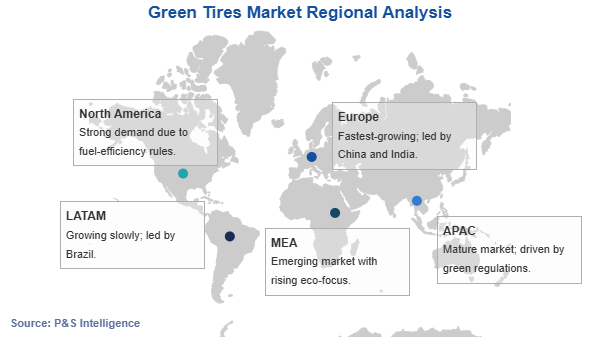
Asia-Pacific held the largest market share, of 35%, in 2024, and it will have the highest CAGR, because of the large automotive manufacturing center, rising automobile ownership, accelerated EV adoption, and supportive government policies. China, India, and South Korea are implementing various regulations for reducing fuel efficiency and helping automakers and tire manufacturers in shifting to eco-friendly technologies.
For instance, the China Rubber Industry Association’s Green Tire Policy determines performance and friction resistance to support energy-saving tires. Moreover, South Korea’s Carbon Neutrality Roadmap and Korean New Deal provide subsidies and government support for eco-friendly tire manufacturing.
The geographical breakdown of the market is as follows:
North America
U.S. (Larger Country)
Canada (Fastest-Growing Country)
Europe
Germany (Larger Country)
U.K.
France (Fastest-Growing Country)
Italy
Spain
Rest of Europe
Asia-Pacific (Largest and Fastest Regional Market)
China (Largest Country)
India (Fastest-Growing Country)
Japan
South Korea
Australia
Rest of APAC
Latin America
Brazil (Largest Country)
Mexico (Fastest-Growing Country)
Rest of LATAM
Middle East and Africa
Saudi Arabia (Fastest-Growing Country)
South Africa (Larger Country)
U.A.E.
Rest of MEA
Green Tires Market Competitive Landscape
The market is moderately fragmented because of the presence of many global and regional players targeting specific categories and eco-friendly materials. Companies, such as Goodyear, Continental, and Bridgestone, hold significant shares, but no single company dominates the whole market. Moreover, the rising development of EVs and increasing number of OEM partnerships promote the niche and emerging players.
Key Green Tires Companies:
Compagnie Générale des Établissements Michelin SCA
Bridgestone Corporation
The Goodyear Tire & Rubber Company
Continental AG
Pirelli & C. S.p.A.
Hankook Tire & Technology Co., Ltd.
Cheng Shin Rubber Ind. Co., Ltd.
Kumho Tire Co., Inc.
Nokian Tyres plc
The Yokohama Rubber Co., Ltd.
Apollo Tyres Ltd.
Sailun Group Co., Ltd.
Green Tires Market News
In June 2025, Prism Worldwide announced three new technologies for tire recycling aimed at reducing odor, developing sustainable thermoplastic vulcanizates, and reusing high-content EPDM.
In May 2025, JK Tyres & Industries Ltd. launched its UX Royale Green range of passenger car tires in India. They are made from materials with ISCC Plus certification for sustainability.
In February 2025, Continental AG launched the EcoContact 7 S and EcoContact 7 tires to reduce energy consumption in EVs and fuel usage in ICE vehicles. They also enhance driving efficiency, decrease rolling noise, and enable dynamic handling.
In September 2024, Marubeni Corporation announced plans to invest in Green Rubber Energy Company Limited, a company developing a pyrolysis technique for recycling end-of-life tires in Thailand.
In August 2024, Goodyear Canada Inc. announced an investment of CAD 575 million in its Ontario plant to increase clean tire production, a move that was supported by provincial governments and the Canadian federal.
In April 2024, Compagnie Générale des Établissements Michelin SCA, Enviro, and Antin Infrastructure collaborated to construct a tire recycling plant in Sweden, to produce useful materials, such as carbon black.
In November 2023, Compagnie Générale des Établissements Michelin SCA and Bridgestone Corporation launched a white paper that promotes the use of recovered carbon black to minimize waste and support recycling in the manufacturing process.
Want a report tailored exactly to your business need?
Leading companies across industries trust us to deliver data-driven insights and innovative solutions for their most critical decisions. From data-driven strategies to actionable insights, we empower the decision-makers who shape industries and define the future. From Fortune 500 companies to innovative startups, we are proud to partner with organisations that drive progress in their industries.
Client Testimonials
Working with P&S Intelligence and their team was an absolute pleasure – their awareness of timelines and commitment to value greatly contributed to our project's success. Eagerly anticipating future collaborations.
McKinsey & Company
India
Unmatched Standards
Our insights into the minutest levels of the markets, including the latest trends and competitive landscape, give you all the answers you need to take your business to new heights
Complete Data Security
We take a cautious approach to protecting your personal and confidential information. Trust is the strongest bond that connects us and our clients, and trust we build by complying with all international and domestic data protection and privacy laws