Green Data Center Market Size & Share Analysis - Trends, Drivers, Competitive Landscape, and Forecasts (2026 - 2032)
This Report Provides In-Depth Analysis of the Green Data Center Market Report Prepared by P&S Intelligence, Segmented by component (Solution, Services), Data Center Type (Enterprise Data Centers, Colocation / Shared Data Centers, Hyperscale Data Centers, Edge & Micro Data Centers, Modular / Prefabricated Data Centers), End-Use Industry (IT & Telecom, Banking, Financial Services & Insurance (BFSI), Healthcare & Life Sciences, Government & Public Sector, Retail & E-Commerce, Manufacturing & Industrial, Energy & Utilities, Education & Research, Transportation & Logistics), and Geographical Outlook for the Period of 2021 to 2032
Explore the market potential with our data-driven report
Green Data Center Market Outlook
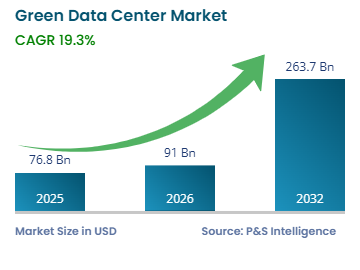
The green data center market size was USD 76.8 billion for 2025, and it will grow by 19.3% during 2026-2032, to reach USD 263.7 billion by 2032.
The market is expanding rapidly because sustainability is important in the increasing ways that data centers around the world are constructed and operated. As cloud services, AI, video streaming, and enterprise software consume large amounts of energy from data centers, operators are focused on reducing their carbon footprint while also ensuring that data centers continue to operate at high levels of uptime and availability. Government and large enterprises’ sustainability goals to reduce greenhouse gas emissions are driving innovation in energy-efficient and eco-friendly data center designs.
Improved cooling systems, renewable energy sources, modular construction techniques, and advanced energy management drive the market. According to the International Energy Agency (IEA), global electricity consumption from data centers is projected to double from 460 TWh in 2022 to more than 1,000 TWh by 2026, highlighting the urgent need for energy-efficient data center technologies.
Green Data Center Market Emerging Trends & Growth Drivers
Energy-Aware Infrastructure Design and Automation Frameworks Are Trending
The growing demand for green data centers has led to operators adopting automated systems that focus on minimizing the impact on our environment. Operators are increasingly utilizing more efficient cooling methods along with increased use of intelligent power systems. In addition, automated renewable energy systems will help operators reduce their carbon emissions and be more sustainable. There is also a trend among operators moving to modular and prefabricated buildouts to facilitate increasing speed of installation with less energy used during construction.
Data center operators are collaborating and making sustainability commitments, which is driving the adoption of lifecycle assessments, reductions in the amount of embodied energy in a building, and circular economy principles in how data centers are designed and operated. These collaborative sustainability initiatives reflect a greater trend towards environmentally integrated digital structures. As per Microsoft, modern data centers achieved nearly a 39% improvement in water usage efficiency in 2023. New AI-optimized designs use zero water for cooling, reflecting the shift toward automated and resource-efficient infrastructure.
Rising Focus on Climate Commitments Drives Market
The increased focus on climate duties from corporations and regulation is driving growth in the green data center market. Corporations are being encouraged to reduce energy consumption and lessen their Carbon footprint. With the vast expansion of digital infrastructure to enable Cloud Computing, artificial intelligence and enormous data storage, the Energy requirements of these Platforms and resulting Carbon Emissions have become a strategic issue. There is a growing number of stakeholders in both Public and Private sectors who are using Sustainability as one of their factors in making procurement and investment decisions.
In 2025, the global average surface temperature was about 1.4–1.5 °C above pre-industrial (1850–1900) levels, making it one of the three warmest years ever recorded, according to the World Meteorological Organization (WMO). The period from 2023 to 2025 averaged close to 1.5 °C above pre-industrial levels, and the years 2015–2025 represent the warmest decade on record, as reported by the WMO and NASA. Atmospheric carbon dioxide concentrations exceeded 420 ppm in 2024 and continued rising in 2025, compared with about 280 ppm before industrialization, based on measurements from NOAA and the WMO.
Methane concentrations rose above 1,900 ppb and nitrous oxide above 335 ppb, both reaching record highs, according to the WMO Greenhouse Gas Bulletin. Global greenhouse gas emissions exceeded 53 billion tonnes of CO₂-equivalent per year, remaining at record levels in the mid-2020s, according to the UN Environment Programme. Over 90% of the excess heat from global warming is stored in the oceans, and upper-ocean heat content reached its highest observed level, as documented by NOAA and the WMO. Global mean sea level has been rising at about 3–4 mm per year, and Arctic summer sea-ice extent remains well below late-20th-century averages, according to NASA and NOAA.
They are favoring data center facilities and operations that are associated with lower carbon intensity, more efficient resource utilization, and alignment with national and international environmental objectives. According to the European Commission, data centers are expected to account for 3.2% of the European Union’s total electricity demand by 2030, triggering stricter efficiency and transparency requirements.
Green Data Center Market Segmentation Analysis
Component Analysis
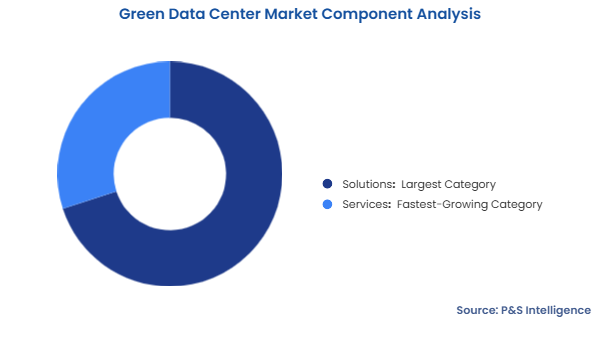
Solution is the largest category, holding a market share of 70%, as they include all the core technologies that create a sustainable data center. They include energy-efficient cooling systems, power management technology, advanced monitoring processes, integrated/optimized networking technologies, built/designed with the intent to minimize the negative impact on the environment These technologies form the basis of all green data center strategies for organizations as they are significant drivers of the operational efficiency, energy consumption, and optimization of resources (such as materials & equipment) for an environmentally sustainable operation.
Most organizations begin investing in their green data centers with the above-mentioned core technologies creating a baseline of sustainability before integrating further services into the green data center strategy. According to the IEA, global investment in data centers reached nearly USD 500 billion in 2024, and industry forecasts put it at USD 622.4 billion by 2030. Most of the capital is directed toward core infrastructure, such as cooling and power systems, to manage rising AI and cloud demand.
Services are the faster-growing category, registering a CAGR of 19.6%. As the spending on data centers grows, both operators and enterprises are seeing a demand for expertise to operate them more sustainably. Sustainability requires multiple steps and methods for determining how to achieve sustainability, including determining energy use, and developing methods to achieve energy efficiency, developing retrofitting plans, achieving compliance with government regulations, and providing ongoing reporting on the performance of sustainability. Field services and digital infrastructure services recorded double-digit growth in 2024, driven by rising demand for commissioning, modernization, and maintenance across green data center facilities.
The components analyzed in this report are:
Solutions (Largest Category)
Services (Fastest-Growing Category)
Data Center Type Analysis
Hyperscale is the largest category, holding a market share of 50%, as they are the largest facilities where energy optimization has the biggest visibility and potential effect. These facilities handle the largest volume of workloads for cloud providers, digital platforms, and enterprise ecosystems, which drives demand for sustainable technology to decrease resource consumption. Operators are driven to adopt green infrastructure by operational costs, stakeholder pressure and attempting to meet or exceed environmental targets.
The scale of these facilities allows for the implementation of sophisticated energy reduction architectures and renewable integration systems that might not be a priority in smaller operations. According to the IEA, the combined electricity use of the world’s largest hyperscalers more than doubled between 2017 and 2021 to 72 TWh, highlighting the scale at which green infrastructure can deliver major energy savings.
Edge & micro are the faster-growing category, registering a CAGR of 19.5%, because they are associated with distributed computing applications that need to be processed locally near users. As a result, these smaller, modular facilities often employ sustainable design principles from the ground up (e.g., using lower cooling requirements, optimized power distribution and utilizing flexible power sources). As data center infrastructure expands near the edge of the network to deliver latency-sensitive services, the incremental addition of numerous small facilities has created a need for standardized green practices. As per Nokia, next-generation distributed edge infrastructure systems can reduce energy consumption by up to 50% compared to 2019 levels, enabling rapid deployment of small-scale, energy-efficient data center modules.
The data center type analyzed in this report are:
Hyperscale (Larger Category)
Edge & Micro (Faster-Growing Category)
Enterprise
Colocation
Modular/Prefabricated
End-Use Industry Analysis
IT & telecom is the largest category, because it provides all of the digital infrastructure we need to connect to the internet, store data on the cloud, operate phones, run businesses using software. These companies consume large amounts of electricity and generate massive amounts of carbon emissions, which is forcing them to develop green infrastructure. To increase efficiency and minimize their overall environmental impact, these companies have made significant investments in green data centers.
The size of the cloud will only continue to grow as more and more people access it, making it critical for cloud service providers, network operators, and public service companies to use energy-aware solutions and architectures. According to the International Telecommunication Union (ITU), leading digital companies consumed 581 TWh of electricity in 2022, making energy-efficient infrastructure a critical priority for IT & telecom operators.
Healthcare & Life Sciences is the faster-growing category, as organizations modernize their IT infrastructure to support digital health records, telemedicine, genomics research, and real-time analytics. Most of these workloads require robust data center capabilities to securely and efficiently store sensitive data, as well as operate across multiple facilities. The increasing emphasis on regulatory compliance with regard to patient privacy and data governance typically drives additional investment in green infrastructure that can provide clear evidence of compliance and reduced operational risk. As per Philipps, over 90% of the healthcare firms are currently investing in advanced digital platforms and data integration to automate clinical workflows, directly increasing demand for high-performance and energy-efficient data center capacity.
The end-use industry analyzed in this report are:
IT & Telecom (Larger Category)
Healthcare & Life Sciences (Faster-Growing Category)
Banking, Financial Services & Insurance (BFSI)
Government & Public Sector
Retail & E-Commerce
Manufacturing & Industrial
Energy & Utilities
Education & Research
Transportation & Logistics
Others
Drive strategic growth with comprehensive market analysis
Green Data Center Market Geographical Analysis
North America Green Data Center Market Analysis
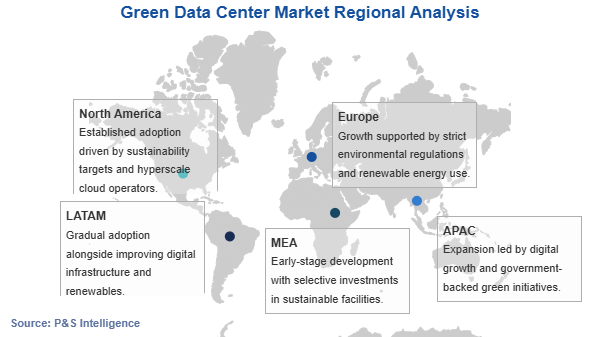
North America is the largest region with 40% share, driven by its well-established digital infrastructure as a result of high enterprise adoption of sustainability initiatives and the increased emphasis on regulatory requirements to achieve energy efficiency. The growth of corporate use of renewable energy sources, along with federal and local government energy incentives and certifications promoting the operation of environmentally responsible data centers are also contributing factors.
U.S. Green Data Center Market Growth
U.S. dominance is based on the widespread use of green building standards and laws that regulate Datacenter energy usage among all datacenters in the U.S. Datacenters are concentrated in three main areas (Silicon Valley, Virginia, and Texas) where the datacenter operators have developed very large clusters of datacenters with the use of renewable energy contracts. Utility partnerships and corporate sustainability programs help provide cooling and power systems with energy efficiency through the use of renewable energy.
The federal government also provides financial incentives through tax credits and energy efficiency grants to stimulate investment in low carbon infrastructure. According to the U.S. Environmental Protection Agency (EPA), major tech and telecom companies consumed nearly 47.7 billion kWh of green power annually in 2024, demonstrating the large scale of renewable adoption in U.S. data centers.
Canada Green Data Center Market Growth
With abundant supplies of renewable energy and hydro-electricity, Canada has become one of the fastest growing markets for green data centers. The demand for energy-efficient systems is driven by government policy promoting carbon neutrality, the need for strict energy reporting, and the growing number of large data center operators in Toronto, Montreal, and Vancouver that are using modular and prefabricated designs to reduce their impact on the environment.
In addition to providing incentives to companies for the integration of clean energy, the deployment of low-carbon data center infrastructure is being supported by cross-border partnerships with U.S. firms due to the rapid rate of digital transformation in areas such as government services, banking, and healthcare. According to Hydro-Québec, over 99.8% of the electricity supplied to Quebec’s data center network is generated from renewable sources, making Canada a major destination for low-carbon data center deployments.
Asia-Pacific Green Data Center Market Analysis
APAC has the highest CAGR, of 19.4%, due to digital innovation, rapid expansion of industry, and increasing sustainability laws. Diverse infrastructure maturity and strong government incentives supporting carbon-free initiatives are incentives causing an increase in renewable technology investments for both metropolitan and secondary metropolis areas, as well as the installation of efficient cooling systems and modular designs.
China Green Data Center Market Growth
China is leading APAC's green data center market due to the country's strong carbon-neutrality and energy-efficient targets for computing infrastructure. Hyperscale data centers and enterprise data centers use renewable energy to power their advanced monitoring, cooling, and power systems. The Chinese government has put in place energy-performance mandates and created an industrial park for the development of green computing, which allows for low-carbon designs to be implemented locally. These large companies in China also partner with utility companies to optimize their grid and utilize smart energy management platforms for efficient operations. China’s East Data, West Computing project has driven over 200 billion yuan in investment, building a national green computing network powered by renewable energy.
India Green Data Center Market Growth
The Indian market for green data centers will continue to grow rapidly due to government-sponsored programs that promote the use of renewable energy, the emergence of new data center technologies, rapid growth of data from IT and telecommunications companies, and the emergence of smart and sustainable energy production through partnerships between public and private sectors. In Mumbai, Bangalore, and Hyderabad, modular design and energy-efficient cooling are being leveraged with advanced monitoring systems to reduce carbon emissions.
Digital transformation in industries such as banking, e-commerce and government have created increased demand for distributed green data centers throughout India. In India, nearly 49% of total energy consumed by core data center facilities was transitioned to renewable sources in FY 2024–25, reflecting the rapid shift toward sustainable infrastructure.
The regions and countries analyzed in this report are:
North America (Largest Regional Market)
U.S. (Larger Country)
Canada (Faster-Growing Country)
Europe
Germany (Largest Country)
U.K. (Fastest-Growing Country)
France
Italy
Spain
Rest of Europe
Asia-Pacific (Fastest-Growing Regional Market)
China (Largest Country)
India (Fastest-Growing Country)
Japan
South Korea
Australia
Rest of APAC
Latin America
Brazil (Largest Country)
Mexico (Fastest-Growing Country)
Rest of LATAM
Middle East and Africa
Saudi Arabia (Largest Country)
U.A.E. (Fastest-Growing Country)
South Africa
Rest of MEA
Green Data Center Market Competitive Landscape
The green data center market is highly fragmented due to the presence of many different technology providers, services providers, infrastructure integrators, and consulting firms. As a result of the many different ways to implement sustainable practices in this industry, the green data center marketplace is very diverse in terms of how vendors approach sustainability. Some vendors specialize in certain technologies for cooling systems, energy management, network optimization, environmental monitoring, etc., while others focus on services such as performing energy audits, compliance consulting, and building modular green data centers.
The marketplace also includes many different types of data centers such as hyperscale, colocation and edge facilities each with its own unique operational and sustainability priorities. Because of geographic differences in regulatory requirements, energy costs, and corporate environmental policies, buyers, preferences vary considerably from region to region, resulting in a situation where there are many smaller and mid-sized players, as well as larger infrastructure providers, that compete with each other for the same customers. Therefore, because of the many different ways to adopt sustainable practices and the ever-changing sustainability criteria, the fragmentation of the green data center marketplace continues as the defining characteristic of this market.
Green Data Center Market News
In January 2026, Alphabet announced the acquisition of Intersect, an energy specialist firm, to help secure diverse and sustainable energy sources for its data center network infrastructure.
In September 2025, JERA Group signed an agreement with Google to supply environmental value through a solar power purchase framework for Google’s data center in Japan, advancing renewable energy sourcing.
In August 2025, Equinix announced issuance of green bonds in Singapore to further support its sustainability initiatives and fund environmentally focused projects within its data center operations.
In June 2025, DayOne Data Centers signed a renewable energy supply contract with Tenaga Nasional Berhad to secure clean energy for its Malaysian data center campuses, under the national clean energy scheme.
In April 2025, NTT DATA released its first sustainability report for its global data centers division, outlining environmental stewardship efforts and progress toward lower emissions in data center operations.
Want a report tailored exactly to your business need?
Leading companies across industries trust us to deliver data-driven insights and innovative solutions for their most critical decisions. From data-driven strategies to actionable insights, we empower the decision-makers who shape industries and define the future. From Fortune 500 companies to innovative startups, we are proud to partner with organisations that drive progress in their industries.
Client Testimonials
Working with P&S Intelligence and their team was an absolute pleasure – their awareness of timelines and commitment to value greatly contributed to our project's success. Eagerly anticipating future collaborations.
McKinsey & Company
India
Unmatched Standards
Our insights into the minutest levels of the markets, including the latest trends and competitive landscape, give you all the answers you need to take your business to new heights
Complete Data Security
We take a cautious approach to protecting your personal and confidential information. Trust is the strongest bond that connects us and our clients, and trust we build by complying with all international and domestic data protection and privacy laws