This Report Provides In-Depth Analysis of the Graphite Thermal Management Materials Market Report Prepared by P&S Intelligence, Segmented by Material Type (Synthetic Graphite, Natural Graphite, Graphite Composites), Product Form (Sheets and Films, Foils and Tapes, Panels and Modules), Application (Consumer Electronics, Automotive and Mobility, Telecommunications and Data Centers, Industrial Equipment, Aerospace and Defense, Healthcare and Other Applications), and Geographical Outlook for the Period of 2021 to 2032
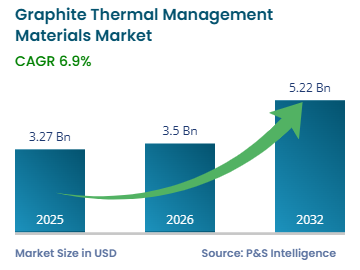
The graphite thermal management materials market size was USD 3.27 billion in 2025 and is estimated at USD 3.50 billion in 2026. It is projected to reach USD 5.22 billion by 2032, advancing at a CAGR of 6.9% during 2026–2032. Demand is shifting from stand-alone heat-spreading sheet toward engineered combinations that distribute heat across thinner devices, higher-power electronics, batteries, and tightly packaged assemblies.
Consumer electronics remains the largest application because smartphones, tablets, computers, displays, and wearables combine high production volumes with persistent constraints on thickness and surface temperature. Automotive and mobility is the fastest-growing application as battery packs, power electronics, infotainment, displays, and ADAS add thermal-design points per vehicle.
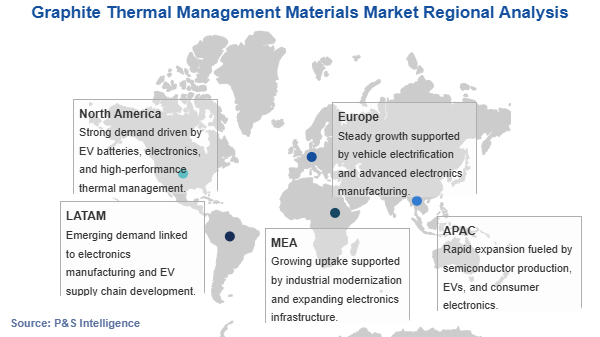
Asia-Pacific held 52% of the Graphite Thermal Management Materials Market share in 2025 and is expected to expand at 7.3% annually over 2026–2032. Its position reflects the region's concentration of electronics manufacturing and graphite-material conversion. Latin America is forecast to grow fastest, at 8.4%, from a smaller 2025 base as local electronics, vehicle, and digital-infrastructure investment broadens addressable demand.
Key Market Insights
By material type, synthetic graphite held 60% in 2025, while graphite composites are projected to record a 9.3% CAGR during 2026–2032.
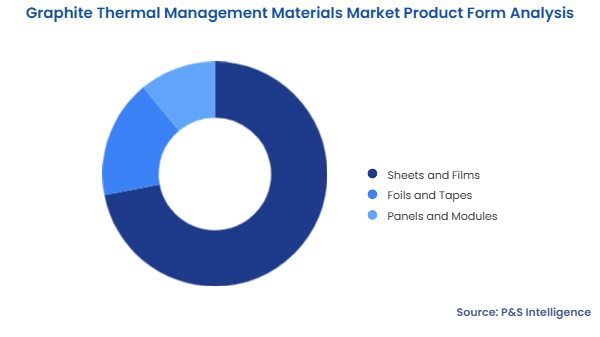
By product form, sheets and films accounted for 72% in 2025, while panels and modules are forecast to rise at a 9.7% CAGR during 2026–2032.
By application, consumer electronics represented 55% in 2025, while automotive and mobility is projected to expand at a 10.1% CAGR during 2026–2032.
By geography, Asia-Pacific led with 52% in 2025, while Latin America is expected to post the fastest CAGR of 8.4% during 2026–2032.
The graphite thermal management materials market analysis by material type shows synthetic graphite accounting for 60% of revenue in 2025. Its leading position reflects high and controllable in-plane conductivity, thin-gauge availability, and established use in compact electronics. Panasonic Industry lists PGS grades reaching 1,850 W/m·K in-plane, a performance level that supports rapid lateral heat spreading where designers have little space for metal structures. The specification explains technical suitability, not the modeled market share.
Graphite Composites are projected to expand at a 9.3% CAGR during 2026–2032. Growth is supported by designs that join graphite to metal, polymer, adhesive, or phase-change layers so that spreading, contact, insulation, and mounting can be addressed in one qualified part. Natural Graphite remains relevant where flexibility, conformability, broad temperature tolerance, and lower material cost outweigh the need for the highest conductivity.
Product Form
Sheets and films held 72% of the market in 2025. The form fits established roll processing, lamination, encapsulation, and die cutting across high-volume electronics. Shenzhen FRD Science & Technology lists graphite film from 0.017 mm to 0.1 mm thick and from 300 W/m·K to 1,850 W/m·K in-plane, illustrating the wide design window available to converters and OEMs.
Panels and modules are forecast to grow at a 9.7% CAGR during 2026–2032. Their advance reflects buyer demand for more integrated thermal paths in batteries, servers, industrial power electronics, and vehicle systems. Encapsulation and graphite-metal construction can reduce handling risk and shift interface engineering upstream, although the higher value per part depends on validation for a specific assembly.
Application
Consumer electronics represented 55% of revenue in 2025. Worldwide smartphone shipments reached about 1.26 billion in 2025, giving graphite producers a large annual pool of designs in which thinness, low weight, and surface-temperature control matter. The shipment figure supports the size of the design opportunity and does not imply universal graphite content in every device.
Automotive and mobility is projected to rise at a 10.1% CAGR during 2026–2032. Global electric-car sales exceeded 20 million in 2025, up 20% from 2024, according to the International Energy Agency. More electric vehicles increase the addressable set of batteries, power electronics, chargers, displays, and ADAS hardware, although graphite must still win each thermal location against metals, ceramics, greases, pads, and active cooling.
The complete segmentation hierarchy is as follows.
Material Type
Synthetic Graphite
Pyrolytic Graphite Sheet
Graphitized Polyimide Film
Other Engineered Synthetic Graphite
Natural Graphite
Expanded Natural Graphite Sheet
Compressed Flexible Graphite Foil
Graphite Composites
Graphite-Metal Laminates
Graphite-Polymer Composites
Graphite-Phase-Change-Material Hybrids
Product Form
Sheets and Films
Ultra-Thin Sheets and Films
Multilayer and Die-Cut Sheets
Foils and Tapes
Rolled Foils
Adhesive-Backed Tapes
Panels and Modules
Encapsulated Graphite Panels
Graphite-Metal Heat-Spreader Modules
Application
Consumer Electronics
Smartphones and Tablets
PCs and Displays
Wearables and Gaming Devices
Automotive and Mobility
Battery and Power Electronics
Infotainment, Displays, and ADAS
Telecommunications and Data Centers
Network and 5G Equipment
Servers and Data-Center Hardware
Industrial Equipment
Power Electronics and Automation
Semiconductor and LED Equipment
Aerospace and Defense
Healthcare and Other Applications
Drive strategic growth with comprehensive market analysis
Asia-Pacific led with 52% of global revenue in 2025 and is projected to grow at a 7.3% CAGR during 2026–2032. Electronics assembly, component supply, graphite-film conversion, and end-device manufacturing are concentrated across China, Japan, South Korea, India, and Southeast Asia. National electronics production reached about USD 133 billion in FY2024–25 after a 20.91% CAGR from FY2021–22, according to India's Ministry of Electronics and Information Technology. The national figure does not establish a regional market total, but it supports the continuing expansion of an important demand base. Asia-Pacific should remain largest, although its share could soften if device assembly and qualified conversion capacity diversify to other regions.
Latin America represented 6% of revenue in 2025 and is expected to deliver the fastest Graphite Thermal Management Materials Market growth, at 8.4% annually over 2026–2032. Expansion starts from a small base and depends on electronics assembly, automotive electrification, telecom equipment, and data infrastructure. The region remains import-dependent for many advanced graphite forms, so exchange-rate volatility, logistics costs, and limited local qualification capacity can interrupt adoption. Its share should rise modestly if investment programs convert into operating hardware demand. A slowdown in electronics and vehicle investment would pull performance below the model.
China generated 44% of Asia-Pacific revenue in 2025. Output reached 1.27 billion smartphones, 332 million microcomputers, and 484.3 billion integrated circuits in 2025, according to the Ministry of Industry and Information Technology. The production density supports local qualification, conversion, and delivery of thin graphite materials across consumer and industrial electronics. China is expected to retain the largest country position in the region. Its lead could narrow if OEM supply chains relocate materially or domestic device output contracts over several cycles.
Brazil held 46% of Latin American revenue in 2025 and is projected to advance at an 8.9% CAGR during 2026–2032. Its vehicle, electronics, telecom, and data-infrastructure base gives suppliers a broader set of applications than is available in many neighboring markets. National industrial production increased 0.6% in 2025, while the December reading showed weakness in motor vehicles and electronic and optical equipment, according to the Brazilian Institute of Geography and Statistics. The evidence supports an established, cyclical industrial base, not a direct graphite-demand total. Brazil should remain the regional center, but Mexico could close the gap if nearshoring-led electronics and automotive investment scales faster.
The regions and countries this report covers are listed below.
The graphite thermal management materials industry is fragmented. Global diversified-material companies compete with graphite specialists, Chinese high-volume film producers, and application-focused converters. No verified evidence supports a dominant company share, and purchasing decisions are dispersed across consumer devices, vehicles, network equipment, industrial systems, aerospace programs, and healthcare hardware. Buyers therefore compare suppliers by qualified performance, consistency, form factor, conversion support, regional delivery, and the ability to maintain a specification over a product cycle.
Panasonic Industry Co. Ltd. competes through thin PGS grades and compressible GraphiteTIM formats suited to design-in work. NeoGraf Solutions LLC emphasizes flexible-graphite interfaces and heat spreaders, while SGL Carbon SE combines natural-graphite foil with graphite-metal and phase-change-material structures. Toyo Tanso Co. Ltd. and Mersen SA address demanding temperature and purity requirements through flexible graphite portfolios. Shenzhen FRD Science & Technology Co. Ltd., JONES TECH PLC, Jiangsu Sidike New Materials Science and Technology Co. Ltd., and Suzhou Dasen Electronics Material Co. Ltd. add film, coating, lamination, die-cutting, and system-integration capabilities close to Asian electronics supply chains. Mitsubishi Chemical Corporation is developing thicker high-conductivity sheet concepts for heat-spreader applications.
Competition is likely to intensify at two levels. Standard sheet and foil grades face price, yield, and delivery pressure, while composites and modules compete on interface design, validation data, and manufacturing repeatability. Entry barriers are moderate for basic conversion but higher for graphitization, ultrathin handling, purity control, automotive qualification, and long-term supply assurance. The market rewards suppliers that can bridge materials science and application engineering. It also remains open to specialists because no single architecture satisfies every balance of conductivity, insulation, flexibility, thickness, and cost.
Leading Companies in the Graphite Thermal Management Materials Market:
Panasonic Industry Co. Ltd.
Kaneka Corporation
NeoGraf Solutions LLC
SGL Carbon SE
Toyo Tanso Co. Ltd.
Mersen SA
Nippon Carbon Co. Ltd.
Shenzhen FRD Science & Technology Co. Ltd.
JONES TECH PLC
Jiangsu Sidike New Materials Science and Technology Co. Ltd.
In March 2026, Mitsubishi Chemical Corporation showcased its thick, high-conductivity graphite sheet heat-spreader work at JEC World in Paris, including a laminated-sheet cooling comparison. The event advances an emerging product concept, with commercialization timing still unconfirmed.
In January 2026, Shenzhen FRD Science & Technology Co. Ltd. listed a liquid-cooling module for AI servers, new-energy vehicles, energy storage, and robots. The finished module sits outside the material-market boundary, but its launch shows a graphite-film supplier moving closer to integrated thermal-system customers.
Frequently Asked Questions About This Report
What is the graphite thermal management materials market size?+
The graphite thermal management materials market size was USD 3.27 billion in 2025 and is estimated at USD 3.50 billion in 2026.
Which region leads the market?+
Asia-Pacific held 52% of the graphite thermal management materials market share in 2025 and is expected to expand at 7.3% annually over 2026-2032.
Which region is growing fastest?+
Latin America is forecast to grow fastest, at 8.4%, from a smaller 2025 base as local electronics, vehicle, and digital-infrastructure investment broadens addressable demand.
What is the competitive structure of the market?+
The graphite thermal management materials industry is fragmented. Global diversified-material companies compete with graphite specialists, Chinese high-volume film producers, and application-focused converters.
Want a report tailored exactly to your business need?
Leading companies across industries trust us to deliver data-driven insights and innovative solutions for their most critical decisions. From data-driven strategies to actionable insights, we empower the decision-makers who shape industries and define the future. From Fortune 500 companies to innovative startups, we are proud to partner with organisations that drive progress in their industries.
Client Testimonials
Working with P&S Intelligence and their team was an absolute pleasure – their awareness of timelines and commitment to value greatly contributed to our project's success. Eagerly anticipating future collaborations.
McKinsey & Company
India
Unmatched Standards
Our insights into the minutest levels of the markets, including the latest trends and competitive landscape, give you all the answers you need to take your business to new heights
Complete Data Security
We take a cautious approach to protecting your personal and confidential information. Trust is the strongest bond that connects us and our clients, and trust we build by complying with all international and domestic data protection and privacy laws