Germany Solid-State Battery Market Size Forecast
Key Highlights
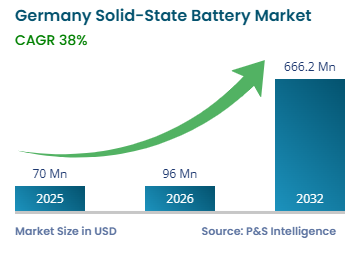
| Study Period | 2021 - 2032 |
| Market Size in 2025 | USD 70.0 Million |
| Market Size in 2026 | USD 96.0 Million |
| Market Size by 2032 | USD 666.2 Million |
| Projected CAGR | 38% |
| Largest State | North Rhine-Westphalia |
| Fastest-Growing State | Lower Saxony |
| Market Structure | Fragmented |
Market Size
Explore the market potential with our data-driven report
Germany Solid-State Battery Market Key Insights
- Thin-film batteries have the larger share, of 70%, and the highest CAGR, of 38.3%.
- Multi-cell configurations have the larger share, of 75%, and the highest CAGR, of 38.5%.
- Secondary (rechargeable) batteries have the largest share, of 70%, and the highest CAGR, of 38.7%.
- The 20 mAh–500 mAh category commanded the largest share in 2025, of 60%.
- The electric vehicle category has the highest CAGR during 2026–2032, of 38.8%.
- North Rhine-Westphalia holds the largest share of 40%.
- Lower Saxony is the fastest-growing state, with 38.9% CAGR.
Germany Solid-State Battery Market Analysis
The Germany solid-state battery market valued at USD 70.0 million in 2025, and it is projected to reach USD 666.2 million by 2032, expanding at a compound annual growth rate of 38.0% over the forecast period (2026–2032). This is due to the accelerating transition to electric mobility and the increasing deployment of stationary energy storage systems tied to the country's renewable energy expansion.
Solid-state batteries represent a fundamental architectural departure from conventional liquid electrolyte lithium-ion cells, replacing volatile liquid electrolytes with solid inorganic or polymer conductors. This enables potential energy densities exceeding 500 Wh/kg in advanced solid-state lithium batteries, along with improved thermal stability and up to 1,000 charge–discharge cycles with minimal capacity degradation. These characteristics address the persistent limitations in conventional battery technology that constrain EV adoption and grid storage deployment.
Germany's solid-state battery ecosystem is anchored by the high concentration of automotive OEMs and publicly funded applied research infrastructure. The German Federal Network Agency (Bundesnetzagentur) reported more than 2 million battery storage installations across Germany as of mid-2025 across the residential, commercial, and automotive segments.
Germany Solid-State Battery Market Trends & Drivers
Electrolyte Engineering Initiatives of Automotive OEMs Are Trending
Numerous automotive OEMS in Germany are extensively engaged in electrolyte engineering. Volkswagen AG, through its battery subsidiary, PowerCo SE, in Salzgitter, Lower Saxony, has established a non-exclusive licensing agreement with QuantumScape Corporation for ceramic oxide solid-state cells, targeting production capacity of 40–80 GWh annually. QuantumScape's QSE-5 cell features a proprietary anode-free lithium-metal architecture with ceramic separator. It has achieved an energy density of 844 Wh/L and a charge time of 12.2 minutes from 10% to 80% SoC in B-sample deliveries commencing October 2024.
Bayerische Motoren Werke AG is pursuing sulfide-based solid-state cells through a partnership with Solid Power, integrating test cells into the BMW i7 platform with energy density targeting 440 Wh/kg and range exceeding 800 kilometers. Similarly, Mercedes-Benz Group AG in Stuttgart is validating Factorial Energy's Solstice quasi-solid-state architecture following a September 2025 road test demonstrating 749-mile single-charge range.
Complementing OEM-led programs, the Fraunhofer Research Institution for Battery Cell Production FFB in Münster provides shared pilot-scale electrode, cell assembly, and module manufacturing lines accessible to multiple development-stage companies. Backed by approximately EUR 820 million in combined federal and state funding, the Fraunhofer FFB facility supports the transition from laboratory development to industrial deployment, thereby reducing capital barriers associated with prototype and pre-production battery manufacturing.
EU Battery Regulations and German EV Policy Framework Driving Adoption
The regulations governing battery development and deployment in Germany reflect EU-level mandates and national industrial policy commitments, accelerating solid-state battery adoption. EU Regulation 2023/1542 on Batteries and Waste Batteries establishes mandatory carbon footprint declarations for EV batteries from February 2025 and introduces minimum recycled content thresholds phasing in through 2031. These requirements create cost advantages for solid-state architectures the simplified electrolyte systems and reduced thermal management complexity of which lower per-cell carbon intensity relative to liquid-electrolyte alternatives.
Germany’s Federal Climate Protection Act mandates a 65% reduction in greenhouse gas emissions by 2030 relative to 1990 levels, while the country is also aligned with European Union regulations phasing out new internal combustion engine vehicle sales by 2035. This dual pressure on automotive OEMs to decarbonize both fleet operation and manufacturing creates a compounding demand signal for advanced battery technologies.
High Manufacturing Costs and Scalability Issues Restrain Market Growth
The German solid-state battery market faces material commercialization constraints centered on manufacturing economics that significantly limit near-term addressable market size. Current solid-state battery production costs range from USD 400 to 800 per kWh, depending on electrolyte chemistry and cell format. This is three-to-seven times more than conventional lithium-ion cells, which require approximately USD 115 per kWh to manufacture.
This is because solid electrolyte materials—particularly ceramic oxides and high-purity sulfides—require specialized precursor supply chains and processing conditions not yet established at commodity scale. Additionally, the solid-solid interfacial resistance at electrode-electrolyte boundaries requires precise stack pressure management and surface engineering that complicates manufacturing yield optimization. Moreover, dry-room production environments operating below dew points of −40°C impose substantially higher capital expenditure and operating cost burdens than those of conventional lithium-ion production.
Industry analysts and automotive OEM development roadmaps consistently position initial commercial solid-state battery production in Germany between 2027 and 2030. This could limit near-term adoption primarily to premium EVs, specialized wearables, and medical devices, where buyers accept a significant unit cost premium for performance and safety advantages.
Federal R&D Investment and Infrastructure Development Create Opportunities
Germany's federal and state R&D investment framework is creating the infrastructure foundation necessary to take solid-state battery technology from laboratory to commercial production. The Fraunhofer Research Institution for Battery Cell Production FFB has received EUR 750 million from the Federal Ministry of Education and Research and EUR 320 million from the State of North Rhine-Westphalia to establish an applied battery cell production research center. The facility has full-scale pilot lines for electrode manufacturing, cell assembly, and module integration, which are accessible to both established OEMs and development-stage companies. It provides shared pilot production infrastructure that systematically de-risks capital formation for solid-state battery development at all stages of the technology readiness spectrum.
Altech Batteries GmbH received binding conditional funding approval of EUR 46.11 million under Germany's federal STARK economic development program in January 2026. The funding is for its CERENERGY sodium-chloride solid-state battery manufacturing facility in Saxony, targeting 120 MWh of annual production capacity for grid-scale stationary storage.
Germany Solid-State Battery Market Segmentation Analysis
Type Analysis
Thin-film batteries held approximately 70% German solid-state battery market share in 2025, and they also have the higher CAGR, of 38.3%. This is due to their suitability for IoT devices, smartwatches, fitness bands, and connected medical patches, all of which witness high sales volumes across Germany. Thin-film architecture delivers a lower weight, higher energy density, minimal electrolyte leakage risk, and tighter packaging, which portable device manufacturers prioritize.
The European Commission's Horizon Europe program has directed targeted funding toward thin-film solid electrolyte research at German institutions, accelerating material development and reinforcing the technology's commercial readiness advantage over conventional portable designs. Essentially, their usage is driven by the rapid IoT deployment in industrial automation, smart packaging, and wearable health monitoring, where compact, non-flammable energy storage is a regulatory and safety prerequisite.
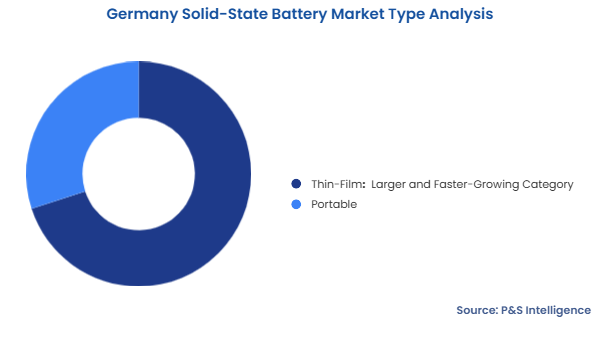
The market segments into the following types:
- Thin-Film (Larger and Faster-Growing Category)
- Portable
Cell Type Analysis
Multi-cell configurations held approximately 75% German solid-state battery market share in 2025, and they also have the higher CAGR, due to the strong demand from automotive OEMs and consumer electronics manufacturers. EV manufacturers require battery architectures capable of managing multiple electrochemical cells simultaneously and offer protection against undervoltage, overvoltage, overcurrent, and overtemperature. Germany's automotive industry relies on multi-cell solid-state formats to deliver the energy throughput required for extended EV driving ranges.
Laptop and energy backup manufacturers similarly depend on multi-cell designs for sustained power output. German automotive OEMs have increasingly complex battery management requirements, sustaining demand for high-capability multi-cell formats. Moreover, solid-state EV battery programs at PowerCo SE in Salzgitter and BMW's testing program with Solid Power will soon begin commercial production.
The market segments into the following cell types:
- Single-Cell
- Multi-Cell (Larger and Faster-Growing Category)
Rechargeability Analysis
Secondary (rechargeable) batteries hold the largest share in the German solid-state battery market in 2025, and they will have the higher CAGR, of 38.7%. This is owing to the rising demand for EVs, energy storage systems, and consumer electronics, all of which require repeated charge– discharge cycling and long lifespans. Germany's aggressive EV transition, supported by the European Union's 2035 ICE phase-out mandate, propels the demand for secondary solid-state cells that can withstand thousands of cycles without significant capacity degradation. The EU Regulation 2023/1542 on batteries and waste batteries establishes minimum performance and capacity retention thresholds for EV batteries, encouraging the adoption of advanced battery technologies capable of meeting stringent durability and lifecycle requirements.
Moreover, grid-scale energy storage deployments and increasing drone sales drive this category. By 2025, Germany’s total installed BESS capacity was approximately 25.5 GWh of usable energy and nearly 16 GW of gross power across 2.22 million registered storage systems. In 2025, approximately 526,000 new battery storage systems were added, contributing about 7.3 GWh of additional capacity.
Moreover, Germany added approximately 842 MW of grid-scale battery storage capacity in 2025, along with around 1.6 GWh of energy capacity, reflecting strong growth in large-scale storage deployment. According to the Federal Network Agency (BNetzA), there were about 9,710 grid connection requests for medium- and high-voltage battery storage systems in 2024. These represented around 400 GW of planned power capacity and roughly 660 GWh of planned storage capacity. Of these, about 3,800 requests were approved, covering approximately 25 GW of power capacity and 46 GWh of storage capacity.
The market segments into the following rechargeability categories:
- Primary
- Secondary (Larger and Faster-Growing Category)
Capacity Analysis
The 20–500 mAh category commanded the largest share of the German solid-state battery market in 2025, of 60%. This range meets the power requirements of smartwatches, IoT sensors, wearable medical monitors, wireless earbuds, and industrial tracking devices.
The below-20 mAh category is expected to register the fastest CAGR during 2026–2032, fueled by the expanding deployment of wireless sensor networks, smart packaging applications, transdermal medical patches, and RFID-based logistics systems. In Germany, government-backed initiatives such as smart mobility and industrial IoT programs are driving the adoption of ultra-compact, low-power devices, supporting demand in the below-20 mAh segment.
The market segments into the following capacity categories:
- Below 20 mAh (Fastest-Growing Category)
- 20 mAh–500 mAh (Largest Category)
- Above 500 mAh
Application Analysis
Portable consumer electronics captured the largest share of the German solid-state battery market in 2025, ascribed to the country's high per-capita consumption of smartphones, laptops, tablets, digital cameras, and wearable devices. Electronics manufacturers prefer solid-state batteries for their superior energy density, safety, and form-factor advantages over liquid electrolyte alternatives. Germany's robust retail electronics sector and its role as a major European distribution hub drive battery sales.
The electric vehicle category is projected to register the highest CAGR during 2026–2032. PowerCo SE is targeting Gigawatt-hour-scale solid-state production through its QuantumScape licensing partnership, while BMW is integrating Solid Power cells into the i7 platform, and Mercedes-Benz is advancing Factorial Energy's Solstice architecture toward commercial deployment before 2030. Germany’s public EV charging network expanded rapidly to nearly 146,000 points by mid-2024, with infrastructure growth outpacing new EV registrations. According to the Federal Network Agency (Bundesnetzagentur), Germany had 154,037 publicly accessible EV charging points by the end of 2024. This encourages people to purchase EVs, in turn, prompting OEMs to augment battery procurement.
In 2025, Germany produced a record 1.67 million EVs, an increase of about 23% compared with 2024, according to the German Association of the Automotive Industry (VDA). Of these, approximately 1.22 million were BEVs, and around 450,000 were PHEVs. In all, EVs accounted for roughly 40% of the country’s passenger car production. Federal Motor Transport Authority (KBA) data shows that about 545,142 new BEVs were registered in 2025, representing a 43.2% YoY increase and making up 19.1% of the new car registrations. As of 1 January 2025, Germany had approximately 1.65 million BEVs and about 900,000 plug-in hybrids in circulation, comprising around 5.2% of the passenger car fleet.
The market segments into the following applications:
- Portable Consumer Electronics (Largest Category)
- Electric Vehicles (Fastest-Growing Category)
- Energy Harvesting
- Wearables & Medical Devices
- Others
Drive strategic growth with comprehensive market analysis
Germany Solid-State Battery Market Geographical Analysis
North Rhine-Westphalia Solid-State Battery Market Analysis
North Rhine-Westphalia holds the largest share of the German solid-state battery market, of 40%, anchored by the high concentration of battery manufacturing activity, applied research infrastructure, and grid-scale deployment projects. The state leads Germany in new battery storage installations, recording approximately 10,900 new units between January and July 2025, according to the International Economic Forum for Renewable Energies (IWR) and the Federal Network Agency's Marktstammdatenregister. North Rhine-Westphalia is home to the Fraunhofer Research Institution for Battery Cell Production FFB in Münster, backed by EUR 750 million from the Federal Ministry of Research and EUR 320 million from the state government.
HOPPECKE Batterien GmbH & Co. KG, headquartered in Brilon; and the MEET Battery Research Center at the University of Münster further anchor the state's solid-state ecosystem. NRW's former power plant sites, strong industrial infrastructure, and grid connection assets are enabling a structural transition from legacy power generation toward battery storage hub status, a trajectory expected to deepen through 2030 as grid-scale and SSB-integrated storage projects multiply.
Lower Saxony Solid-State Battery Market Share
Lower Saxony is the fastest-growing state, with 38.9% CAGR, driven primarily by the commissioning of the PowerCo SE Gigafactory in Salzgitter in late 2025 with initial capacity of 20 GWh, expandable to 40 GWh. Moreover, Volkswagen AG is expanding battery R&D at its Salzgitter facility, with a new test field operational in 2026 that may support next-generation technologies, including solid-state batteries. PowerCo and QuantumScape extended their licensing collaboration in July 2025 to accelerate QSE-5 solid-state battery development and industrialization, enabling gigawatt-hour-scale production. The state government of Lower Saxony has actively endorsed battery cell production as a strategic industrial pillar.
The states analyzed in this report include:
- North Rhine-Westphalia (Largest State Market)
- Bavaria
- Baden-Württemberg
- Lower Saxony (Fastest-Growing State Market)
- Rest of Germany
Germany Solid-State Battery Market Share
The German solid-state battery market is highly fragmented, with no single player commanding dominant market share across all segments. This is because solid electrolyte technologies are still at the nascent stage and differentiated by chemistry type and application. Capital intensity in solid-state cell development requires multi-year R&D investment cycles and pilot-scale production infrastructure. This has concentrated serious activity among a relatively small number of well-capitalized automotive groups and their technology partners.
On the other hand, the broader supplier and component ecosystem remains distributed across dozens of specialized firms. Competitive intensity is shaped more by technology access and institutional partnerships than by price competition. The competitive landscape is expected to consolidate incrementally as commercial production timelines converge and capital deployment requirements escalate beyond the capacity of smaller research-stage entities.
Leading Companies in the Germany Solid-State Battery Market:
- Robert Bosch GmbH
- Volkswagen AG
- Bayerische Motoren Werke AG
- Mercedes-Benz Group AG
- PowerCo SE
- VARTA AG
- Theion GmbH
- Solid Power Inc.
- QuantumScape Corporation
- ProLogium Technology Co. Ltd.
- Sakuu Corporation
- Samsung SDI Co. Ltd.
- Panasonic Holdings Corporation
- LG Chem Ltd.
- Toyota Motor Corporation
- Factorial Energy
- Altech Batteries GmbH
Germany Solid-State Battery Market News
- In January 2026, Altech Batteries GmbH received binding conditional funding approval of EUR 46.11 million from Germany's Federal Ministry for Economic Affairs and Climate Protection under the STARK economic development program for the 120-MWh CERENERGY sodium-chloride solid-state battery project in Schwarze Pumpe, Saxony.
- In December 2025, PowerCo SE commissioned the Salzgitter Gigafactory with an initial annual capacity of up to 20 GWh of Unified Cell prismatic batteries, expandable to 40 GWh. The expansion of the co-located solid-state cell R&D and validation center, housing a new test field, was scheduled to commence operation in early 2026.
- In October 2025, QuantumScape Corporation commenced the delivery of B1 samples of its QSE-5 solid-state battery cell, featuring an energy density of 844 Wh/L and a charge time of 12.2 minutes from 10% to 80% SoC. They are produced using the Cobra ceramic separator process.
- In September 2025, Mercedes-Benz Group AG completed a long-distance validation test in which a prototype EQS sedan equipped with a Factorial Energy solid-state battery traveled 749 miles (approximately 1,205 kilometers) on a single charge.
- In September 2025, PowerCo SE and QuantumScape Corporation conducted a live demonstration of a Ducati all-electric motorcycle with up to 980 QSE-5 solid-state lithium-metal cells in Munich. They also expanded their strategic licensing arrangement, providing up to USD 131 million in new milestone-based payments over two years to fund accelerated industrialization and higher-volume cell deliveries.