This Report Provides In-Depth Analysis of the Germanium Market Report Prepared by P&S Intelligence, Segmented by Product Type (Germanium Tetrachloride, High-Purity GeO2, Germanium Ingot), Application (Fiber Optics, Infrared Optics, Electronics & Solar, Polyethylene Terephthalate), End-Use Industry (Telecommunications, Electronics & Semiconductors, Solar Energy, Defense & Aerospace), and Geographical Outlook for the Period of 2019 to 2032
Explore the market potential with our data-driven report
Germanium Market Analysis
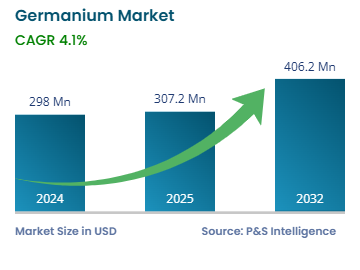
The global germanium market was valued at USD 298 million in 2024, which is predicted to reach USD 406.2 million by 2032, growing at a CAGR of 4.1% during 2025–2032.
This steady expansion is primarily driven by the accelerating deployment of fiber-optic networks for 5G telecommunications infrastructure, rising demand from the renewable energy sector for high-efficiency solar cells, and growing applications in infrared optics for defense and aerospace industries. The market's growth trajectory reflects germanium's critical role as a strategic material in enabling next-generation technologies across multiple high-value sectors.
Germanium tetrachloride serves as a crucial dopant in optical fiber production, enabling low-loss signal transmission for high-speed data networks. The rapid expansion of 5G networks globally has created unprecedented demand for germanium-based optical fibers, as telecommunications operators invest heavily in network densification to support enhanced mobile broadband, ultra-reliable low-latency communications, and massive machine-type communications. Furthermore, the increasing adoption of cloud computing services, streaming platforms, and Internet of Things applications continues to drive data center expansions, which rely extensively on germanium-enhanced fiber optic interconnects for high-bandwidth data transmission.
According to the IEA, global renewable capacity is expected to grow by about 2.7 times by 2030, with solar energy leading this expansion. In 2023, solar photovoltaic (PV) generation saw a remarkable increase of 320 TWh, representing a 25% rise, and surpassing 1,600 TWh. Germanium substrates remain the preferred choice for high-efficiency multijunction solar cells in space applications and concentrated photovoltaics, because their superior electrical performance and radiation resistance justify the higher cost.
Germanium Market Emerging Trends & Growth Drivers
Technological Advancements in Semiconductor Applications Are Key Trend
The use of germanium in semiconductor technology has significantly increased due to its superior electron and hole mobility over traditional silicon, enabling faster and more efficient transistors and logic devices.
Germanium is being increasingly integrated into next-generation semiconductor structures such as gate-all-around field-effect transistors (GAAFETs) and complementary field-effect transistors (CFETs), which are essential for scaling down chip sizes, while enhancing performance and power efficiency.
Germany is allocating EUR 2 billion under the European Chips Act to strengthen its semiconductor ecosystem and reduce reliance on Asian suppliers.
The development of silicon–germanium (SiGe) alloys has enabled higher switching speeds and reduced power consumption in analog and RF integrated circuits.
This further expands germanium’s presence in high-speed computing and 5G infrastructure.
In quantum computing, germanium-based materials are being explored for developing spin qubits and heterostructures, as they exhibit long coherence times and compatibility with existing semiconductor manufacturing processes.
As demand for energy-efficient and high-frequency devices surges, especially in sectors like automotive electronics, AI hardware, and defense electronics, germanium’s role in ensuring low-power, high-speed performance continues to solidify.
Tower Semiconductor announced USD 350 million in investment to expand the production of silicon–germanium and photonics technologies, supporting applications in AI, autonomous vehicles, and high-performance computing.
The upgrades span facilities in San Antonio, Migdal Haemek, and Uozu.
Advanced manufacturing methods and process integration improvements are reducing material wastage and increasing the purity levels of germanium wafers, making them more cost-effective and viable for large-scale semiconductor applications.
Expansion of 5G Networks and Fiber Optic Infrastructure Is Accelerating Market Growth
Germanium plays a critical role in fiber-optic cables.
Germanium dioxide (GeOâ‚‚) and germanium tetrachloride (GeClâ‚„) are used to elevate the refractive index of optical fibers, enabling faster data transmission over long distances with minimal signal loss.
A Deloitte study estimates that over USD 130–150 billion will be invested in fiber infrastructure in the U.S. within the next 5–7 years to support broadband competition, rural coverage, and 5G densification.
The rapid deployment of 5G networks is driving a dramatic surge in demand for high-performance fiber-optic infrastructure, which in turn boosts consumption of germanium-based materials.
As telecom providers worldwide invest heavily in fiber backhaul for 5G (connecting cell towers to core networks), the need for germanium-doped fibers intensifies sharply.
The German government has launched its Gigabit Strategy 2030 with funding of around EUR 6 billion to deliver nationwide fiber-to-the-home (FTTH) and full 5G coverage.
This aggressive push for digital infrastructure directly supports germanium demand, especially for GeClâ‚„, which is used in fiber production.
The global consumption of germanium tetrachloride (used in fiber optics) is supported by the rising deployment of FTTH networks, data centers, and submarine cable networks.
High-purity germanium products, particularly GeClâ‚„, are essential for modern telecommunications infrastructure, further reinforcing the strategic importance of germanium.
The Chinese government invested over USD 170 billion (RMB 1.2 trillion) into new infrastructure projects in 2024, with significant portions directed to 5G networks and optical fiber expansions.
Given China’s dominance in germanium refining, such investments not only boost domestic consumption but also bring down global prices and expand availability.
Germanium Market Segmentation Analysis
Product Type Analysis
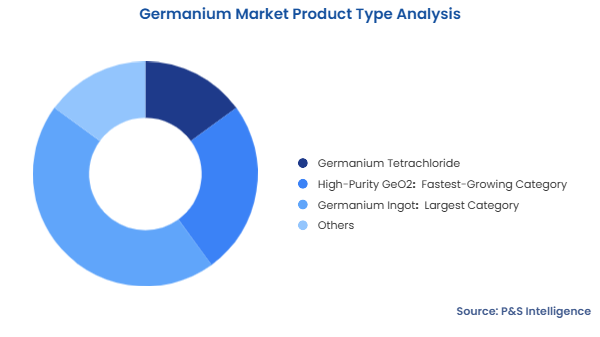
The germanium ingot category commanded the largest market share in 2024, of 45%, primarily due to its fundamental role as the starting material for various high-value applications. Germanium ingots serve as the primary feedstock for manufacturing semiconductor wafers, infrared optical components, and specialized electronic devices. The dominance of this category reflects the integrated nature of the germanium value chain, where ingots undergo further processing into specific end-use products.
Major consumers include semiconductor manufacturers requiring high-purity germanium for epitaxial substrates and infrared optics producers manufacturing lenses and windows for thermal imaging systems. The consistent demand from these established industries, combined with stringent quality requirements that favor integrated supply chains, maintains the ingot category's market leadership position.
The high-purity germanium dioxide category is experiencing the fastest growth trajectory, during 2025–2032. This rapid expansion is driven by the surging demand for optical fiber production, where germanium dioxide serves as a critical dopant material for achieving desired refractive index profiles. As per the IEA, U.S. renewable energy expansion could more than double over 2024–2030 to almost 500 GW, propelled by generous Inflation Reduction Act (IRA) stimulus in the form of tax incentives, creating additional demand for germanium in solar applications.
The category benefits from the global telecommunications infrastructure upgrade cycle, as network operators deploy extensive fiber optic networks to support 5G services and growing data traffic. Furthermore, the increasing adoption of germanium dioxide in catalyst applications for polyethylene terephthalate production and specialized glass manufacturing contributes to category growth. The technical advantages of high-purity germanium dioxide, including precise dopant control and minimal impurity levels, justify premium pricing and encourage continued investment in production capacity expansion.
These product types are covered:
Germanium Tetrachloride
High-Purity GeO2 (Fastest-Growing Category)
Germanium Ingot (Largest Category)
Others
Application Analysis
The fiber optics category dominated the germanium market in 2024, capturing 40% share, driven by the global telecommunications infrastructure transformation. The deployment of 5G networks worldwide has created unprecedented demand for optical fibers, where germanium tetrachloride serves as an essential dopant for controlling refractive index profiles. As per studies, the global government and industry spending on 5G infrastructure is projected to exceed USD 600 billion by 2030, driven by massive telecom operator investments, national rollout programs, and spectrum licensing revenues.
This application benefits from the continuous expansion of data center interconnects, submarine cable systems, and metropolitan area networks supporting cloud computing and streaming services. The technical requirements for ultra-low latency and high-bandwidth communications in 5G networks necessitate premium optical fibers with precise germanium doping, ensuring sustained demand growth throughout the forecast period.
The electronics & solar category exhibits the highest growth potential, during 2025–2032. This acceleration is attributed to the increasing adoption of germanium in high-efficiency multijunction solar cells for space applications and concentrated photovoltaics. In 2024, solar PV and wind generation together surpass hydropower generation, highlighting the renewable energy sector's expansion that drives germanium demand.
The semiconductor industry's growing interest in germanium for advanced transistors, photodetectors, and quantum computing applications further propels category growth. Additionally, the development of germanium-based materials for next-generation battery technologies and thermoelectric devices opens new market opportunities. The convergence of renewable energy adoption, semiconductor innovation, and emerging technology applications positions this category for sustained expansion beyond traditional market boundaries.
These applications are covered:
Fiber Optics (Largest Category)
Infrared Optics
Electronics & Solar (Fastest-Growing Category)
Polyethylene Terephthalate
Others
End-Use Industry Analysis
The telecommunications sector emerged as the largest category in 2024, accounting for 40% of the global germanium sales revenue. This dominance reflects the industry's massive capital investments in network infrastructure modernization to support 5G deployments and increasing data traffic. Telecommunications operators worldwide are expanding fiber optic networks to enable enhanced mobile broadband services, fixed wireless access, and enterprise connectivity solutions. The sector's growth is further supported by government initiatives promoting digital infrastructure development and broadband accessibility.
The defense & aerospace category demonstrates the fastest growth trajectory, during 2025–2032. This expansion is driven by the increasing defense budgets globally, modernization of military equipment, and growing emphasis on surveillance and reconnaissance capabilities. As per the Stockholm International Peace Research Institute (SIPRI), in 2024, global military expenditure reached USD 2.718 trillion, marking a 9.4% real-term increase compared to the previous year—the steepest annual rise since at least the end of the Cold War.
The category benefits from the proliferation of unmanned aerial vehicles requiring thermal imaging systems, satellite deployments necessitating radiation-resistant solar cells, and advanced missile guidance systems incorporating germanium-based infrared sensors. As of August 2025, India has placed orders for 31 MQ-9B drones, 87 medium-altitude, long-endurance (MALE) drones, and 450 Nagastra-1R loitering munitions for around USD 8.1 billion (INR 67,000 crore).
The dual-use nature of many germanium applications, serving both military and civilian markets, provides additional growth opportunities through technology transfer and commercialization of defense innovations. Rising geopolitical tensions and the strategic importance of infrared technologies in modern warfare ensure sustained investment in germanium-based defense systems.
These end-use industries are covered:
Telecommunications (Largest Category)
Electronics & Semiconductors
Solar Energy
Defense & Aerospace (Fastest-Growing Category)
Others
Drive strategic growth with comprehensive market analysis
Germanium Market Regional Market Performance
Asia-Pacific Germanium Market Share
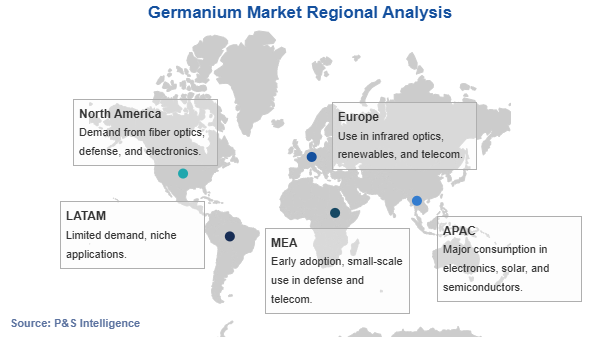
The Asia-Pacific region dominated the global germanium market in 2024, commanding 40% share. China's position as the world's largest germanium producer and consumer underpins regional dominance, with the country accounting for approximately 70% of global primary germanium production from zinc smelting byproducts and coal fly ash recovery. The region's supremacy is reinforced by its massive telecommunications infrastructure investments, where China, Japan, and South Korea lead global 5G network deployments. The rapid industrialization and technological advancement across Asia-Pacific nations drive diverse germanium applications.
South Korea's dominant position in consumer electronics and display technologies creates demand for germanium-based materials in advanced manufacturing processes. Furthermore, India's expanding telecommunications network and growing solar energy sector represent emerging growth markets within the region. The concentration of electronic device manufacturing, coupled with increasing defense spending across Asian nations, ensures the region's continued dominance in germanium consumption throughout the forecast period.
China Germanium Market Share
China is set to cement its position as the global renewable’s leader, accounting for 60% of the expansion in global capacity to 2030, creating substantial demand for germanium in solar cell applications. China's domestic semiconductor industry development, supported by government initiatives to achieve technological self-sufficiency, has increased demand for high-purity germanium materials. Japan's leadership in optical technologies and precision manufacturing maintains steady consumption of germanium for infrared optics and specialized electronic components.
North America Germanium Market Outlook
North America represents the fastest-growing regional market for germanium, projected to achieve a CAGR of approx. 4.5% during 2025–2032. The U.S. drives regional growth through substantial investments in telecommunications infrastructure modernization, defense capabilities enhancement, and renewable energy deployment. The implementation of the Infrastructure Investment and Jobs Act has allocated significant funding for broadband expansion, directly supporting fiber optic network deployments that consume germanium-based materials. Additionally, the Department of Defense's focus on maintaining technological superiority has increased procurement of advanced infrared systems and satellite technologies incorporating germanium components.
Europe Germanium Market Size
Europe held a 20% share of the global germanium market in 2024. The European Union's digital transformation agenda and Green Deal initiatives drive demand for germanium across multiple applications. The region's commitment to achieving widespread fiber-to-the-home coverage by 2030 necessitates substantial optical fiber deployments, supporting germanium consumption in telecommunications infrastructure. Germany leads regional demand through its advanced manufacturing sector, which utilizes germanium in semiconductor production, infrared optics manufacturing, and specialized industrial applications.
The regions and countries analyzed in this report are:
North America (Fastest-Growing Regional Market)
U.S. (Larger Country Market)
Canada (Faster-Growing Country Market)
Europe
Germany (Largest Country Market)
U.K. (Fastest-Growing Country Market)
France
Italy
Spain
Rest of Europe
Asia-Pacific (Largest Regional Market)
Japan
China (Largest Country Market)
India (Fastest-Growing Country Market)
South Korea
Australia
Rest of APAC
Latin America
Brazil (Largest Country Market)
Mexico (Fastest-Growing Country Market)
Rest of LATAM
Middle East and Africa
Saudi Arabia (Largest Country Market)
South Africa
U.A.E. (Fastest-Growing Country Market)
Rest of MEA
Germanium Market Share Analysis
The global germanium market exhibits a consolidated structure, this concentration reflects the capital-intensive nature of germanium production, technical expertise requirements, and limited availability of germanium-bearing raw materials. The market structure is characterized by vertical integration, with leading players maintaining operations across mining, refining, and product manufacturing to ensure supply security and quality control. Chinese companies dominate primary production, leveraging access to zinc smelting byproducts and coal fly ash resources, while Western companies focus on high-value downstream applications and recycling operations.
Market leadership is maintained through technological capabilities in purification and crystal growth, essential for producing electronic and optical grade materials. The top three companies, including Yunnan Chihong Zinc & Germanium, Umicore, and Teck Resources, commanded approximately 40% market share in 2024, with their positions strengthened by long-term supply agreements with major end-users. These industry leaders have invested substantially in expanding refining capacities and developing recycling technologies to address supply constraints. Yunnan Chihong's vertical integration from zinc mining through germanium products provides cost advantages, while Umicore's expertise in recycling and specialty materials positions it strongly in the circular economy transition.
Key Germanium Companies:
Yunnan Chihong Zinc & Germanium Co., Ltd.
Umicore N.V.
Teck Resources Limited
JSC Germanium
PPM Pure Metals GmbH
Indium Corporation
China Germanium Co., Ltd. (CNGE)
AXT, Inc.
5N Plus Inc.
Noah Chemicals
Yunnan Lincang Xinyuan Germanium Industry Co., Ltd.
Hangzhou Zhonghao Technology Co., Ltd.
Germanium Market Developments
In May 2024, Umicore N.V./S.A. partnered with STL (a Chemaf subsidiary) to recover germanium from mining waste at the Lubumbashi site in the Democratic Republic of the Congo, strengthening its role in sustainable supply and circular economy practices.
In May 2024, Nyrstar N.V. launched a USD 150-million germanium and gallium recovery project at its Clarksville, Tennessee, zinc smelter. The project targets producing up to 80% of annual U.S. germanium demand by 2027 from zinc refining residues, a move aimed at significantly reducing North America’s reliance on imports.
In May 2024, Mitsubishi Materials Group reached a framework agreement to acquire H.C. Starck Holding GmbH from Masan High-Tech Materials. This transaction positions them in the tungsten category rather than germanium.
In September 2023, Umicore N.V./S.A. Electro-Optic Materials and RENA Technologies partnered to integrate ACE Inception processing into germanium wafer production, enhancing scalability and efficiency for space solar cell applications.
Want a report tailored exactly to your business need?
Leading companies across industries trust us to deliver data-driven insights and innovative solutions for their most critical decisions. From data-driven strategies to actionable insights, we empower the decision-makers who shape industries and define the future. From Fortune 500 companies to innovative startups, we are proud to partner with organisations that drive progress in their industries.
Client Testimonials
Working with P&S Intelligence and their team was an absolute pleasure – their awareness of timelines and commitment to value greatly contributed to our project's success. Eagerly anticipating future collaborations.
McKinsey & Company
India
Unmatched Standards
Our insights into the minutest levels of the markets, including the latest trends and competitive landscape, give you all the answers you need to take your business to new heights
Complete Data Security
We take a cautious approach to protecting your personal and confidential information. Trust is the strongest bond that connects us and our clients, and trust we build by complying with all international and domestic data protection and privacy laws