This Report Provides In-Depth Analysis of the Generator Market Report Prepared by P&S Intelligence, Segmented by Generator Type (Portable Generators, Inverter Generators, Standby Generators), Fuel Type (Diesel, Gasoline, Natural Gas), Power Capacity (Below 75 kVA, 75, 375, Above 750 kVA), Application (Standby / Backup Power, Prime / Continuous Power, Peak Shaving / Load Management, Remote & Off-Grid Power), End-User (Industrial, Commercial, Residential), and Geographical Outlook for the Period of 2021 to 2032
Explore the market potential with our data-driven report
Generator Market Future Outlook
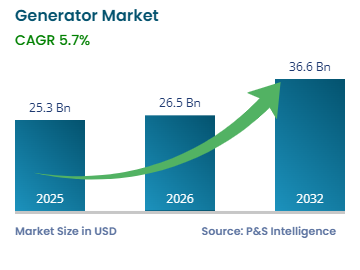
The generator market size was USD 25.3 billion for 2025, and it will grow by 5.7% during 2026-2032, to reach USD 36.6 billion by 2032.
The market is expanding as reliable power becomes necessary for industries, commercial buildings, public facilities, and households facing rising electricity use and unstable grid performance. Construction activity, urban expansion, manufacturing growth, and digital infrastructure are increasing dependence on uninterrupted power for daily operations. Generators are therefore used as backup systems during outages and as primary power sources in remote sites where grid access is weak or unavailable. According to the International Energy Agency, global electricity demand increased by 4.3% in 2024, compared with 3.2% growth in global gross domestic product. This rising electricity load is putting more pressure on transmission and distribution networks, increasing the need for standby and continuous power systems across industrial, commercial, residential, and off-grid applications.
The market is also changing as customers look for generators that are more fuel efficient, lower emission, and suitable for long operating hours. Diesel generators remain widely used because they provide strong load handling and quick backup during grid failures, but natural gas and hybrid systems are gaining attention where fuel availability, emissions compliance, and operating cost matter. Generator demand is also supported by remote mining sites, oil and gas facilities, rural businesses, and disaster-prone areas that cannot depend fully on grid supply. The International Energy Agency states that electricity demand growth in 2024 was driven by electrification, digitalisation, record temperatures, and rising use of data centres and air conditioning. These factors are encouraging generator manufacturers to improve engine efficiency, fuel flexibility, emission control, and remote monitoring features.
Key Market Insights
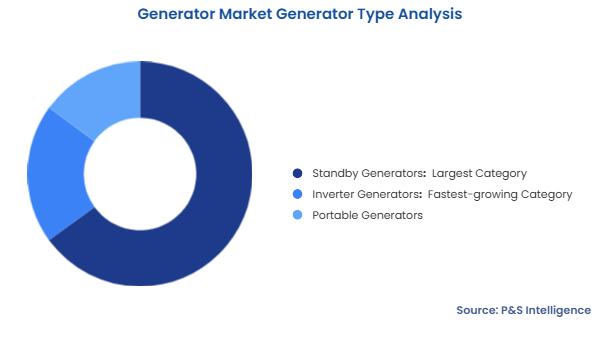
Standby Generators is the largest type, holding a market share of 65%, due to rising data centre electricity demand requiring uninterrupted backup power
Natural Gas is the fastest-growing fuel type, registering a CAGR of 6.0%, driven by increasing gas consumption and a shift toward lower-emission power solutions
Below 75 kVA is the largest rating segment, holding a market share of 45%, due to widespread SME presence requiring cost-effective low-capacity backup systems
China holds the largest share of 40%, due to 6.8% growth in electricity consumption, increasing pressure on industrial power infrastructure
India is the fastest-growing country, registering a CAGR of 6.8%, driven by peak electricity demand reaching 250 GW, straining national grid capacity
Generator Market Emerging Trends & Growth Drivers
Shift Toward Hybrid and Cleaner Generator Technologies Is Major Trend
The industry is shifting toward generators using cleaner fuels and advanced control systems instead of conventional diesel units. Companies are introducing hybrid models integrating batteries to reduce fuel consumption and emissions. Users increasingly prefer systems with remote monitoring and real-time load adjustment for better efficiency. According to the International Renewable Energy Agency (IRENA), global renewable power capacity reached 5,149 GW in 2025, reflecting strong growth in cleaner energy infrastructure. Additionally, according to the International Energy Agency (IEA), global energy-related CO₂ emissions reached a record high of 37.8 billion tonnes in 2024, driven by rising energy demand and increased fossil fuel consumption, increasing regulatory pressure. Furthermore, this is accelerating the adoption of low-emission and hybrid generator technologies across industries.
Rising Need for Uninterrupted Power Across Critical Operations Drives Market
The market is growing as industries and essential services cannot afford power interruptions. Hospitals, data centres, factories, and commercial facilities require continuous electricity to maintain operations. In many regions, unreliable grid supply increases dependence on backup generators. Additionally, expanding industrial activity and infrastructure development are placing higher pressure on power demand. According to the International Energy Agency (IEA), global data centre electricity consumption reached approximately 415 TWh in 2024, driven by rapid growth in cloud computing, artificial intelligence, and digital infrastructure expansion worldwide, highlighting rising reliance on uninterrupted power. Furthermore, according to the International Monetary Fund (IMF), global industrial production growth accelerated to 2.0% in 2024, supported by stronger manufacturing activity across emerging and developing economies, increasing strain on power systems and strengthening the need for reliable onsite generation.
Strict Emission Rules and Environmental Concerns Limiting Adoption
The market faces pressure as traditional generators, especially diesel-based systems, produce high emissions and noise. Governments are enforcing stricter environmental regulations, increasing complexity and compliance costs for installation and operation. Additionally, restrictions on diesel generator usage are rising in urban areas, while growing sustainability awareness is limiting adoption. According to the World Bank, carbon pricing revenues exceeded USD 100 billion in 2024, with carbon pricing instruments covering around 28% of global greenhouse gas emissions. Furthermore, these rising cost pressures are discouraging the use of high-emission generator systems and accelerating the shift toward cleaner alternatives.
Expansion of Distributed Energy and Off-Grid Power Solutions
The market is creating opportunities as investments in decentralised and off-grid power systems increase across remote and underserved regions. Industries, construction sites, and rural areas are demanding reliable electricity where grid access is limited. This is driving the adoption of flexible generator systems that can operate independently or alongside renewables. Additionally, hybrid solutions integrating solar, storage, and generators are gaining traction. According to the International Renewable Energy Agency (IRENA), global off-grid renewable capacity reached 11.1 GW in 2025, growing by 1.7 GW, led by solar-based systems. Furthermore, expanding telecom and data centre infrastructure in developing regions is increasing demand for scalable and reliable backup power solutions.
Generator Market Segmentation Analysis
Generator Type Analysis
Standby Generators is the largest category, holding a market share of 65%, due to their widespread use across hospitals, commercial buildings, and data centres requiring uninterrupted power. These systems ensure automatic backup during outages, supporting critical operations. Additionally, increasing dependence on continuous electricity in urban infrastructure is strengthening demand. According to the International Energy Agency (IEA), data centre electricity demand reached 415 TWh in 2024 and is expected to grow significantly, reinforcing the need for reliable standby power systems.
Inverter Generators are the fastest-growing category, registering a CAGR of 5.9%, due to rising demand for portable and fuel-efficient power solutions in residential and small commercial settings. These generators produce stable electricity suitable for sensitive electronics, which makes them more appealing than conventional portable units. Their compact size and lower noise levels also attract users looking for convenient backup options. Growing outdoor activities and mobile power needs are further contributing to their rapid adoption in recent years.
The generator type analysed in this report are:
Standby Generators (Largest Category)
Inverter Generators (Fastest-growing Category)
Portable Generators
Fuel Type Analysis
Diesel is the largest category, holding a market share of 45%, because it is widely available and offers high efficiency for heavy-duty and long-duration operations. Industries and large commercial facilities rely on diesel generators for their durability and ability to handle high loads. These systems are also preferred in areas with frequent power outages due to their proven performance. Despite environmental concerns, diesel remains dominant due to its strong infrastructure support and cost-effectiveness in large-scale applications.
Natural Gas is the fastest-growing category, registering a CAGR of 6.0%, due to increasing preference for cleaner and lower-emission fuel alternatives. These generators are suitable for regions with strict environmental regulations and offer a reliable fuel supply through pipelines. Additionally, businesses are adopting gas-based systems to meet sustainability targets while ensuring backup power. According to the International Gas Union (IGU), global natural gas demand reached 4,122 bcm in 2024, reflecting rising industrial reliance on gas-based power solutions.
The fuel type analysed in this report are:
Diesel (Largest Category)
Natural Gas (Fastest-growing Category)
Gasoline
Others
Power Capacity Analysis
Below 75 kVA is the largest category, holding a market share of 45%, because it is widely used across small businesses, residential units, and light commercial applications. These generators are cost-effective and suitable for basic backup needs during short outages. Additionally, increasing small-scale commercial activity is supporting demand. According to the World Bank, SMEs account for around 90% of businesses globally, highlighting the strong need for affordable, low-capacity power solutions to maintain operations.
75–375 kVA is the fastest-growing category, registering a CAGR of 6.2%, due to increasing demand from medium-sized commercial establishments and industrial units. These generators provide a balance between power output and operational cost, making them ideal for offices, malls, and manufacturing facilities. As businesses expand and require a more stable power supply, this capacity range is becoming more relevant. Rising infrastructure development is further driving demand for mid-range power solutions.
The power capacity analysed in this report are:
Below 75 kVA (Largest Category)
75–375 kVA (Fastest-growing Category)
375–750 kVA
Above 750 kVA
Application Analysis
Standby / Backup Power is the largest category, holding a market share of 40%, because most users install generators mainly to handle unexpected power outages. Industries, commercial buildings, and households depend on backup systems to avoid disruptions and financial losses. This application is essential in regions where grid reliability is inconsistent. The growing need for continuous operations in critical sectors is keeping demand for standby power solutions consistently high across markets.
Prime / Continuous Power is the fastest-growing category, registering a CAGR of 6.3%, as industries and remote operations increasingly depend on generators as a primary power source. Construction, mining, and off-grid sites require continuous and reliable electricity. Additionally, the expansion of infrastructure in remote regions is supporting demand. According to Natural Resources Canada, global refined copper production grew by 3.8% in 2024, reflecting rising mining activity that requires uninterrupted onsite power generation.
The application analysed in this report are:
Standby / Backup Power (Largest Category)
Prime / Continuous Power (Fastest-growing Category)
Peak Shaving / Load Management
Remote & Off-Grid Power
Others
End-User Analysis
Industrial is the largest category, holding a market share of 45%, because manufacturing, oil and gas, and heavy industries require a consistent and high-capacity power supply. These sectors rely on generators to avoid operational disruptions. Additionally, increasing global production is driving demand for reliable power systems. According to the United Nations Industrial Development Organisation (UNIDO), manufacturing value added grew by 2.9% in 2024, supporting the need for continuous and large-scale power infrastructure.
Residential is the fastest-growing category, registering a CAGR of 6.5%, due to increasing awareness about power backup solutions among households. Frequent outages and rising dependency on electrical appliances are pushing homeowners to invest in small generators. Compact and user-friendly systems are making adoption easier in this segment. Growth in urban housing and improving affordability are also encouraging more people to install backup power systems at home.
The end-user analysed in this report are:
Industrial (Largest Category)
Residential (Fastest-growing Category)
Commercial
Others
Drive strategic growth with comprehensive market analysis
Generator Market Geographical Analysis
Asia-Pacific Generator Market Analysis
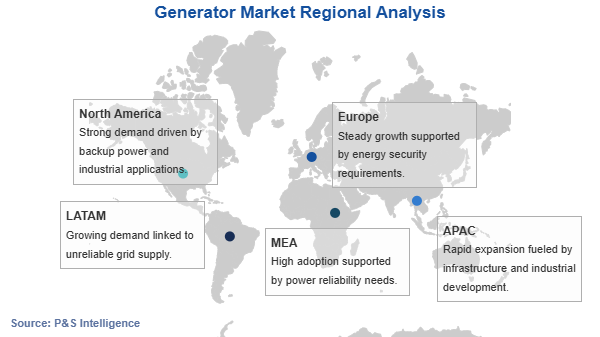
Asia-Pacific holds the largest share, of 45%, because rapid industrial growth and ongoing infrastructure development are creating strong demand for reliable power systems. Countries in this region face frequent power gaps between supply and demand, which increases dependence on generators across industries and commercial spaces. The region also has a large number of construction projects and manufacturing facilities that require continuous power support. In addition, expanding telecom networks and data centres in developing economies are further pushing the need for backup and prime power solutions across both urban and remote areas.
China Generator Market Analysis
China has a strong generator market driven by its extensive industrial base and continuous expansion in manufacturing, construction, and digital infrastructure. High energy consumption across industries and rapid urban development are increasing reliance on stable power systems. Additionally, regional supply imbalances are strengthening demand for backup and onsite generation. According to the State Council of the People's Republic of China, electricity consumption rose by 6.8% to 9.85 trillion kWh in 2024. Furthermore, this surge in demand is intensifying grid pressure, making generators critical for ensuring uninterrupted industrial and commercial operations.
India Generator Market Analysis
India is experiencing rising demand for generators due to inconsistent grid reliability and increasing electricity consumption across industrial, commercial, and residential sectors. Rapid urbanisation, infrastructure expansion, and growth in telecom and construction are further supporting adoption. Additionally, frequent peak load pressures are increasing dependence on backup systems. According to the Press Information Bureau, peak electricity demand reached 250 GW in May 2024. Furthermore, this rising demand is straining grid capacity, reinforcing the importance of standby generators for maintaining continuous operations.
North America Market Analysis
North America has the highest CAGR, of 7.0%, as the region is seeing rising demand for stable backup systems across critical sectors like healthcare, data centres, and emergency services. Ageing grid infrastructure in certain areas and increasing weather-related disruptions are making power reliability a key concern. Businesses are investing in advanced generator systems that offer better efficiency and monitoring. At the same time, strict regulations are encouraging the shift toward cleaner and more efficient technologies, shaping how generators are adopted and used across different applications.
U.S. Generator Market Analysis
The United States shows strong demand for generators driven by frequent extreme weather events and high dependence on uninterrupted power across critical sectors. Businesses, healthcare facilities, and data centres require reliable backup systems to prevent operational and financial losses. Additionally, increasing focus on grid resilience and infrastructure upgrades is supporting the adoption of advanced generator systems. According to the National Centres for Environmental Information, the U.S. recorded 27 billion-dollar weather disasters in 2024. Furthermore, this high frequency of disruptions is weakening grid stability, accelerating demand for resilient backup power solutions.
Canada Generator Market Analysis
Canada is experiencing growing demand for generators due to its large remote geography and limited grid connectivity in resource-intensive regions. Industries such as mining, oil extraction, and forestry rely heavily on continuous onsite power for operations. Additionally, harsh weather conditions increase the need for dependable backup systems. According to Statistics Canada, crude oil production rose by 4.3% to 298.8 million cubic metres in 2024. Furthermore, expanding extraction activities in off-grid locations are driving demand for durable and continuous power generation systems.
Europe Market Analysis
Europe is experiencing steady demand due to strong regulatory control and a clear focus on reducing environmental impact. Many countries are limiting the use of traditional diesel generators, which is influencing buying decisions and pushing users toward cleaner options. The region also has a well-developed grid system, so generators are mostly used for backup rather than continuous power. However, rising energy security concerns and the need for reliable power during emergencies are supporting consistent demand across commercial and industrial sectors.
The regions and countries analysed in this report are:
North America (Fastest-Growing Regional Market)
U.S. (Larger Country)
Canada (Faster-Growing Country)
Europe
Germany (Largest Country)
U.K. (Fastest-Growing Country)
France
Italy
Spain
Rest of Europe
Asia-Pacific (Largest Regional Market)
China (Largest Country)
India (Fastest-Growing Country)
Japan
South Korea
Australia
Rest of APAC
Latin America
Brazil (Largest Country)
Mexico (Fastest-Growing Country)
Rest of LATAM
Middle East and Africa
Saudi Arabia (Largest Country)
U.A.E. (Fastest-Growing Country)
South Africa
Rest of MEA
Generator Market Competitive Landscape
The market is fragmented in nature, with a mix of global manufacturers and many regional and local players competing across different power ranges and applications. Large companies offer advanced and high-capacity systems, but smaller firms remain active in price-sensitive and localised markets. The presence of multiple fuel options and varied customer needs allows new entrants to operate in niche areas. Competition is based on product reliability, fuel efficiency, service support, and pricing. Technological competition is also increasing as manufacturers develop hybrid generator systems, remote monitoring features, and lower-emission fuel options to meet changing customer and regulatory requirements. Regional players often have an advantage in distribution and maintenance services, which keeps the competitive landscape diverse.
This works because hybrid systems combine generator sets with battery storage, renewables, or other power sources to improve efficiency and support lower-emission power supply. Caterpillar also describes hybrid energy systems as solutions that can combine diesel, natural gas, solar, wind, and battery storage for more efficient operation.
Leading Companies in the Generator Market:
Caterpillar Inc.
Cummins Inc.
Generac Holdings Inc.
Kohler Co.
Rolls-Royce Holdings plc
Mitsubishi Heavy Industries, Ltd.
Atlas Copco AB
Wärtsilä Corporation
Yanmar Holdings Co., Ltd.
Honda Motor Co., Ltd.
Siemens Energy AG
Briggs & Stratton LLC
Kirloskar Oil Engines Limited
Weichai Power Co., Ltd.
Doosan Enerbility Co., Ltd.
Generator Market News
In March 2026, Generac Holdings Inc. launched the SD1250 and SD1500 industrial diesel generators for mission-critical applications such as data centers, healthcare facilities, utilities, and heavy industrial operations, strengthening its portfolio of high-capacity power generation solutions.
In February 2026, Garrett Motion Inc. introduced its MEG turbocharger platform for genset and marine engine applications, marking its first commercial deployment in large-bore engines used for power generation systems.
In December 2025, Cummins India Limited launched a CPCB IV+ compliant genset at EXCON 2025, designed for construction and infrastructure applications, with a focus on meeting updated emission standards.
Frequently Asked Questions About This Report
What factors are driving growth in the generator market?+
Generator demand is rising because businesses, homes, data centres, hospitals, and remote sites need reliable backup power during outages and grid instability.
Why are standby generators widely used across commercial facilities?+
Standby generators automatically provide emergency power when grid supply fails, helping facilities protect operations, safety systems, equipment, and critical services.
How does rising electricity demand support generator adoption?+
Higher electricity demand increases pressure on power networks, making backup generators important for facilities that cannot afford operational downtime.
Why are portable generators used during emergency power outages?+
Portable generators provide temporary electricity when normal power infrastructure is damaged, unavailable, or unsafe to use during storms, disasters, and emergency response.
What safety risks are linked with portable generator use?+
Portable generators can cause carbon monoxide poisoning, electric shock, and fire if used indoors, in wet areas, or without proper connection practices.
Want a report tailored exactly to your business need?
Leading companies across industries trust us to deliver data-driven insights and innovative solutions for their most critical decisions. From data-driven strategies to actionable insights, we empower the decision-makers who shape industries and define the future. From Fortune 500 companies to innovative startups, we are proud to partner with organisations that drive progress in their industries.
Client Testimonials
Working with P&S Intelligence and their team was an absolute pleasure – their awareness of timelines and commitment to value greatly contributed to our project's success. Eagerly anticipating future collaborations.
McKinsey & Company
India
Unmatched Standards
Our insights into the minutest levels of the markets, including the latest trends and competitive landscape, give you all the answers you need to take your business to new heights
Complete Data Security
We take a cautious approach to protecting your personal and confidential information. Trust is the strongest bond that connects us and our clients, and trust we build by complying with all international and domestic data protection and privacy laws