Explore the market potential with our data-driven report
Generator Cooling Systems Market Overview
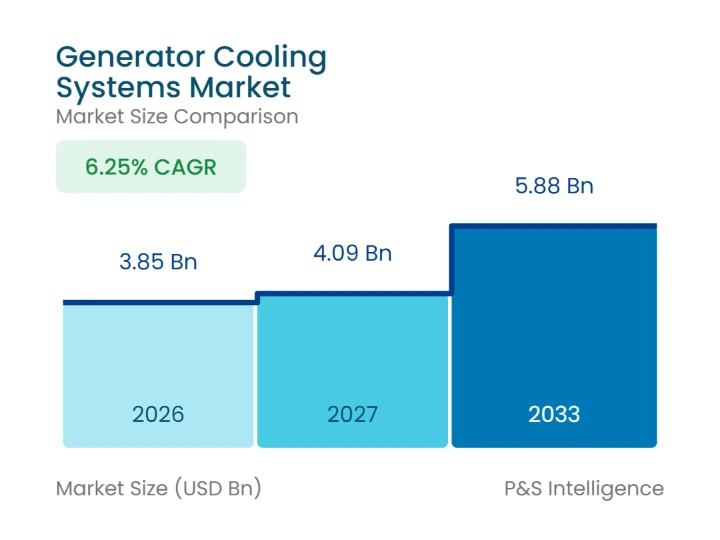
The global generator cooling systems market size is estimated at USD 3.85 Billion in 2026 and is projected to reach USD 4.09 Billion in 2027. Revenue is projected to climb to USD 5.88 Billion by 2033, advancing at a CAGR of 6.25% during 2027-2033. Data center developers buying multi-megawatt backup gensets, and utilities adding gas-fired, nuclear, and hydro units, account for most purchases of radiators, dry coolers, heat exchangers, and gas-conditioning skids. Each cooling package is engineered to a specific generator rating and site climate, so thermal equipment makers usually win orders at the design stage.
Hyperscale and AI campus construction has made data center operators the largest end-use buyer group for genset radiators and dry coolers. Figures released by the US Department of Energy put data center use at 4.4% of total US electricity in 2023 and at 6.7% to 12% by 2028. Each added megawatt of IT load needs standby generation behind it, and multi-megawatt gensets typically reject heat through remote coolers sized to hold full output on the hottest days of the year. Cooling purchases therefore scale with campus megawatts, which rewards suppliers able to ship large radiator arrays on construction schedules.
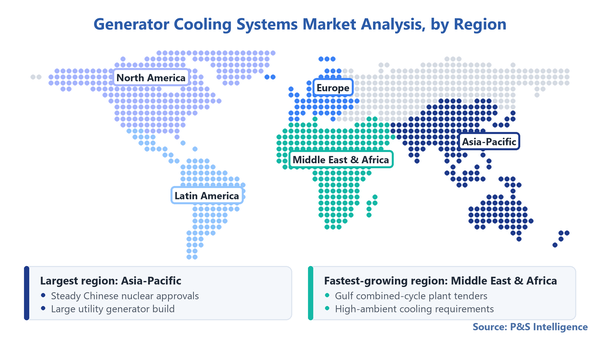
Asia-Pacific accounts for more than a quarter of 2026 revenue, the largest regional share, as China and India keep commissioning nuclear, coal, and hydro units whose generators use hydrogen, stator-water, and water-to-air cooling. Middle East & Africa is projected to grow fastest, at a CAGR of 6.9% during 2027-2033, because Saudi Arabia and Qatar are contracting large combined-cycle plants. Generator cooling systems market growth in Asia-Pacific depends on a steady utility build pipeline, while Gulf orders arrive in blocks tied to tender awards.
Key market insights
By cooling technology, liquid / water-cooled systems account for 44.0% of revenue in 2026, while air-cooled systems are projected to grow fastest, at a 6.85% CAGR during 2027-2033.
By product and hardware configuration, remote radiators and dry coolers account for 36.0% in 2026 and are projected to grow fastest, at a 7.2% CAGR during 2027-2033.
By generator type and power rating, reciprocating engine gensets account for 46.0% in 2026 and are projected to grow fastest, at a 6.9% CAGR during 2027-2033.
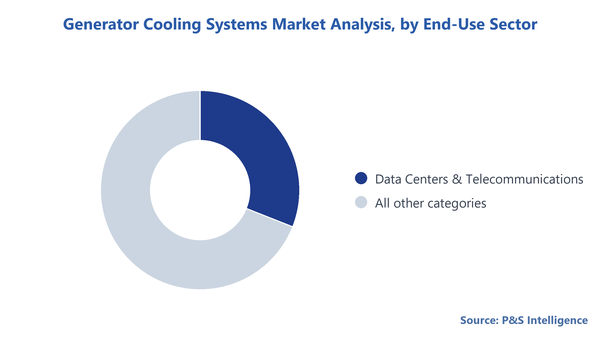
By end-use sector, data centers and telecommunications account for 31.0% in 2026 and are projected to grow fastest, at an 8.25% CAGR during 2027-2033.
By geography, Asia-Pacific accounts for 27.6% in 2026, while Middle East & Africa is projected to grow fastest, at a 6.9% CAGR during 2027-2033.
Generator Cooling Systems Market Dynamics
Gas gensets running as primary power are reshaping cooling specifications
Data center developers that need power before a utility connection is ready are starting to run natural gas generator sets as their main supply, and that duty changes how the cooling package is specified. A standby diesel unit runs mostly for testing and short outages, so its radiator is sized for brief operation at peak ambient temperature. A prime-power gas unit runs around the clock, which calls for jacket-water circuits, separate aftercoolers, and fan arrays rated for continuous heat rejection. Cooling content per installed megawatt is likely to rise as a result.
Cummins Inc. confirmed on June 16, 2026 that it will supply natural gas generator sets on its HSK78 and QSK60 platforms for a behind-the-meter microgrid serving Circe Energy's West Texas AI computing campus as its primary power source, with deliveries scheduled from 2026 through 2030. Projects of this type move genset cooling out of an emergency-backup budget and into a power-plant budget, where operators judge equipment on efficiency and uptime. Radiator and heat exchanger makers already qualified on continuous-duty gas engine packages are better positioned to win this work.
Gas turbine reservations are driving orders for turbogenerator cooling packages
Utilities and independent power producers are reserving gas turbine production slots years before construction, and every reserved turbine drives a generator whose cooling design is fixed when the order is placed. Aeroderivative and mid-size frame units usually run air-cooled or water-to-air cooled generators, while the largest frame machines use hydrogen cooling with seal oil and gas control skids. Each reservation therefore commits future demand for coolers, heat exchangers, and auxiliary systems from the generator maker's supply chain.
GE Vernova Inc.'s second-quarter 2026 results, released July 22, 2026, show Gas Power equipment backlog and slot reservation agreements rising from 100 GW to 116 GW, with at least 125 GW expected by the end of 2026. The same release targets annual gas turbine output of 20 GW in the third quarter of 2026 and 24 GW in 2028. A queue several times larger than yearly factory output gives cooling suppliers order visibility for several years, although their delivery timing follows turbine production schedules.
Grid stability shortfalls are opening demand for synchronous condenser cooling
Transmission operators retiring coal and gas units are contracting synchronous condensers to restore the short-circuit strength and inertia those plants once provided. These machines spin on the grid without a turbine, yet their windings shed heat much like a generator's, so each unit needs water-to-air coolers, closed-air circuits, or hydrogen systems. Demand of this kind grows with renewable connections instead of fossil construction, which gives generator cooling suppliers a buyer group that expands as thermal fleets shrink.
Quinbrook Infrastructure Partners stated on April 29, 2026 that its Cilfynydd and Sellindge condensers in Great Britain, awarded under Phase 3 of the National Energy System Operator's Pathfinder program, are under construction for completion in 2027 and 2028 and will add a combined 2,531 MVA of short-circuit level. Grid operators pay for these machines through long-term stability contracts, so cooling equipment sold into them draws on transmission budgets that stay in place when power-plant orders slow. Makers of large water-to-air cooler bundles could gain from each new tender round.
Local generator permitting rules are constraining backup power rollouts
Counties hosting dense data center clusters are tightening approvals for on-site generators, which slows how quickly backup fleets and their radiators get installed. Noise caps at property lines push operators toward slower fans, larger radiator faces, and acoustic enclosures, raising the cost of each cooling package. Tighter emissions rules usually add exhaust aftertreatment that has to fit within the same genset layout. Projects that cannot meet these conditions face delays or relocation, which defers cooling orders even when campus demand is firm.
In Loudoun County, Virginia, the zoning ordinance caps sound at 55 dBA at residential property lines, and the county notes that state regulators began requiring Tier 4-equivalent emissions standards for new or modified data center generators on July 1, 2026. Since a March 2025 zoning change, each new campus there also needs legislative approval from the Board of Supervisors. Radiator makers already sell low-speed, multi-fan designs for noise-limited sites, so the rules mostly add cost and approval time instead of blocking projects. For genset packagers, acoustic and emissions engineering has become part of every bid in these hubs.
Segmentation Outlook
Cooling Technology
Liquid / water-cooled systems account for 44.0% of generator cooling systems market revenue in 2026. Most stationary diesel and gas gensets reject heat through a closed jacket-water circuit, and larger units add a separate aftercooler loop, so liquid cooling covers the biggest installed fleet by unit count. At the top of the size range, nuclear and supercritical turbogenerators pass demineralized water through hollow stator bars, which brings water treatment and polishing skids into the order. Together, these two applications give liquid systems both high volume and high value per machine.
Air-cooled systems are projected to post the quickest growth, at a CAGR of 6.85% during 2027-2033. Data center gensets increasingly reject heat through remote dry coolers that consume no evaporative water, which suits water-stressed sites and avoids treatment chemicals. At utility scale, Siemens Energy positions its air-cooled generator series, rated up to 370 MVA, as a cost-effective alternative to hydrogen- or water-cooled generators for industrial applications. Dropping hydrogen removes purge, seal oil, and gas monitoring equipment, a saving that matters most to industrial and mid-size utility buyers.
Product and Hardware Configuration
Remote radiators & dry coolers account for 36.0% of revenue in 2026. Multi-megawatt gensets set in rows inside data center yards or enclosed generator halls often cannot carry a radiator large enough on the engine skid, so buyers mount horizontal or vertical coolers outside on roofs or pads. Each installation is engineered for local ambient temperature, altitude, and noise limits, which lifts the price per kilowatt above that of a skid-mounted radiator. Heat exchangers and auxiliary skids on this axis are counted only when specified for generator circuits, not for wider plant cooling.
The same category is projected to grow fastest, at a 7.2% CAGR during 2027-2033. Hyperscale campuses install multi-megawatt gensets in large arrays, and each unit needs coolers that hold full heat rejection at high ambient temperatures without derating. Planning documents filed with Ireland's An Bord Pleanála for one data center generation plant specify its air-cooled radiators as "ultra-ultra-low noise", a requirement typically met with variable-speed fans and sound-attenuating cowls that lift dollar content per package faster than unit volume. Manufacturers with flexible lines for large coil and fan assemblies are better positioned as campus programs scale.
Generator Type and Power Rating
Reciprocating Engine Gensets account for 46.0% of revenue in 2026, the largest share by generator type. They sell in far greater numbers than turbogenerators across data centers, hospitals, factories, mines, and telecom sites, and every unit leaves the factory with a radiator or a specification for a remote cooler. For US hospitals, the Centers for Medicare & Medicaid Services emergency preparedness rule sets generator location, inspection, and testing requirements by reference to NFPA 99, NFPA 101, and NFPA 110, which keeps healthcare standby fleets in service. Cooling makers therefore gain steady volume through engine OEM supply agreements.
Reciprocating gensets are also projected to grow fastest, at a CAGR of 6.9% during 2027-2033. AI campus construction is adding gensets in diesel standby and natural gas prime-power roles, and the gas units run long hours that call for larger aftercooler and jacket-water circuits. Modular gas engine plants also suit industrial sites and remote mines that need power sooner than a turbine plant can be delivered. For heat exchanger and radiator makers, the higher running hours of these units raise the value of each cooling specification.
End-Use Sector
Data centers & telecommunications account for 31.0% of revenue in 2026. Colocation and hyperscale operators design for continuous uptime, installing standby capacity at or above full IT load, often with redundant units, so one campus can order a large fleet of gensets and coolers in a single program. Telecom operators add smaller but more numerous gensets at switching centers and tower sites. Uptime requirements also make cooling failures costly, which leads these buyers to specify redundant fans, pumps, and circuits on each radiator.
The segment is projected to expand fastest, at an 8.25% CAGR during 2027-2033. The International Energy Agency projects global data center electricity use to more than double from 415 TWh in 2024 to around 945 TWh by 2030, with AI the main driver, and operators size standby generator fleets to that rising load. Noise and emissions rules in established hubs further raise the value of each cooling package. Purchasing power is concentrated in a small group of hyperscale operators that buy in multi-year programs, which favors suppliers able to commit factory capacity in advance.
The following segments are analysed in this report.
Cooling Technology
Liquid / Water-Cooled Systems
Air-Cooled Systems
Hydrogen-Cooled Systems
Hybrid Systems
Product & Hardware Configuration
Remote Radiators & Dry Coolers
Engine-Mounted Integrated Radiators
Shell & Tube and Plate Heat Exchangers
Auxiliary BOP Conditioning Skids
Generator Type & Power Rating
Reciprocating Engine Gensets
Gas Turbogenerators
Steam Turbogenerators
Hydrogenerators & Synchronous Condensers
End-Use Sector
Data Centers & Telecommunications
Electric Utilities & IPPs
Industrial, Petrochemical & Mining
Commercial & Healthcare
Marine & Offshore
Copyright P&S Intelligence. Reuse requires attribution under CC BY 4.0.
Geographical Analysis
Asia-Pacific generator cooling systems market outlook
Asia-Pacific holds 27.6% of the generator cooling systems market in 2026, the largest share of any region, because utilities in China and India are still commissioning large thermal, nuclear, and hydro units. Each of those machines ships with hydrogen, stator-water, or water-to-air cooling plus auxiliary skids for gas, seal oil, and water treatment. China, the region's largest market, also hosts domestic turbogenerator makers that build their own hydrogen and stator-water cooling systems, which is likely to keep much of the utility-side value inside national supply chains.
China's State Council approved eight new nuclear units on July 31, 2026, continuing a pace of at least ten approvals a year from 2022 to 2025. Large nuclear turbogenerators typically pair water-cooled stator windings with hydrogen cooling, so each approval adds a future order for treatment skids, gas systems, and heat exchangers once main equipment is contracted. Data center construction in Japan, Singapore, and Malaysia adds a second, genset-led stream of demand. The region's lead is likely to hold through 2033, with foreign suppliers competing mainly for components and data center packages.
Middle East & Africa generator cooling systems market growth
Middle East & Africa is projected to grow fastest, at a CAGR of 6.9% during 2027-2033, as Gulf governments contract large combined-cycle plants to meet peak summer load. Ambient temperatures in the Gulf can exceed 45°C, so generator coolers, lube-oil coolers, and auxiliary heat exchangers need extra surface area to hold rated output, which raises equipment value per plant. Saudi Arabia, the region's fastest-growing market, buys power capacity through a centralized procurement model in which tender awards set the timing of turbine and generator orders.
According to ACWA Power, its Rumah 1 project is an 1,800 MW combined-cycle plant contracted under a 25-year power purchase agreement with the Saudi Power Procurement Company. A single award of this size can carry several turbogenerators and their cooling packages, which explains why regional orders arrive unevenly. Data center campuses planned in Saudi Arabia and the U.A.E. add genset cooling demand that is less tied to tender rounds, and dry coolers suit sites where fresh water is scarce. Suppliers with high-ambient designs and service crews in the Gulf are better positioned as these programs proceed.
Copyright P&S Intelligence. Reuse requires attribution under CC BY 4.0.
North America market analysis
North America holds a large, data-center-heavy share of global revenue, with standby fleets concentrated in Virginia, Texas, Ohio, and Arizona and a growing number of on-site gas plants serving AI campuses. Growth here depends mostly on higher value per installation, since buyers specify low-noise fan arrays, high-ambient ratings, and redundant radiator circuits on each genset. Canada contributes demand through industrial and hydro generator work, which adds water-to-air cooler orders to the regional mix.
As per the US Energy Information Administration, developers plan to add 6.3 GW of natural gas capacity in 2026, of which 3.3 GW is combined-cycle and 2.8 GW is combustion turbines. Each of these units brings a generator cooling package, although the planned figure covers utility-scale plants and largely excludes data center backup gensets. Utility-side demand is therefore modest next to the region's genset base, which keeps radiator and dry cooler makers with US plants and short delivery times better positioned than turbogenerator cooling specialists.
Europe market analysis
Europe contributes a mature share of revenue, with little new fossil construction and demand shaped by data centers, grid-stability machines, and hydro fleets in the Alps and the Nordic countries. Data center clusters around Frankfurt, Amsterdam, London, and Dublin buy standby gensets with dry coolers built to strict urban noise limits, which lifts value per unit. Transmission operators in Great Britain, Germany, and Ireland are also buying synchronous condensers that need large water-to-air coolers.
Ireland's Central Statistics Office recorded data center consumption of 7,663 GWh in 2025, equal to 23% of the country's metered electricity. That figure measures electricity use, not generator purchases, but each new Irish campus installs standby generation sized to its load. Limited utility construction caps volume gains across the region, so suppliers in Europe tend to compete on acoustic design, efficiency, and compliance with local permitting more than on unit volume.
Latin America market analysis
Latin America contributes a smaller share of revenue, built on Brazil's large hydro fleet, Mexico's gas-fired expansion, and diesel and gas gensets at mines in Chile. Hydrogenerators use air-to-water coolers inside the machine housing, so modernization programs at older plants can create cooling orders alongside rewinds and runner upgrades. Mining sites in remote, high-altitude locations need radiators derated for thin air, which favors suppliers with engineering support in the region.
Mexico's federal plan for strengthening and expanding the national electricity system through 2030 includes new combined-cycle plants for the state utility CFE, each of which would require turbogenerator cooling and auxiliary skids. Public financing cycles and currency swings can delay these projects, which makes order timing in the region less predictable than in North America. Suppliers with local assembly or service capability in Mexico or Brazil are better positioned to meet short delivery windows when awards do arrive.
The following geographies are analysed in this report.
Asia-Pacific
China
India
Japan
South Korea
Taiwan
Malaysia
Singapore
Thailand
Vietnam
Indonesia
Philippines
Australia
Rest of Asia-Pacific
Middle East & Africa
Saudi Arabia
U.A.E.
Israel
Qatar
Oman
Kuwait
South Africa
Egypt
Morocco
Nigeria
Rest of Middle East & Africa
Europe
Germany
U.K.
France
Italy
Netherlands
Spain
Switzerland
Sweden
Belgium
Austria
Finland
Denmark
Rest of Europe
Latin America
Brazil
Mexico
Chile
Argentina
Colombia
Rest of Latin America
North America
U.S.
Canada
Generator Cooling Systems Market Competition Analysis
Competition in the generator cooling systems market splits into two layers with different economics. At utility scale, cooling is engineered into the turbogenerator itself, so a small number of generator manufacturers control the hydrogen, stator-water, and water-to-air designs and buy coolers and skids from qualified subcontractors. Switching cooling suppliers within a fleet is costly because components typically carry the generator maker's qualification and warranty. In distributed gensets the layer is more open, with radiator and dry cooler makers competing on delivery speed, high-ambient performance, acoustic design, and engine OEM approvals, while regional fabricators take smaller jobs.
GE Vernova Inc., Siemens Energy AG, Mitsubishi Heavy Industries Ltd., and Dongfang Electric Corporation Limited compete on generator ratings, efficiency, and the ability to supply cooling, seal oil, and gas systems with the turbine. Cummins Inc. and Caterpillar Inc. shape the genset layer by specifying matched radiators and aftercoolers with their engines. Specialist thermal manufacturers, including Modine Manufacturing Company, Kelvion Holding GmbH, AKG Thermotechnik International GmbH & Co. KG, and Alfa Laval AB, compete for those OEM framework positions and for direct sales to data center contractors, differentiating through coil technology, fan control, and factory capacity near major campus clusters.
Data center programs that award multi-year volume tend to favor specialists able to guarantee output, which pushes thermal manufacturers to add plant capacity ahead of orders. For buyers, large reserved programs can lengthen lead times for smaller projects, so early specification of the cooling package carries more weight than it did when standby gensets were bought one site at a time.
Major Companies in Generator Cooling Systems Market:
Modine Manufacturing Company
AKG Thermotechnik International GmbH & Co. KG
Kelvion Holding GmbH
API Heat Transfer Inc.
SPX Technologies Inc.
Alfa Laval AB
GE Vernova Inc.
Siemens Energy AG
Mitsubishi Heavy Industries Ltd.
Cummins Inc.
Caterpillar Inc.
Vestas Aircoil A/S
Baltimore Aircoil Company Inc.
Harbin Electric Company Limited
Dongfang Electric Corporation Limited
Recent Developments in the Market
In August 2026, Kelvion Holding GmbH agreed to be acquired by SLB for approximately USD 3.4 Billion in cash plus about USD 0.7 Billion of assumed debt, with closing expected in the first half of 2027. The deal places a heat exchange supplier whose largest and fastest-growing end market is data centers inside a group expanding its data center infrastructure business.
In May 2026, Modine Manufacturing Company signed a long-term capacity agreement guaranteeing a strategic data center customer more than USD 4 Billion of Airedale by Modine data center cooling products from 2027 through 2029, backed by a USD 165 Million upfront payment. The payment funds capacity additions at a manufacturer that also builds genset radiators and dry coolers.
In February 2026, Alfa Laval AB announced a multi-year investment, already underway, to double heat exchanger production capacity at its Richmond, Virginia, facility by mid-2028, including a factory re-layout and more automated production lines. Added domestic output could shorten lead times for US utilities and genset packagers that use heat exchangers on generator auxiliary water circuits.
In January 2026, Caterpillar Inc. secured an order from AIP Corp. for 2 GW of G3516 fast-response natural gas generator sets for the first phase of the Monarch campus in West Virginia, with deliveries from September 2026 through August 2027. Orders of this size bring a large fleet of matched genset cooling packages into a single procurement program.
In January 2026, Mitsubishi Heavy Industries Ltd. won a contract, through its Mitsubishi Power brand, to supply M701JAC gas turbines for Qatar's 2.4 GW Facility E power and water plant, due to begin operating in 2028. The award fixes the turbine platform for about a fifth of Qatar's grid capacity, and generator cooling equipment is typically specified to match it.
Last Updated: October 2026
Frequently Asked Questions About This Report
How big is the generator cooling systems market?+
The global generator cooling systems market size is estimated at USD 3.85 Billion in 2026 and is projected to reach USD 4.09 Billion in 2027.
What is driving demand for generator cooling systems?+
Hyperscale and AI campus construction has made data center operators the largest end-use buyer group for genset radiators and dry coolers.
Which region holds the largest share of the generator cooling systems market?+
Asia-Pacific holds 27.6% of the generator cooling systems market in 2026, the largest share of any region, because utilities in China and India are still commissioning large thermal, nuclear, and hydro units.
Which region is growing fastest in the generator cooling systems market?+
Middle East & Africa is projected to grow fastest, at a CAGR of 6.9% during 2027-2033, as Gulf governments contract large combined-cycle plants to meet peak summer load.
What are the advantages of air-cooled generators over hydrogen-cooled generators?+
Dropping hydrogen removes purge, seal oil, and gas monitoring equipment, a saving that matters most to industrial and mid-size utility buyers.
Who are the key companies in the generator cooling systems market?+
GE Vernova Inc., Siemens Energy AG, Mitsubishi Heavy Industries Ltd., and Dongfang Electric Corporation Limited compete on generator ratings, efficiency, and the ability to supply cooling, seal oil, and gas systems with the turbine.
Want a report tailored exactly to your business need?
Leading companies across industries trust us to deliver data-driven insights and innovative solutions for their most critical decisions. From data-driven strategies to actionable insights, we empower the decision-makers who shape industries and define the future. From Fortune 500 companies to innovative startups, we are proud to partner with organisations that drive progress in their industries.
Client Testimonials
Working with P&S Intelligence and their team was an absolute pleasure – their awareness of timelines and commitment to value greatly contributed to our project's success. Eagerly anticipating future collaborations.
McKinsey & Company
India
Unmatched Standards
Our insights into the minutest levels of the markets, including the latest trends and competitive landscape, give you all the answers you need to take your business to new heights
Complete Data Security
We take a cautious approach to protecting your personal and confidential information. Trust is the strongest bond that connects us and our clients, and trust we build by complying with all international and domestic data protection and privacy laws