Explore the market potential with our data-driven report
GCC Wealth Management Market Future Outlook
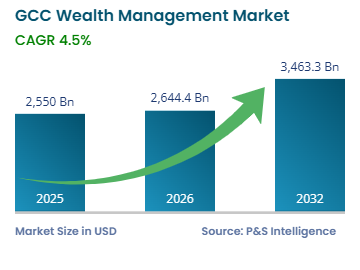
The GCC wealth management market size will be an estimated USD 2,550.0 billion for 2025, and it will grow by 4.5% during 2026–2032, to reach USD 3,463.3 billion by 2032.
The market growth is primarily driven by the significant high-net-worth individual population, accelerating digital transformation of financial services, expanding alternative investment allocations across the region, and economic diversification initiatives under national transformation programs.
The UAE attracted 9,800 new millionaires in 2025, representing the world's largest HNWI inflow, while Saudi Arabia ranked fifth globally with 2,400 millionaire inflows. The region's attractiveness stems from zero personal income tax policies, robust regulatory frameworks, and strategic Vision 2030 initiatives that are fundamentally reshaping the financial services landscape across Gulf nations.
Reports indicate that 69% of GCC investors already allocate assets to alternative investments, significantly higher than the global average, reflecting the sophisticated investment preferences of the region's wealthy clientele. Furthermore, the region's sovereign wealth funds collectively managed over USD 3.5 trillion in assets by 2024, positioning the GCC as a major force in global capital markets and creating substantial opportunities for wealth management providers to serve both institutional and private investors.
GCC Wealth Management Market Dynamics
Digital Transformation and Fintech InnovationAre Key Trends
The GCC wealth management sector is a key trend undergoing rapid digital transformation, with technology adoption reshaping service delivery models and client engagement strategies.
Mobile wallet penetration surpassed 60% in the UAE in 2024, while smartphone usage is projected to reach 97% by 2025 across the GCC.
This digital-first consumer behavior is driving wealth managers to invest heavily in robo-advisory platforms, AI-powered portfolio management tools, and hybrid advisory models that combine automated solutions with personalized human guidance.
According to the recent survey, 87% of UAE investors express satisfaction with their financial institution's digital services, higher than the international average of 77%.
The demand for immediate, digital-first engagement is compelling traditional wealth managers to upgrade their technological infrastructure.
The integration of artificial intelligence represents a paradigm shift in wealth management delivery.
In 2025, major financial institutions introduced AI assistants to help advisers respond more quickly to client demands, analyze financial data, and provide investment recommendations.
In the GCC specifically, fintech companies reached 329 active entities in the UAE and 224 in Saudi Arabia by Q2 2024, reflecting the region's commitment to becoming a global fintech hub under national transformation strategies.
National Governments’ Economic DiversificationInitiativesare Biggest Driver
Saudi Arabia's Vision 2030 and parallel economic diversification initiatives across GCC countries are generating substantial wealth management through mega-project development, privatization programs, and non-oil sector expansion.
Vision 2030's financial sector development targets explicitly aim to enable financial institutions to support private sector growth, develop an advanced capital market, and promote financial planning services while maintaining stability.
According to a report, Saudi Arabia documented 178 deals representing 31% of MENA's total transactions, up from 29% in 2023, reflecting increased foreign direct investment and entrepreneurial activity.
The creation of five special economic zones across four regions in April 2023, each focusing on different industry sectors with tailored incentives, provides platforms for wealth managers to structure investments aligned with national priorities.
Furthermore, the estimated generational wealth transfer of USD 1 trillion by 2030 across the Middle East is driving the demand for succession planning, trust services, and family office establishment.
The Dubai International Financial Centre records 120 family offices collectively managing approximately USD 1.2 trillion in assets, demonstrating the institutionalization of family wealth management in the region.
This convergence of economic transformation, wealth creation, and generational transfer is fundamentally reshaping the GCC wealth management landscape and creating sustained growth opportunities for service providers.
The ultra-high-net-worth individuals category holds the largest market share, of 45%, in 2025. This dominance reflects the region's concentration of ultra-wealthy families, who have accumulated significant fortunes primarily through oil and gas revenues, real estate holdings, and successful family businesses spanning multiple decades. These ultra-affluent clients demand comprehensive solutions, including discretionary portfolio management, family office structures, trust and fiduciary services, succession planning, and access to alternative investments, such as private equity, hedge funds, and real estate. Rising complexity in UHNWI needs is compelling wealth managers to expand their advisory capabilities, increase product breadth, and digitize operating models to meet evolving expectations.
The high-net-worth individuals category will have the highest CAGR, of 4.8%, driven by wealth creation among entrepreneurial families, technology sector professionals, and senior corporate executives across diversifying economies. The expansion of this segment reflects Vision 2030's success in generating non-oil economic activity and creating new pathways to wealth accumulation beyond traditional hydrocarbon industries. According to reports, alternative investments now represent 15% of HNWI portfolios globally, with 61% of millennial and Gen Z HNWIs actively seeking exposure to private equity and cryptocurrencies, demonstrating evolving investment preferences that wealth managers must accommodate through expanded product offerings and digital engagement platforms.
The discretionary portfolio management category holds the largest market share, of 40%, in 2025, reflecting the strong preference among wealthy GCC clients for professional asset managers to make investment decisions on their behalf within pre-defined mandates. This preference stems from the region's client base typically having substantial business operations requiring their primary attention, combined with recognition of the complexity of modern global capital markets and the value of specialized investment expertise.
The financial planning category will have the highest CAGR, as GCC wealth managers shift toward holistic wealth advisory models encompassing comprehensive financial planning, goal-based investing, retirement planning, and multi-generational wealth structuring. The Dubai International Financial Centre reports that family offices in the region are increasingly seeking integrated solutions that connect investment management with tax optimization, estate planning, and philanthropic structuring.
The service offerings analyzed in this report are:
The alternatives category holds the largest market share, of 35%, in 2025, reflecting the sophisticated investment preferences and risk appetite of the region's wealthy clientele. The Abu Dhabi Investment Authority announced a target allocation of 12–17% for private equity in 2023, reinforcing the broader regional preference for alternative asset classes. The GCC's growing alternative investments ecosystem is supported by substantial sovereign wealth fund participation, expanding family office sophistication, and increasing co-investment opportunities with international private equity firms.
The Sharia-compliant products category will have the highest CAGR, of 4.6%, driven by increasing demand for ethical, faith-based investment solutions that adhere to Islamic financial principles. The Islamic wealth and asset management segment is experiencing burgeoning demand among HNWIs and sovereign wealth funds for Sharia-compliant private banking services, funds, and structured investments. The growth in Sharia-compliant wealth management is further accelerated by innovation in sustainable sukuk issuance. This convergence of faith-based investment principles with environmental, social, and governance criteria creates a compelling value proposition for GCC investors seeking investments that align with both religious convictions and sustainability objectives.
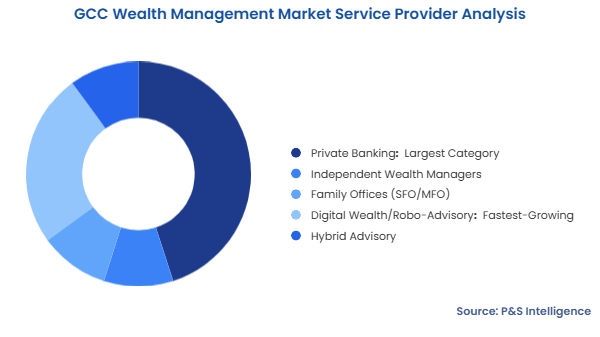
The private banking category holds the largest market share, of 45%, in 2025, reflecting the traditional dominance of established banking relationships and the comprehensive service capabilities that large financial institutions provide to wealthy clients. Major regional and international banks operating private banking divisions benefit from extensive branch networks, trusted brand recognition built over decades, integrated product platforms spanning lending, custody, investment management, and advisory services, and the ability to provide seamless cross-border banking solutions for globally mobile clients.
First Abu Dhabi Bank notes that international investment remains attractive, but there is a growing trend of clients retaining a more significant portion of their assets in the region, driven by robust regulatory frameworks and initiatives encouraging local investment company establishment. Mashreq Bank reported a 20% increase in private banking clients and overall wealth management volumes in 2024, underscoring strong demand for sophisticated banking solutions.
The service providers analyzed in this report are:
Private Banking (Largest Category)
Independent Wealth Managers
Family Offices (SFO/MFO)
Digital Wealth/Robo-Advisory (Fastest-Growing Category)
Hybrid Advisory
Drive strategic growth with comprehensive market analysis
UAE holds the largest market share, of 40%, in 2025. The UAE's dominance stems from Dubai and Abu Dhabi's established status as premier global financial centers, attractive zero-tax policies, world-class infrastructure, and progressive regulatory frameworks that have attracted unprecedented wealth inflows over the past decade.
Furthermore, the UAE's removal from the Financial Action Task Force's grey list in early 2024 significantly boosted investor confidence and removed a major barrier to international capital flows. The UAE’s competitive strengths include its Golden Visa program, strategic location linking Asia, Africa, and Europe, strong aviation hubs such as Dubai and Abu Dhabi airports, and its deepening tech cooperation with the U.S., including the AI Acceleration Partnership announced in May 2025.
Saudi Arabia Wealth Management Market Size
Saudi Arabia will have the highest CAGR, of 4.7%, driven by Vision 2030's ambitious economic transformation agenda, mega-project development, and expanding non-oil private sector activity. The Kingdom's wealth management sector is experiencing rapid expansion as Riyadh emerges as a new financial hub, with a 35% year-on-year increase in HNWI relocations in 2024, fueled by transformative projects and a growing financial sector. Vision 2030's Financial Sector Development Program achieved remarkable milestones in 2024, with locally managed assets reaching a record USD 267 billion (SAR 1 trillion), fintech firms reaching 261 companies, and venture capital investment in the sector exceeding USD 2.0 billion (SAR 7.6 billion).
The Public Investment Fund plays a central role in driving wealth creation and investment opportunities, with assets under management reaching USD 913 billion in 2024, more than tripling since Vision 2030's launch, exceeding annual targets. The PIF's strategic co-investments with international private equity firms and regional family offices provide sophisticated wealth management opportunities aligned with national priorities. Furthermore, Saudi Arabia introduced government savings sukuk in February 2024, elevating individual savings rates while enhancing financial literacy, positioning the Kingdom among a few countries offering retail sukuk alongside Indonesia and Oman.
The countries of the market are as follows:
Saudi Arabia (Fastest-Growing Country)
UAE (Largest Country)
Kuwait
Qatar
Bahrain
Oman
GCC Wealth Management Market Share
The market is semi-consolidated, due to the diverse mix of international private banks with century-long heritage and substantial global assets, regional banking champions with deep local market knowledge and extensive distribution networks, independent wealth managers offering specialized boutique services, and emerging digital wealth platforms leveraging technology to capture younger, tech-savvy investor segments. The competitive landscape is further shaped by family offices' evolution from passive wealth preservation to active investment vehicles. Opportunities exist for new entrants and existing players to differentiate through specialized expertise in high-growth sectors aligned with Vision 2030 priorities, including renewable energy, technology, healthcare, and education. The consolidation trend across the broader financial services sector may accelerate as smaller players seek scale, while larger institutions pursue bolt-on acquisitions to expand client segments, product capabilities, or geographic coverage across GCC markets.
Key GCC Wealth Management Companies:
Emirates NBD Bank PJSC
First Abu Dhabi Bank PJSC
Qatar National Bank Q.P.S.C
BNP Paribas Wealth Management
Al Rajhi Capital Company
Mashreqbank PSC
HSBC Bank Middle East Limited
UBS AG
Bank Julius Baer & Co. Ltd.
Lombard Odier
EFG Hermes Holding S.A.E
Sarwa Digital Wealth Limited
GCC Wealth Management Market News
In May 2025, Gulf Islamic Investments participated in the Nasdaq bell-ringing ceremony in New York City, marking the successful public offering of zSpace shares on the US Nasdaq in December 2024, demonstrating GCC wealth managers' expanding presence in international technology investments and public market exits.
In January 2025, the Saudi Financial Sector Development Program reported locally managed assets reached a record USD 267 billion in 2024, with fintech firms reaching 261 companies and venture capital investment exceeding USD 2.0 billion, reflecting the Kingdom's rapid financial services transformation under Vision 2030.
In July 2024, Gulf Islamic Investments concluded funding arrangements in a consortium led by Brookfield Asset Management to invest in GEMS Education, Dubai's leading private schools operator, highlighting wealth managers' participation in large-scale private equity transactions in the education sector.
In April 2024, Microsoft Corporation invested USD 1.5 billion in G42, a UAE-based artificial intelligence firm, opening co-investment accessfor GCC wealth managers and family offices seeking exposure to cutting-edge technology partnerships between global leaders and regional champions.
Want a report tailored exactly to your business need?
Leading companies across industries trust us to deliver data-driven insights and innovative solutions for their most critical decisions. From data-driven strategies to actionable insights, we empower the decision-makers who shape industries and define the future. From Fortune 500 companies to innovative startups, we are proud to partner with organisations that drive progress in their industries.
Client Testimonials
Working with P&S Intelligence and their team was an absolute pleasure – their awareness of timelines and commitment to value greatly contributed to our project's success. Eagerly anticipating future collaborations.
McKinsey & Company
India
Unmatched Standards
Our insights into the minutest levels of the markets, including the latest trends and competitive landscape, give you all the answers you need to take your business to new heights
Complete Data Security
We take a cautious approach to protecting your personal and confidential information. Trust is the strongest bond that connects us and our clients, and trust we build by complying with all international and domestic data protection and privacy laws