GCC Warehouse Management System Market Size & Share Analysis - Trends, Drivers, Competitive Landscape, and Forecasts (2025 - 2032)
This Report Provides In-Depth Analysis of the GCC Warehouse Management System Market Report Prepared by P&S Intelligence, Segmented by Type (Inventory Management, Analytics and Optimization, Order Processing and Management, Workforce Management, System Integration and Maintenance), Component (Hardware, Software, Services), Deployment (On-Premises, Cloud), Industry (Retail & E-commerce, Automotive, Chemicals, Electrial and Electronics, Food and Beverages, Manufacturing, Medical Devices and Pharmaceuticals, Transportation and Logistics), and Geographical Outlook for the Period of 2019 to 2032
GCC Warehouse Management System Market Size Forecast
Key Highlights
Study Period
2019 - 2032
Market Size in 2024
USD 150 Million
Market Size in 2025
USD 172.8 Million
Market Size by 2032
USD 493.4 Million
Projected CAGR
16.2%
Largest Region
Saudi Arabia
Fastest Growing Region
U.A.E.
Market Structure
Fragmented
Market Size
Major Companies
Important Takeaways
Market Size and Forecast
Industry Trend
Regulatory Landscape
Demand Trend Analysis
Companies Recent Strategical Developments
Key Stakeholders
Voice of Industry Experts/KOLs
Future Opportunity
Explore the market potential with our data-driven report
GCC Warehouse Management System Market Overview
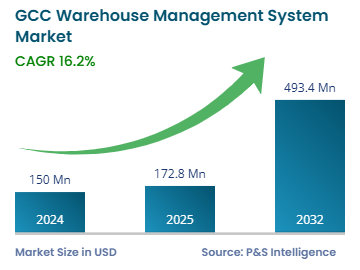
The GCC warehouse management system market size was USD 150 million in 2024, and it will grow by 16.2% during 2025-2032, to reach USD 493.4 million by 2032.
The growth of the market is primarily attributed to the region's rapid digital transformation initiatives, exponential e-commerce expansion, strategic investments in logistics infrastructure as part of national economic diversification programs such as Saudi Arabia's Vision 2030 and the U.A.E.'s National Innovation Strategy, and the rising penetration of e-commerce platforms. Additionally, government initiatives like Smart Dubai and Qatar's National Vision 2030 have emphasized technological advancement in logistics operations, further propelling the demand for advanced WMS solutions across the region.
The surge in e-commerce activities across the GCC region has emerged as a fundamental catalyst for warehouse management system adoption. This digital commerce revolution has prompted both established retailers and emerging logistics providers to implement advanced WMS platforms to handle increasing order volumes, optimize inventory management, and meet evolving customer expectations for rapid fulfillment. Furthermore, the integration of cutting-edge technologies such as artificial intelligence, machine learning, and IoT sensors within warehouse management systems is enabling GCC businesses to achieve new levels of operational efficiency and supply chain visibility.
GCC Warehouse Management System Market Dynamics
Technological Advancement in Automation and Robotics Is Key Trend
The integration of advanced automation technologies with warehouse management systems represents a key trend transforming the GCC logistics landscape.
Modern WMS platforms are increasingly incorporating capabilities to manage and optimize automated material handling equipment, robotic picking systems, and autonomous mobile robots, creating intelligent warehouses that operate with minimal human intervention.
Contemporary warehouse management systems in the GCC market are embedding artificial intelligence algorithms for demand forecasting, machine learning models for optimal slotting strategies, and computer vision systems for quality control and inventory verification.
The convergence of WMS with internet of things sensors enables real-time monitoring of environmental conditions, equipment performance, workforce productivity, predictive maintenance capabilities, and enhanced decision-making support, providing unprecedented operational visibility.
They also help in space optimization and error reduction in picking and inventory management within GCC warehouses.
In the U.A.E. and Saudi Arabia, digital twin models of warehouse operations are being piloted to simulate real-time logistics workflows and enhance strategic decision-making.
Private 5G networks are being deployed to provide ultra-low latency, high-bandwidth communication for IoT devices and robotics within smart warehouse environments.
Government-Led Infrastructure and Economic Diversification Is Major Driver
Strategic government initiatives across the GCC region are creating a highly conducive environment for warehouse management system implementation.
Saudi Arabia has approved four new special economic zones, which will be established in main urban centers such as Riyadh, Jazan, Ras Al-Khair, and King Abdullah Economic City, each requiring sophisticated logistics capabilities supported by advanced WMS platforms.
These infrastructure developments, combined with regulatory reforms facilitating foreign investment and technology adoption, are accelerating the modernization of warehouse operations across various industry sectors.
Governments and private companies across the GCC are investing in large-scale infrastructure developments, such as multimodal transportation hubs and advanced warehousing networks.
Saudi Arabia is improving its logistics market, including warehousing, and has made strong steps forward in logistics management as part of Vision 2030.
The development of smart logistics parks and free trade zones creates demand for integrated warehouse management systems capable of coordinating complex supply chain networks.
Additionally, initiatives promoting paperless documentation, blockchain integration for supply chain transparency, and automated customs clearance processes are driving businesses to adopt comprehensive WMS solutions that can interface with these digital government services.
Saudi Arabia's Vision 2030 aims to reduce oil dependency and develop sectors like retail, manufacturing, and logistics.
The U.A.E.'s Operation 300bn strategy, launched in 2021, aims to raise the industrial sector's contribution to GDP from AED 133 billion to AED 300 billion by 2031.
These government initiatives are creating a fertile environment for WMS adoption across the region as businesses align with national economic transformation goals.
GCC Warehouse Management System Market Segmentation Analysis
Type Analysis
The system integration and maintenance category held the largest market share, of 45%, in 2024, due to its established base of permitting installation, customization, and long-term operation across industries. As Saudi Arabia and the U.A.E. undergo rapid digitalization with initiatives such as Vision 2030 and Operation 300bn, companies are implementing WMS that require integration with diverse enterprise systems.
The analytics and optimization category will have the highest CAGR, approx. 16.5%, due to the increasing emphasis on data-driven decision-making in warehouse operations. GCC businesses are leveraging advanced analytics modules within their WMS to gain insights into operational bottlenecks, predict demand patterns, and optimize resource allocation. The integration of artificial intelligence and machine learning algorithms enables predictive maintenance of warehouse equipment, dynamic labor planning based on order forecasts, and continuous improvement of picking paths and storage strategies. As warehouses generate vast amounts of operational data, the analytics capabilities of WMS become crucial for maintaining a competitive advantage.
The types analyzed in this report are:
Inventory Management
Barcode scanning
Radiofrequency identification
Bin location
Analytics and Optimization (Fastest-Growing Category)
Order Processing and Management
Picking
Single order
Batch
Zone
Wave
Workforce Management
Workforce training
Performance measurement
System Integration and Maintenance (Largest Category)
Component Analysis
The services category held the largest market share, of 60%, in 2024, driven by the increasing complexity of WMS implementations and the critical need for ongoing support and optimization. Professional services encompass initial consultation, system design, data migration, integration with existing IT infrastructure, user training, and continuous improvement initiatives. The shortage of skilled WMS professionals in the GCC region further amplifies demand for vendor-provided services.
The software category will have the highest CAGR, due to the critical importance of intelligent algorithms, user interfaces, and integration capabilities in modern warehouse operations. WMS software encompasses core functionalities including inventory tracking, order management, labor management, and reporting modules. The sophistication of software solutions continues to evolve, with vendors incorporating advanced features such as voice-directed picking, augmented reality interfaces, and blockchain integration for supply chain transparency.
The components analyzed in this report are:
Hardware
Software (Fastest-Growing Category)
Services (Largest Category)
Deployment Analysis
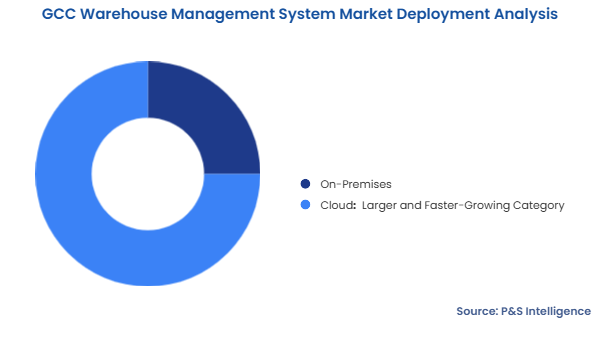
The cloud category held the larger market share, of 75%, in 2024, and it will have the higher CAGR, driven by multiple factors, including lower upfront costs, faster implementation timelines, and enhanced scalability. The cloud model eliminates the need for substantial upfront infrastructure investments, making advanced WMS capabilities accessible to a broader range of businesses. Additionally, cloud deployment facilitates rapid scaling to accommodate seasonal demand fluctuations common in the retail and e-commerce sector. Cloud-based WMS solutions are particularly appealing to small and medium-sized enterprises, which the vast majority of the businesses in the GCC are.
The deployments analyzed in this report are:
On-Premises
Cloud (Larger and Faster-Growing Category)
Industry Analysis
The retail & e-commerce category held the largest market share, of 35% in 2024, due to the profound impact of digital commerce transformation across the GCC region and the rising need to manage increasingly complex omnichannel operations, where inventory must be visible and available across physical stores, online platforms, and mobile applications simultaneously. Major retailers in the region are implementing sophisticated WMS solutions to enable capabilities such as ship-from-store, buy-online-pickup-in-store, and endless aisle strategies.
The transportation & logistics category will have the highest CAGR, of approx. 17.5%. The growth is fueled by the expansion of third-party logistics providers, the development of specialized logistics parks, and increasing demand for value-added services. Logistics companies are adopting advanced WMS platforms to differentiate their service offerings, improve operational efficiency, and provide real-time visibility to their clients.
The industries analyzed in this report are:
Retail & E-commerce (Largest Category)
Automotive
Chemicals
Electricals and Electronics
Food and Beverages
Manufacturing
Medical Devices and Pharmaceuticals
Transportation and Logistics (Fastest-Growing Category)
Drive strategic growth with comprehensive market analysis
GCC Warehouse Management System Market Regional Outlook
Saudi Arabia held the largest market share, of 40% in 2024, driven by the Kingdom's ambitious Vision 2030 transformation program and massive investments in logistics infrastructure. The Kingdom's strategic focus on becoming a global logistics hub, evidenced by the development of NEOM and the Red Sea Project, creates unprecedented demand for sophisticated warehouse management capabilities.
Moreover, the rapid expansion of e-commerce and the modernization of traditional retail operations contribute to the market growth in this region. Government initiatives promoting foreign investment, coupled with the growth of local e-commerce champions like Noon and the expansion of international players like Amazon, are driving widespread WMS adoption across various warehouse types and sizes. The Kingdom's strategic location connecting three continents positions it as a critical logistics hub, necessitating world-class warehouse management capabilities.
The U.A.E. will have the highest CAGR, due to its position as a regional logistics powerhouse, anchored by world-class facilities like Jebel Ali Port and Dubai International Airport, drive continuous innovation in warehouse management practices. Dubai's emergence as a global e-commerce hub, combined with Abu Dhabi's industrial diversification efforts, creates diverse demand for WMS solutions across multiple sectors. The implementation of smart city initiatives, blockchain adoption in logistics, and the development of specialized free zones for e-commerce operations position the U.A.E. at the forefront of warehouse management innovation.
Moreover, the high labor costs and localization policies, such as Saudization in Saudi Arabia and Emiratization in the U.A.E., are pushing businesses to heavily invest in these solutions to automate labor-intensive processes, ensure adherence, and preserve productivity.
The countries analyzed in this report are:
Saudi Arabia (Largest Category)
U.A.E. (Fastest-Growing Category)
Qatar
Oman
Bahrain
Kuwait
GCC Warehouse Management System Market Share
This market is moderately fragmented due to the presence of global payers, along with niche and emerging players. Companies such as SAP, Oracle, and Manhattan Associates, control large-scale deployment, while the small companies are capturing the market due to their cost-effectiveness and cloud-based solutions customized according to the needs, leading to market fragmentation.
Key GCC Warehouse Management System Companies:
SAP SE
Oracle Corporation
Manhattan Associates, Inc.
Zeymo Technologies
Diggipacks
Barq Systems
Unicommerce eSolutions Pvt. Ltd
IQ Fulfillment
Swisslog Middle East LLC
Infor Global Solutions Middle East FZ LLC
Business Experts Gulf
Peniel Technology LLC
GCC Warehouse Management System Market News
In July 2025, Oracle Corporation introduced a new solution in Oracle Fusion Cloud Supply Chain and Manufacturing (SCM), which is a component of the Oracle Fusion Cloud Applications Suite, aimed at assisting organizations in optimizing warehouse operations and improving supply chain efficiency. Oracle Fusion Cloud Advanced Inventory Management utilizes integrated AI to streamline processes, enhance decision-making, and optimize fulfillment.
In November 2024, Unicommerce eSolutions Pvt. collaborated with Shiprocket Arabia to launch a unified logistics and warehouse integration platform for the Middle East, combining warehouse automation with regional delivery services to support seamless e-commerce operations.
In September 2023, IQ Robotics, part of IQ Holding, signed a multi-million-dirham agreement with Brands for Less Group to deploy 130–156 autonomous robots at its JAFZA facility, aiming to enhance sorting automation and support BFL’s expansion into Saudi Arabia.
Want a report tailored exactly to your business need?
Leading companies across industries trust us to deliver data-driven insights and innovative solutions for their most critical decisions. From data-driven strategies to actionable insights, we empower the decision-makers who shape industries and define the future. From Fortune 500 companies to innovative startups, we are proud to partner with organisations that drive progress in their industries.
Client Testimonials
Working with P&S Intelligence and their team was an absolute pleasure – their awareness of timelines and commitment to value greatly contributed to our project's success. Eagerly anticipating future collaborations.
McKinsey & Company
India
Unmatched Standards
Our insights into the minutest levels of the markets, including the latest trends and competitive landscape, give you all the answers you need to take your business to new heights
Complete Data Security
We take a cautious approach to protecting your personal and confidential information. Trust is the strongest bond that connects us and our clients, and trust we build by complying with all international and domestic data protection and privacy laws