This Report Provides In-Depth Analysis of the GCC Telemedicine Market Report Prepared by P&S Intelligence, Segmented by Type (Tele Hospitals and Clinics, Tele Home), Service (Tele Consulting, Tele Monitoring, Tele Education, Tele Training), Specialty (Dermatology, Gynecology, Neurology, Cardiology, Orthopedics), and Geographical Outlook for the Period of 2019 to 2032
Explore the market potential with our data-driven report
GCC Telemedicine Market Overview
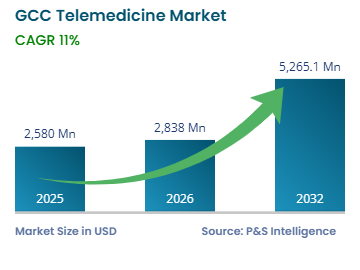
The GCC telemedicine market value is estimated at USD 2580.0 million in 2025 and is projected to grow at a CAGR of 11.0% during 2026–2032, reaching USD 5265.1 million by 2032.
The major factors driving this growth include rapid digitalization of healthcare services, increasing prevalence of chronic diseases, and strong government support through initiatives such as Saudi Arabia's Vision 2030 and the U.A.E.'s digital health transformation agenda. Saudi Arabia allocated more than USD 50 billion of investment in 2023 toward digital health services aimed at improving efficiency, accessibility, and transparency in healthcare. The growing burden of chronic diseases across the GCC countries is creating significant demand for remote healthcare solutions.
Among GCC countries, diabetes prevalence is particularly high, with the diabetic population expected to increase substantially by 2045. The Middle East bears a disproportionate burden of cardiovascular disease complications among diabetic patients, further amplifying the need for continuous remote monitoring and teleconsultation services.
Telemedicine offers critical advantages in addressing healthcare accessibility challenges across geographically dispersed populations in the Gulf region, enabling patients in remote areas to connect with specialists without the need for extensive travel. The COVID-19 pandemic significantly accelerated the adoption of virtual care platforms, and this momentum has continued as both patients and healthcare providers recognize the convenience, cost-effectiveness, and efficiency of telemedicine solutions.
GCC Telemedicine Market Growth Factors
Integration of Artificial Intelligence Is Biggest Market Trend
The integration of AI and machine learning into telemedicine platforms is significantly improving diagnostic accuracy, enabling predictive patient monitoring, and enhancing treatment personalization across the GCC region.
AI-powered chatbots and virtual assistants are streamlining patient triage processes, while advanced algorithms support clinicians in making data-driven decisions during remote consultations.
The rollout of 5G networks across GCC countries is further enhancing telemedicine quality by enabling seamless high-definition video consultations, real-time transmission of medical images, and more accurate remote diagnostics.
Healthcare providers are increasingly deploying AI-integrated remote patient monitoring devices that can detect early warning signs of health deterioration, allowing for timely interventions that prevent hospital readmissions.
Saudi Arabia's Seha Virtual Hospital and Nala platforms exemplify AI-powered telemedicine solutions that are enhancing healthcare access.
These technological advancements are reducing diagnostic errors, improving workflow efficiency for healthcare professionals, and enabling more personalized treatment plans for patients managing chronic conditions such as diabetes and cardiovascular disease.
Rising Chronic Disease Prevalence Is Driving Telemedicine Demand in GCC
The escalating burden of chronic diseases across the GCC region is a fundamental driver for telemedicine adoption.
Telemedicine enables continuous remote monitoring of patients with chronic conditions, facilitating medication adherence tracking, vital sign monitoring, and timely medical interventions without requiring frequent hospital visits.
This is particularly valuable for managing diabetes, hypertension, and cardiovascular diseases, which require long-term supervision and treatment adjustments.
Remote patient monitoring devices and wearable health trackers allow clinicians to detect early signs of complications, reducing emergency department visits and hospitalizations while improving patient outcomes.
The aging population across GCC countries is compounding this trend, as elderly individuals are more susceptible to multiple chronic conditions requiring coordinated care management.
Telemedicine platforms offer elderly patients convenient access to specialist consultations, medication management support, and health education resources, enabling them to maintain their quality of life while managing complex health conditions from their homes.
Government Support Offers Long-Term Opportunities
Government initiatives across GCC countries are playing a pivotal role in accelerating telemedicine adoption.
The kingdom launched Seha Virtual Hospital in August 2022, now the world's largest virtual hospital, connecting over 224 facilities and facilitating over 1.6 million virtual consultations.
The Saudi government has also introduced supportive regulatory frameworks, expanded telehealth reimbursement policies, and invested heavily in digital health infrastructure.
The U.A.E. Ministry of Health and Prevention planned to launch a comprehensive Smart Digital Health regulatory framework requiring all healthcare providers to offer at least one form of remote service.
The Telecommunications Regulatory Authority of the U.A.E. has approved multiple companies to provide telemedicine solutions, while the Seha telemedicine platform and Wareed integrated health records system are advancing digital healthcare delivery across the Emirates.
Public–private partnerships are further catalyzing market growth.
Bahrain is in discussions to connect to Saudi Arabia's Seha Virtual Hospital network, exemplifying regional collaboration in expanding telemedicine reach.
These government-backed initiatives are creating an enabling environment for telemedicine providers, reducing barriers to adoption, and ensuring sustainable long-term market growth across all six GCC member states.
GCC Telemedicine Market Segmentation Analysis
Type Insights
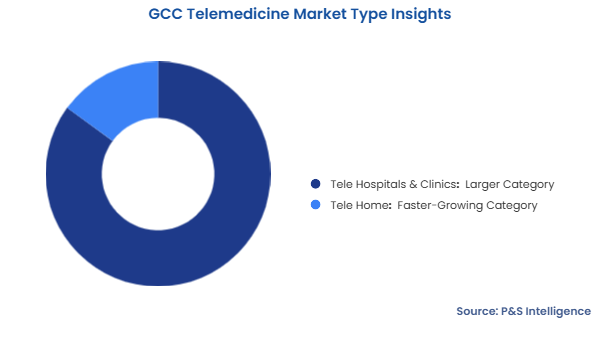
The tele hospitals & clinics category holds the larger share in the GCC telemedicine market in 2025, of 85%, and it is expected to maintain its position during the forecast period. This dominance is primarily attributable to extensive investments by healthcare institutions in establishing comprehensive virtual care infrastructure, the presence of specialist physicians on hospital-based telemedicine platforms, and strong integration with existing hospital information systems that enable seamless care coordination.
Saudi Arabia's Seha Virtual Hospital connects over 224 healthcare facilities and has facilitated over 1.6 million virtual consultations, demonstrating the scale of hospital-based telemedicine adoption. Hospital & clinic-based telemedicine platforms offer access to multidisciplinary care teams, advanced diagnostic capabilities through integration with hospital imaging and laboratory systems, and the ability to provide urgent care consultations alongside routine follow-ups.
The tele home category is projected to witness the higher CAGR during 2026–2032, driven by growing patient preference for receiving healthcare services in the comfort of their homes, expanding availability of home-based remote monitoring devices, and cost advantages associated with reducing hospital visits. The elderly population particularly benefits from home-based telemedicine services, which eliminate travel burdens while ensuring continuous health monitoring for chronic disease management. The proliferation of user-friendly mobile health applications and wearable devices is further enabling patients to actively participate in their healthcare from home settings.
These types are covered:
Tele Hospitals & Clinics (Larger Category)
Tele Home (Faster-Growing Category)
Service Insights
The tele consulting category accounts for the largest share in the GCC telemedicine market in 2025, of 35%, reflecting the high demand for remote physician consultations across various medical specialties. Teleconsultation services have become increasingly sophisticated, incorporating high-definition video conferencing, secure messaging platforms, and integrated electronic prescription capabilities that replicate many aspects of in-person physician visits.
Saudi Arabia's Mawid app facilitated over 3 million virtual consultations during the COVID-19 pandemic, underscoring widespread adoption of teleconsultation services. Patients across the GCC region are increasingly comfortable consulting physicians remotely for non-emergency medical concerns, follow-up appointments, medication adjustments, and second opinions. Healthcare providers recognize teleconsultation as an efficient mechanism to expand their patient reach while optimizing clinic capacity and reducing patient waiting times.
The tele monitoring category is expected to register the highest CAGR during the forecast period, fueled by the rising prevalence of chronic diseases requiring continuous health parameter tracking, advancements in wearable medical devices and Internet of Things technologies, and healthcare system emphasis on preventive care and early intervention strategies. Remote patient monitoring enables real-time tracking of vital signs such as blood glucose levels, blood pressure, heart rate, and oxygen saturation, allowing clinicians to detect adverse trends before they escalate into serious complications. This is particularly valuable for managing patients with diabetes, hypertension, heart failure, and respiratory conditions who benefit from ongoing supervision between scheduled consultations.
These services are covered:
Tele Consulting (Largest Category)
Tele Monitoring (Fastest-Growing Category)
Tele Education
Tele Training
Others
Specialty Insights
The cardiology specialty dominates the GCC telemedicine market in 2025 with 40% share, driven by the high prevalence of cardiovascular diseases across the region and the suitability of cardiac conditions for remote monitoring through specialized devices. Telecardiology enables remote electrocardiogram monitoring, cardiac rehabilitation supervision, and timely consultation for patients experiencing chest pain or other cardiac symptoms, significantly improving access to cardiology specialists who are in limited supply across many GCC healthcare systems.
The dermatology specialty is anticipated to exhibit the fastest growth during the forecast period, propelled by the visual nature of dermatological assessments making them highly suitable for telemedicine, increasing incidence of skin conditions across the GCC population, and growing patient comfort with submitting photographs for remote skin evaluations.
Teledermatology platforms enable patients to receive timely evaluations for concerns, including acne, eczema, psoriasis, allergic reactions, and suspicious moles, without lengthy waits for in-person dermatology appointments. The ability to capture high-quality smartphone images of skin conditions has made remote dermatological consultations increasingly accurate and reliable. Additionally, dermatology consultations often do not require physical examinations or invasive procedures, making them particularly well-suited for the telemedicine delivery model.
These specialties are covered:
Cardiology (Largest Category)
Dermatology (Fastest-Growing Category)
Gynecology
Neurology
Orthopedics
Others
Drive strategic growth with comprehensive market analysis
GCC Telemedicine Market Regional Outlook
Saudi Arabia Telemedicine Market Size
Geographically, Saudi Arabia holds the largest share in the GCC telemedicine market in 2025, of 40%, and it is expected to maintain its dominant position throughout the forecast period. This is primarily credited to the kingdom's Vision 2030 digital transformation initiative, substantial government investments exceeding USD 50 billion in healthcare digitalization, and the deployment of large-scale telemedicine infrastructure, including the Seha Virtual Hospital network.
Saudi Arabia launched Seha Virtual Hospital in August 2022, which has grown to become the world's largest virtual hospital, connecting over 224 healthcare facilities across the kingdom. The hospital offers medical services to more than 400,000 patients annually and utilizes AI tools to provide telehealth consultations, particularly benefiting patients in remote areas. The Saudi government has implemented supportive regulatory frameworks for telemedicine practice, established reimbursement policies encouraging virtual care adoption, and launched national health applications like Mawid, Sehhaty, and Wasfaty that integrate telemedicine capabilities.
The Kingdom faces significant healthcare challenges that telemedicine helps address, including the dispersion of population across vast desert territories, shortage of specialist physicians in rural regions, and growing healthcare demands from an expanding and aging population. Private sector healthcare providers are also actively investing in telemedicine platforms, while public-private partnerships are accelerating the deployment of digital health solutions across government and private healthcare facilities.
U.A.E. Telemedicine Market Growth
The U.A.E. is projected to register the fastest growth in the GCC telemedicine market during 2026–2032, with a CAGR of approx. 11.5%, attributed to the Emirates' advanced digital infrastructure, progressive regulatory environment supportive of healthcare innovation, and strategic positioning as a regional healthcare and medical tourism hub. The UAE telehealth market held the largest share of 24.8% in the Middle East and Africa region in 2024.
The UAE has emerged as a leader in digital health adoption, ranking first in the Arab world and 20th globally according to the Global Innovation Index 2022. Cities like Dubai and Abu Dhabi have implemented comprehensive telehealth platforms, including the Seha telemedicine service, while the Wareed integrated health records system facilitates seamless information exchange across public and private healthcare providers. During the COVID-19 pandemic, telehealth consultations increased by 70% in the U.A.E., reflecting the rapid adoption of remote care models.
The U.A.E. government has established clear regulatory frameworks for telemedicine practice, data privacy protection, and cross-border teleconsultations, creating confidence among both healthcare providers and patients in utilizing virtual care services. The country's high smartphone penetration exceeding 93%, robust 5G network coverage, and tech-savvy population facilitate widespread telemedicine adoption. Healthcare authorities are actively encouraging digital health innovation through initiatives supporting healthtech startups, regulatory sandboxes for testing new telemedicine solutions, and partnerships with international technology providers to deploy cutting-edge virtual care capabilities.
These countries are covered:
Saudi Arabia (Largest Country Market)
U.A.E. (Fastest-Growing Country Market)
Qatar
Kuwait
Oman
Bahrain
GCC Telemedicine Market Share
The GCC telemedicine market is slightly fragmented due to the presence of various established regional players alongside international telemedicine service providers and technology vendors. The market features a mix of hospital-based virtual care platforms, standalone telemedicine application providers, and healthcare IT infrastructure companies offering telemedicine-enabling technologies.
In recent years, market participants have focused on expanding their service portfolios to encompass multiple medical specialties, enhancing platform features through AI integration and advanced analytics capabilities, and establishing partnerships with hospitals and government health authorities. Strategic collaborations between GCC healthcare institutions and global technology companies are accelerating the deployment of sophisticated telemedicine solutions. For instance, government initiatives to connect multiple healthcare facilities through centralized virtual hospital networks are creating ecosystem opportunities for technology providers offering interoperable platforms.
Investment activity in the GCC digital health sector has increased substantially, with both government entities and private investors recognizing the strategic importance of telemedicine infrastructure. Healthcare providers are prioritizing user experience improvements, ensuring regulatory compliance with data privacy requirements, and integrating telemedicine capabilities with existing electronic health record systems. The competitive landscape is characterized by innovation in specialty-specific telemedicine applications, expansion of multilingual support to serve diverse GCC populations, and deployment of culturally appropriate virtual care models that respect local healthcare preferences and practices.
Key GCC Telemedicine Companies:
Abu Dhabi Telemedicine Centre
Aster DM Healthcare
Cerner Corporation
CISCO Systems Inc.
GE HealthCare Technologies Inc.
GRANTEQ LLC
Health at Hand
Koninklijke Philips N.V.
Life Gulf Assistance
Okadoc Technologies FZ-LLC
Altibbi
Vezeeta
Okadoc
Mawid
Medtronic PLC
GCC Telemedicine Market News
In August 2025, Saudi Arabia advanced its digital health strategy with increased adoption of AI-powered telemedicine platforms, including Seha Virtual Hospital and Nala, significantly enhancing healthcare service accessibility across remote regions of the Kingdom.
In March 2025, Saudi Arabia launched expanded capabilities for Seha Virtual Hospital, the world's largest virtual hospital, introducing digital health twins that enable proactive care through predictive AI simulations and connecting additional healthcare facilities to the network.
In January 2025, the Saudi Ministry of Health launched the Regulatory Healthcare Sandbox platform, providing startups and established companies a secure environment to test and refine digital health and AI-powered telemedicine solutions for potential integration into the national healthcare system.
In May 2024, Bayer AG and Huma Therapeutics Limited launched an innovative digital Heart Health Risk Assessment tool in Saudi Arabia, aligning with Vision 2030 healthcare transformation objectives and demonstrating continued private sector investment in specialized telemedicine applications.
Want a report tailored exactly to your business need?
Leading companies across industries trust us to deliver data-driven insights and innovative solutions for their most critical decisions. From data-driven strategies to actionable insights, we empower the decision-makers who shape industries and define the future. From Fortune 500 companies to innovative startups, we are proud to partner with organisations that drive progress in their industries.
Client Testimonials
Working with P&S Intelligence and their team was an absolute pleasure – their awareness of timelines and commitment to value greatly contributed to our project's success. Eagerly anticipating future collaborations.
McKinsey & Company
India
Unmatched Standards
Our insights into the minutest levels of the markets, including the latest trends and competitive landscape, give you all the answers you need to take your business to new heights
Complete Data Security
We take a cautious approach to protecting your personal and confidential information. Trust is the strongest bond that connects us and our clients, and trust we build by complying with all international and domestic data protection and privacy laws