GCC Solar Photovoltaic Market Size & Share Analysis - Key Trends, Future Opportunities, Growth Strategies, and Forecasts (2026 - 2032)
This Report Provides In-Depth Analysis of the GCC Solar Photovoltaic Market Report Prepared by P&S Intelligence, Segmented by Application (Commercial, Residential, Industrial, Power Utilities), Technology (Crystalline Silicon, Thin-Film), Deployment Mode (Rooftop, Ground-Mounted), Connectivity Type (On-Grid, Off-Grid), and Geographical Outlook for the Period of 2019 to 2032
Explore the market potential with our data-driven report
GCC Solar Photovoltaic Market Analysis
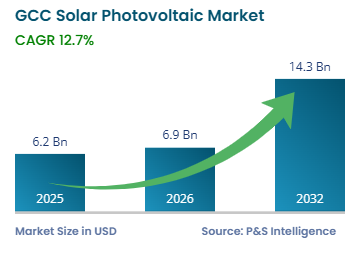
The GCC solar photovoltaics market size will be an estimated USD 6.2 billion for 2025, and it will grow by 12.7% during 2026–2032, to reach USD 14.3 billion by 2032.
The market’s strong expansion is primarily driven by GCC countries’ ambitious renewable energy goals, declining solar PV installation costs, and increasing government initiatives to diversify energy sources beyond fossil fuels.
The region's abundant solar resources, with average solar irradiation levels exceeding 2,000 kWh/m² annually, position the GCC as one of the most favorable regions globally for solar energy development. According to the International Renewable Energy Agency, the GCC region receives some of the highest levels of solar radiation worldwide, with Saudi Arabia and the UAE leading solar capacity additions.
Major utility-scale projects, including Saudi Arabia's NEOM green hydrogen project and the U.A.E.'s Mohammed bin Rashid Al Maktoum Solar Park, are transforming the regional energy landscape. The convergence of economic diversification strategies, environmental commitments under Vision 2030 programs, and technological advancements in solar PV efficiency is creating unprecedented opportunities for market expansion across all GCC member states.
GCC Solar Photovoltaic Market Emerging Trends & Growth Drivers
Adoption of Solar Energy for Desalination due to Severe Water Scarcity Is Key Driver
The growing integration of the solar PV technology for desalination is a major trend in the market.
According to the World Bank, the GCC countries are among the most water-scarce globally, with per capita water availability below 100 cubic meters annually in several nations, far below the 500 m³ threshold for absolute scarcity.
To meet demand, countries rely heavily on desalination, which supplies up to 90% of water in some states, despite high per capita usage of 500–550 liters daily.
The energy required for desalination accounts for significant portions of national electricity consumption, with Saudi Arabia's desalination plants consuming approximately 20% of domestic oil and gas production.
Solar-powered desalination projects are emerging as strategic solutions, combining renewable energy generation with water security objectives.
Saudi Arabia's NEOM project plans to develop entirely solar-powered desalination facilities, setting new benchmarks for sustainable water production.
The integration of solar PV in desalination reduces operational costs, lowers COâ‚‚ emissions, and frees valuable hydrocarbons for export.
Government policies and renewable energy strategies, such as the U.A.E. Clean Energy Strategy 2050 and the Saudi Vision 2030, support this trend by promoting renewable-powered critical infrastructure.
As of 2024, Saudi Arabia leads the GCC in desalination, producing about 11.5 million cubic meters of desalinated water per day, with the public sector contributing 7.5 million and the private sector 3.6 million cubic meters daily.
The country generated roughly 2.9 billion cubic meters of desalinated water in 2022, including from the world’s largest single desalination plant producing nearly 3 million cubic meters daily.
Dubai’s desalination facilities produced around 40.5 billion imperial gallons in Q3 2024, with peak daily demand of about 455 million imperial gallons.
Ambitious National Renewable Energy Targets Are Biggest Drivers
The implementation of comprehensive renewable energy strategies across GCC nations represents the driver for solar photovoltaics market expansion.
Saudi Arabia's National Renewable Energy Program targets 58.7 GW of renewable capacity by 2030, with solar PV comprising approximately 40 GW of this target.
The U.A.E. Energy Strategy 2050 aims to increase clean energy contribution to 50% of the total energy mix, requiring substantial solar PV installations across the Emirates.
These national targets are supported by dedicated renewable energy procurement programs and regulatory frameworks that streamline project development.
The establishment of specialized entities, such as Saudi Arabia's Renewable Energy Project Development Office and Abu Dhabi's Emirates Water and Electricity Company, has institutionalized solar PV deployment.
Kuwait's recent announcement to achieve a 15% renewable energy share by 2030 and 50% by 2050 demonstrates the accelerating regional commitment.
The alignment of these targets with economic diversification goals ensures sustained governmental support and funding allocation for solar PV projects throughout the forecast period.
GCC Solar Photovoltaic Market Segmentation Analysis
Application Analysis
The commercial category holds the largest market share, of 60%, in 2025, driven by large-scale utility projects launched under national renewable energy initiatives. This dominance reflects the region's preference for large-scale, centralized power generation facilities that can deliver substantial capacity additions efficiently. Saudi Arabia's 2.6 GW Sudair solar project and the U.A.E.'s 2 GW Al Dhafra solar project exemplify the scale of utility deployments.
The power utilities category will have the highest CAGR, of 12.9%, propelled by new regulations mandating solar installations on commercial buildings and attractive net metering policies. The implementation of Dubai's Shams Dubai program, which requires solar panels on all new buildings by 2030, has catalyzed commercial adoption. Similar initiatives in Saudi Arabia's Eastern Province and Qatar's national building codes are expanding commercial solar deployment. The segment's growth is further supported by innovative financing mechanisms like solar leasing and power purchase agreements tailored for commercial customers.
The applications analyzed in this report are:
Commercial (Fastest-Growing Category)
Residential
Industrial
Power Utilities (Largest Category)
Technology Analysis
The crystalline silicon category holds the largest market share, of 90%, in 2025, and it will have the highest CAGR, of 13.1%, with monocrystalline silicon leading due to its superior efficiency and performance in high-temperature environments. The preference for crystalline silicon reflects its proven reliability, extensive track record in desert conditions, and competitive pricing achieved through global manufacturing scale.
The technologies analyzed in this report are:
Crystalline Silicon (Largest and Fastest-Growing Category)
Monocrystalline
Polycrystalline
Thin-Film
Others
Deployment Mode Analysis
The ground-mounted category holds the larger market share, of 65%, in 2025, reflecting the abundance of available desert land and the prevalence of utility-scale projects across the GCC region. The vast expanses of uninhabited desert areas in Saudi Arabia, U.A.E., and Oman provide ideal locations for large solar farms without competing land use pressures. Ground-mounted systems offer optimal tilt angle adjustment, easier maintenance access, and superior cooling compared to rooftop installations. The Noor Abu Dhabi project, spanning 8 square kilometers of desert, exemplifies the scale possibilities of ground-mounted deployments.
The rooftop category will have the higher CAGR, of 13.0%, driven by space optimization needs in urban areas and supportive building regulations. The implementation of mandatory rooftop solar requirements for new constructions in Dubai, Abu Dhabi, and Riyadh's diplomatic quarter accelerates adoption. The segment benefits from reduced transmission losses, lower installation costs for smaller systems, and immediate electricity cost savings for building owners. Enhanced mounting solutions for the flat roofs typical in GCC buildings, along with better wind resistance, overcome earlier technical limitations.
The deployment modes analyzed in this report are:
Rooftop (Faster-Growing Category)
Ground-Mounted (Larger Category)
Connectivity Type Analysis
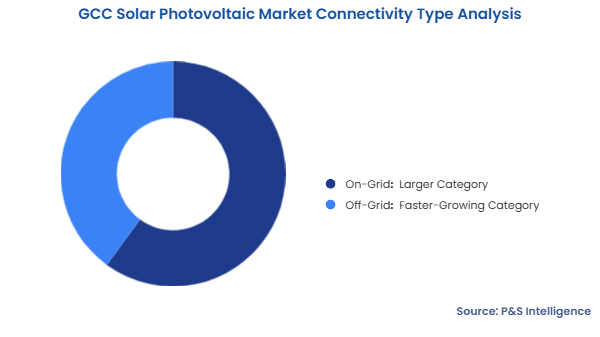
The on-grid category holds the larger market share in 2025, aligning with the GCC's well-developed electricity grid infrastructure and centralized power distribution model. The extensive grid networks across urban and industrial areas facilitate seamless integration of solar PV systems, supported by advanced grid codes and interconnection standards. Net metering policies implemented across the UAE, Saudi Arabia, and Oman enable bidirectional power flow, making on-grid systems financially attractive for all customer segments.
The off-grid category will have the higher CAGR during the forecast period, driven by remote area electrification needs and specialized applications. The electrification of remote villages in Saudi Arabia's Empty Quarter and Oman's mountain communities relies increasingly on standalone solar systems. According to the King Abdullah City for Atomic and Renewable Energy, over 200 remote communities in Saudi Arabia require off-grid solutions. Off-grid applications in telecommunications towers, border security installations, and agricultural pumping systems present growing opportunities. The integration of battery storage technologies with off-grid solar systems enhances reliability and expands potential applications.
The connectivity types analyzed in this report are:
On-Grid (Larger Category)
Off-Grid (Faster-Growing Category)
Drive strategic growth with comprehensive market analysis
GCC Solar Photovoltaic Market Regional Market Performance
Saudi Arabia Market Size
Saudi Arabia holds the largest market share, of 40%, in 2025, driven by its extensive renewable energy initiatives, vast land resources, and substantial government investments in solar infrastructure. The Saudi National Renewable Energy Program's commitment to develop 40 GW of solar PV capacity by 2030 drives continuous project development, with annual tenders of 3–4 GW maintaining robust market activity. The Saudi solar PV market is projected to grow from approximately USD 3,920.0 million in in 2024 to USD 44,263.8 million by 2030.
The kingdom's solar development benefits from exceptional solar resources, with direct normal irradiance levels exceeding 2,500 kWh/m² annually in Tabuk and Al-Jouf. Major projects, including the 2.6 GW Sudair solar plant and the 1.5 GW Red Sea renewable complex, demonstrate Saudi Arabia's commitment to large-scale deployment. The establishment of local manufacturing capabilities, including solar panel assembly facilities in NEOM and King Salman Energy Park, reduces costs and creates employment opportunities. The Public Investment Fund's dedicated renewable energy vehicles, including ACWA Power's renewable portfolio, provide substantial capital for project development.
U.A.E. Market Size
U.A.E. will have the highest CAGR, of 12.8%, driven by ambitious clean energy targets and innovative project structures. The Emirates' commitment to achieving 50% clean energy by 2050 necessitates accelerated solar deployment across all seven emirates.
The U.A.E.’s groundbreaking achievement in record-low solar tariffs draws international investment and sets new standards for solar project economics. The Mohammed bin Rashid Al Maktoum Solar Park, planned to reach 5 GW by 2030, serves as a global showcase for solar innovation, including CSP integration and energy storage. Abu Dhabi's 2 GW Al Dhafra solar project, featuring the world's largest single-site solar plant, reinforces the Emirates' leadership position. The implementation of supportive policies, including mandatory solar installations, green building codes, and innovative financing mechanisms, such as green bonds, accelerates market growth.
The geographical breakdown of the market is as follows:
Saudi Arabia (Largest Country Market)
U.A.E. (Fastest-Growing Country Market)
Kuwait
Qatar
Oman
Bahrain
GCC Solar Photovoltaic Market Share
The market is fragmented because it involves numerous local and international developers, EPC contractors, and technology providers. Projects range from small residential rooftops to large utility-scale solar parks, creating diverse opportunities for multiple players. Each GCC country issues independent tenders and renewable energy projects, allowing various companies to participate. No single company dominates the entire regional market, and competition exists across technologies like crystalline silicon, thin-film, and bifacial panels, resulting in a highly distributed, fragmented market structure.
Key GCC Solar Photovoltaic Companies:
JinkoSolar Holding Co., Ltd.
First Solar, Inc.
Trina Solar Co., Ltd.
JA Solar Technology Co., Ltd.
Canadian Solar Inc.
Alsa Solar Systems LLC
SirajPower
Enerwhere Sustainable Energy
Yellow Door Energy
ACWA Power
Masdar
Dubai Electricity and Water Authority
GCC Solar Photovoltaic Market News
In April 2025, Gulf Warehousing Company Q.P.S.C. began a collaboration with Yellow Door Energy to establish solar power plants at three key logistics hubs in the Gulf region: Logistics Village Qatar, Bu Sulba Warehousing Park, and Al Wukair Logistics Park.
In March 2025, Tanmiah Food Company announced a partnership with Emerge, a joint venture between Masdar and the EDF Group, to establish a solar power plant with a capacity of 3 Megawatt-peak (MWp) at Tanmiah’s facility in Haradh. Emerge will deliver a comprehensive turnkey solution for Tanmiah, encompassing the financing, design, procurement, construction, operations, and maintenance of the facility for 25 years. The solar power plant is expected to supply 35% of the electricity necessary to operate the agricultural processing facility.
In August 2024, China Energy Engineering Corporation entered into a USD 972-million contract to construct a 2-GW solar power plant in Saudi Arabia. This project is a joint venture involving Saudi entities such as the Public Investment Fund, ACWA Power, and Saudi Aramco Power Company.
Want a report tailored exactly to your business need?
Leading companies across industries trust us to deliver data-driven insights and innovative solutions for their most critical decisions. From data-driven strategies to actionable insights, we empower the decision-makers who shape industries and define the future. From Fortune 500 companies to innovative startups, we are proud to partner with organisations that drive progress in their industries.
Client Testimonials
Working with P&S Intelligence and their team was an absolute pleasure – their awareness of timelines and commitment to value greatly contributed to our project's success. Eagerly anticipating future collaborations.
McKinsey & Company
India
Unmatched Standards
Our insights into the minutest levels of the markets, including the latest trends and competitive landscape, give you all the answers you need to take your business to new heights
Complete Data Security
We take a cautious approach to protecting your personal and confidential information. Trust is the strongest bond that connects us and our clients, and trust we build by complying with all international and domestic data protection and privacy laws