This Report Provides In-Depth Analysis of the GCC Smart Ports Market Report Prepared by P&S Intelligence, Segmented by Element (Smart Port Infrastructure, Termination Automation & Cargo Handling, Port Community Systems, Smart Safety & Security, Traffic Management System), Technology (Internet of Things (IoT), Process Automation, Blockchain, Artificial Intelligence (AI)), Port Type (Seaports, Inland Ports), and Geographical Outlook for the Period of 2019 to 2032
Explore the market potential with our data-driven report
GCC Smart Ports Market Analysis
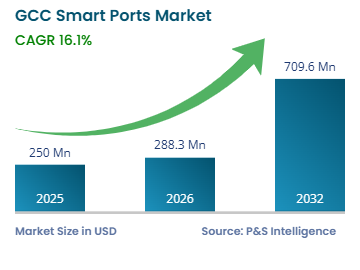
The GCC smart ports market size will be an estimated USD 250.0 million for 2025, and it will grow by 16.1% during 2026–2032, to reach USD 709.6 million by 2032.
The market expansion is primarily driven by government-led digital transformation initiatives aligned with national visions, particularly the UAE's strategic maritime development programs, coupled with surging containerized trade volumes through the region's strategically positioned ports.
The Gulf Cooperation Council nations, comprising Saudi Arabia, the UAE, Oman, Qatar, Kuwait, and Bahrain, are witnessing an unprecedented transformation in their maritime infrastructure. According to the GCC Statistics Center, 10 container terminals from the GCC region secured positions among the top 70 most efficient terminals worldwide in 2024, selected from a global pool of 405 terminals, demonstrating the region's commitment to operational excellence.
IoT technology is revolutionizing smart ports by providing unprecedented visibility into cargo movements, equipment performance, and environmental conditions throughout port operations.
IoT sensors embedded into containers, cranes, vehicles, and storage facilities continuously collect and transmit data on location, temperature, humidity, vibration, and operational status.
This real-time data flow enables port operators to monitor cargo conditions, track container movements with centimeter-level precision using RTK-enhanced GPS, and predict equipment maintenance requirements before failures occur.
Major GCC ports are deploying comprehensive IoT infrastructure to enhance operational efficiency.
Jebel Ali Port utilizes IoT sensors throughout its 42-kilometer port complex to monitor traffic patterns, equipment status, and environmental parameters.
The port's implementation of automated internal terminal vehicles with IoT connectivity has significantly improved container handling efficiency.
Khalifa Port employs 5G-connected sensors for real-time monitoring of infrastructure status and environmental conditions, enabling ultra-low-latency AI systems for immediate operational responses.
King Abdullah Port has integrated IoT devices into its Smart Gate System and Truck Management System to automate logistics procedures and improve truck flow efficiency.
According to the UNCTAD, approximately 80% of global trade by volume is carried out through seaborne transportation, emphasizing the criticality of IoT-enabled smart port technologies in facilitating efficient global commerce.
Moreover, as per the OECD, 15% of the global maritime trade in 2023 went through the Red Sea, the Bab-el-Mandeb Strait, as well as the Suez Canal.
The technology enables predictive maintenance that reduces unplanned equipment downtime, optimizes yard space utilization through intelligent container stacking algorithms, and provides complete supply chain visibility from origin to final destination.
Government-Led Digital Transformation Initiatives Are Biggest Drivers
GCC governments are leading extensive digital transformation programs that are fundamentally reshaping the regional maritime sector.
The UAE is equally committed to smart port development, with Dubai incorporating advanced technologies such as blockchain-based logistics, AI-driven traffic management systems, and IoT for real-time monitoring in its flagship Jebel Ali Port.
The port has invested USD 8.7 billion in infrastructure development, including Terminal 4 construction.
Abu Dhabi's Khalifa Port, managed by AD Ports Group, operates as a semi-automated facility utilizing AI-controlled ship-to-shore cranes, automated stacking cranes, and digital twin technology for predictive simulation of container flow and vessel scheduling.
These government initiatives provide regulatory support, funding mechanisms, and policy frameworks that accelerate the adoption of smart technologies across port operations.
GCC Smart Ports Market Segmentation Analysis
Element Analysis
The smart port infrastructure category holds the largest market share, of 40%, in 2025. This leadership position stems from infrastructure being the foundational layer upon which all smart port functionalities are built. Smart port infrastructure encompasses automated mooring systems, shore power facilities, gate automation equipment, intelligent energy management systems, environmental monitoring solutions, waste treatment units, smart lighting installations, and smart metering devices. GCC ports are making substantial capital investments in physical infrastructure upgrades to support digital transformation objectives. According to Ibrahim Al Najjar, Director of the Information Technology Department at DP World UAE Region, the system represents a quantum leap that increased automation levels to maximum capacity.
The smart safety & security category will have the highest CAGR during the forecast period due to escalating security concerns and regulatory compliance requirements. Smart safety systems integrate AI-powered video analytics, license plate recognition, facial recognition, perimeter intrusion detection, and cybersecurity frameworks to protect port assets and cargo. The technology enables continuous monitoring of vast port areas that human security personnel cannot effectively cover. Deep-learning cameras enhance security by identifying unauthorized access to restricted zones and alerting security teams instantly.
AI video systems detect unauthorized human presence in restricted areas and alert security teams instantly at major global ports. GCC ports face unique security challenges due to their strategic importance and high cargo volumes, driving investments in comprehensive smart security solutions that ensure operational continuity while meeting international safety standards.
The IoT category holds the largest market share in 2025, as it serves as the nerve system of smart ports, connecting thousands of devices, sensors, and equipment components into an integrated digital ecosystem. IoT sensors attached to containers, vehicles, cargo, cranes, and terminal equipment enable real-time tracking and monitoring of asset movements, operational performance, and environmental conditions throughout the entire port premises and supply chain network.
The widespread adoption of IoT in GCC ports is evident across major facilities. Benchmarking global best practices, GCC ports are increasingly deploying comprehensive 5G-connected IoT systems that connect traffic lights, ships, cranes, and environmental sensors, enabling remote-controlled operations and real-time infrastructure monitoring.
The process automation category will have the highest CAGR, of 16.3%, owing to the proven efficiency gains from automating repetitive port operations. Process automation leverages cloud-based software to assist in automated tasks such as ship billing, port gate operations, container tracking, and customs documentation, significantly reducing human intervention requirements. Automated equipment provides vast amounts of operational data that machine learning algorithms analyze to optimize terminal operations beyond current expectations.
The technologies analyzed in this report are:
Internet of Things (IoT) (Largest Category)
Process Automation (Fastest-Growing Category)
Blockchain
Artificial Intelligence (AI)
Others
Port Type Analysis
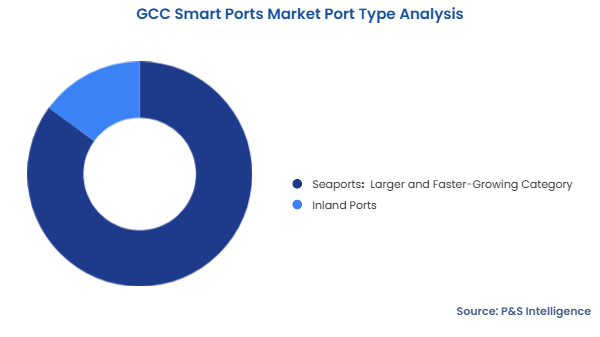
The seaports category holds the largest market share, of 85%, in 2025, and it will have the highest CAGR, of 16.4%, during the forecast period. Seaports handle the overwhelming majority of international trade and containerized cargo in the GCC region, processing millions of TEUs annually through facilities equipped with sophisticated infrastructure capable of accommodating ultra-large container vessels. The massive cargo volumes, complex logistics operations, and strategic importance of seaports necessitate comprehensive smart technology deployments to maintain operational efficiency and competitive positioning.
Major GCC seaports are at the forefront of smart port technology adoption. For instance, King Abdullah Port features the world's deepest 18-meter berths and processes container, bulk, and roll-on/roll-off cargo through advanced automated systems. These major seaports deploy AI-driven robotic systems for container handling, automated cranes and gantries for rapid loading and unloading, and digital platforms that connect shipping lines, freight forwarders, and customs authorities for seamless documentation processing, collectively driving the seaports segment's dominant market position.
The port types analyzed in this report are:
Seaports (Larger and Faster-Growing Category)
Inland Ports
Drive strategic growth with comprehensive market analysis
GCC Smart Ports Market Geographical Analysis
UAE Smart Ports Market Size
UAE holds the largest market share, of 45%, in 2025. The UAE's dominance stems from its well-established position as a global maritime and logistics hub, anchored by world-class port infrastructure and comprehensive government support for digital transformation initiatives. The nation's ports, particularly Jebel Ali and Khalifa Port, serve as major transshipment centers connecting Asia, Europe, and Africa trade routes.
Dubai's Jebel Ali Port stands as the region's flagship smart port implementation. According to DP World, Jebel Ali Port handled a record-breaking 7.3 million TEUs in the first half of 2024 alone, marking a 3.9% year-over-year increase, demonstrating sustained growth momentum. The system represents a quantum leap from its predecessor, delivering world-class efficiency with advanced solutions for remote control of port facilities. Jebel Ali has also implemented autonomous internal terminal vehicles in partnership with DP World to boost terminal efficiency and reduce fleet size requirements. The port utilizes DP World's CARGOES digital logistics platform that integrates blockchain, AI, and IoT to provide real-time shipment visibility.
As per the Abu Dhabi Chamber of Commerce & Industry, Khalifa Port is set to increase its capacity to 9.1 million TEUs by 2026 following a USD 1 billion investment. The port has partnered with Huawei to integrate 5G and edge AI capabilities that enable ultra-low-latency AI systems for real-time operations. The nation's strategic investments in port infrastructure, combined with advanced technology adoption and a favorable business environment, solidify the UAE's position as the GCC's leading smart ports market.
Saudi Arabia Smart Ports Market Size
Saudi Arabia will have the highest CAGR, of 16.2%, driven by the Kingdom's ambitious Vision 2030 program and massive infrastructure investments aimed at transforming the nation into a global logistics hub. Vision 2030, led by Crown Prince Muhammad bin Salman, seeks to diversify Saudi Arabia's economy beyond oil dependence by establishing world-class maritime infrastructure and smart port capabilities that connect three continents. The government has allocated unprecedented funding for port modernization, automation implementation, and digital logistics platform deployment.
King Abdullah Port serves as the centerpiece of Saudi Arabia's smart port strategy. Located in King Abdullah Economic City on the Red Sea coast, the port occupies 17.4 square kilometers and provides strategic access to Jeddah, Makkah, Madinah, and Yanbu. The port features the world's deepest 18-meter berths capable of accommodating ultra-large vessels, industry-leading processing facilities, and fully integrated Port Community and Smart Gate e-systems.
The facility has partnered with TABADUL, the Saudi Company for Electronic Information Exchange, to integrate its Smart Gate System with TABADUL's Truck Management System, enhancing services through world-class technologies that automate logistics procedures within the Port Community System. According to King Abdullah Port's master development plan, the facility will be equipped to handle 25 million TEUs, 25 million tons of bulk cargo, and 1.5 million CEUs annually upon completion.
The Kingdom's broader port development strategy encompasses substantial investments across multiple facilities. Jeddah Islamic Port’s berths are being expanded with an investment of approximately USD 170.5 million, to accommodate mega container ships with capacities up to 24,000 TEUs. The government announced investments exceeding USD 2.66 billion to develop 18 new logistics zones as part of the plan to increase logistics zones from 22 to 59 by 2030.
The countries of the market are as follows:
UAE (Largest Country Market)
Saudi Arabia (Fastest-Growing Country Market)
Qatar
Oman
Kuwait
Bahrain
GCC Smart Ports Market Share
The market is semi-consolidated due to the presence of various global technology providers, port operators, and specialized smart port solution vendors competing alongside government-owned port authorities. Port authorities in GCC nations maintain significant influence through ownership and operation of major port facilities while partnering with technology providers for smart solutions implementation. Major international technology vendors like IBM, ABB, Cisco Systems, Accenture, and Wipro provide critical infrastructure components, automation systems, and software platforms to GCC ports. Recent years have witnessed significant strategic activities among market participants to strengthen their positions. Port authorities are investing heavily in automation equipment upgrades, digital twin implementations, and blockchain platform deployments to enhance operational efficiency and maintain competitive advantages.
Key GCC Smart Ports Companies:
DP World
Abu Dhabi Ports Group
Maqta Gateway LLC
Innovez One Pte. Ltd.
ASYAD Group
APM Terminals
IBM
Accenture plc
W
Navis LLC
Huawei Technologies Co., Ltd.
ABB Ltd
GCC Smart Ports Market News
In October 2025, AD Ports Group signed a strategic collaboration with the United Nations Development Programme to advance digital trade, smart logistics, and the adoption of IoT/automation in port operations.
In September 2025, ADNOC Logistics & Services deployed the first AI‑powered smart port solution in the GCC, cutting vessel service sourcing time from ~3 hours to 45 seconds and improving jetty utilization by 20%.
In November 2024, SANY Marine Heavy Industry Co. Ltd., Marine’s H-Move2.0 system at Tianjin Port boosted tire crane efficiency to 20 moves/hour, introducing anti-shaking and anti-twisting technologies for safer automated operations.
In June 2023, King Abdullah Port partnered with TABADUL to integrate its Smart Gate and Truck Management Systems, automating logistics and enhancing Saudi ports’ competitiveness.
Want a report tailored exactly to your business need?
Leading companies across industries trust us to deliver data-driven insights and innovative solutions for their most critical decisions. From data-driven strategies to actionable insights, we empower the decision-makers who shape industries and define the future. From Fortune 500 companies to innovative startups, we are proud to partner with organisations that drive progress in their industries.
Client Testimonials
Working with P&S Intelligence and their team was an absolute pleasure – their awareness of timelines and commitment to value greatly contributed to our project's success. Eagerly anticipating future collaborations.
McKinsey & Company
India
Unmatched Standards
Our insights into the minutest levels of the markets, including the latest trends and competitive landscape, give you all the answers you need to take your business to new heights
Complete Data Security
We take a cautious approach to protecting your personal and confidential information. Trust is the strongest bond that connects us and our clients, and trust we build by complying with all international and domestic data protection and privacy laws