GCC Satellite Internet Market Size & Opportunities Analysis - Growth Strategies, Competitiveness, and Forecasts (2026 - 2032)
This Report Provides In-Depth Analysis of the GCC Satellite Internet Market Report Prepared by P&S Intelligence, Segmented by Frequency Band (C-Band, L-Band, X-Band, Ka-Band, Ku-Band, V-Band), Orbit Type (Low Earth Orbit, Medium Earth Orbit, Geostationary Earth Orbit, Highly Elliptical Orbit), Connectivity Type (Two-Way Service, One-Way Service, Hybrid Connectivity), End User (Government & Public Sector, Oil & Gas, Maritime, Aviation, Transportation & Logistics, Media & Entertainment, Telecommunications), and Geographical Outlook for the Period of 2021 to 2032
Explore the market potential with our data-driven report
GCC Satellite Internet Market Outlook
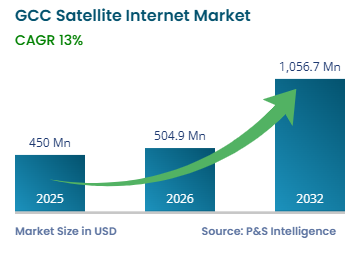
The GCC satellite internet market size will be an estimated USD 450.0 million for 2025, and it will grow by 13.0% during 2026–2032, to reach USD 1056.7 million by 2032.
The major factors responsible for the growth of the market include the increasing investments in digital infrastructure under national diversification programs, expanding demand for reliable connectivity in remote areas and offshore operations, and rapid deployment of low Earth orbit satellite constellations across the region.
The surging investments in smart city developments and digital transformation initiatives are key factors behind the rising adoption of satellite internet connectivity. GCC countries are implementing comprehensive national visions, such as Saudi Vision 2030, UAE Centennial 2071, Qatar National Vision 2030, and Bahrain Economic Vision 2030, which prioritize digital infrastructure and seamless connectivity. For instance, Saudi Arabia has allocated USD 500 billion toward NEOM, a futuristic smart city designed to incorporate satellite-enabled IoT technologies, autonomous systems, and AI-driven urban management.
The rapid deployment of LEO satellite constellations by countries across the GCC region represents a transformative trend in the satellite internet market.
Starlink's expansion began with Oman becoming the first GCC nation to offer services in March 2025, followed by Bahrain in May 2025.
Saudi Arabia approved Starlink for maritime and aviation use in May 2025, while the UAE leverages the technology in humanitarian operations and is exploring partnerships in the aviation and maritime industries.
LEO satellites typically operate at altitudes of 500–2,000 kilometers, delivering latency in the range of 20–70 milliseconds, approaching terrestrial broadband performance.
This represents an improvement over traditional GEO satellites, enabling real-time applications, including video conferencing, cloud services, and IoT communications critical for smart city and industrial operations.
Kuwait and Qatar have also integrated LEO satellite services, with Qatar Airways completing installations across its Boeing 777 fleet and commencing on Airbus A350 aircraft.
National Digital Transformation ProgramsAre Biggest Drivers
The comprehensive digital transformation strategies implemented by GCC governments constitute a primary growth driver for the satellite internet market.
Saudi Vision 2030 prioritizes technology infrastructure and digital economy development as central pillars of economic diversification.
The initiative aims to double the digital economy contribution to GDP from 9.7% to 19.4% within a decade, creating substantial demand for reliable connectivity solutions, including satellite internet services.
The UAE Digital Government Strategy 2025 aims to digitize and automate the majority of government services and build a robust digital infrastructure for seamless service delivery.
The city's IoT-driven initiatives have achieved a 12% reduction in carbon emissions while generating projected annual savings of AED 5.5 billion through efficiency improvements.
Bahrain Economic Vision 2030 similarly prioritizes digital transformation and knowledge economy development, with satellite internet services approved for business operations since April 2022.
GCC Satellite Internet Market Segmentation Analysis
Frequency Band Analysis
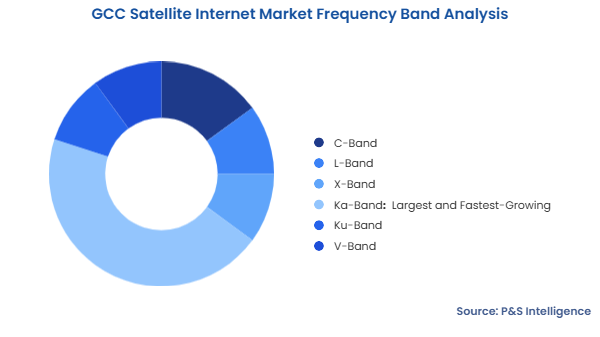
The Ka band category holds the largest market share, of 45%, in 2025, and it will have the highest CAGR, due to Ka-Band's superior throughput capabilities and lower cost-per-bit ratio compared to the Ku band. The Ka band frequency operates in the 26.5-to-40-GHz range, enabling high-speed data transmission essential for enterprise applications, smart city infrastructure, and IoT deployments across the GCC region. The frequency band supports streaming, cloud services, and real-time applications, which are central to the region's digital transformation initiatives.
The frequency bands analyzed in this report are:
C-Band
L-Band
X-Band
Ka-Band (Largest and Fastest-Growing Category)
Ku-Band
V-Band
Orbit Type Analysis
The low earth orbit category holds the largest market share, in 2025. This dominance stems from LEO satellites' ability to provide a significantly lower latency, ranging from 20 to 40 milliseconds, than GEO satellites, enabling real-time applications crucial for autonomous vehicles, industrial IoT, and smart city operations across the GCC. The deployment of Starlink and OneWeb constellations throughout the region has accelerated LEO adoption, particularly in maritime, aviation, and remote oil field operations.
The geostationary earth orbit category will have the highest CAGR, of 13.2%, driven by established infrastructure and wide coverage capabilities. GEO satellites positioned at 35,786 kilometers altitude provide consistent coverage across vast geographic areas, making them ideal for broadcast services, maritime communications across the Arabian Gulf, and backup connectivity for critical infrastructure. Regional operators, including Yahsat, Arabsat, and Thuraya, maintain extensive GEO satellite fleets serving government, commercial, and defense sectors throughout the GCC region.
The two-way service category holds the largest market share, of 65%, in 2025. Two-way connectivity enables bidirectional data transmission essential for interactive applications, including video conferencing, cloud computing, real-time monitoring systems, and IoT communications. The GCC region's focus on smart city development, digital government services, and enterprise applications requires full-duplex communication capabilities that only two-way services can provide effectively.
The hybrid connectivity category will have the highest CAGR, of 13.3%, owing to its ability to optimize bandwidth utilization by combining satellite and terrestrial networks. Hybrid systems intelligently route traffic between cellular, fiber, and satellite connections based on availability, cost, and application requirements. This approach is particularly valuable in the GCC region, where urban areas have extensive fiber infrastructure, while remote locations, including desert areas, offshore platforms, and construction sites, depend on satellite connectivity. The integration enables seamless failover and bandwidth aggregation for mission-critical applications.
The connectivity types analyzed in this report are:
Two-Way Service (Largest Category)
One-Way Service
Hybrid Connectivity (Fastest-Growing Category)
End User Analysis
The oil & gas category holds the largest market share, of 30%, in 2025, driven by the sector's extensive remote operations and critical connectivity requirements. The GCC region accounts for substantial global hydrocarbon production with operations extending across vast desert areas, offshore platforms, and pipeline networks where terrestrial infrastructure is impractical. Satellite connectivity enables real-time monitoring of drilling operations, pipeline integrity systems, SCADA networks, and worker safety communications across these remote facilities.
The aviation category will have the highest CAGR, driven by expanding in-flight connectivity services and unmanned aerial vehicle operations. Qatar Airways, Emirates, and other Gulf carriers are deploying high-speed satellite internet across their fleets to enhance passenger experience and operational communications. Qatar Airways completed the deployment of Starlink’s LEO-based in-flight Wi-Fi connectivity across a significant portion of its Boeing 777 fleet and began installation on Airbus A350 aircraft, positioning it among the first Gulf carriers to offer comprehensive low-latency satellite broadband for passengers. Additionally, the GCC countries are expanding drone operations for infrastructure inspection, border surveillance, and emergency response, all requiring reliable satellite connectivity.
The end users analyzed in this report are:
Government & Public Sector
Oil & Gas (Largest Category)
Maritime
Aviation (Fastest-Growing Category)
Transportation & Logistics
Media & Entertainment
Telecommunications
Others
Drive strategic growth with comprehensive market analysis
GCC Satellite Internet Market Regional Outlook
Saudi Arabia Satellite Internet Market Size
Saudi Arabia holds the largest market share, of 40%, in 2025, driven by the kingdom's massive investment in digital infrastructure under Vision 2030 and extensive geographic challenges requiring satellite connectivity solutions. The country allocated USD 266.57 million in October 2023 to establish its first satellite manufacturing plant, demonstrating a commitment to developing indigenous space capabilities and reducing dependency on international providers.
The expansion of NEOM, The Line, and Qiddiya mega-projects creates substantial demand for satellite internet infrastructure to support smart city operations, autonomous systems, and IoT networks across remote desert locations. The kingdom's oil & gas sector operates numerous remote drilling sites, offshore platforms, and pipeline networks requiring continuous satellite connectivity for operational monitoring, worker communications, and safety systems.
UAE Satellite Internet Market Size
UAE will have the highest CAGR, of 13.1%, driven by its position as a regional technology hub and extensive smart city initiatives. The country's satellite internet adoption is accelerated by Smart Dubai, Zayed Smart City, and Masdar City projects requiring comprehensive connectivity infrastructure. The UAE is an early 5G deployer, with satellite internet providing critical backup and redundancy for these advanced telecommunications systems.
The UAE government's USD 5.1-billion contract to Yahsat in September 2023 for satellite services over 17 years underscores the strategic importance of satellite connectivity for government operations, defense communications, and critical infrastructure. Dubai's IoT-driven smart city initiatives are projected to generate AED 5.5 billion through operational efficiencies enabled by comprehensive connectivity infrastructure, including satellite internet.
The maritime sector represents a significant growth driver, with Dubai hosting one of the world's busiest ports and extensive offshore oil and gas operations. In January 2023, Starlink partnered with Dubai-based Elcome to integrate satellite internet into maritime vessels, oil rigs, and luxury yachts operating in regional waters. The UAE's humanitarian operations in Gaza utilized Starlink connectivity to enable real-time telemedicine consultations between field hospitals and medical centers, demonstrating satellite internet's critical role in emergency response and humanitarian missions.
The countries of the market are as follows:
Saudi Arabia (Largest Country)
UAE (Fastest-Growing Country)
Kuwait
Qatar
Bahrain
Oman
GCC Satellite Internet Market Share
The market is semi-consolidated by the presence of established regional satellite operators, including Yahsat, Arabsat, and Thuraya, alongside global LEO constellation providers such as SpaceX Starlink, OneWeb, and Amazon's Project Kuiper entering the market. Regional operators maintain strong positions through government partnerships, defense contracts, and established GEO satellite infrastructure. The entry of LEO constellation providers is intensifying competition and driving innovation in service delivery. Strategic partnerships and infrastructure investments characterize competitive strategies in the market. The market remains attractive for new entrants and smaller players focusing on specialized applications, including maritime connectivity, aviation services, and oil & gas sector solutions. High capital requirements, spectrum licensing, and regulatory approvals continue to limit large-scale entry, reinforcing the semi-consolidated structure of the market.
Key GCC Satellite Internet Companies:
SpaceX (Starlink)
Eutelsat Group
Amazon.com, Inc. (Project Kuiper)
Viasat, Inc.
EchoStar Corporation
SES S.A.
Intelsat S.A.
Telesat Corporation
Al Yah Satellite Communications Company PJSC (Yahsat)
Arab Satellite Communications Organization (Arabsat)
Thuraya Telecommunications Company PJSC
Iridium Communications Inc.
GCC Satellite Internet Market News
In May 2025, Telesat Corporation secured a broadband capacity agreement with the Saudi-based Arab Satellite Communications Organization to support services from Telesat's proposed LEO constellation.
In May 2025, Saudi Arabia approved Starlink services for maritime and aviation industries during the Saudi-U.S. Investment Forum in Riyadh, enabling expanded adoption for LEO satellite internet providers.
In November 2025, Emirates Airways announced an exploration of a partnership with Starlink to enhance in-flight Wi-Fi services, following the successful rollout of Qatar Airways' fleet-wide deployment.
In March 2025, Oman launched Starlink services to improve connectivity challenges in mountainous and remote desert regions.
In March 2025, Orange Middle East and Africa signed a strategic partnership with Eutelsat Group to expand satellite connectivity services across Africa and the Middle East, enhancing regional service capabilities.
In October 2023, Saudi Arabia announced an investment of USD 266.57 million to establish the kingdom's first satellite manufacturing plant, advancing domestic space industry capabilities and reducing dependency on international suppliers.
Frequently Asked Questions About This Report
Which satellite internet providers operate in the GCC region?+
The market includes regional satellite operators and international service providers offering broadband, mobility, and enterprise connectivity solutions across GCC countries.
What are the major applications of satellite internet in the GCC?+
The market serves major applications such as remote connectivity, maritime and aviation communications, government and defense networks, oil and gas operations, and disaster recovery services.
How does satellite internet support remote and offshore connectivity in the GCC?+
The market enables reliable connectivity in remote deserts, offshore oilfields, and maritime routes where terrestrial networks are limited or unavailable.
What role do government and defense sectors play in GCC satellite internet demand?+
The market sees strong demand from government and defense sectors using satellite internet for secure communications, surveillance support, emergency response, and national connectivity programs.
What is the future outlook of the GCC satellite internet market?+
The market is expected to grow steadily, supported by digital transformation initiatives, smart infrastructure development, and increasing demand for high-reliability connectivity.
Want a report tailored exactly to your business need?
Leading companies across industries trust us to deliver data-driven insights and innovative solutions for their most critical decisions. From data-driven strategies to actionable insights, we empower the decision-makers who shape industries and define the future. From Fortune 500 companies to innovative startups, we are proud to partner with organisations that drive progress in their industries.
Client Testimonials
Working with P&S Intelligence and their team was an absolute pleasure – their awareness of timelines and commitment to value greatly contributed to our project's success. Eagerly anticipating future collaborations.
McKinsey & Company
India
Unmatched Standards
Our insights into the minutest levels of the markets, including the latest trends and competitive landscape, give you all the answers you need to take your business to new heights
Complete Data Security
We take a cautious approach to protecting your personal and confidential information. Trust is the strongest bond that connects us and our clients, and trust we build by complying with all international and domestic data protection and privacy laws