This Report Provides In-Depth Analysis of the GCC Petrochemicals Market Report Prepared by P&S Intelligence, Segmented by Product (Ethylene, Propylene, Benzene, Butadiene, Toluene, Xylene, Methanol), Application (Plastics, Synthetic Fibers, Rubbers & Elastomers, Solvents, Fertilizers), Vertical (Construction, Packaging, Consumer Goods, Agriculture, Healthcare, Automotive, Electronics), and Geographical Outlook for the Period of 2021 to 2032
Explore the market potential with our data-driven report
GCC Petrochemicals Market Overview
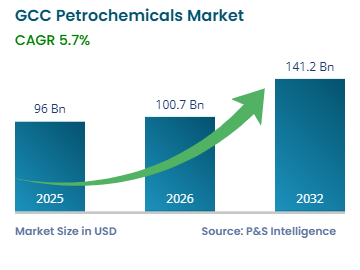
The GCC petrochemicals market size will be an estimated USD 96.0 billion for 2025, and it will grow by 5.7% during 2026–2032, to reach USD 141.2 billion by 2032.
The market growth is driven by abundant feedstock availability and expanding demand from downstream industries, including packaging, construction, and automotive, across regional and international markets. As per the Gulf Petrochemicals and Chemicals Association, GCC has established itself as a global petrochemicals hub with production capacity reaching 156.2 million tonnes in 2023, with Saudi Arabia accounting for approximately 75.0% of regional output.
Moreover, the region's petrochemical industry produces over USD 108 billion worth of products annually, representing the second largest manufacturing sector in the GCC after oil and gas. The predominantly gas-based production structure with C1, C2, and C3 value chains provides significant cost advantages, positioning GCC producers competitively in global markets, particularly for commodity petrochemicals, including ethylene, propylene, and methanol.
GCC Petrochemicals Market Dynamics
Rising Exports to Asian Markets Are Key Trend
Asia, particularly China, India, and Southeast Asia, has emerged as the leading destination for GCC petrochemical exports, driven by robust industrial demand and manufacturing expansion.
The region's demographic growth, rising middle-class consumption, and infrastructure development sustain consistent demand for plastics, polymers, and chemical intermediates.
Strong trade partnerships, efficient maritime shipping routes through the Arabian Gulf and Red Sea, and Asia's reliance on imported feedstocks position the GCC as a natural and reliable supplier.
India's infrastructure boom and manufacturing sector expansion similarly generate increasing petrochemical requirements that GCC producers are strategically positioned to fulfill given proximity and established trade relationships.
The GCC's focus on Asia diversifies revenue streams beyond traditional Western markets, while capitalizing on the world's fastest-growing chemical consumption region.
This geographical strategy aligns with broader economic diversification objectives and hedges against demand volatility in mature markets experiencing slower growth rates.
GCC governments have strengthened bilateral trade agreements and long-term supply arrangements with Asian economies to secure stable petrochemical export demand, particularly with China, India, Japan, and South Korea.
National port and logistics authorities across Saudi Arabia, the UAE, and Oman are expanding export terminals, bulk chemical handling capacity, and integrated logistics zones to support higher petrochemical export volumes to Asia.
Economic Diversification Programs Are Biggest Drivers
Government-led economic diversification initiatives across the GCC are fundamentally reshaping the petrochemicals landscape.
Saudi Vision 2030 emphasizes petrochemicals as a cornerstone of industrial strategy, with the Kingdom targeting to increase non-oil revenues by 113.0% over baseline.
The initiative promotes downstream integration, localization of value chains, and development of specialty chemicals to reduce import dependence and enhance export diversification.
The UAE's Operation 300bn industrial strategy and Qatar's economic diversification efforts similarly prioritize the petrochemical sector’s expansion.
QatarEnergy's production capacity expansion to 14 million tonnes per annum by 2026 represents the country's largest petrochemical investment, demonstrating national commitment to sector growth beyond traditional hydrocarbon exports.
These programs are attracting substantial foreign direct investment and technology partnerships, while fostering industrial clusters in Jubail, Yanbu, Ras Al-Khair, and Ruwais.
GCC governments provide preferential feedstock allocation, land grants, and utility pricing to petrochemical projects aligned with national diversification objectives.
Public sector financing institutions and sovereign wealth funds are actively supporting large-scale petrochemical and downstream investments through equity participation and project financing.
Industrial policies emphasize local downstream conversion of petrochemicals into plastics, packaging, automotive materials, and construction products, increasing domestic value addition.
National sustainability and energy-transition roadmaps encourage petrochemical producers to invest in low-carbon technologies, circular polymers, and energy-efficient production, reinforcing long-term policy support for the sector.
GCC Petrochemicals Market Segmentation Analysis
Product Analysis
The ethylene category holds the largest market share, of 35%, in 2025, driven by ethylene's foundational role in producing polyethylene, the most widely consumed plastic globally, alongside critical derivatives, including ethylene oxide, ethylene glycol, and ethylene dichloride, which are used extensively across packaging, textiles, automotive, and construction applications.
The methanol category will have the highest CAGR, of 5.%, fueled by the expanding applications in chemical synthesis of formaldehyde, acetic acid, and emerging use as an alternative transportation fuel. Moreover, the growing demand from Asia-Pacific markets for methanol-to-olefins applications and methanol's role in energy transition as a clean-burning fuel additive are driving accelerated capacity expansions across Saudi Arabia and the UAE.
The products analyzed in this report are:
Ethylene (Largest Category)
Propylene
Benzene
Butadiene
Toluene
Xylene
Methanol (Fastest-Growing Category)
Others
Application Analysis
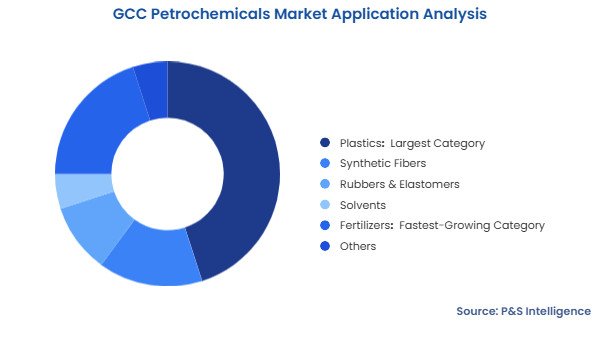
The plastics category holds the largest market share, of 45%, in 2025, driven by the massive consumption of polyethylene and polypropylene in packaging, consumer goods, and manufacturing applications. Rising e-commerce, food and beverage packaging requirements, and industrial packaging needs sustain robust plastics demand throughout GCC domestic markets and export destinations.
The fertilizers category will have the highest CAGR, of 6.0%, supported by agricultural development initiatives across the GCC and strong export demand from South Asia and Africa. The region's ammonia and urea production capacity exceeds 15 million tonnes combined, with abundant natural gas enabling cost-competitive nitrogen fertilizer production.
The applications analyzed in this report are:
Plastics (Largest Category)
Synthetic Fibers
Rubbers & Elastomers
Solvents
Fertilizers (Fastest-Growing Category)
Others
Vertical Analysis
The packaging category holds the largest market share, of 40%, in 2025, reflecting pervasive plastic consumption across food and beverage containers, flexible packaging films, rigid packaging, and industrial packaging materials. Integrated petrochemical and plastics conversion hubs in Saudi Arabia, the UAE, and Qatar facilitate the efficient supply of polymer resins to packaging manufacturers across the GCC and export markets. Additionally, government-led initiatives to expand food processing, pharmaceuticals, and consumer goods manufacturing are indirectly strengthening demand for petrochemical-based packaging materials.
The automotive category will have the highest CAGR, of 5.9%, driven by regional automotive manufacturing expansion, lightweighting trends requiring advanced polymers and composites, and electric vehicle production utilizing specialized petrochemical-derived materials. Saudi Arabia, through initiatives such as the King Salman Automotive Cluster, aims to significantly boost local vehicle production to around 300,000 units annually by 2030, supporting substantial demand for plastics, synthetic rubbers, adhesives, coatings, and other chemical materials, in line with economic diversification objectives under Vision 2030.
The verticals analyzed in this report are:
Construction
Packaging (Largest Vertical)
Consumer Goods
Agriculture
Healthcare
Automotive (Fastest-Growing Vertical)
Electronics
Others
Drive strategic growth with comprehensive market analysis
GCC Petrochemicals Market Geographical Analysis
Saudi Arabia Petrochemicals Market Size
Saudi Arabia holds the largest market share, of 45%, in 2025, reflecting its position as the region's largest producer and exporter. The Kingdom's production capacity of 118 million tonnes annually, according to industry reports, encompasses ethylene, propylene, methanol, aromatics, and derivatives across integrated complexes in Jubail and Yanbu. This is underpinned by SABIC's global presence operating in over 50 countries, substantial Aramco investments in chemicals, and aggressive capacity expansion aligned with Vision 2030 diversification objectives.
The Kingdom's focus on specialty chemicals and high-value products alongside commodity petrochemicals positions Saudi Arabia to capture increasing value-added in global supply chains. For instance, Aramco aims to increase petrochemical production capacity in projects where it holds equity stakes to 4 million barrels per day equivalent by 2030. Moreover, Saudi Arabia benefits from the world's lowest-cost petrochemical production economics due to abundant ethane feedstock, integrated energy infrastructure, and economies of scale achieved through world-class facilities.
UAE Petrochemicals Market Size
UAE will have the highest CAGR, driven by ADNOC's aggressive capacity expansion and strategic investments in downstream integration. The Ruwais petrochemical complex expansion represents an investment of approximately USD 45 billion, as announced by ADNOC and reported in regional business media, aimed at significantly expanding the UAE’s downstream and petrochemicals capacity to around 14 million tonnes per annum as part of its long-term industrial and export growth strategy.
The UAE's Operation 300bn initiative promotes manufacturing sector growth, including petrochemicals, alongside renewable energy and advanced industries. Borouge Group International, ADNOC's joint venture with Austria's Borealis, provides global market access, particularly in Europe and North America. The UAE leverages Dubai and Abu Dhabi as regional hubs for packaging, pharmaceuticals, and consumer products manufacturing.
The countries of the market are as follows:
Saudi Arabia (Largest Country)
UAE (Fastest-Growing Country)
Kuwait
Qatar
Bahrain
Oman
GCC Petrochemicals Market Share
The market is consolidated, reflecting significant barriers to entry, including massive capital requirements, feedstock access, and integrated infrastructure. The dominance of state-owned enterprises and joint ventures with global petrochemical leaders characterizes competitive dynamics, with companies leveraging vertical integration from upstream hydrocarbons through downstream derivatives production. Strategic activities include capacity expansions, technology licensing agreements, downstream integration, joint ventures for market access, and sustainability initiatives. Companies are investing in carbon capture technologies, renewable energy integration, and reduced-emission processes to meet evolving environmental standards and customer requirements. Downstream specialty and performance chemical segments remain relatively less consolidated compared to upstream commodity petrochemicals.
Key GCC Petrochemicals Companies:
Saudi Aramco
SABIC
Abu Dhabi National Oil Company (ADNOC)
Borouge Plc
QatarEnergy
Chevron Phillips Chemical Company LLC
Kuwait Petroleum Corporation
OQ SAOC
Rabigh Refining and Petrochemical Company
Saudi Kayan Petrochemical Company
Equate Petrochemical Company
Qatar Petrochemical Company (QAPCO)
National Industrialization Company
Saudi International Petrochemical Company
The Dow Chemical Company
BASF SE
LyondellBasell Industries Holdings B.V.
Huntsman Corporation
Clariant AG
Evonik Industries AG
Arkema SA
Covestro AG
Eastman Chemical Company
Lubrizol Corporation
Mitsui Chemicals Inc.
Mitsubishi Chemical Group Corporation
LG Chem
DuPont de Nemours, Inc.
LOTTE Chemical Corporation
Petroliam Nasional Berhad
Exxon Mobil Corporation
Chevron Corporation
Shell plc
BP p.l.c.
TotalEnergies SE
Eni S.p.A.
GCC Petrochemicals Market News
In May 2025, QatarEnergy announced plans to significantly expand its global plastics raw materials portfolio, with Qatar-Chevron Phillips Chemical Company LLC’s ethane cracker project in the U.S. It is scheduled to begin operations in the first quarter of 2027 with a 2.08-million-tonne annual ethane cracker and 2-million-tonne annual high-density polyethylene capacity.
In April 2024, Saudi Basic Industries Corporation (SABIC) launched a circular packaging project in collaboration with FONTE bakery, introducing bread bags made from certified circular polyethylene manufactured by Napco National. The packaging was produced by Napco National using food-contact certified circular resin grades supplied by SABIC.
In January 2023, QatarEnergy, along with Chevron Phillips Chemical Company LLC, approved the USD 6-billion Ras Laffan Petrochemicals Complex in Qatar, targeting a production capacity of 14 million tonnes per annum by 2026.
Frequently Asked Questions About This Report
What are the major drivers of the GCC petrochemicals market?+
The GCC petrochemicals market is driven by abundant low-cost hydrocarbon feedstock, large-scale integrated complexes, strong export demand, and government-led industrial diversification initiatives.
Which country dominate the GCC petrochemicals market?+
Saudi Arabia dominates the GCC petrochemicals market.
What are the major products produced in the GCC petrochemicals market?+
Major products include ethylene, propylene, methanol, aromatics, polymers, fertilizers, and other petrochemical derivatives.
How do oil and gas feedstock advantages impact the GCC petrochemicals market?+
The GCC petrochemicals market benefits from low-cost oil and gas feedstock, enabling cost-efficient production and strong global competitiveness.
What is the future outlook of the GCC petrochemicals market?+
The market is expected to grow steadily, driven by capacity expansions, downstream integration, specialty chemicals development, and rising demand from Asia-Pacific and Africa.
Want a report tailored exactly to your business need?
Leading companies across industries trust us to deliver data-driven insights and innovative solutions for their most critical decisions. From data-driven strategies to actionable insights, we empower the decision-makers who shape industries and define the future. From Fortune 500 companies to innovative startups, we are proud to partner with organisations that drive progress in their industries.
Client Testimonials
Working with P&S Intelligence and their team was an absolute pleasure – their awareness of timelines and commitment to value greatly contributed to our project's success. Eagerly anticipating future collaborations.
McKinsey & Company
India
Unmatched Standards
Our insights into the minutest levels of the markets, including the latest trends and competitive landscape, give you all the answers you need to take your business to new heights
Complete Data Security
We take a cautious approach to protecting your personal and confidential information. Trust is the strongest bond that connects us and our clients, and trust we build by complying with all international and domestic data protection and privacy laws