This Report Provides In-Depth Analysis of the GCC Payment Gateway Market Report Prepared by P&S Intelligence, Segmented by Product Type (Hosted, Non-Hosted, Local Bank Integrated, Direct, Platform-Based), Enterprise Size (Large Enterprises, Small and Medium Enterprises (SMEs)), Application (BFSI, Retail & E-commerce, Travel & Hospitality, Healthcare, Media & Entertainment, IT & Telecom, Energy & Utilities), and Geographical Outlook for the Period of 2019 to 2032
Explore the market potential with our data-driven report
GCC Payment Gateway Market Outlook
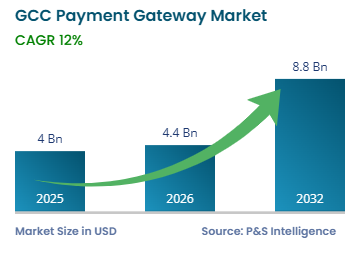
The GCC payment gateway market size will be an estimated USD 4.0 billion for 2025, and it will grow by 12.0% during 2026–2032, to reach USD 8.8 billion by 2032.
The major factors responsible for the growth of the market include rapid digital transformation initiatives across the region, growing e-commerce penetration, and government-led cashless economy drives under various national vision programs.
The growing adoption of digital payments is transforming the way consumers and businesses transact throughout the GCC. The rapid expansion of fintech ecosystems, particularly in Saudi Arabia and the UAE, has created an environment where payment gateways serve as critical infrastructure enabling the region's economic diversification goals. Electronic payments made up 79% of all retail transactions in Saudi Arabia in 2024, up from 70% the previous year, the market demonstrates strong momentum that positions payment gateways as essential enablers of the region's digital economy transformation.
GCC Payment Gateway Market Emerging Trends
Open Banking Integration Is Key Trend
The integration of open banking frameworks with payment gateway services represents a transformative trend reshaping the GCC financial landscape.
This trend is characterized by the regulatory-driven mandate for banks to securely share customer financial data with third-party providers through APIs, fundamentally altering how payment gateways operate and deliver value.
The trend is particularly pronounced in Bahrain, Saudi Arabia, and the UAE, which have established comprehensive regulatory frameworks enabling this transformation.
The impact of open banking on payment gateways manifests in several critical ways, including enhanced payment experiences in which payment gateways can now access real-time account information to enable instant account verification.
This reduces the volume of failed transactions and improves authorization rates.
This capability allows merchants to offer account-to-account payments directly, bypassing traditional card networks and reducing transaction costs.
Open banking APIs enable payment gateways to develop sophisticated risk assessment models, offer personalized payment options based on customer financial profiles, and create innovative services, such as automated reconciliation and cash flow management tools.
This trend aims to foster competition and innovation in financial services by enabling new players to offer tailored products, such as personalized budgeting tools, enhanced payment solutions, and lending services.
Payment gateway providers leveraging open banking can offer value-added services beyond basic transaction processing, including financial analytics, credit scoring, and integrated lending solutions.
In June 2024, Saudi entrepreneurs launched a fintech startup, Thimsa, to facilitate instant B2B payments and payouts in the UAE and Bahrain, targeting the region's open banking growth.
Payment gateway providers that successfully integrate open banking capabilities will be positioned to capture higher market share and command premium pricing for their enhanced service offerings.
Digital Transformation Initiatives Are Biggest Drivers
The key driver for the market is the comprehensive digital transformation strategies implemented across GCC countries.
GCC states have made significant strides in enhancing digital government services—they are now among the top globally as measured by the GovTech Maturity Index of the World Bank.
Saudi Arabia's Vision 2030 and the U.A.E.'s Digital Strategy 2025-2027 have allocated substantial resources toward building digital infrastructure and promoting cashless societies.
Saudi Arabia has announced a USD 36 billion investment in transportation infrastructure over the next 11 years, with significant portions dedicated to digital payment integration.
Post-pandemic, digital adoption has surged, with businesses shifting to online channels and consumers increasingly using contactless payment methods.
Government entities are leading by example, with initiatives to digitize all government services and mandate electronic payment acceptance across public sector transactions.
Abu Dhabi’s Digital Strategy 2025-2027 aims for 100% sovereign cloud adoption and the digitization of all government processes.
This digital push has created a fertile environment for payment gateway providers to expand their services and capture growing transaction volumes.
As of 2025, internet penetration in the major GCC countries is among the highest in the world.
Saudi Arabia, UAE, Qatar, Bahrain, and Kuwait all report around 99% penetration, while Oman is at approximately 95.3%.
Mobile internet dominates across the region, with Saudi Arabia reporting 99.4% of users accessing the internet via mobile.
Kuwait and Bahrain boast some of the fastest internet speeds globally, with Kuwait’s median mobile speed reaching 258 Mbps and Bahrain's around 118 Mbps.
Fixed broadband speeds are also strong, with Bahrain averaging 86 Mbps. Most GCC nations have more mobile connections than total population, indicating high device saturation.
GCC Payment Gateway Market Segmentation Analysis
Product Type Analysis
The hosted category holds the largest market share, of 45%, in 2025, due to the ease of implementation, reduced merchant liability, and comprehensive security features that hosted gateways provide. SMEs prefer hosted solutions because they remove the burden of PCI DSS compliance and reduce technical complexity. The plug-and-play nature of hosted gateways, combined with their ability to handle the entire payment process on secure third-party servers, has made them the preferred choice for businesses entering the digital commerce space.
The non-hosted category will have the highest CAGR, of 12.2%, owing to the growing demand for customization and brand consistency among large enterprises. These solutions enable businesses to maintain complete control over the payment experience while keeping customers on their website throughout the transaction process. The increasing sophistication of e-commerce platforms and the need for seamless user experiences are driving the adoption of self-hosted solutions, particularly among established retail brands and financial institutions seeking to differentiate their digital offerings.
The product types analyzed in this report are:
Hosted (Largest Category)
Non-Hosted (Fastest-Growing Category)
Local Bank Integrated
Direct
Platform-Based
Enterprise Size Analysis
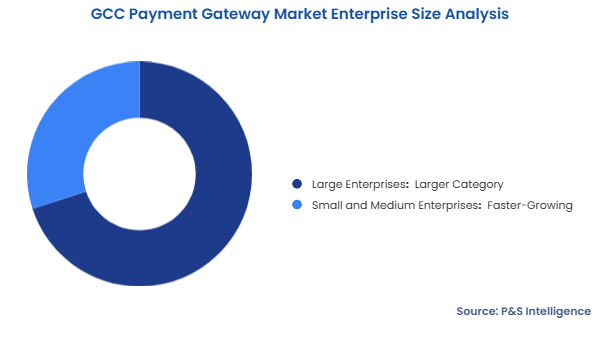
The large enterprises category holds the larger market share, of 70%, in 2025, driven by their substantial transaction volumes and need for sophisticated payment solutions. These organizations require payment gateways that manage complex multi-channel operations, supporting various payment methods, and providing detailed analytics and reporting capabilities. The higher security requirements and regulatory compliance needs of large enterprises have led them to invest significantly in advanced payment gateway solutions that offer enterprise-grade features such as tokenization, advanced fraud detection, and seamless integration with existing ERP systems.
The SMEs category will have the higher CAGR, of 12.3%, as the democratization of digital commerce and the availability of affordable, user-friendly payment gateways enable SMEs to compete effectively in the digital marketplace. Government initiatives supporting SME digitalization, combined with the emergence of fintech solutions tailored to smaller businesses, are accelerating adoption in this segment. The flexibility and scalability offered by modern payment gateways allow SMEs to start with basic features and expand functionality as their business grows.
The enterprise sizes analyzed in this report are:
Large Enterprises (Larger Category)
Small and Medium Enterprises (SMEs) (Faster-Growing Category)
Application Analysis
The retail & e-commerce category holds the largest market share, of 50%, in 2025, reflecting the sector's central role in driving digital payment adoption. Rapid online shopping growth and omnichannel strategies from traditional retailers are driving strong demand for payment gateway solutions. The sector's dominance is reinforced by the increasing consumer preference for digital payments and the proliferation of online marketplaces catering to diverse product categories.
Around 80–85% of the users in countries the UAE and Saudi Arabia regularly shop online. Among millennials, this figure is even higher—up to 83% report having shopped online in the past six months. In terms of frequency, about 38% of users in both Saudi Arabia and the UAE shop online once or a few times a week, while another 25–30% shop 2–3 times per month. Only a small percentage—around 6–8%—shop less than once per year. The average order value in the UAE is approximately USD 102, while broader MENA data shows an AOV range of USD 30–36.
The BFSI category will have the highest CAGR during the forecast period, due to the sector’s rapid digital transformation. Banks and financial institutions are increasingly adopting open banking, fintech solutions, and automated payment platforms. Rising demand for secure, real-time transactions and innovative financial services is driving accelerated growth.
In Saudi Arabia, about 76–81% of customers actively use digital banking platforms, with 82% using them at least once a week and 36% doing so daily. Across the GCC, 89% of consumers say they prefer digital channels over visiting a physical bank branch. Most users rely on mobile apps rather than desktop banking, with common activities including money transfers, bill payments, and checking balances—over 90% of users in some studies use these core features.
The applications analyzed in this report are:
BFSI (Fastest-Growing Category)
Retail & E-commerce (Largest Category)
Travel & Hospitality
Healthcare
Media & Entertainment
IT & Telecom
Energy & Utilities
Others
Drive strategic growth with comprehensive market analysis
U.A.E. holds the largest market share, of 30%, in 2025, due to the country's position as a regional fintech hub, advanced digital infrastructure, and the presence of numerous global technology companies. The U.A.E.'s strategic location as a gateway between East and West has attracted significant investment in payment technologies, with both local and international providers establishing operations in the country.
The country's diverse population and status as a tourist destination have created demand for payment gateways supporting multiple currencies and payment methods. The U.A.E. Central Bank's progressive regulatory approach, including the establishment of regulatory sandboxes and open banking frameworks, has fostered innovation in the payment sector.
Moreover, by embracing technologies like blockchain and AI, the UAE has become a key testing ground for innovative payment solutions. Crypto adoption as a digital asset is especially high in the U.A.E., ranking 3rd globally in residence investment advisor Henley & Partners' Crypto Wealth Report. This technological sophistication, combined with strong government support and a thriving startup ecosystem, ensures the U.A.E.'s continued growth as a key payment gateway market in the region.
Saudi Arabia Payment Gateway Market Size
Saudi Arabia will have the highest CAGR, of 12.1%, due to the Kingdom's ambitious Vision 2030 program, which has prioritized digital transformation and the development of a cashless society. By 2024, close to 11.5 billion card-payment transactions were processed across a point-of-sale network of almost two million terminals, as well as online for e-commerce, demonstrating the massive scale of digital payment infrastructure in the Kingdom.
Saudi Arabia’s government initiatives and supportive financial policies have fostered a conducive environment for payment gateway expansion. The SAMA has licensed Majd Saudi Payments to provide E-wallet solutions. With Majd Saudi Payments, 26 licensed companies now offer payment services in Saudi Arabia. The Kingdom's young, tech-savvy population, combined with high smartphone penetration rates, has accelerated the adoption of digital payment methods across all consumer segments.
Furthermore, Saudi Arabia's position as the largest economy in the GCC provides a substantial market for payment gateway providers. The integration of advanced payment technologies, including the recent launches of Google Pay and Alipay+ through the national payment system 'mada', positions Saudi Arabia at the forefront of payment innovation in the region.
The geographical breakdown of the market is as follows:
Saudi Arabia (Fastest-Growing Country Market)
U.A.E. (Largest Country Market)
Kuwait
Qatar
Bahrain
Oman
GCC Payment Gateway Market Share
The market is fragmented due to the presence of various international players alongside emerging regional providers. Multiple providers compete to offer tailored solutions for different customer needs, contributing to a highly diverse market landscape. The market has witnessed increased competition from fintech startups leveraging modern technologies to offer innovative features such as instant settlements, advanced analytics, and AI-powered fraud prevention. This dynamic environment encourages continuous innovation and gives businesses a wide range of choices in payment gateway solutions.
Key GCC Payment Gateway Companies:
Amazon Payments, Inc.
PayPal Holdings, Inc.
Stripe, inc.
Checkout Ltd
2Checkout.com, Inc.
Adyen N.V.
PayTabs Payment Solutions Private Limited
Infibeam Avenues Limited
Skrill Limited
Telr Payments FZ-LLC
Payoneer Inc.
CASHU LLC
GCC Payment Gateway Market News
In December 2024, the Saudi Central Bank announced the launch of Google Pay and signed an agreement with Ant International to enable Alipay+ payments by 2026, utilizing the Kingdom's National Payment System 'mada' to improve digital payment accessibility.
In October 2024, Mastercard Incorporated launched advanced local processing infrastructure in Saudi Arabia, under the SAMA’s guidance, to support e-commerce transactions and accelerate the country’s digital commerce ecosystem.
In September 2024, Tabby Tecnologies FZ-LLC completed the acquisition of Saudi-based digital wallet Tweeq, licensed by the Saudi Central Bank, expanding its payment offerings.
In March 2024, Loop, a Saudi Central Bank-licensed digital payment technology company, partnered with Mastercard Incorporated to introduce innovative credit card and payment solutions in Saudi Arabia.
Want a report tailored exactly to your business need?
Leading companies across industries trust us to deliver data-driven insights and innovative solutions for their most critical decisions. From data-driven strategies to actionable insights, we empower the decision-makers who shape industries and define the future. From Fortune 500 companies to innovative startups, we are proud to partner with organisations that drive progress in their industries.
Client Testimonials
Working with P&S Intelligence and their team was an absolute pleasure – their awareness of timelines and commitment to value greatly contributed to our project's success. Eagerly anticipating future collaborations.
McKinsey & Company
India
Unmatched Standards
Our insights into the minutest levels of the markets, including the latest trends and competitive landscape, give you all the answers you need to take your business to new heights
Complete Data Security
We take a cautious approach to protecting your personal and confidential information. Trust is the strongest bond that connects us and our clients, and trust we build by complying with all international and domestic data protection and privacy laws