This Report Provides In-Depth Analysis of the GCC Online Food Delivery Market Report Prepared by P&S Intelligence, Segmented by Service Type (Platform-to-Consumer Delivery, Restaurant-to-Consumer Delivery), Platform Type (Mobile Applications, Websites/Desktop), Payment Method (Online, Cash on Delivery), Business Model (Order-Focused, Logistics-Focused, Full-Service), and Geographical Outlook for the Period of 2019 to 2032
Explore the market potential with our data-driven report
GCC Online Food Delivery Market Future Outlook
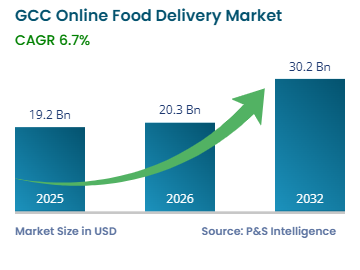
The GCC online food delivery market size will be an estimated USD 19.2 billion for 2025, and it will grow by 6.7% during 2026–2032, to reach USD 30.2 billion by 2032.
The market's robust growth is primarily driven by the increasing smartphone penetration, changing consumer lifestyles, and the rapid expansion of digital payment infrastructure across the region.
The burgeoning expatriate population in GCC countries constitutes a significant catalyst for market expansion. The working professionals, often with hectic schedules and limited time for meal preparation, increasingly rely on online food delivery services for their daily sustenance. The convenience of ordering diverse cuisines through user-friendly mobile applications has transformed food consumption patterns across the region.
Furthermore, the proliferation of cloud kitchens and virtual restaurants has revolutionized the food delivery landscape in GCC countries. The parallel growth of cloud kitchens amplifies the online food delivery market's potential by reducing operational costs and enabling restaurants to expand their delivery radius without traditional infrastructure investments.
In the GCC, online food ordering is most popular among younger adults, particularly those aged 18 to 35. This demographic is highly digital, convenience-focused, and comfortable with app-based services. Among users, men tend to place more orders than women, partly due to higher labor force participation and mobility in some countries. However, in urban centers like Dubai and Doha, ordering is common across both genders. Expatriates, especially South Asians, Arabs, and Westerners, form a significant portion of frequent users, often ordering cuisine from their home countries.
Indian, American (burgers, wings), Lebanese, and Asian (Chinese, sushi) cuisines are top choices. Peak ordering times are typically during dinner hours, followed by lunch. Breakfast and evening snacks see lower but growing activity, particularly for coffee, pastries, and quick bites.
Order volumes in the GCC increase notably during festive months and days, driven by cultural and social practices. During Ramadan, food delivery peaks around iftar, as many prefer to order ready-made meals after a day of fasting, with demand highest in the hour before sunset. Traditional dishes, rice-based meals, and desserts are especially popular. Eid al-Fitr and Eid al-Adha also see strong surges in orders, although volume may dip slightly in the mornings as families gather at home or dine out, before rising again later in the day.
National holidays and New Year’s Eve prompt high demand for fast food, sweets, and party platters. Fridays, marking the weekend in most GCC countries, also experience increased ordering. Overall, festive periods see higher order volumes, larger group meals, and greater interest in celebratory or traditional foods.
GCC Online Food Delivery Market Growth Factors
Platform Aggregators and Cloud Kitchens Are Key Trends
The emergence and proliferation of multi-restaurant aggregator platforms have fundamentally transformed how consumers access food delivery services in the GCC.
These platforms provide an unprecedented variety and convenience by consolidating numerous restaurants and cuisines into a single interface.
Several delivery aggregators, such as Deliveroo and Talabat, partner with small as well as large restaurants to provide consumers with a wide variety of cuisines, including Chinese cuisine, Thai, and Continental.
The cloud kitchen revolution represents a paradigm shift in the food service industry's operational model.
These spaces are fitted with professional cooking equipment, and they must comply with the health and safety regulations of a traditional restaurant, including permits and licenses, food safety, and sanitation.
By eliminating the need for prime real estate and dine-in facilities, cloud kitchens enable entrepreneurs to enter the food delivery market with significantly lower capital requirements, fostering innovation and menu diversification.
Strategic partnerships between established restaurant brands and delivery platforms have created synergistic benefits for all stakeholders.
Restaurants gain access to advanced logistics networks and expanded customer bases, while platforms benefit from exclusive menu items and brand recognition.
These collaborations have resulted in innovative offerings such as virtual brands, limited-time menus, and platform-exclusive discounts that drive customer acquisition and retention.
Rising Smartphone Penetration and Digital Infrastructure Are Biggest Drivers
The exceptional digital connectivity across GCC nations forms the backbone of the online food delivery market's expansion.
According to the Communication, Space, and Technology Commission of Saudi Arabia, the country's internet penetration reached 99% in 2024.
This near-universal internet access, coupled with sophisticated digital infrastructure, creates an ideal ecosystem for online food delivery services to thrive.
The extensive 4G and emerging 5G coverage across the GCC ensures fast and reliable connectivity, supporting seamless app-based ordering experiences.
The mobile-first approach dominates consumer behavior in the region, with smartphones becoming the primary gateway for food ordering.
The increasing smartphone affordability and high penetration among young and urban populations further expand the potential user base.
This overwhelming preference for mobile devices has prompted food delivery platforms to optimize their applications for seamless mobile experiences, featuring intuitive interfaces, real-time tracking, and personalized recommendations powered by artificial intelligence.
The integration of advanced technologies, such as AI and ML, enhances the customer experience significantly.
These platforms leverage predictive analytics to understand consumer preferences, optimize delivery routes, and provide accurate delivery time estimates.
The technological sophistication extends to features like voice ordering, augmented reality menu visualization, and chatbot customer support, making the ordering process more convenient and engaging for tech-savvy GCC consumers.
Government initiatives and smart city programs, e.g., Saudi Vision 2030, Smart Dubai, promote digital adoption and e-services, indirectly supporting the expansion of online food delivery.
Social media influence also plays a role, as platforms such as Instagram, TikTok, and Snapchat drive food discovery and app engagement through promotions and integrated ordering features.
The platform-to-consumer delivery category holds the larger market share, of 65%, in 2025, and it will have the higher CAGR, of 7.0%. This dominance stems from the segment's ability to offer unparalleled convenience and variety through multi-restaurant aggregation. Platforms including Talabat, Deliveroo, and HungerStation have established extensive restaurant networks, providing consumers with access to thousands of dining options through a single application.
The service types analyzed in this report are:
Platform-to-Consumer Delivery (Larger and Faster-Growing Category)
Multi-restaurant aggregators
Single-brand platform delivery
Cloud kitchens/virtual kitchens
Restaurant-to-Consumer Delivery
In-house delivery
Third-party delivery partnerships
Platform Type Analysis
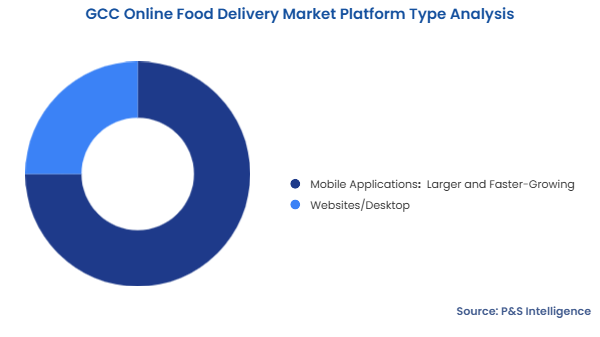
The mobile applications category holds the larger market share, of 75%, in 2025, and it will have the higher CAGR during the forecast period. This dominance reflects the region's mobile-first digital culture, where smartphones serve as the primary internet access device for most consumers. The sophisticated mobile applications developed by leading platforms offer features such as real-time GPS tracking, in-app chat with delivery partners, one-touch reordering, and integrated digital wallets that enhance user convenience.
The platform types analyzed in this report are:
Mobile Applications (Larger and Faster-Growing Category)
Websites/Desktop
Payment Method Analysis
The online category holds the larger market share, of 60%, in 2025, reflecting the GCC region's rapid digital payment adoption. The proliferation of digital wallets, contactless payment options, and integrated banking applications has made online payments the preferred choice for most consumers. Government initiatives promoting cashless transactions, combined with enhanced security features and instant payment confirmations, have accelerated this shift. Moreover, 49.89 million cellular mobile connections are actively present in Saudi Arabia in 2024.
The cash on delivery category will have the higher CAGR, of 6.9%, due to specific consumer segments preferring traditional payment methods. This option serves customers without access to digital payment methods, those concerned about online security, or individuals who prefer payment verification upon delivery. The segment shows declining growth as digital literacy improves and payment infrastructure expands across all demographic segments.
The payment methods analyzed in this report are:
Online (Larger Category)
Credit/Debit Cards
Mobile Wallets/Digital Payment Apps
Cash on Delivery (Faster-Growing Category)
Business Model Analysis
The order-focused category holds the largest market share, of 50%, in 2025, driven by its asset-light model that enables rapid scaling. These platforms act as intermediaries between restaurants and consumers, focusing on technology development, customer acquisition, and order management without owning kitchen facilities or delivery fleets. This model's efficiency in aggregating demand and optimizing delivery routes through AI-powered algorithms maintains its market leadership.
The full-service category will have the highest CAGR during the forecast period, as this integrated model, combining order management, food preparation through cloud kitchens, and last-mile delivery, offers superior quality control and customer experience. Companies adopting this model benefit from higher margins, better brand control, and the ability to launch virtual brands quickly in response to market trends.
The business models analyzed in this report are:
Order-Focused (Largest Category)
Logistics-Focused
Full-Service (Fastest-Growing Category)
Drive strategic growth with comprehensive market analysis
GCC Online Food Delivery Market Regional Outlook
Saudi Arabia Online Food Delivery Market Size
Saudi Arabia holds the largest market share, of 40%, in 2025, due to its large population, high internet and smartphone penetration, and the growing adoption of app-based food delivery services supported by government-led digitalization initiatives, such as Vision 2030. The kingdom's market lead is underpinned by its large population, high smartphone penetration, and government-led digital transformation initiatives. According to the report, there were 36.84 million internet users at the start of 2024 in Saudi Arabia. This extensive digital user base, combined with a young, tech-savvy population, creates ideal conditions for online food delivery services to flourish.
The Saudi market benefits from intense competition among local and international players, driving innovation and service quality improvements. Major players, including Jahez, HungerStation, and Talabat, have strengthened their presence through strategic partnerships and technological innovations, offering features such as real-time tracking, personalized recommendations, and diverse payment options. The government's Vision 2030 initiative, emphasizing digital economy development, further supports the sector through favorable regulations and infrastructure investments.
Moreover, the Kingdom's urbanization trends concentrate demand in major cities like Riyadh, Jeddah, and Dammam, enabling efficient delivery operations. The presence of numerous expatriate communities creates demand for diverse international cuisines, encouraging platform expansion and restaurant participation. Saudi Arabia's market is projected to maintain its leadership position, driven by continued digital adoption and evolving consumer preferences favoring convenience.
U.A.E. Online Food Delivery Market Size
U.A.E. will have the highest CAGR, of 6.8%, as its advanced digital infrastructure, cosmopolitan population, and high per capita income create an environment conducive to premium food delivery services. The country's position as a regional business hub attracts a diverse expatriate workforce that heavily relies on food delivery services.
The UAE market distinguishes itself through early adoption of innovative delivery models, including drone deliveries, autonomous vehicles, and ultra-fast delivery promises. There are currently over 400 cloud kitchens in the UAE, operating from 80 locations, most of them based in Dubai. This extensive cloud kitchen infrastructure enables rapid menu experimentation and reduces delivery times significantly.
Tourism plays a crucial role in market expansion, with millions of annual visitors utilizing food delivery services during their stays. The government's supportive regulatory framework, including streamlined licensing for cloud kitchens and delivery operations, accelerates market growth. The UAE's market sophistication is evident in the prevalence of subscription-based delivery models, loyalty programs, and integration with lifestyle apps.
The geographical breakdown of the market is as follows:
Saudi Arabia (Largest Market)
U.A.E. (Fastest-Growing Market)
Kuwait
Qatar
Bahrain
Oman
GCC Online Food Delivery Market Share
The market is semi-consolidated with the top five players controlling a significant market share. This concentration reflects the capital-intensive nature of building delivery networks and the importance of brand recognition in attracting both restaurants and consumers. With strategic initiatives, such as mergers, collaborations, and acquisitions, the leading market companies, including Talabat, Deliveroo, Mrsool, Zomato, Carriage, Careem, HungerStation, Jahez, EatEasy, and Noon Food, are looking to strengthen their market positions. These strategic moves aim to consolidate market share and achieve operational synergies.
Key GCC Online Food Delivery Companies:
Talabat.com FZ-LLC
Noon Food LLC
Careem Networks FZ-LLC
Mrsool Co.
Deliveroo Holdings plc
Zomato Ltd.
Uber Technologies, Inc.
Carriage Services FZ-LLC
Jahez International Co.
EatEasy Qatar W.L.L.
Locale Services FZ-LLC
HungerStation Co. Ltd.
GCC Online Food Delivery Market News
In September 2025, ITT Foods Pvt Ltd. began discussions to expand its operations into Saudi Arabia and establish a partnership in the U.A.E. The company aims to leverage the rising tourism and pilgrimage traffic in Saudi Arabia to fuel food demand, presenting additional growth opportunities.
In May 2025, Uber Technologies Inc. announced plans to acquire an 85% controlling stake in Trendyol Go, a Turkish food and grocery delivery platform, for USD 700 million. This acquisition aims to expand Uber's footprint in emerging markets, including the Middle East, amid slowing growth in its core North American operations.
Want a report tailored exactly to your business need?
Leading companies across industries trust us to deliver data-driven insights and innovative solutions for their most critical decisions. From data-driven strategies to actionable insights, we empower the decision-makers who shape industries and define the future. From Fortune 500 companies to innovative startups, we are proud to partner with organisations that drive progress in their industries.
Client Testimonials
Working with P&S Intelligence and their team was an absolute pleasure – their awareness of timelines and commitment to value greatly contributed to our project's success. Eagerly anticipating future collaborations.
McKinsey & Company
India
Unmatched Standards
Our insights into the minutest levels of the markets, including the latest trends and competitive landscape, give you all the answers you need to take your business to new heights
Complete Data Security
We take a cautious approach to protecting your personal and confidential information. Trust is the strongest bond that connects us and our clients, and trust we build by complying with all international and domestic data protection and privacy laws