This Report Provides In-Depth Analysis of the GCC Last-Mile Delivery Market Report Prepared by P&S Intelligence, Segmented by Service (B2C, B2B), Application (E-Commerce, Package delivery), and Geographical Outlook for the Period of 2019 to 2032
Explore the market potential with our data-driven report
GCC Last-Mile Delivery Market Overview
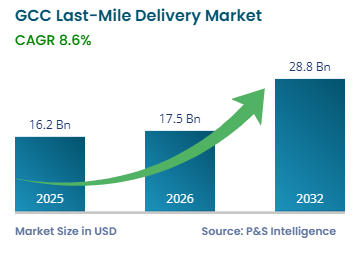
The GCC last-mile delivery market value is estimated at USD 16.2 billion in 2025, which is projected to grow at a CAGR of 8.6% during 2026–2032, to reach USD 28.8 billion by 2032. The significant growth drivers for the market include exponential e-commerce expansion, increasing consumer demand for faster delivery options, and substantial investments in logistics infrastructure across the region.
The surge in digital commerce adoption has transformed the last-mile delivery landscape in the GCC region, particularly following the accelerated digitalization during the pandemic period. This robust e-commerce growth directly fuels demand for efficient last-mile delivery solutions, as consumers increasingly expect same-day and next-day delivery services. The region's young, tech-savvy population, with over 95% internet penetration in the six Gulf countries, has embraced online shopping as a preferred mode of commerce, creating unprecedented opportunities for last-mile delivery service providers.
Urban concentration in major cities, such as Riyadh, Dubai, Abu Dhabi, and Doha, has created dense delivery networks that enable efficient route optimization and faster fulfillment times. The Kingdom of Saudi Arabia recognizes e-commerce as a vital industry to enhance its national economy, with growth of the e-commerce industry being one of the objectives of the National Transformation Program, launched to develop necessary infrastructure and create an environment that enables public, private and non-profit sectors to achieve Vision 2030. This government support, combined with significant infrastructure investments and the development of smart city initiatives, positions the GCC last-mile delivery market for sustained expansion through the forecast period.
GCC Last-Mile Delivery Market Growth Factors
Changing Consumer Expectations Are Major Trends
Modern consumers in the GCC region demand unprecedented levels of convenience, speed, and flexibility in their delivery experiences.
Consumers prefer same-day or next-day delivery, especially for e-commerce transactions, leading logistics companies to invest in technology and operations that enable them to meet these high expectations.
The shift towards on-demand delivery services has extended beyond traditional e-commerce to include groceries, pharmaceuticals, restaurant meals, and other essential items, creating a comprehensive quick-commerce ecosystem.
In the UAE, 44% of consumers are willing to wait only two days for orders, highlighting the urgency of delivery expectations.
This has prompted retailers and logistics providers to establish micro-fulfillment centers in strategic urban locations, enabling faster order processing and delivery.
The introduction of flexible delivery options, including scheduled deliveries, contactless drop-offs, and alternative pickup locations like smart lockers, has enhanced customer convenience.
Businesses are experimenting with various delivery models, such as click-and-collect, where customers order online but pick up items from local stores, or hybrid models combining traditional delivery with locker systems.
These evolving expectations continue to drive innovation and investment in last-mile delivery infrastructure across the region.
Rising E-Commerce Penetration Is Accelerating Market Growth
The exponential growth of e-commerce platforms represents the primary catalyst driving the GCC last-mile delivery market expansion.
The UAE's e-commerce market projected to reach USD 8 billion by 2025, according to the International Trade Administration.
The proliferation of major regional platforms, such as Noon and Amazon.ae, alongside specialized delivery apps, has created a comprehensive ecosystem supporting last-mile delivery services.
The Kingdom of Saudi Arabia has witnessed particularly robust growth, with over 36 million internet users and over 42.5 million active cellular users according to recent reports.
This digital connectivity has enabled seamless online shopping experiences, driving demand for efficient last-mile delivery solutions.
The integration of social commerce, where 99% of the Middle East population is active on social media, has further amplified e-commerce growth, creating additional delivery touchpoints through platforms like Instagram and WhatsApp.
Technological Advancements in Delivery Operations Offers Opportunities
Advanced technologies are revolutionizing last-mile delivery operations across the GCC region, enhancing efficiency and customer satisfaction.
Artificial intelligence-powered route optimization systems, real-time tracking capabilities, and automated sorting facilities have become standard features among leading delivery providers.
Companies in Saudi Arabia are using AI algorithms for route planning and optimization, while electric vehicles powered by solar energy and renewable sources are gaining prominence.
The adoption of IoT devices enables precise package tracking, while blockchain technology enhances supply chain transparency and security.
The region is witnessing increased adoption of autonomous delivery solutions, with the UAE government recently setting down rules and regulations for developing and operating infrastructure for UAVs.
Drone delivery pilots and autonomous vehicle trials are being conducted in controlled environments, particularly in planned cities and designated zones.
Tech-startups like Saee are transforming the landscape by offering platforms that connect freelance drivers with e-commerce companies to deliver parcels.
These gig economy platforms have introduced flexibility and scalability to the delivery ecosystem, enabling businesses to manage demand fluctuations efficiently while providing employment opportunities for thousands of delivery personnel across the region.
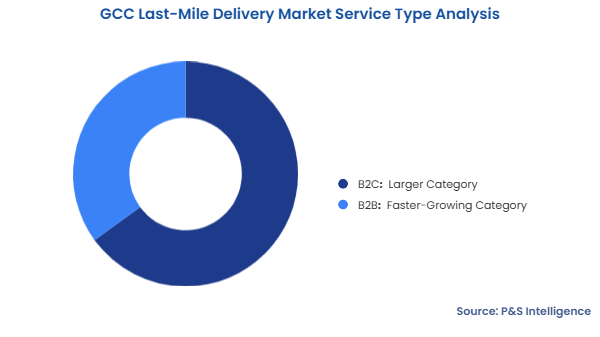
The B2C category dominates the GCC last-mile delivery market in 2025 with 65% share, driven by the surge in online retail activities and changing consumer shopping behaviors. The proliferation of e-commerce platforms, combined with increasing smartphone penetration and digital payment adoption, has made B2C deliveries the cornerstone of the last-mile delivery ecosystem. This category benefits from high order frequencies, particularly in categories like fashion, electronics, and daily essentials, where consumers increasingly prefer the convenience of home delivery over traditional retail shopping.
The B2B category is experiencing the faster growth, with a projected CAGR of 8.8% during the forecast period, fueled by digital transformation initiatives across industries and the rise of B2B e-commerce platforms. The category's growth is driven by businesses seeking efficient supply chain solutions, just-in-time inventory management, and reliable delivery services for commercial transactions. Small and medium enterprises particularly benefit from B2B last-mile delivery services, enabling them to compete effectively without maintaining extensive logistics infrastructure. The integration of enterprise resource planning systems with delivery platforms has streamlined B2B operations, while the growth of industrial zones and free trade areas across the GCC has created substantial demand for specialized B2B delivery services.
These service types are covered:
B2C (Larger Category)
B2B (Faster-Growing Category)
Application Analysis
The e-commerce category holds the largest share in the GCC last-mile delivery market in 2025, of 70%, primarily due to the exponential growth of online retail platforms and marketplaces. This remarkable expansion has created substantial demand for efficient last-mile delivery services capable of handling diverse product categories, from electronics and fashion to home furnishings and beauty products. The category benefits from established delivery networks, sophisticated tracking systems, and flexible fulfillment options that cater to varying customer preferences.
Package delivery represents the fastest-growing category, with a CAGR of 8.9% through 2032. This growth is attributed to increasing cross-border commerce, rising demand for document delivery services, and the expansion of peer-to-peer delivery platforms. In Qatar, employment in the manufacturing industry is projected to rise from 85,000 to 101,000 by 2025, creating additional demand for B2B package delivery services. The category has evolved to include specialized services like temperature-controlled deliveries for pharmaceuticals, secure handling for valuable items, and express options for time-sensitive documents. The integration of digital documentation and electronic proof of delivery systems has enhanced efficiency and transparency in package delivery operations.
These application categories are covered:
E-Commerce (Largest Category)
Package Delivery (Fastest-Growing Category)
Others
Drive strategic growth with comprehensive market analysis
Saudi Arabia commands the largest share of the GCC last-mile delivery market in 2025, of 45%, and it is expected to maintain its dominant position throughout the forecast period. This lead stems from the Kingdom's massive e-commerce expansion, substantial population base, and comprehensive digital transformation initiatives under Vision 2030.
The Kingdom's e-commerce sector has witnessed unprecedented growth, with about 77% of customers shopping online since the outbreak of the pandemic in Saudi Arabia. This surge in online shopping has resulted in increased adoption of cashless payments rather than traditional cash-on-delivery methods. The market is driven by booming e-commerce sector and rising demand for same-day and next-day deliveries. Major cities like Riyadh, Jeddah, and Dammam serve as primary logistics hubs. The government's National Address system has been implemented to enable efficient receiving of services including home delivery and e-commerce, addressing previous challenges with delivery accuracy.
UAE Last-Mile Delivery Market Growth
The UAE represents the fastest-growing last-mile delivery market in the GCC region, with a CAGR of 8.7% projected through 2032. It is driven by the country's position as a regional e-commerce leader, advanced digital infrastructure, and strategic investments in logistics technology and innovation.
Dubai and Abu Dhabi have emerged as pivotal logistics centers, attracting both regional and international delivery service providers. Companies are leveraging AI algorithms to optimize delivery routes, reduce fuel consumption, and minimize delivery times, with Noon establishing new distribution centers at ADNOC service stations across the UAE, enabling 15-minute deliveries through its Noon Minutes service in select areas. The UAE's commitment to sustainability is evident through increasing adoption of electric vehicles and eco-friendly delivery solutions, aligning with the nation's environmental objectives.
Qatar Last-Mile Delivery Market Outlook
Qatar's last-mile delivery market is driven by rapid urbanization, expanding e-commerce activities, and preparations for major international events. One of the major driving factors for growth of the last-mile delivery market in Qatar is increasing consumer demand for faster, more convenient delivery options. The market benefits from concentrated population density in Doha and surrounding areas, enabling efficient route planning and delivery optimization.
Qatar's strategic position as a gateway between Europe, Asia, and Africa enhances its logistics potential, with Hamad Port having a capacity of 2 million TEUs annually. The country's logistics sector is undergoing significant transformation. However, traffic congestion and limited access in urban areas remain challenges, particularly in the capital city, Doha, where traffic delays and roadblocks often disrupt delivery schedules during peak hours. Despite these challenges, ongoing infrastructure improvements and technology adoption continue to enhance the efficiency of last-mile delivery operations in Qatar.
These countries are covered:
Saudi Arabia (Largest Regional Market)
UAE (Fastest-Growing Regional Market)
Qatar
Kuwait
Oman
Bahrain
GCC Last-Mile Delivery Market Share
The GCC last-mile delivery market exhibits a fragmented structure, characterized by intense competition among international logistics giants, regional players, and emerging technology-driven startups. The market fragmentation results from diverse service requirements across different customer segments, varying geographical challenges, and the rapid entry of new players capitalizing on the e-commerce boom. No single player commands more than 15% market share, indicating significant opportunities for growth and consolidation.
The competitive landscape is shaped by continuous innovation in delivery technologies, service differentiation strategies, and strategic partnerships between e-commerce platforms and logistics providers. Traditional logistics companies like Aramex, SMSA Express, and Saudi Post have adapted their operations to meet e-commerce demands, while new entrants, such as Saee and Fetchr, have disrupted the market with technology-first approaches and gig economy models. International players including DHL, FedEx, and UPS maintain strong positions through their global networks and expertise in express delivery services, particularly serving the B2B and cross-border segments.
Market players are increasingly investing in technology infrastructure, with focus on artificial intelligence for route optimization, automated sorting facilities, and real-time tracking capabilities. Strategic activities include expansion of delivery networks into tier-2 and tier-3 cities, establishment of micro-fulfillment centers, and development of sustainable delivery solutions using electric vehicles. The emergence of quick-commerce platforms promising ultra-fast delivery within 15–30 minutes has intensified competition, prompting traditional players to enhance their service offerings and delivery speeds.
Companies are also forming strategic alliances with e-commerce marketplaces, integrating their services directly into online shopping platforms to provide seamless checkout and delivery experiences. The competitive dynamics are further influenced by regulatory developments supporting logistics infrastructure, investment in free trade zones, and government initiatives promoting digital transformation. New market opportunities exist in specialized delivery services, including temperature-controlled logistics for pharmaceuticals and food products, secure handling for luxury goods, and scheduled delivery services for B2B customers.
Key GCC Last-Mile Delivery Companies:
Amazon.com, Inc.
Noon AD Holdings Ltd.
Alibaba Group Holding Limited
Majid Al Futtaim Holding LLC
Al Tayer Group LLC
Apparel Group
Lulu Group International
SHEIN Group Ltd.
Alshaya Group
Chalhoub Group
Azadea Group Holding SAL
Jarir Marketing Company
Alghanim Industries
Fetchr Delivery Services LLC
QExpress Documents Transport LLC
GCC Last-Mile Delivery Market News
In February 2025, Noon AD Holdings Ltd. partnered with the Abu Dhabi National Oil Company to establish new distribution centers at service stations across the UAE. They launched launching Noon Minutes service for 15-minute deliveries in select areas, marking a significant advancement in quick-commerce capabilities.
In January 2025, Saudi Post announced the implementation of advanced AI-powered sorting systems across major distribution centers in Riyadh and Jeddah, improving processing capacity by 40% and reducing delivery times for e-commerce parcels.
In December 2024, Aramex Group launched its autonomous delivery pilot program in Dubai's designated zones, deploying electric delivery robots for last-mile operations in collaboration with technology partners.
In October 2024, SMSA Express Transportation Company Ltd. expanded its electric vehicle fleet with the addition of 500 zero-emission delivery vehicles across Saudi Arabia, supporting the Kingdom's sustainability goals under Vision 2030.
In September 2024, Qatar Post signed a strategic partnership agreement with Emirates Post to enhance cross-border e-commerce shipping capabilities and streamline delivery operations between Qatar and the UAE.
In July 2024, Fetchr Delivery Services LLC introduced its proprietary address verification technology using GPS coordinates and machine learning, reducing failed delivery attempts by 30% across its GCC operations.
In May 2024, Deutsche Post AG (dba DHL) opened its largest logistics hub in the Middle East at Dubai South, featuring automated sorting capabilities and capacity to process 150,000 parcels daily, strengthening its position in the regional last-mile delivery market.
Want a report tailored exactly to your business need?
Leading companies across industries trust us to deliver data-driven insights and innovative solutions for their most critical decisions. From data-driven strategies to actionable insights, we empower the decision-makers who shape industries and define the future. From Fortune 500 companies to innovative startups, we are proud to partner with organisations that drive progress in their industries.
Client Testimonials
Working with P&S Intelligence and their team was an absolute pleasure – their awareness of timelines and commitment to value greatly contributed to our project's success. Eagerly anticipating future collaborations.
McKinsey & Company
India
Unmatched Standards
Our insights into the minutest levels of the markets, including the latest trends and competitive landscape, give you all the answers you need to take your business to new heights
Complete Data Security
We take a cautious approach to protecting your personal and confidential information. Trust is the strongest bond that connects us and our clients, and trust we build by complying with all international and domestic data protection and privacy laws