This Report Provides In-Depth Analysis of the GCC In-Vitro Diagnostic Market Report Prepared by P&S Intelligence, Segmented by Offering (Reagents & Kits, Instruments, Software & Services), Technology (Clinical Chemistry, Immunochemistry, Molecular Diagnostics, Hematology, Microbiology), Application (Infectious Diseases, Diabetes, Oncology, Cardiology, Nephrology, Autoimmune Diseases), End User (Hospitals & Clinics, Point-of-Care Settings, Diagnostic Laboratories, Research & Academic Institutes), and Geographical Outlook for the Period of 2019 to 2032
Explore the market potential with our data-driven report
GCC In-Vitro Diagnostic Market Outlook
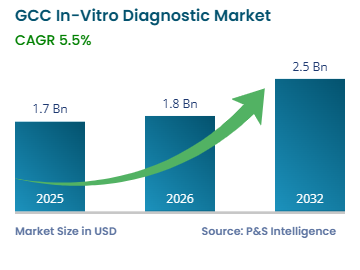
The GCC in-vitro diagnostics market size will be an estimated USD 1.7 billion for 2025, and it will grow by 5.5% during 2026–2032, to reach USD 2.5 billion by 2032.
The market expansion is primarily driven by the rising burden of chronic diseases, growing geriatric population, increasing healthcare infrastructure investments, and the adoption of advanced diagnostic technologies across the region.
The GCC region is experiencing a significant transformation in its healthcare landscape, with governments investing heavily in modernizing diagnostic infrastructure and expanding healthcare access. According to the World Economic Forum, the GCC's healthcare expenditure is forecast to reach USD 135 billion by 2027, demonstrating the commitment to improving healthcare services. This investment surge is creating substantial opportunities for the in-vitro diagnostic market, as accurate and rapid diagnostic testing becomes increasingly crucial for effective disease management and early detection across the region.
GCC In-Vitro Diagnostic Market Growth Factors
Technological Advancements in Molecular Diagnostics Are Key Trends
The adoption of advanced molecular diagnostic technologies represents a paradigm shift in the GCC's diagnostic landscape.
Next-generation sequencing, PCR-based technologies, and innovative biomarker detection methods are gaining significant traction across the region.
The COVID-19 pandemic accelerated the adoption of molecular diagnostics, establishing robust infrastructure for PCR testing that now serves broader diagnostic applications beyond infectious disease detection.
Digital health integration is revolutionizing diagnostic services delivery by enabling the use of AI, digital health platforms, electronic medical records, telemedicine, and other smart healthcare technologies.
These innovations are enabling remote diagnostics, improving test result turnaround times, and enhancing the overall efficiency of diagnostic services across the GCC countries.
Point-of-care diagnostics are experiencing rapid growth, driven by the need for decentralized testing capabilities.
The expansion of primary healthcare centers and the emphasis on bringing diagnostics closer to patients are creating substantial opportunities for portable diagnostic devices, rapid test kits, and point-of-care testing solutions.
They can deliver laboratory-quality results outside traditional laboratory settings.
GCC governments’ investments in healthcare digital infrastructure, e.g., Saudi Arabia’s USD-50 billion in digital health, and GCC-wide investments ranging from USD 0.5 billion to USD 1.2 billion, are supporting the adoption of automated diagnostic platforms and enhancing lab networks and POC facilities.
The focus on healthcare localization, fostering local champions, such as Lifera in Saudi Arabia and M42 in the UAE, is driving partnerships with international IVD manufacturers.
This is enabling technology transfer and local production capabilities across the region.
Rising Burden of Chronic Diseases Is Biggest Driver
The escalating prevalence of chronic diseases across GCC countries represents a fundamental driver for the in-vitro diagnostic market.
This trend is fueled by urbanization, sedentary lifestyles, dietary changes, and increasing life expectancy, all contributing to the growing incidence of non-communicable diseases.
National screening and preventive healthcare programs are further increasing demand for diagnostic testing.
According to recent cancer statistics, there were 42,475 new cancer cases in the GCC countries in 2020, with almost two-thirds occurring in Saudi Arabia.
According to a study published in the journal Cancer Medicine in September 2024, the cancer burden is expected to increase substantially, with projections indicating the cancer burden in the GCC will increase by 116% (Saudi Arabia) to 270% (Qatar), reaching nearly 104,000 cancer cases by 2040.
These figures underscore the growing need for oncology-focused diagnostic testing, including tumor markers, liquid biopsies, and early detection solutions.
Cardiovascular diseases represent another major health concern driving diagnostic demand.
The prevalence of CHD was reported to be 5.5% in Saudi Arabia, while the annual incidence of strokes ranged from 27.6 to 57 per 100,000 in the Gulf countries.
These alarming statistics highlight the critical need for comprehensive cardiovascular diagnostic testing, including cardiac biomarkers, lipid profiles, and coagulation tests.
The diabetes epidemic in the GCC region particularly underscores the importance of regular diagnostic monitoring.
According to the International Diabetes Federation Diabetes Atlas 2024, the prevalence of diabetes among adults aged 20–79 in Saudi Arabia is approximately 23.1%, with over 5.3 million adults affected.
The UAE has about 1.3 million cases and a prevalence of 20.7%, while Kuwait records around 908,500 cases with a notably high prevalence of 24–25%.
In Qatar, around 409,300 adults have diabetes, with a prevalence of 24.6%, and Bahrain reports 197,600 cases at a rate of 22.1%.
Oman has an estimated 412,300 cases, with a comparatively lower but still significant prevalence of 17%.
This chronic disease burden is driving demand for routine diagnostic testing and continuous monitoring solutions.
This creates a sustained demand for glucose monitoring tests, HbA1c testing, and diabetes complication screening.
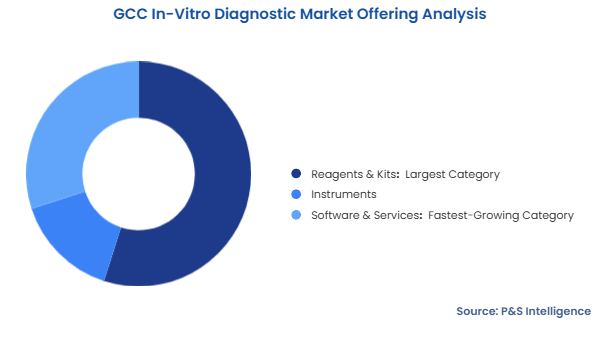
The reagents & kits category holds the largest market share, of 55%, in 2025. This leadership position is attributed to the consumable nature of reagents and kits, which ensures recurring revenue streams, and the expanding test menu across various diagnostic disciplines. The continuous need for reagents in routine testing, coupled with the introduction of novel biomarkers and specialized test panels, sustains the segment's growth momentum.
The software & services category will have the highest CAGR, of 5.9%, driven by expanding digital health platforms, electronic medical records, telemedicine, and smart healthcare solutions that enhance diagnostic efficiency, workflow management, and remote patient monitoring across the region.
The offerings analyzed in this report are:
Reagents & Kits (Largest Category)
Instruments
Software & Services (Fastest-Growing Category)
Technology Analysis
The immunochemistry category holds the largest market share, of 30%, in 2025, due to its widespread application in infectious disease testing, hormone analysis, and tumor marker detection. The technology's versatility in detecting a broad range of analytes, from cardiac biomarkers to fertility hormones, ensures its continued relevance across multiple clinical applications. The high disease burden of conditions requiring immunoassay-based testing, such as thyroid disorders and cardiac conditions, reinforces this category’s market lead.
The molecular diagnostics category will have the highest CAGR, of 5.6%, driven by the expanding applications of PCR, next-generation sequencing, and microarray technologies in personalized medicine, pharmacogenomics, and infectious disease detection. The increasing focus on precision medicine initiatives across GCC countries and the growing adoption of companion diagnostics for targeted therapies are propelling this segment's rapid expansion.
The technologies analyzed in this report are:
Clinical Chemistry
Immunochemistry (Largest Category)
Molecular Diagnostics (Fastest-Growing Category)
Hematology
Microbiology
Application Analysis
The infectious diseases category holds the largest market share in 2025, reflecting the high burden of communicable diseases and the enhanced focus on infection control following the COVID-19 pandemic. The category benefits from routine screening programs for hepatitis, HIV, and other sexually transmitted infections, as well as the implementation of comprehensive antimicrobial resistance testing protocols across the region.
The oncology category will have the highest CAGR during the forecast period, due to the rising incidence of cancer in the region and the increasing emphasis on early and accurate detection.The implementation of national cancer screening programs, adoption of liquid biopsy technologies, and the growing emphasis on early cancer detection are key growth drivers for this category.
The applications analyzed in this report are:
Infectious Diseases (Largest Category)
Diabetes
Oncology (Fastest-Growing Category)
Cardiology
Nephrology
Autoimmune Diseases
Others
End User Analysis
The diagnostic laboratories category holds the largest market share, of 40%, in 2025, due to the increasing outsourcing of diagnostic services by hospitals, the establishment of large-scale reference laboratories, and the consolidation trend in the diagnostic services sector. The region is witnessing notable consolidation among payers and providers, with healthcare organizations aiming to expand beyond current borders, which is benefiting specialized diagnostic laboratory chains.
The point-of-care settings category will have the highest CAGR, of 5.7%, due to the rising demand for decentralized and rapid diagnostic testing. The expansion of primary healthcare centers, increased patient access needs, and advancements in portable devices, molecular diagnostics, and AI integration are driving fast adoption outside traditional laboratory settings.
The end users analyzed in this report are:
Hospitals & Clinics
Point-of-Care Settings (Fastest-Growing Category)
Diagnostic Laboratories (Largest Category)
Research & Academic Institutes
Others
Drive strategic growth with comprehensive market analysis
Saudi Arabia holds the largest market share, of 40%, in 2025, driven by its position as the most-populous country in the region and its ambitious healthcare transformation initiatives under Vision 2030. The Kingdom's substantial healthcare investments create a robust foundation for IVD market expansion. Saudi Arabia's USD 100-billion AI investment, known as Project Transcendence, demonstrates its commitment to leveraging advanced technologies in healthcare diagnostics. The country faces significant health challenges that necessitate comprehensive diagnostic capabilities.
The Saudi government's focus on healthcare localization through initiatives such as establishing Lifera as a national champion in healthcare is creating opportunities for local manufacturing and distribution of diagnostic products. The emphasis on preventive healthcare and early disease detection aligns perfectly with the expanding role of in-vitro diagnostics in the Kingdom's healthcare ecosystem.
U.A.E. In-Vitro Diagnostics Market Size
U.A.E. will have the highest CAGR, of 5.8%, fueled by the country's strategic positioning as a regional healthcare hub and its significant investments in healthcare innovation. The UAE led with 198 healthcare investment deals between 2021 and April 2025, demonstrating strong investor confidence in the healthcare sector.
The UAE's focus on medical tourism and its world-class healthcare infrastructure create substantial demand for advanced diagnostic services. The UAE's efforts to build genomics expertise, including the launch of a new school to train students in genomics, highlight the country's commitment to advancing precision medicine and molecular diagnostics. The presence of numerous international healthcare providers and the establishment of specialized medical free zones further accelerate market growth.
Dubai's position as a global healthcare destination and Abu Dhabi's investments in healthcare infrastructure through entities such as M42 are transforming the diagnostic landscape. The implementation of mandatory health insurance across emirates and the growing expatriate population contribute to increased diagnostic test volumes and market expansion.
Qatar In-Vitro Diagnostics Market Size
Qatar's in-vitro diagnostic market is experiencing robust growth driven by its National Health Strategy and preparations for hosting major international events. The country's focus on building a world-class healthcare system is reflected in its per capita healthcare spending, which ranks among the highest in the region. Qatar shares the fifth-highest diabetes rate, at 24.6%, creating substantial demand for diabetes-related diagnostic tests.
The implementation of precision medicine initiatives and the establishment of Qatar Biobank demonstrate the country's commitment to advancing diagnostic capabilities. Qatar's investments in research and development, particularly in genomics and personalized medicine, are positioning it as a leader in innovative diagnostic applications within the GCC region.
The geographical breakdown of the market is as follows:
Saudi Arabia (Largest Country)
U.A.E. (Fastest-Growing Country)
Qatar
Kuwait
Oman
Bahrain
GCC In-Vitro Diagnostic Market Share
The market is semi-consolidated with a few multinational corporations holding significant market share while regional and niche players gradually expand their presence. High entry barriers, including stringent regulations and capital-intensive manufacturing, limit new entrants, reinforcing the dominance of top companies. However, opportunities in specialized segments like molecular diagnostics, point-of-care testing, and localized healthcare solutions allow smaller players to coexist. This balance between dominant global players and emerging regional companies creates a semi-consolidated market structure.
Key GCC In-Vitro Diagnostic Companies:
Abbott Laboratories
Danaher Corporation
Thermo Fisher Scientific Inc.
Sysmex Corporation
F. Hoffmann-La Roche Ltd
Siemens Healthineers AG
Sysmex Corporation
Becton, Dickinson and Company
bioM
QIAGEN N.V.
DiaSorin S.p.A.
Bio-Rad Laboratories, Inc.
GCC In-Vitro Diagnostic Market News
In January 2024, bioMérieux SA announced the acquisition of LUMED, a software company specializing in clinical decision support systems. This acquisition aims to optimize antimicrobial prescriptions and monitor healthcare-associated infections, enhancing diagnostic precision and patient safety in Saudi Arabia.
In August 2023, Sysmex Corporation announced an expansion of its global business partnership agreement with Roche Diagnostics International Ltd. This collaboration aims to enhance diagnostic capabilities and improve patient outcomes in Saudi Arabia by integrating advanced diagnostic technologies.
Want a report tailored exactly to your business need?
Leading companies across industries trust us to deliver data-driven insights and innovative solutions for their most critical decisions. From data-driven strategies to actionable insights, we empower the decision-makers who shape industries and define the future. From Fortune 500 companies to innovative startups, we are proud to partner with organisations that drive progress in their industries.
Client Testimonials
Working with P&S Intelligence and their team was an absolute pleasure – their awareness of timelines and commitment to value greatly contributed to our project's success. Eagerly anticipating future collaborations.
McKinsey & Company
India
Unmatched Standards
Our insights into the minutest levels of the markets, including the latest trends and competitive landscape, give you all the answers you need to take your business to new heights
Complete Data Security
We take a cautious approach to protecting your personal and confidential information. Trust is the strongest bond that connects us and our clients, and trust we build by complying with all international and domestic data protection and privacy laws