This Report Provides In-Depth Analysis of the GCC Hydroponics Market Report Prepared by P&S Intelligence, Segmented by Type (Aggregate Systems, Liquid Systems), Crop Type (Vegetables, Herbs & Microgreens, Fruits, Flowers & Ornamentals), Equipment (HVAC Systems, LED Grow Lights, Irrigation Systems, Control Systems, Material Handling Equipment), Farming Method (Indoor, Outdoor), Crop Area (Upto 1000 Square Feet, 1000-50000 Square Feet, Above 50000 Square Feet), and Geographical Outlook for the Period of 2019 to 2032
Explore the market potential with our data-driven report
GCC Hydroponics Market Outlook
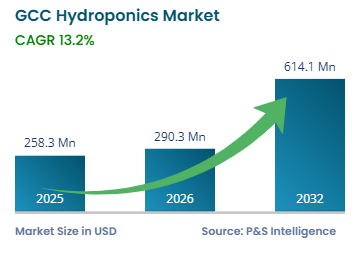
The GCC hydroponics market size will be an estimated USD 258.3 million for 2025, and it will grow by 13.2% during 2026–2032, to reach USD 614.1 million by 2032.
The rapid expansion of this market is primarily driven by acute water scarcity across the Gulf region, government initiatives supporting food security objectives, and increasing consumer demand for locally grown, pesticide-free produce in urban areas.
The implementation of controlled-environment agriculture systems across the GCC represents a paradigm shift in regional food production strategies. This technology enables year-round cultivation of high-value crops, while consuming up to 90% less water compared to conventional farming methods, addressing the region's critical resource constraints. The convergence of technological innovation and strategic government support has positioned hydroponics as an essential component of the GCC's agricultural transformation agenda.
GCC Hydroponics Market Growth Factors
Rising Consumer Demand for Fresh, Locally Produced Organic Vegetables Is Key Trend
The shifting Consumer preferences in the GCC region toward locally grown, pesticide-free produce, are a key trend in the market.
By 2030, the GCC population is expected to hit 58.3 million, rising to 72.3 million by 2050.
This population growth, combined with increasing health consciousness and higher disposable incomes, drives demand for premium fresh produce.
Urban consumers increasingly prioritize food safety and nutritional value, making hydroponically grown vegetables particularly appealing.
The ability to trace produce from seed to harvest and guarantee pesticide-free cultivation resonates strongly with health-conscious consumers.
Additionally, the reduced transportation distance from urban farms to retail outlets ensures superior freshness compared to imported alternatives, commanding premium prices in high-end supermarkets and restaurants across the region.
The hospitality sector, particularly in Dubai and other tourism hubs, has become a significant driver of demand.
Hotels and restaurants seek consistent, high-quality supplies of fresh herbs and vegetables year-round, which traditional farming cannot guarantee in the harsh climate.
This institutional demand provides stable revenue streams for hydroponic operations and encourages further market expansion.
Water Scarcity Crisis Propels Adoption of Water-Efficient Farming Technologies
The worsening water crisis in GCC countries serves as a key driver for the growth of the hydroponics market.
The benchmark for absolute water scarcity is 500 cubic meters of renewable freshwater per person annually, a figure that remains a distant aspiration for many of these countries, some of whose renewable freshwater reserves are below 100 cubic meters per capita.
As per the United Nations Economic and Social Commission for Western Asia (UNESCWA), the GCC countries have an average per capita allocation of natural freshwater resources amounting to 120 m3/year compared to average annual water consumption of approximately 800 m3/capita/year.
Thus, they have been significantly dependent on desalination to bridge the disparity between the supply and demand for fresh water.
This severe water shortage has made traditional agriculture increasingly unsustainable across the region.
Despite this scarcity, GCC countries have seen a surge in water consumption, driven by economic growth, population increase, and urbanization.
Consumption rates often exceed 500 liters per person per day, dwarfing the figures of countries with comparable income levels, where consumption is around 120 liters per person per day.
The disparity between water availability and consumption patterns underscores the urgent need for water-efficient agricultural solutions.
The technology's ability to recirculate nutrient solutions and minimize water loss through evaporation makes it particularly suited to the GCC's arid environment.
GCC Hydroponics Market Segmentation Analysis
Type Analysis
The aggregate systems category holds the largest market share, of 60%, in 2025, due to its versatility in supporting diverse crop types and relatively lower technical complexity compared to liquid systems. These systems utilize inert growing media such as perlite, rockwool, and coconut coir, providing excellent root support and water retention capabilities essential for the region's extreme climate conditions. Aggregate systems are widely adopted due to their proven reliability in commercial operations and seamless integration with existing greenhouse infrastructure across the GCC.
The liquid systems category will have the highest CAGR, of 13.4%, driven by technological advancements in nutrient film technique and deep water culture systems. These sophisticated systems offer superior control over nutrient delivery and oxygen availability to plant roots, resulting in accelerated growth rates and higher yields per square meter. The increasing deployment of liquid systems in vertical farming facilities, particularly in urban areas of Dubai and Riyadh, reflects their suitability for space-constrained environments and alignment with smart city initiatives.
The types analyzed in this report are:
Aggregate Systems (Largest Category)
Ebb & Flow Systems
Drip Systems
Wick Systems
Liquid Systems (Fastest-Growing Category)
Nutrient Film Technique (NFT)
Deep Water Culture
Aeroponics
Floating Hydroponics
Crop Type Analysis
The vegetables category holds the largest market share, of 65%, in 2025, driven by strong demand for tomatoes and leafy greens in both retail and food service sectors. Within this category, tomatoes represent the single largest crop by production volume, benefiting from established cultivation protocols and consistent market demand throughout the year. The suitability of tomatoes for hydroponic cultivation, combined with their extended harvest period and premium pricing for locally grown varieties, reinforces their market leadership position.
The herbs & microgreens category will have the highest CAGR, of 13.5%, during the forecast period. This rapid growth is attributed to increasing demand from upscale restaurants and hotels seeking ultra-fresh, locally sourced ingredients for culinary applications. The short growth cycle of herbs and microgreens, typically 7–21 days, enables rapid inventory turnover and superior return on investment compared to other crop categories. Additionally, the high value-to-weight ratio of specialty herbs makes them particularly attractive for urban hydroponic operations.
The crop types analyzed in this report are:
Vegetables (Largest Category)
Tomatoes
Lettuce & Leafy Greens
Cucumbers
Peppers
Herbs & Microgreens (Fastest-Growing Category)
Fruits (strawberries, berries)
Flowers & Ornamentals
Others
Equipment Analysis
The LED grow lights category holds the largest market share in 2025, reflecting their critical role in enabling year-round production within controlled environments. Adoption of advanced LED technology has accelerated thanks to enhanced energy efficiency and optimized spectral output for various crop growth stages. Modern LED systems offer programmable light recipes tailored to specific crops, enabling producers to maximize yield while minimizing electricity consumption, a crucial consideration given the region's high energy costs.
LED lighting typically uses 50–80% less energy than traditional incandescent or halogen bulbs—because LEDs convert far more of their power into light rather than heat. This high efficiency, combined with lifespans of 15,000–50,000 hours, results in substantial long-term cost savings through lower energy bills and fewer replacements.
The control systems category will have the highest CAGR, driven by the increasing sophistication of hydroponic operations requiring precise monitoring and automation of environmental parameters. Advanced control systems integrate sensors, data analytics, and automated response mechanisms to optimize growing conditions continuously. The deployment of Internet of Things technologies and artificial intelligence in these systems enables predictive maintenance and yield optimization, attracting significant investment from commercial operators.
The equipment analyzed in this report is:
HVAC Systems
LED Grow Lights (Largest Category)
Irrigation Systems
Control Systems (Fastest-Growing Category)
Material Handling Equipment
Others
Farming Method Analysis
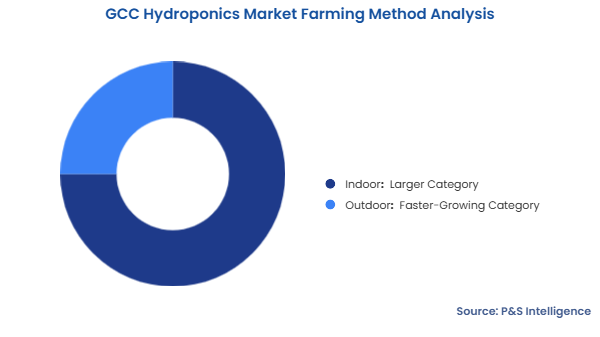
The indoor category holds the largest market share, of 75%, in 2025, due to controlled environment agriculture, which ensures year-round production despite harsh desert conditions. High-value crops like leafy greens, herbs, and vegetables benefit from stable temperature, humidity, and nutrient control, meeting urban and hospitality sector demand while maximizing yield per square meter.
The outdoor category will have the highest CAGR, of 13.6%, driven by large-scale expansion, government support, and innovative technologies like solar-powered irrigation and climate-adaptive greenhouses. Semi-controlled outdoor systems offer cost-efficient solutions for food security objectives, boosting domestic production and reducing import dependence, particularly in regions with available land and favorable infrastructure.
The farming methods analyzed in this report are:
Indoor (Larger Category)
Outdoor (Faster-Growing Category)
Crop Area Analysis
The above 50,000 square feet category holds the largest market share in 2025, demonstrating the dominance of large-scale commercial operations in driving market value. These industrial-scale facilities, primarily located in Saudi Arabia and the UAE, benefit from economies of scale and access to institutional capital for advanced automation systems. Major projects like Pure Harvest Smart Farms' multi-hectare facilities and Emirates Flight Catering's Bustanica vertical farm exemplify this segment's growth trajectory.
The 1,000–50,000 square feet category will have the highest CAGR, driven by increasing participation from medium-scale entrepreneurs and agricultural cooperatives. This segment benefits from lower capital requirements while maintaining commercial viability, making it accessible to a broader range of investors. Government support programs specifically targeting mid-sized agricultural enterprises have accelerated adoption in this category, particularly in Kuwait and Bahrain.
Drive strategic growth with comprehensive market analysis
GCC Hydroponics Market Geographical Analysis
Saudi Arabia Hydroponics Market Size
Saudi Arabia holds the largest market share, of 40%, in 2025, driven by the kingdom's ambitious agricultural transformation agenda under Vision 2030. Saudi Arabia's hydroponic sector has rapidly expanded, fueled by government investments and international collaborations to reduce reliance on food imports. A hydroponic farm in Madinah has produced over 2 million kilograms of crops, setting a benchmark for sustainable farming in Saudi Arabia. The project aligns with Saudi Arabia's National Water Strategy 2030, promoting food security and environmental sustainability.
The kingdom's commitment to hydroponic agriculture is evidenced by large-scale infrastructure projects and technology adoption initiatives. The farm covers 183,000 sq. meters with 20 air-conditioned halls, cultivating lettuce, celery, rosemary, wild thyme, and basil.
Major agricultural zones in Riyadh, Jeddah, and the Eastern Province have emerged as hydroponic hubs, supported by dedicated funding programs and technical assistance from the Ministry of Environment, Water and Agriculture. The Saudi Agricultural Development Fund has allocated substantial resources specifically for controlled-environment agriculture projects, facilitating rapid market expansion. Additionally, the NEOM project's Agri-FoodTech Accelerator represents a future-oriented approach to establishing the kingdom as a regional leader in agricultural innovation.
UAE Hydroponics Market Size
UAE will have the highest CAGR, of 13.3%, during 2026-2032, positioning it as the regional innovation hub for controlled-environment agriculture. The emirates' strategic location, advanced infrastructure, and proactive government policies have created an optimal ecosystem for hydroponic farming expansion. Dubai and Abu Dhabi lead this transformation through substantial investments in vertical farming facilities and research centers.
In June 2022, Emirati vertical farming pioneer Pure Harvest Smart Farms raised USD 180.5 million to expand across GCC and Asia. Crop One Holdings partnered with Emirates Flight Catering to launch the world's largest vertical farming plant in Dubai. These landmark investments demonstrate the UAE's commitment to establishing itself as a global leader in sustainable agriculture technology.
The UAE's National Food Security Strategy 2051 provides comprehensive support for hydroponic farming through various initiatives. Food Tech Valley, integral to the UAE's national food security vision and the "Plant the Emirates" initiative launched by His Highness Sheikh Mohammed bin Rashid Al Maktoum, aims to transform agriculture through hydroponic, aeroponic, and vertical farming technologies. This government-backed project serves as a catalyst for private sector investment and international collaboration in advanced farming technologies.
The countries analyzed are as follows:
Saudi Arabia (Largest Country)
UAE (Fastest-Growing Country)
Kuwait
Qatar
Bahrain
Oman
GCC Hydroponics Market Share
The market is a fragmented structure with emerging consolidation trends as established players expand their operational footprint across multiple countries. The competitive landscape comprises a mix of regional pioneers, international technology providers, and new entrants backed by substantial investment capital. Leading market participants have distinguished themselves through advanced technology adoption, consistent product quality, and established distribution networks. Strategic activities shaping the competitive landscape include technology partnerships, vertical integration, and geographic expansion. Companies are increasingly focusing on developing proprietary cultivation systems optimized for the GCC's extreme climate while establishing long-term supply agreements with major retail chains and hospitality groups.
Key GCC Hydroponics Companies:
Pure Harvest Smart Farms
Bustanica
AeroFarms
Madar Farms
VeggiTech
Badia Farms
Emirates Hydroponics Farms
Armela Farms
Mowreq Specialized Agriculture Co.
iFarm Corp.
Smart Acres
Red Sea Farms
GCC Hydroponics Market News
In January 2025, Saudi agritech startup Arable secured USD 2.55 million in seed funding to develop hydroponic systems specifically designed for desert climates, with plans to reduce setup costs by 75% compared to imported systems.
In March 2024, Edamah partnered with UAE-based Badia Farms to establish a multi-million dollar hydroponic facility in Hamala, marking Bahrain's entry into commercial-scale controlled-environment agriculture.
Want a report tailored exactly to your business need?
Leading companies across industries trust us to deliver data-driven insights and innovative solutions for their most critical decisions. From data-driven strategies to actionable insights, we empower the decision-makers who shape industries and define the future. From Fortune 500 companies to innovative startups, we are proud to partner with organisations that drive progress in their industries.
Client Testimonials
Working with P&S Intelligence and their team was an absolute pleasure – their awareness of timelines and commitment to value greatly contributed to our project's success. Eagerly anticipating future collaborations.
McKinsey & Company
India
Unmatched Standards
Our insights into the minutest levels of the markets, including the latest trends and competitive landscape, give you all the answers you need to take your business to new heights
Complete Data Security
We take a cautious approach to protecting your personal and confidential information. Trust is the strongest bond that connects us and our clients, and trust we build by complying with all international and domestic data protection and privacy laws