GCC Home Decor Market Size & Share Analysis - Trends, Drivers, Competitive Landscape, and Forecasts (2026 - 2032)
This Report Provides In-Depth Analysis of the GCC Home Decor Market Report Prepared by P&S Intelligence, Segmented by Product Type (Furniture, Home Textiles, Floor Covering, Wall Décor, Decorative Accessories), Distribution Channel (Supermarkets & Hypermarkets, Speciality Stores, E-commerce/Online Stores), End User (Residential, Commercial, Institutional), Price Tier (Mass/Volume, Mid-market, Premium/Luxury), and Geographical Outlook for the Period of 2019 to 2032
Explore the market potential with our data-driven report
GCC Home Decor Market Analysis
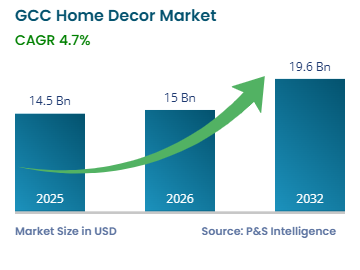
The GCC home decor market size will be an estimated USD 14.5 billion for 2025, and it will grow by 4.7% during 2026–2032, to reach USD 19.6 billion by 2032.
The rapid urbanization, coupled with increasing disposable income levels drive the demand for modern and stylish interior products. Vision 2030 initiatives across multiple GCC nations are channeling significant investments into residential and commercial real estate developments, creating sustained demand for home furnishing solutions that blend contemporary aesthetics with traditional cultural elements.
The expanding expatriate population and youthful demographics fuel market expansion as households seek to personalize living spaces. Economic diversification efforts beyond oil revenues have strengthened consumer confidence and purchasing power across Saudi Arabia, the UAE, and other member states.
Digital transformation represents another crucial growth driver as e-commerce platforms and social media channels redefine how consumers discover and purchase home decor. The Saudi Ministry of Communications and Information Technology reports internet penetration exceeding 99% in Saudi Arabia, enabling consumers to access diverse product ranges from international and local suppliers. Social media platforms, particularly Instagram and Pinterest, shape consumer preferences, with lifestyle influencers showcasing interior design trends that inspire frequent home refreshes and renovations.
GCC Home Decor Market Emerging Trends
E-Commerce Penetration Is Key Trend
Digital commerce channels are a key trend that revolutionizes how consumers discover and purchase home decor items across the GCC region.
This growth directly benefits home furnishing retailers who leverage online platforms to showcase extensive product catalogs and reach consumers beyond traditional brick-and-mortar limitations.
Online platforms provide virtual room visualization tools, augmented reality features, and personalized recommendations that enhance shopping experiences and reduce purchase hesitation.
The convenience of doorstep delivery, combined with flexible payment options including buy-now-pay-later services, removes traditional barriers to home improvement spending.
Social media integration with e-commerce creates seamless pathways from inspiration to transaction.
Research indicates that 61% of consumers in both Saudi Arabia and THE UAE plan to shop through Instagram and TikTok, with 37% of Saudi residents and 30% of THE UAE residents allocating increased budgets specifically for home decor and furnishings.
Growing Real Estate Development Is Biggest Driver
The construction boom across GCC nations serves as the primary catalyst for home decor market growth.
According to reports, the total value of planned or ongoing real estate projects in GCC economies reached USD 1.68 trillion in 2024, representing a significant increase from USD 1.38 trillion in 2023.
The GCC region hosts some of the world’s largest real estate megaprojects, led by Saudi Arabia’s NEOM, a USD 500 billion futuristic city spanning roughly 26,500 km², making it the biggest development in the region by both cost and scale.
Following it is Diriyah (City of Earth) near Riyadh, with an investment of about USD 63 billion over 14 km², and King Abdullah Economic City (KAEC), valued at around USD 55–60 billion and covering 168 km² along the Red Sea.
Also in Saudi Arabia, Jeddah Central represents a USD 20 billion redevelopment effort over 5.7 km², transforming the city’s waterfront.
In the UAE, Al Habtoor City in Dubai stands out as a USD 3 billion mixed-use complex featuring residential towers and hotels, built on approximately 0.39 km².
These massive infrastructure initiatives create immediate demand for furnishing solutions across residential communities, hospitality venues, and commercial facilities.
The Saudi Real Estate Institute indicates that over 300,000 residential units are planned for delivery by 2027, with 40% concentrated in Riyadh.
The emphasis on mixed-use developments integrating retail, residential, and recreational spaces within single complexes drives demand for versatile decor products.
Developers are increasingly adopting smart home technologies and sustainable design principles, shaping both product specifications and consumer expectations.
GCC Home Decor Market Segmentation Analysis
Product Type Analysis
The furniture category holds the largest market share, of 50%, in 2025. This dominance stems from furniture's essential role in both residential and commercial spaces, where sofas, beds, dining sets, and storage solutions form the foundation of functional interior environments. The demand for multifunctional and space-efficient furniture grows particularly strongly in urban apartments where maximizing limited square footage remains a priority.
The decorative accessories category will have the highest CAGR, of 2.0%, owing to their affordability and ability to refresh interiors without substantial investment. Items including artwork, vases, decorative lighting, and textiles enable consumers to update aesthetics frequently in response to seasonal trends and social media inspiration. The growing influence of interior design content on digital platforms encourages experimentation with accessories that personalize spaces and reflect individual style preferences.
The product types analyzed in this report are:
Furniture (Largest Category)
Home Textiles
Floor Covering
Wall Decor
Decorative Accessories (Fastest-Growing Category)
Others
Distribution Channel Analysis
The specialty stores category holds the largest market share in 2025, providing curated selections and expert consultation that enhance shopping experiences. These retailers offer premium brands and exclusive collections unavailable through mass-market channels, attracting consumers seeking quality and personalized service. As home decor products are highly tactile, customers prefer visiting stores to assess textures, colors, and sizes before making a purchase.
The e-commerce/online stores category will have the highest CAGR during the forecast period, owing to convenience, extensive product variety, and competitive pricing. Online platforms eliminate geographical constraints, enabling consumers in remote areas to access international brands and niche products unavailable locally. Virtual showrooms, 360-degree product views, and customer reviews reduce uncertainty while doorstep delivery and flexible return policies minimize risk.
The distribution channels analyzed in this report are:
The residential category holds the largest market share, of 65%, in 2025, driven by ongoing housing development and the cultural importance placed on home aesthetics. Families invest significantly in furnishing living rooms, bedrooms, kitchens, and outdoor spaces to create comfortable environments that reflect personal values and hospitality traditions.
The commercial category has the highest CAGR, driven by strong growth in hospitality, retail, and office developments. With tourism, luxury hotels, and mixed-use projects booming—especially in Saudi Arabia and the UAE—demand for high-quality interior finishes, furnishings, and decorative elements is rising. Businesses are investing in aesthetic, brand-aligned spaces to enhance customer experience and employee well-being, fueling sustained growth across commercial décor categories.
The hospitality subcategory is expanding owing to tourism expansion and mega-project developments requiring extensive interior finishing. As per the Saudi Press Agency, the kingdom received 17.5 million international visitors from January to July 2024, marking a 10% rise compared to the same timeframe in 2023 and a remarkable 73% increase relative to the figures from 2019. Notably, there has been a staggering 656% surge in the number of tourists arriving specifically for entertainment and holiday purposes. According to the ministry, 4.2 million tourists came for these reasons in the first seven months of 2024, reflecting a 25% increase from the previous year and a significant rise compared to pre-pandemic levels in 2019.
This continues to create a surging demand for hotel furnishings, restaurant decor, and public space aesthetics that deliver memorable guest experiences. The integration of smart technologies and sustainable materials in hospitality interiors establishes new benchmarks, influencing residential consumer expectations.
The end users analyzed in this report are:
Residential (Largest Category)
Homeowners
Tenants/Renters
Interior Design Enthusiasts
Others
Commercial (Fastest-Growing Category)
Offices & Corporate Spaces
Retail Stores & Showrooms
Hospitality
Health & Wellness
Entertainment & Leisure Venues
Others
Institutional
Educational Institutions
Healthcare Facilities
Government Buildings
Religious Institutions
Cultural Centers & Museums
Others
Price Tier Analysis
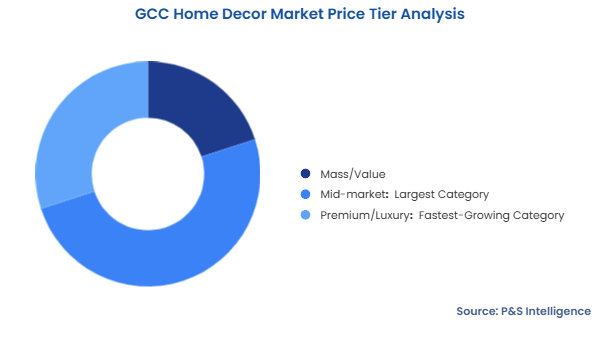
The mid-market category holds the largest market share in 2025, catering to middle-income households seeking quality products at accessible price points. This segment balances affordability with aesthetic appeal, offering trendy designs that replicate luxury styles without premium pricing. Budget-aware consumers prefer brands that offer dependable quality and stylish designs that complement modern home interiors.
The premium/luxury category will have the highest CAGR, of 2.1%, owing to growing affluence and appreciation for craftsmanship among high-income consumers. Bespoke furniture, designer collections, and exclusive collaborations attract customers willing to invest substantially in distinctive pieces that serve as long-term assets. The emphasis on sustainability and ethical sourcing resonates particularly with luxury segment consumers who prioritize environmental responsibility alongside aesthetic considerations.
The price tiers analyzed in this report are:
Mass/Value
Mid-market (Largest Category)
Premium/Luxury (Fastest-Growing Category)
Drive strategic growth with comprehensive market analysis
GCC Home Decor Market Regional Outlook
Saudi Arabia Home Decor Market Size
Saudi Arabia holds the largest market share, of 45%, in 2025. This reflects Vision 2030's transformative impact on construction activity, with mega-projects including NEOM, Qiddiya, and the Red Sea destination channeling over USD 1.06 trillion into infrastructure development. The National Housing Company reported SAR 13 billion in sales during the first half of 2024, executing 130 projects across various regions that require comprehensive interior finishing solutions.
Riyadh's emergence as a global business hub attracts multinational corporations establishing regional headquarters, creating demand for both residential accommodations for expatriate employees and premium office furnishings. This construction boom generates immediate demand for furniture, textiles, and decorative items across newly completed residential towers, commercial complexes, and hospitality venues.
The Kingdom's cultural emphasis on hospitality and family gatherings drives investment in home furnishings that accommodate large social events. The homeownership rate target of 70% by 2030 propels first-time buyers into the market, seeking affordable yet stylish furniture collections suitable for modern Saudi lifestyles. E-commerce adoption accelerates as electronic payments comprised 79% of retail transactions in 2024, facilitating online purchasing of home decor items from both domestic and international suppliers.
UAE Home Decor Market Size
THE UAE will have the highest CAGR, of 1.9%, driven by rapid urban development, rising expatriate population, and strong real estate investment across Dubai and Abu Dhabi. High-net-worth individuals and expatriate professionals seek luxury residences in premium developments, including Palm Jumeirah and Downtown Dubai, driving demand for designer furniture and exclusive interior solutions.
Abu Dhabi's diversification initiatives under Vision 2021 expand non-oil economic activities, creating employment opportunities and strengthening consumer spending capacity. The UAE Cabinet approved significant residential construction projects in 2024, addressing housing demand while maintaining quality standards that necessitate premium interior products. The tourism sector's vitality, with Dubai International Airport handling 90 million passengers annually, sustains hospitality sector investments requiring periodic renovations and refurbishments.
The Emirates' status as a cultural melting pot influences interior design preferences, with consumers blending traditional Arabic elements with contemporary international styles. Smart home technology adoption reaches high penetration rates as tech-savvy residents integrate automated lighting, climate control, and security systems into their properties. Sustainability initiatives, including green building certifications, encourage the selection of eco-friendly furnishing materials and energy-efficient appliances, aligning with government environmental objectives.
As per the Ministry of Foreign Affairs, in 2016, the travel & tourism sector directly contributed USD 18.7 billion (AED 68.5 billion) to the UAE's GDP, representing 5.2% of the overall GDP. It is projected to grow at an annual rate of 5.1% from 2017 to 2027, reaching USD 31.6 billion (AED 116.1 billion), which would account for 5.4% of the total GDP by 2027. The overall contribution of the travel & tourism sector to the UAE's GDP amounted to USD 43.3 billion (AED 159.1 billion), constituting 12.1% of the GDP. It is set to increase by 4.9% annually, resulting in USD 72 billion (AED 264.5 billion), which would represent 12.4% of GDP in 2027.
The countries of the market are as follows:
Saudi Arabia (Largest Country)
UAE (Fastest-Growing Country)
Qatar
Kuwait
Oman
Bahrain
GCC Home Decor Market Share
The market is fragmented due to the presence of numerous international brands, regional players, and local retailers, each targeting specific customer segments and price points. International furniture giants, including IKEA, Home Center, and Ashley Furniture HomeStore, maintain a substantial presence across multiple GCC markets, leveraging extensive product catalogs and established brand recognition to capture volume sales. Local and regional companies, including Al Huzaifa, Royal Furniture, and Danube Home, compete effectively by understanding cultural preferences, personalized customer service, and curated collections featuring traditional designs alongside contemporary options. Strategic activities among leading players focus on expanding physical store networks in high-traffic retail developments while simultaneously enhancing digital commerce capabilities.
Key GCC Home Decor Companies:
IKEA
Home Centre
Danube Home
Pan Home
THE One
Ashley HomeStore
Home Box
Pottery Barn
Marina Home Interiors
Royal Furniture
Al Huzaifa Furniture
IDdesign
GCC Home Decor Market News
In February 2025, Christie's International Real Estate entered the Saudi Arabian market through a partnership with tech company Wasalt, aiming to serve the Kingdom's growing luxury property market and capitalize on rising high-end real estate demand driven by Vision 2030 developments.
In February 2025, AI-powered real estate platform GetProp launched in THE UAE, easing real estate transactions through advanced search tools, virtual tours, and video showcases that enhance home-buying experiences and subsequent furnishing decisions.
In December 2024, ROSHN launched its first residential community in Makkah, aiming to improve living standards, support the national development goals outlined in Vision 2030.
In September 2024, Mountain View launched Mountain View Saudi Arabia, marking entry into the Kingdom's real estate sector through a partnership with Maya and Al Saedan Real Estate. It acquired land in Riyadh to develop urban communities aligned with Vision 2030, emphasizing quality living environments.
Want a report tailored exactly to your business need?
Leading companies across industries trust us to deliver data-driven insights and innovative solutions for their most critical decisions. From data-driven strategies to actionable insights, we empower the decision-makers who shape industries and define the future. From Fortune 500 companies to innovative startups, we are proud to partner with organisations that drive progress in their industries.
Client Testimonials
Working with P&S Intelligence and their team was an absolute pleasure – their awareness of timelines and commitment to value greatly contributed to our project's success. Eagerly anticipating future collaborations.
McKinsey & Company
India
Unmatched Standards
Our insights into the minutest levels of the markets, including the latest trends and competitive landscape, give you all the answers you need to take your business to new heights
Complete Data Security
We take a cautious approach to protecting your personal and confidential information. Trust is the strongest bond that connects us and our clients, and trust we build by complying with all international and domestic data protection and privacy laws