This Report Provides In-Depth Analysis of the GCC Halal Tourism Market Report Prepared by P&S Intelligence, Segmented by Service (Accomodation, Food & Beverage, Transportation, Travel Pckages & Tours), Tour Type (International, Domestic), Tourist Type (Independent Travelers, Tour Groups, Package Travelers), Purpose (Religious & Spiritual, Leisure & Recreation, Business & MICE, Wellness & Medicine), and Geographical Outlook for the Period of 2019 to 2032
Explore the market potential with our data-driven report
GCC Halal Tourism Market Outlook
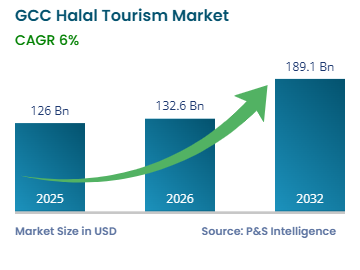
The GCC halal tourism market size will be an estimated USD 126.0 billion for 2025, and it will grow by 6.0% during 2026–2032, to reach USD 189.1 billion by 2032.
The expansion is driven by increasing Muslim population, growing religious tourism infrastructure, government initiatives to promote halal-compliant tourism, and rising demand for faith-based travel experiences across the region.
Saudi Arabia dominates the regional market due to its position as the host of Islam's two holiest cities, Mecca and Medina, which attract millions of pilgrims annually for Hajj and Umrah. The country aims to welcome 100 million tourists by 2030, according to Saudi Vision 2030. The U.A.E. has also emerged as a leading destination, combining halal-friendly services with world-class tourism infrastructure, luxury hospitality, and diverse entertainment options that align with Islamic values. The GCC countries are investing heavily in tourism infrastructure development, including halal-certified hotels, prayer facilities, gender-segregated recreational areas, and halal food establishments.
GCC Halal Tourism Market Emerging Trends
Digital Transformation Is Key Trend
The halal tourism sector in the GCC is experiencing a significant digital transformation, with technology playing a crucial role in enhancing Muslim traveler experiences.
Mobile applications offering prayer time notifications, Qibla direction, halal restaurant locators, and digital travel guides have become essential tools for Muslim tourists.
Online booking platforms are increasingly incorporating halal-friendly filters, allowing travelers to search for accommodations and services that meet Islamic requirements.
The integration of artificial intelligence and personalized recommendation systems helps tourists discover halal-compliant attractions, dining options, and activities tailored to their preferences.
Social media platforms and digital marketing have revolutionized how GCC destinations promote their halal tourism offerings to global Muslim audiences.
Influencer marketing, virtual tours, and user-generated content showcasing halal-friendly experiences have significantly influenced travel decisions among younger Muslim demographics.
The COVID-19 pandemic accelerated the adoption of contactless technologies, digital payment systems, and virtual concierge services in hotels and tourist facilities, improving operational efficiency while maintaining religious compliance.
Growing Religious Tourism Is Biggest Driver
Religious tourism remains the primary driver for the GCC halal tourism market, with Saudi Arabia serving as the epicenter of Islamic pilgrimages.
The annual Hajj pilgrimage and year-round Umrah attract millions of Muslims from across the globe, generating substantial economic activity in accommodation, transportation, food services, and retail sectors.
The Saudi government has undertaken massive infrastructure expansion projects to increase the capacity of holy sites, improve pilgrim services, and enhance the overall religious tourism experience.
Beyond Saudi Arabia, other GCC countries are developing religious tourism attractions, including historic mosques, Islamic heritage sites, and spiritual retreat centers.
Qatar has invested in promoting Islamic cultural tourism through museums, educational centers, and faith-based attractions that appeal to Muslim families seeking culturally enriching experiences.
The U.A.E. has positioned itself as a hub for Islamic finance conferences, halal certification exhibitions, and Muslim lifestyle events, attracting business travelers and religious scholars.
The rise of spiritual wellness tourism, combining religious observance with health and relaxation, is creating new opportunities in the market.
Ramadan tourism has gained popularity, with hotels and resorts offering special packages that include pre-dawn meals, iftar buffets, Tarawih prayer facilities, and spiritual programs during the holy month.
GCC Halal Tourism Market Segmentation Analysis
Service Analysis
The accommodation category holds the largest market share, of 50%, in 2025. This dominance is attributed to the extensive network of halal-certified hotels, resorts, apartments, and serviced accommodations across the region that cater specifically to Muslim travelers' requirements. These establishments provide prayer facilities, Qibla indicators, halal-certified food options, gender-segregated pools and spas, and alcohol-free environments, making them preferred choices for religious and family tourists.
The travel packages & tours category will have the highest CAGR, of 6.1%, due to the rising demand for all-inclusive, convenient, and culturally compliant travel experiences. Muslim travelers prefer packages that combine halal-friendly accommodations, dining, transportation, and visits to religious or cultural sites. Increasing disposable incomes, greater awareness of halal travel options, and the desire for personalized and stress-free itineraries are driving significant growth in this category across the region.
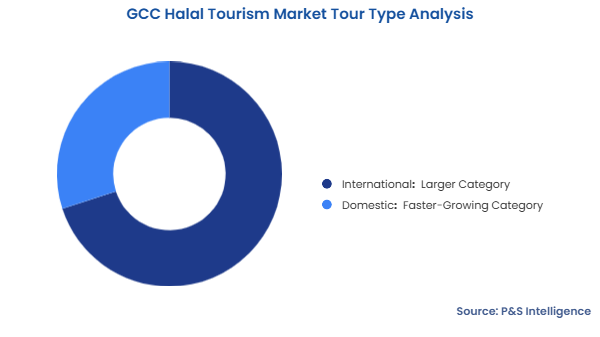
The international category holds the larger market share, of 70%, in 2025, due to the millions of Muslim pilgrims traveling to Saudi Arabia for Hajj and Umrah from countries worldwide. The GCC's strategic geographic position connecting Asia, Africa, and Europe makes it accessible for international Muslim travelers. The region's reputation for luxury shopping, modern infrastructure, and halal-compliant entertainment attracts tourists from Southeast Asia, North Africa, South Asia, and Western countries with significant Muslim populations.
The domestic category will have the higher CAGR, of 6.3%, as GCC governments implement initiatives to promote local tourism, develop domestic tourist destinations, and encourage citizens and residents to explore their own countries. Saudi Arabia's tourism strategy particularly emphasizes growing domestic travel through seasonal festivals, heritage site development, and entertainment offerings. The rise of staycations, weekend getaways, and domestic religious tourism is supported by improving transportation infrastructure and marketing campaigns highlighting local attractions.
The tour types analyzed in this report are:
International (Larger Category)
Domestic (Faster-Growing Category)
Tourist Type Analysis
The independent travelers category holds the largest market share, of 60%, in 2025, due to the growing trend of Muslim travelers planning their own itineraries, booking accommodations and transportation independently, and seeking personalized experiences. The availability of digital tools, online booking platforms, travel apps, and comprehensive information about halal-friendly facilities has empowered Muslim tourists to travel without tour operator assistance. Younger demographics particularly prefer the flexibility and authenticity that independent travel offers.
The package travelers category will have the highest CAGR, of 6.2%, driven by increasing demand for organized Hajj and Umrah packages, growing popularity of all-inclusive halal vacation packages, and family travelers seeking convenience and value. Tour operators are developing specialized packages combining religious tourism with leisure activities, cultural experiences, and shopping opportunities. Corporate and MICE tourism packages catering to Muslim business travelers are also expanding, offering halal-certified accommodations, prayer facilities, and culturally appropriate networking environments.
The tourist types analyzed in this report are:
Independent Travelers (Largest Category)
Tour Groups
Package Travelers (Fastest-Growing Category)
Purpose Analysis
The religious & spiritual category holds the largest market share, of 55%, in 2025, and it will have the highest CAGR during the forecast period, as Hajj and Umrah pilgrimages to Saudi Arabia, which represent the core of the GCC halal tourism market. The spiritual significance of visiting Islam's holiest sites drives consistent demand throughout the year, with peak seasons during Ramadan and the Hajj period. Umrah pilgrimage can be performed any time, providing year-round revenue for the religious tourism sector.
The purposes of travel analyzed in this report are:
Religious & Spiritual (Largest and Fastest-Growing Category)
Hajj
Umrah
Ramadan
Leisure & Recreation
Business & MICE
Wellness & Medical
Others
Drive strategic growth with comprehensive market analysis
GCC Halal Tourism Market Regional Growth Dynamics
Saudi Arabia Halal Tourism Market Size
Saudi Arabia holds the largest market share, of 40%, in 2025, and it will have the highest CAGR during the forecast period. This dominance is primarily attributed to the country's unique position as the host of Mecca and Medina, Islam's two holiest cities, which attract millions of Muslim pilgrims annually for Hajj and Umrah. The religious significance of these cities creates consistent and growing demand for tourism services, accommodation, transportation, and related hospitality offerings.
Massive investments in tourism infrastructure include the development of luxury hotels near holy sites, expansion of transportation networks, construction of entertainment cities, and creation of coastal tourism destinations along the Red Sea. The country is developing mega-projects, such as NEOM, Qiddiya entertainment city, and the Red Sea Project, which will offer world-class tourism experiences while maintaining Islamic values.
Saudi Arabia welcomed 18.5 million Umrah pilgrims in 2024 alone, demonstrating the scale of religious tourism demand. The government has continuously expanded the capacity of the Grand Mosque in Mecca and the Prophet's Mosque in Medina to accommodate more pilgrims. The introduction of electronic visa systems, streamlined entry procedures for tourists, and relaxed visa policies for international visitors have made the country more accessible to global Muslim travelers.
The Kingdom is also promoting its diverse tourism offerings beyond religious sites, including UNESCO World Heritage Sites, natural attractions, cultural festivals, and modern entertainment venues. The development of domestic tourism is supported by national campaigns encouraging Saudi citizens to explore their country's historic and natural attractions, creating a growing category of internal halal tourism alongside international religious travelers.
UAE Halal Tourism Market Size
UAE is the second-largest country in the GCC halal tourism market due to the country successfully positioning itself as a premium halal tourism destination, combining Islamic cultural values with world-class luxury, entertainment, and business facilities. Dubai and Abu Dhabi attract millions of Muslim tourists seeking high-quality halal-compliant services, family-friendly attractions, and diverse experiences.
The country's tourism infrastructure includes hundreds of halal-certified hotels, thousands of halal restaurants, prayer facilities in shopping malls and tourist attractions, and entertainment venues designed to accommodate Muslim families. The U.A.E.'s strategic location as a global aviation hub makes it easily accessible for Muslim travelers from Asia, Africa, and Europe.
The U.A.E. government has invested heavily in developing Muslim-friendly tourism offerings while maintaining appeal to diverse international markets. The country hosts major Islamic finance conferences, halal industry exhibitions, and Muslim lifestyle events that attract business travelers and industry professionals. Dubai's reputation for luxury shopping, modern architecture, and entertainment, combined with its Islamic cultural foundation creates a unique value proposition for Muslim tourists seeking both leisure and religious compliance.
Abu Dhabi has developed cultural and religious tourism attractions, including the Sheikh Zayed Grand Mosque, one of the world's largest mosques and a major tourist attraction welcoming millions of visitors annually. The emirate focuses on family-oriented tourism with theme parks, cultural museums, and beach resorts offering halal-certified services. The U.A.E.'s visa-free policies for many nationalities, efficient transportation systems, and multilingual hospitality services enhance its attractiveness to international Muslim travelers.
The countries analyzed in the market are as follows:
Saudi Arabia (Largest Country)
UAE (Fastest-Growing Country)
Kuwait
Qatar
Oman
Bahrain
GCC Halal Tourism Market Share
The market is fragmented, characterized by the presence of numerous international hotel chains, regional hospitality groups, tour operators, and local service providers competing for market share. The market includes global luxury hotel brands operating halal-certified properties, regional hotel chains specializing in Muslim-friendly accommodations, independent hotels and resorts, tour operators organizing religious pilgrimages, and various service providers offering transportation, food, and entertainment services compliant with Islamic requirements.
The competitive landscape presents opportunities for innovation in areas such as technology-enabled services, sustainable halal tourism, wellness and medical tourism combined with religious travel, and luxury halal hospitality experiences. New market entrants can capture opportunities by focusing on underserved segments, emerging destinations within GCC countries, or specialized services catering to specific Muslim traveler demographics.
Key GCC Halal Tourism Companies:
Musafir.com LLC
Yusuf Bin Ahmed Kanoo Co. W.L.L.
Al Tayyar Travel Group Holding Company
Rehlat Online Services DWC-LLC
Al Mousa Travel Agency
HalalBooking Ltd.
Tour Halal Tourism LLC
HalalTrip Pte. Ltd.
Wego Pte. Ltd.
Al Habtoor Group LLC
Jannah Hotels & Resorts LLC
Al Jawhara Group of Hotels & Apartments LLC
GCC Halal Tourism Market News
In June 2025, the Gulf Cooperation Council (GCC) officially approved a unified tourist visa, akin to the Schengen visa, enabling seamless travel across all six member states: UAE, Saudi Arabia, Bahrain, Qatar, Oman, and Kuwait. This initiative is expected to significantly boost regional tourism, including halal travel, by simplifying cross-border mobility.
In May 2025, ASEAN and GCC issued a joint declaration endorsing the ASEAN-GCC Framework of Cooperation (2024–2028), which outlines joint actions in areas of mutual interest, including halal food, beverages, and tourism. This collaboration aims to enhance sectoral cooperation between the two regions.
Want a report tailored exactly to your business need?
Leading companies across industries trust us to deliver data-driven insights and innovative solutions for their most critical decisions. From data-driven strategies to actionable insights, we empower the decision-makers who shape industries and define the future. From Fortune 500 companies to innovative startups, we are proud to partner with organisations that drive progress in their industries.
Client Testimonials
Working with P&S Intelligence and their team was an absolute pleasure – their awareness of timelines and commitment to value greatly contributed to our project's success. Eagerly anticipating future collaborations.
McKinsey & Company
India
Unmatched Standards
Our insights into the minutest levels of the markets, including the latest trends and competitive landscape, give you all the answers you need to take your business to new heights
Complete Data Security
We take a cautious approach to protecting your personal and confidential information. Trust is the strongest bond that connects us and our clients, and trust we build by complying with all international and domestic data protection and privacy laws