This Report Provides In-Depth Analysis of the GCC Fintech Market Report Prepared by P&S Intelligence, Segmented by Business Model (B2C, B2B, B2B2C , Marketplace), Technology (Artificial Intelligence (AI), Blockchain, Application Programming Interface (API), Robotic Process Automation (RPA), Data Analytics), Deployment Mode (Cloud-based, On-premises), Application (Payment and Fund Transfer, Digital Lending, Insurance (Insurtech), Wealth Management, Personal Finance), By End User (Banking, Insurance Companies, Investment Firms), and Geographical Outlook for the Period of 2019 to 2032
Explore the market potential with our data-driven report
GCC Fintech Market Outlook
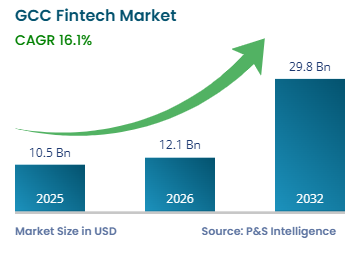
The GCC fintech market was valued at USD 10.5 billion in 2025, and it is projected to grow at a CAGR of 16.1% during 2026–2032, to reach USD 29.8 billion by 2032. The major factors responsible for the growth of the market include supportive government initiatives and regulatory frameworks, rapid digital transformation across the region, and increasing smartphone penetration coupled with a tech-savvy young population seeking innovative financial solutions.
The surge in digital payment adoption has emerged as the cornerstone of fintech growth across the GCC region. According to the Saudi Central Bank (SAMA), digital transactions in Saudi Arabia alone constituted 79% of all financial transactions in 2024, reflecting a significant shift towards a cashless economy. This transformation is supported by the establishment of regulatory sandboxes and open banking frameworks across multiple GCC countries, enabling fintech companies to test innovative solutions while ensuring consumer protection and financial stability. The region's strategic position as a bridge between East and West, combined with substantial sovereign wealth fund investments in financial technology, has created an environment conducive to both local innovation and international expansion of fintech services.
GCC Fintech Market Emerging Trends
Rapid Digital Transformation and High Smartphone Penetration Are Key Trends
The GCC region boasts one of the highest smartphone penetration rates globally.
Saudi Arabia reported 36.84 million internet users and a penetration rate of 99.0% in early 2024.
This widespread digital connectivity, combined with a young, affluent demographic eager to embrace technology, has created unprecedented demand for digital financial services.
The shift toward digital payments has been particularly pronounced, with contactless payment solutions, mobile wallets, and peer-to-peer transfer platforms experiencing exponential growth across all GCC countries.
The COVID-19 pandemic significantly accelerated digital adoption in financial services, with consumers and businesses rapidly transitioning to online banking, digital payments, and remote financial management tools.
This behavioral shift has proven permanent, with digital-first banking becoming the new normal across the region.
Financial institutions have responded by investing heavily in digital transformation initiatives, partnering with fintech startups, and launching their own digital banking subsidiaries to meet evolving customer expectations.
Growing Government Support and Vision 2030 Initiatives Drive Market
The key driver for the GCC fintech market is the unprecedented government support and strategic national transformation programs across the region.
Saudi Arabia's Vision 2030 initiative has set ambitious targets for the fintech sector, aiming to establish 525 active fintech companies by 2030, a significant increase from just 224 companies in Q2 2024.
The Financial Sector Development Program (FSDP), a key component of Vision 2030, focuses on fostering a dynamic and innovative financial ecosystem through regulatory support, funding initiatives, and infrastructure development.
The UAE government has been equally proactive in supporting fintech growth.
According to a report by the PayTabs Group, the country witnessed over 329 active fintech companies in 2024, representing a 128.5% increase from 144 companies in 2021.
Bahrain has positioned itself as an early mover in regulatory innovation, becoming the first GCC country to implement open banking regulations in 2020 and establishing comprehensive cryptocurrency regulations through its Crypto-Assets Module in 2019.
These regulatory frameworks have created a fertile ground for fintech innovation while ensuring consumer protection and financial stability.
GCC Fintech Market Segmentation Analysis
Business Model Analysis
The B2C category held the largest share of 50% in the GCC fintech market in 2025, driven by the proliferation of consumer-facing digital payment solutions, neobanks, and personal finance management applications. The category's dominance reflects the high consumer demand for convenient, accessible, and user-friendly financial services. Neobanks like Liv by Emirates NBD and STC Pay have acquired millions of users by offering fee-free banking, instant account opening, and innovative features tailored to young professionals.
The B2B2C category is projected to grow at the highest CAGR of 16.3% during the forecast period, as fintech companies increasingly partner with traditional businesses to embed financial services into their platforms. This includes white-label solutions that enable non-financial companies to offer banking services, payment processing, and lending products to their customers. The rise of banking-as-a-service platforms and the implementation of open banking regulations are key enablers of this category's rapid growth.
These business models are covered:
B2C (Largest Category)
Neobanks
Retail Payment
Others
B2B
Payments Infrastructure
Banking-as-a-Service
Others
B2B2C (Fastest-Growing Category)
Fintech Companies
White-Label Platforms
Others
Marketplace
P2P Lending
Crowd-funding Platforms
Others
Technology Analysis
The artificial intelligence category holds the largest share in the GCC fintech market in 2025, of 35%, and it is expected to maintain its dominance throughout the forecast period. This is primarily due to the widespread adoption of AI-powered solutions for fraud detection, risk assessment, customer service automation, and personalized financial recommendations. Financial institutions across the GCC are leveraging AI to enhance operational efficiency, with banks reporting up to 40% reduction in operational costs through AI implementation.
Blockchain will witness the highest CAGR during the forecast period, driven by increasing government initiatives in blockchain adoption and the growing interest in cryptocurrency and digital assets. The UAE's establishment of the Virtual Assets Regulatory Authority (VARA) and Bahrain's comprehensive crypto regulations have created a supportive environment for blockchain innovation. Applications in cross-border payments, smart contracts, and tokenization of assets are gaining significant traction, with multiple sovereign wealth funds investing in blockchain infrastructure development.
These technologies are covered:
Artificial Intelligence (Largest Category)
Blockchain (Fastest-Growing Category)
Application Programming Interface
Robotic Process Automation
Data Analytics
Others
Deployment Mode Analysis
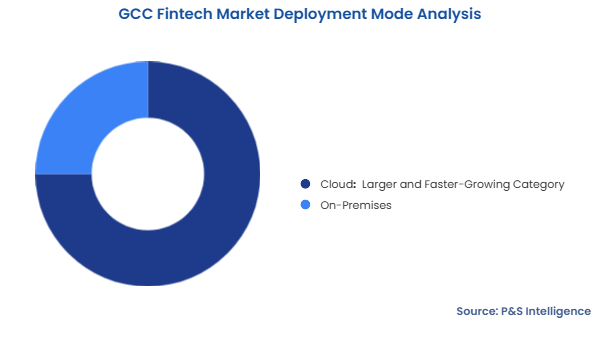
The cloud mode captured 75% GCC fintech market share in 2025, and it will also have the higher CAGR. This reflects the regional shift toward scalable, flexible, and cost-effective technology infrastructure. Cloud adoption enables fintech companies to rapidly deploy services, ensure high availability, and comply with data sovereignty requirements while maintaining operational efficiency. The availability of regional data centers from major cloud providers and government cloud-first policies have accelerated this transition.
These deployment modes are covered:
Cloud (Larger and Faster-Growing Category)
On-Premises
Application Analysis
Payment & fund transfer solutions dominate the GCC fintech market with 45% share in 2025, driven by the rapid adoption of digital wallets, contactless payments, and cross-border remittance platforms. The implementation of instant payment networks across GCC countries and the standardization of QR code payments have further strengthened this category's position. Companies like STC Pay in Saudi Arabia and PayBy in the UAE are processing billions of dollars in transactions annually.
Digital lending is experiencing the fastest growth, with a projected CAGR of 16.4%, during 2026–2032. This growth is fueled by the rise of Buy Now Pay Later (BNPL) services, peer-to-peer lending platforms, and AI-driven credit assessment models that enable faster loan approvals. The Central Bank of the UAE's new regulatory framework for BNPL services and Saudi Arabia's comprehensive BNPL guidelines have provided clarity and confidence to both providers and consumers in this rapidly evolving category.
These applications are covered:
Payment & Fund Transfer (Largest Category)
Digital Lending (Fastest-Growing Category)
Insurance
Wealth Management
Personal Finance
Others
End User Analysis
Banks hold 50% market share in 2025, as traditional banks actively adopt fintech solutions to enhance their digital capabilities, improve operational efficiency, and meet changing customer expectations. Banks are investing heavily in API integration, AI-powered analytics, and blockchain technology to modernize their infrastructure and compete with digital-native challengers.
Investment firms constitute the fastest-growing category, with an expected CAGR of 16.5% through 2032. The adoption of robo-advisors, algorithmic trading platforms, and digital wealth management solutions is transforming how investment services are delivered in the region. The growth is particularly pronounced in the UAE and Saudi Arabia, where regulatory reforms have enabled greater market access for retail investors and the emergence of commission-free trading platforms.
These end users are covered:
Banks (Largest Category)
Insurance Companies
Investment Firms (Fastest-Growing Category)
Others
Drive strategic growth with comprehensive market analysis
GCC Fintech Market Regional Growth Dynamics
Saudi Arabia Fintech Market Share
Saudi Arabia holds the largest regional market share, of 40%, in 2025, and it is expected to maintain its leadership position through 2032. This dominance is primarily attributed to the government's Vision 2030 initiative, which has created a comprehensive ecosystem for fintech development including regulatory sandboxes, dedicated funding programs, and strategic partnerships with global technology leaders. The Kingdom's fintech sector has expanded from just 10 companies in 2018 to over 224 by Q2 2024, demonstrating remarkable growth momentum.
The country processed over SAR 800 billion in digital transactions in 2024, with digital payments contributing the majority. The Saudi Central Bank's target of achieving 70% cashless transactions by 2030 continues to drive innovation in payment technologies, while the recent issuance of digital banking licenses to STC Bank, D360 Bank, and Saudi Digital Bank signals a new era of competition and innovation in the banking sector. The establishment of NEOM and other smart city projects further reinforces Saudi Arabia's commitment to becoming a global fintech hub.
UAE Fintech Market Outlook
The UAE fintech market is projected to grow at the highest CAGR, of 16.2%, during 2026–2032, driven by its position as a global financial center and gateway between East and West. The country's dual financial hub structure, with Abu Dhabi Global Market (ADGM) and Dubai International Financial Centre (DIFC) offering distinct advantages, has attracted over 329 fintech companies by 2024. The UAE's progressive approach to regulation, including the establishment of VARA for virtual assets and comprehensive open banking frameworks, has created an environment conducive to innovation.
Dubai's emergence as a cryptocurrency hub, with major exchanges establishing regional headquarters, and Abu Dhabi's focus on blockchain and AI innovation through initiatives such as Hub71, demonstrate the emirates' complementary strategies in fintech development. The UAE processed over USD 265 million in fintech funding in 2024, with Tabby achieving unicorn status and expanding across the MENA region. The country's 89% digital banking adoption rate, the highest in the GCC, reflects the population's readiness for innovative financial services.
Bahrain Fintech Market Value
Bahrain has established itself as a pioneer in fintech regulation within the GCC, despite its smaller market size. The Kingdom was the first in the region to launch a regulatory sandbox in 2017 and implement open banking regulations in 2020. Bahrain FinTech Bay, acquired by BENEFIT Company in 2023, has incubated over 116 startups since its inception, creating a vibrant ecosystem for innovation.
The Central Bank of Bahrain's progressive approach has attracted global fintech players, with Tarabut Gateway becoming the MENA region's largest open banking platform and Rain establishing itself as the first regulated crypto-assets trading platform in the region. Bahrain's focus on Islamic fintech and its strategic partnerships with international fintech hubs position it as a specialized center for financial innovation in the GCC.
These regions and countries are covered:
Saudi Arabia (Largest Country Market)
UAE (Fastest-Growing Country Market)
Qatar
Bahrain
Kuwait
Oman
GCC Fintech Market Share
The GCC fintech market is moderately fragmented, with a dynamic mix of international fintech giants, regional champions, and innovative startups competing across various segments. The market structure reflects the region's unique characteristics, with strong government backing enabling rapid scaling of local players while attracting significant international investment. The presence of multiple regulatory sandboxes and supportive frameworks has lowered barriers to entry, resulting in a competitive landscape where innovation and customer experience are key differentiators.
The market exhibits characteristics of a consolidated structure in specific segments, with the top 10 players collectively controlling approximately 45% of the total market share in 2025. In the digital payments category, STC Pay, PayTabs, and Network International dominate with their extensive merchant networks and processing capabilities. STC Pay alone processes over SAR 30 billion in transactions annually, leveraging its telecom distribution channels to lead in peer-to-peer transfers. The neobanking category shows higher concentration, with Liv, YAP, and D360 Bank capturing significant market share through aggressive customer acquisition strategies and innovative product offerings.
Recent strategic activities have reshaped the competitive landscape significantly. The acquisition of Tweeq by Tabby for integration into its BNPL ecosystem, Riyad Bank's SAR 800-million venture fund for fintech investments, and the entry of global players, such as Pine Labs, into the UAE market demonstrate the sector's dynamism. Traditional banks are responding to fintech competition by launching their own digital subsidiaries, forming strategic partnerships with technology providers, and investing in fintech startups through corporate venture capital arms.
The competitive environment is further intensified by the entry of non-financial players, particularly telecommunications companies and technology giants, who are leveraging their customer base and technological capabilities to offer financial services. The implementation of open banking regulations across the region is expected to further democratize the market, enabling smaller players to compete effectively by accessing customer data and building innovative services on top of existing banking infrastructure.
Market opportunities remain abundant for new entrants, particularly in underserved segments such as SME lending, wealth management for the mass affluent, and specialized Islamic fintech solutions. The fragmented nature of the GCC market, with six distinct regulatory jurisdictions, creates opportunities for companies that can successfully navigate the regulatory landscape and achieve regional scale.
Key GCC Fintech Companies:
Tabby
Fawry for Banking Technology and Electronic Payments
Rasan Information Technology
MyFatoorah
MadfooatCom for ePayments Company
MNT-Halan
Thndr
EFG Hermes
HyperPay
PayTabs Group
Sarwa
Rain
OPTASIA
Telr
Ziina
GCC Fintech Market News
In January 2025, Bank Alfalah acquired a 9.9% equity stake in Jingle Pay, enabling the fintech super-app to leverage the bank's infrastructure for expansion into Pakistan while strengthening its position in cross-border payments.
In December 2024, CredibleX, a UAE-based embedded finance platform, raised USD 55 million in seed funding from Further Ventures and Kilgour Williams Capital to expand its SME lending solutions across the GCC region.
In November 2024, National Bank of Bahrain and ARP Digital launched a Bitcoin-linked structured investment product.
In October 2024, Mashreq Bank introduced the NEO CORP digital banking platform in Kuwait, offering corporate clients enhanced cash management and trade services through an intuitive interface with real-time data analytics capabilities.
In September 2024, Tabby completed its acquisition of Tweeq, a Saudi-based digital wallet licensed by SAMA, enhancing its product portfolio with spending accounts and money management tools for the Saudi market.
In September 2024, Riyad Bank launched an SAR 800-million venture capital fund during the 24 Fintech conference in Riyadh, focusing on investing in fintech startups and innovative financial solutions to position Saudi Arabia as a regional fintech hub.
In June 2024, Xpence and Paymob formed a strategic partnership to enhance digital payment solutions for SMEs across the GCC, integrating advanced payment processing technology for seamless online and in-person transactions.
Want a report tailored exactly to your business need?
Leading companies across industries trust us to deliver data-driven insights and innovative solutions for their most critical decisions. From data-driven strategies to actionable insights, we empower the decision-makers who shape industries and define the future. From Fortune 500 companies to innovative startups, we are proud to partner with organisations that drive progress in their industries.
Client Testimonials
Working with P&S Intelligence and their team was an absolute pleasure – their awareness of timelines and commitment to value greatly contributed to our project's success. Eagerly anticipating future collaborations.
McKinsey & Company
India
Unmatched Standards
Our insights into the minutest levels of the markets, including the latest trends and competitive landscape, give you all the answers you need to take your business to new heights
Complete Data Security
We take a cautious approach to protecting your personal and confidential information. Trust is the strongest bond that connects us and our clients, and trust we build by complying with all international and domestic data protection and privacy laws