This Report Provides In-Depth Analysis of the GCC E-learning Market Report Prepared by P&S Intelligence, Segmented by Provider Type (Content, Service), Technology (Learning Management System (LMS), Mobile E-learning, Virtual Classroom, Online/Rapid E-learning), End User (Academic, Corperate, Government), Deployment Mode (Cloud, On-Premises), Learning Type (Self-Paced, Instructor-Led, Blended), and Geographical Outlook for the Period of 2019 to 2032
Explore the market potential with our data-driven report
GCC E-learning Market Future Outlook
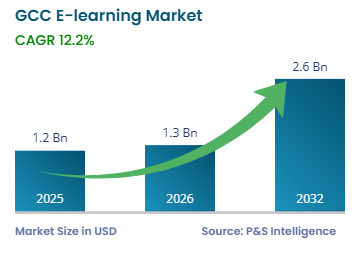
The GCC e-learning market size will be an estimated USD 1.2 billion for 2025, and it will grow by 12.2% during 2026–2032, to reach USD 2.6 billion by 2032.
The major factors contributing to the market growth include the significant government investments in digital education, rising smartphone and internet penetration, and increasing demand for flexible, technology-driven learning solutions across academic and corporate sectors. The increasing consumer inclination toward digital learning solutions and the rising penetration of IoT-based smart devices further contribute to the market. This technological advancement is complemented by the region's young, tech-savvy population that actively embraces digital learning platforms for both academic and professional development purposes.
The market is experiencing robust expansion driven by the comprehensive digital transformation initiatives across all GCC member states. Saudi Arabia, under its Vision 2030, has poured resources into its own programs via the Saudi Data & AI Authority and a new initiative, called Project Transcendence—a USD-100 billion drive to accelerate AI and advanced tech adoption.
Furthermore, the corporate sector's emphasis on continuous workforce upskilling has significantly contributed to market expansion. Organizations across the GCC are increasingly adopting e-learning platforms to provide scalable, cost-effective training solutions that align with the region's economic diversification goals. The convergence of high internet connectivity, government support, and evolving educational needs positions the GCC e-learning market for sustained growth throughout the forecast period.
GCC E-learning Market Growth Factors
Rising Demand for Flexible and Personalized Learning Solutions Is Key Trend
The rising demand for flexible, self-paced learning is a key GCC e-learning market trend.
The dynamic nature of the job market and the need for upskilling and reskilling are driving individuals and organizations to embrace e-learning as a means of acquiring new skills and knowledge.
This trend is particularly pronounced among working professionals who seek to enhance their qualifications without disrupting their careers.
Corporate organizations are leading this transformation by implementing comprehensive e-learning programs for employee development.
Companies are leveraging advanced technologies, such as AI-driven learning paths, gamification, and microlearning modules, to create engaging, personalized learning experiences that improve knowledge retention and practical application.
The integration of emerging technologies is revolutionizing the learning experience across the region.
Virtual reality (VR) and augmented reality (AR) applications are being adopted for immersive training scenarios, particularly in technical fields, such as healthcare, engineering, and aviation.
Furthermore, through instituting rewards and engaging tasks, there is a shift in the education and business-related e-learning environments, which is leading to improved participation.
Mobile learning platforms have gained particular traction, with learners accessing educational content through smartphones and tablets, enabling continuous learning regardless of location or time constraints.
Government initiatives, such as smart learning programs, digital classrooms, and e-learning platforms, are driving the adoption of technology-enabled education across schools, universities, and vocational institutions.
Government-backed initiatives, particularly under Saudi Arabia’s Vision 2030 and the UAE’s digital transformation agendas, are accelerating the adoption of flexible and personalized e-learning platforms across academic and corporate sectors.
There is also a growing emphasis on Arabic language content and culturally localized platforms, ensuring accessibility and engagement for learners across the region.
Government Initiatives Are Biggest Drivers
The primary driver for the GCC e-learning market is the unprecedented government support and investment in digital education infrastructure across all member states.
Saudi Arabia has listed 11 new PPP education projects for the higher education segment to accommodate the anticipated rise in the number of students.
The kingdom has allocated 17% of its national budget, amounting to USD 50.4 billion in 2023, specifically for the education sector’s development as part of Vision 2030.
The UAE has, similarly, demonstrated a strong commitment through multiple initiatives.
The initiative aims to create a solid and integrated e-learning platform that actively involves teachers, students, and parents to enhance the learning experience.
The Mohammed bin Rashid Smart Learning Programme, with an investment of AED 1 billion, represents a comprehensive approach to educational transformation.
Starting in the 2025–2026 academic year, every public school will integrate AI lessons into the core curriculum, making the UAE the first country globally to mandate AI education from kindergarten through grade 12.
These government-led initiatives are creating a multiplier effect across the education ecosystem.
The focus extends beyond infrastructure investment to include teacher training, curriculum development, and the creation of locally relevant digital content, ensuring sustainable market growth.
Saudi Arabia and the U.A.E. have programs to upskill teachers and the workforce in digital skills, including AI, coding, and edtech tools, which directly supports e-learning adoption.
For instance, the SDAIA and similar authorities run workshops and certification programs for educators and corporates.
GCC E-learning Market Segmentation Analysis
Provider Type Analysis
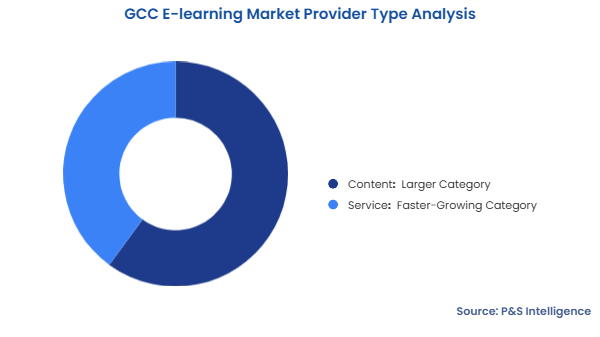
The content category holds the larger market share, of 60%, in 2025, due to the increasing demand for high-quality, diverse educational materials that cater to the region's multilingual population and specific cultural requirements. Content providers are successfully addressing the critical need for Arabic-language educational resources while also offering internationally recognized courses and certifications.
The service category will have the higher CAGR, of 12.5%, driven by increasing demand for end-to-end e-learning solutions encompassing platform management, technical support, and customization services. Organizations are increasingly seeking end-to-end solutions that encompass learning management system implementation, content curation, and ongoing maintenance. The rise of cloud-based services and Software-as-a-Service models has made these solutions more accessible and cost-effective for educational institutions and corporations alike.
The provider types analyzed in this report are:
Content (Larger Category)
Service (Faster-Growing Category)
Technology Analysis
The learning management system category holds the largest market share in 2025, as it forms the backbone of most e-learning implementations across academic and corporate sectors. LMS platforms provide essential functionalities that are crucial for structured learning programs, including course delivery, student tracking, assessment management, and reporting capabilities. The segment's dominance is reinforced by the increasing adoption of cloud-based LMS solutions that offer scalability, accessibility, and reduced infrastructure costs.
The mobile e-learning category will have the highest CAGR, of 12.3%, driven by the region's exceptional smartphone penetration rates and mobile-first user behavior. The high mobile connectivity, combined with the development of responsive learning applications and mobile-optimized content, is driving rapid adoption of mobile learning solutions across all user demographics.
As of 2023, smartphone penetration across GCC countries is approximately 82%, with some markets like the UAE and Saudi Arabia exceeding that. As per Ericsson’s Mobility Report, 4G remains widely used, but 5G penetration has grown rapidly, reaching between 34% and 47% of mobile subscriptions in the region. Mobile data usage is among the highest globally, with averages over 18 GB per smartphone per month. By 2029, 5G is projected to account for 89–93% of all mobile subscriptions in the GCC.
The technologies analyzed in this report are:
Learning Management System (LMS) (Largest Category)
Mobile E-learning (Fastest-Growing Category)
Virtual Classroom
Online/Rapid E-learning
End User Analysis
The academic category holds the largest market share, of 50%, in 2025, driven by the massive digital transformation initiatives in educational institutions across the GCC. Within the academic segment, higher education institutions are leading the adoption of e-learning technologies, implementing comprehensive digital learning ecosystems that include virtual classrooms, online assessment systems, and collaborative learning platforms. K-12 education is also experiencing significant growth as governments mandate technology integration in schools and develop digital curricula aligned with 21st-century skills.
The corporate category will have the highest CAGR during the forecast period, reflecting organizations' increasing focus on employee development and digital transformation. Organizations looking to develop e-learning modules that reflect local contexts and language preferences can significantly enhance engagement and effectiveness. Companies across the oil & gas, finance, healthcare, and retail sectors are investing heavily in e-learning platforms to provide continuous professional development, compliance training, and skill enhancement programs.
The end users analyzed in this report are:
Academic (Largest Category)
K–12 Education
Higher Education
Corporate (Fastest-Growing Category)
Government
Deployment Mode Analysis
The cloud category holds the larger market share, of 70%, in 2025, and it will have the higher CAGR during the forecast period, driven by the numerous advantages of cloud solutions, including scalability, cost-effectiveness, reduced IT infrastructure requirements, and seamless accessibility from any location. Educational institutions and corporations are increasingly adopting cloud-based solutions to support remote learning initiatives and enable real-time collaboration among geographically dispersed learners. The shift towards cloud deployment has been accelerated by the region's robust internet infrastructure and the growing acceptance of Software-as-a-Service models.
The deployment modes analyzed in this report are:
Cloud (Larger and Faster-Growing Category)
On-Premises
Learning Type Analysis
The instructor-led category holds the largest market share, of 45%, in 2025, as it combines the benefits of both traditional instructor-led training and modern digital learning methods. This hybrid approach has gained significant traction across academic institutions and corporate training programs, as it offers flexibility while maintaining the human interaction and immediate feedback that many learners value. Blended learning models are particularly effective in the GCC region, where cultural preferences for face-to-face interaction remain strong, while the benefits of digital learning are increasingly recognized. Educational institutions are implementing flipped classroom models where theoretical content is delivered online, and practical sessions are conducted in person.
The self-paced learning category will have the highest CAGR, of 12.6%, driven by the increasing demand from working professionals and adult learners who require flexibility in their learning schedules. Widespread mobile device usage and high-speed internet allow learners to access educational content at their convenience, ensure higher completion rates and better learning outcomes, and establish the foundations of self-learning and methodology, along with the traditional educational institution. This learning type is particularly popular for professional development courses, technical certifications, and language learning programs where learners can progress according to their individual pace and learning capacity.
The learning types analyzed in this report are:
Self-Paced (Fastest-Growing Category)
Instructor-Led (Largest Category)
Blended
Drive strategic growth with comprehensive market analysis
GCC E-learning Market Regional Growth Dynamics
Saudi Arabia E-learning Market Size
Saudi Arabia holds the largest market share, of 45%, in 2025, and it will have the highest CAGR, of 12.4%, due to the kingdom's massive investment in education as part of Vision 2030. The PPP initiative is driving Saudi Arabia to build 120 new schools in Jeddah and Makkah for more than 100,000 pupils by 2024. Saudi Arabia’s e-learning sector is gaining momentum from extensive digital transformation initiatives implemented across all levels of education.
A little over a year ago, the Education Ministry introduced an initiative called Future Gate to promote digital learning and "change the whole setting" in schools. This initiative distributed iPads to students and teachers while encouraging technology-enabled teaching methods. Furthermore, Saudi Arabia's focus on developing local digital content and establishing specialized online universities to reduce student outflow for international education is creating substantial market opportunities. The corporate sector's adoption of e-learning for workforce development, particularly in line with economic diversification goals, further strengthens Saudi Arabia's market position.
U.A.E. E-learning Market Size
The U.A.E. has a significant market presence in the GCC e-learning market, driven by the country's pioneering approach to educational technology and its ambition to become a global hub for innovation and digital learning. The UAE's Artificial Intelligence, Digital Economy, and Remote Work Applications Office and Samsung Gulf Electronics have announced a groundbreaking partnership to integrate Samsung's Innovation Campus into the UAE AI Camp 2024.
The U.A.E.'s market growth is further accelerated by its world-class digital infrastructure and highest internet penetration rates in the region. In the U.A.E., yearly ICT spending was projected to reach USD 23 billion by 2024, growing at a compound annual growth rate of 8%. The country's strategic initiatives, including the mandate for AI education in all schools and the establishment of smart universities, position it at the forefront of educational innovation. Private sector participation through international partnerships and the presence of global EdTech companies establishing regional headquarters in the UAE contribute significantly to market expansion.
The geographical breakdown of the market is as follows:
Saudi Arabia (Largest and Fastest-Growing Country Market)
U.A.E.
Kuwait
Qatar
Oman
Bahrain
GCC E-learning Market Share Analysis
The market is fragmented due to the presence of numerous international players, regional companies, and emerging local startups. The market structure reflects a dynamic competitive landscape, where global EdTech giants compete with specialized regional providers offering culturally relevant and Arabic-language content. This fragmentation is driven by the diverse needs of different user segments, varying technological requirements, and the growing importance of localized content in the education sector.
Key GCC E-learning Companies:
Capytech FZ LLC
XpertLearning LLC
Webanywhere Ltd.
Edufic Digital
Coursera Inc.
Docebo Inc.
Pearson Plc
John Wiley & Sons Inc.
Houghton Mifflin Harcourt Co.
Simplilearn Solutions Pvt. Ltd.
Human Logic LLC
Zabeel International Institute of Management & Technology
GCC E-learning Market News & Updates
In July 2025, the Bahrain Institute of Banking and Finance (BIBF) introduced a fully online, self-paced course on anti-money laundering, specifically tailored for Saudi Arabia’s insurance professionals. Targeted at individuals engaged in compliance, risk management, operations, internal audit, and similar roles, the course delivers an extensive understanding of AML within the insurance framework. It encompasses essential concepts, industry best practices, and regulatory requirements, emphasizing practical application.
In March 2024, Ziyyara Edutech Private Limited, an online tuition platform, expanded its operations in the UAE to meet the rising demand for flexible and personalized e-learning solutions in the country's competitive educational landscape.
In May 2023, Knowledge Group Consulting, based in Abu Dhabi, introduced a new digital learning platform aimed at assisting organizations in enhancing the skills of their workforce. Named eduZ, this platform enables organizations to develop online learning programs for their employees by analyzing corporate objectives and the specific challenges and goals associated with various roles. The curriculum encompasses diverse programs and training sessions covering strategy, economics, finance, sales and marketing, data science, sustainability, digital transformation, and innovative concepts like the metaverse. Additionally, there are behavioral training sessions focused on leadership and management skills.
Want a report tailored exactly to your business need?
Leading companies across industries trust us to deliver data-driven insights and innovative solutions for their most critical decisions. From data-driven strategies to actionable insights, we empower the decision-makers who shape industries and define the future. From Fortune 500 companies to innovative startups, we are proud to partner with organisations that drive progress in their industries.
Client Testimonials
Working with P&S Intelligence and their team was an absolute pleasure – their awareness of timelines and commitment to value greatly contributed to our project's success. Eagerly anticipating future collaborations.
McKinsey & Company
India
Unmatched Standards
Our insights into the minutest levels of the markets, including the latest trends and competitive landscape, give you all the answers you need to take your business to new heights
Complete Data Security
We take a cautious approach to protecting your personal and confidential information. Trust is the strongest bond that connects us and our clients, and trust we build by complying with all international and domestic data protection and privacy laws