This Report Provides In-Depth Analysis of the GCC Cybersecurity Market Report Prepared by P&S Intelligence, Segmented by Component (Solutions, Services), Security Type (Application Security, Network Security, Endpoint Security, Cloud Security, Enterprise Security), Deployment Type (On-Premises, Cloud), Enterprise Size (Large Enterprises, Small and Medium Enterprises), Use Case (Security Monitoring, Network Traffic Analysis, Threat Hunting, Incident Response, Data Exfiltration Protection), Industry Vertical (Aerospace & Defense, Government & Public Administration, Banking, Financial Services & Insurance (BFSI), Healthcare, Retail & E-Commerce, IT & Telecommunications, Manufacturing, Energy & Utilities), and Geographical Outlook for the Period of 2019 to 2032
Explore the market potential with our data-driven report
GCC Cybersecurity Market Outlook
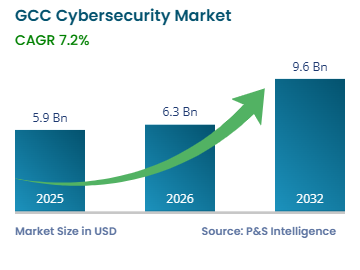
The GCC cybersecurity market size will be an estimated USD 5.9 billion for 2025, and it will grow by 7.2% during 2026–2032, to reach USD 9.6 billion by 2032.
The growth is driven by escalating cyber threats targeting critical infrastructure, accelerated digital transformation initiatives under national vision programs, and stringent data protection regulations across the region. The GCC region witnessed a 23.2% share of initial access broker activity in the Middle East during 2024. UAE public sector organizations encounter roughly 50,000 cyberattacks each day, highlighting the intensity and sophistication of threats targeting the region. The implementation of national cybersecurity strategies, particularly Saudi Arabia's Vision 2030 and the UAE's Digital Government Strategy 2025, is compelling organizations to invest heavily in comprehensive security solutions to protect critical infrastructure and support economic diversification goals.
The growing adoption of cloud computing and Internet of Things technologies across smart city projects is expanding the attack surface, creating urgent demand for advanced threat detection, identity management, and security monitoring solutions. All six GCC countries now have personal data protection regimes in place, with regulations mirroring the EU's General Data Protection Regulation, further accelerating compliance-driven cybersecurity investments across public and private sectors.
Cybercrime in GCC countries has surged in recent years, with 27.5% of global state-backed cyberattacks in 2024 targeting the region. Between March 2022 and February 2023, 47 ransomware incidents were reported, with Saudi Arabia, the UAE, and Kuwait being the most affected. Ransomware-related data leaks also spiked, with victims published on data leak sites increasing by 65%—from 32 in 2022 to 53 in 2023. These figures reflect the region’s growing vulnerability due to rapid digital transformation, making cybersecurity a top priority for both government and private sectors across the GCC.
GCC Cybersecurity Market Growth Factors
Artificial Intelligence Integration in Cybersecurity Operations Is Key Trend
The integration of artificial intelligence and machine learning technologies into cybersecurity operations represents the most transformative trend reshaping the GCC cybersecurity market.
AI-driven cybersecurity platforms leverage machine learning algorithms to analyze massive volumes of security data in real-time, identifying anomalous patterns and potential threats that would be impossible for human analysts to detect manually.
AI empowers security operations centers to move from reactive responses to proactive threat hunting, detecting indicators of compromise before attackers can achieve their goals.
The talent shortage amplifies AI's strategic value across the region.
Organizations struggle to recruit and retain qualified cybersecurity professionals capable of managing increasingly complex security infrastructures.
AI-powered security orchestration and automated response platforms address this gap by handling routine security tasks, correlating alerts across disparate security tools, and executing predefined response workflows without human intervention.
This automation multiplies the effectiveness of existing security teams, enabling small analyst groups to monitor and protect enterprise-scale environments.
The technology is particularly valuable for small and medium enterprises lacking resources to maintain dedicated security operations centers, democratizing access to enterprise-grade threat detection capabilities through cloud-delivered AI services.
Saudi Arabia's Vision 2030 emphasizes AI development across critical sectors, with cybersecurity applications receiving particular attention.
The explainability of AI-driven security decisions remains a challenge, particularly in regulated sectors where compliance requirements mandate clear audit trails and justification for security actions.
The convergence of AI with other emerging technologies is creating new cybersecurity paradigms.
AI-powered behavioral analytics combined with zero-trust architecture principles enable continuous authentication and authorization based on user behavior patterns, device posture, and contextual risk factors.
Investment in AI cybersecurity capabilities is accelerating across both public and private sectors.
Major cloud providers expanding regional presence, including Microsoft, Google Cloud, and Oracle, are embedding advanced AI security capabilities into their regional cloud offerings to make sophisticated threat detection accessible through consumption-based pricing models.
Government Initiatives and Regulatory Mandates Are Biggest Drivers
National digitalization programs, data protection, and cybersecurity regulations across the GCC are fundamentally reshaping cybersecurity requirements and investment patterns.
Saudi Arabia's Vision 2030 identifies sophisticated digital infrastructure as integral to advanced industrial activities and fundamental economic competitiveness.
These transformation programs involve massive technology deployments that exponentially expand organizational attack surfaces.
Saudi Arabia’s NEOM smart city integrates AI-driven technologies and cyber-physical systems, introducing multiple vulnerability points that necessitate robust cybersecurity measures.
Government mandates are translating digital ambitions into concrete cybersecurity requirements. Bahrain's cloud-first policy mandates that government agencies use cloud solutions as their primary method for IT service delivery.
Saudi Arabia's National Cybersecurity Authority ranked the kingdom second globally in the Global Cybersecurity Index in 2023, reflecting systematic investments in security capabilities.
The push toward e-governance, digital identity systems, and smart infrastructure across the region is creating sustained demand for enterprise-grade security solutions capable of protecting increasingly complex digital ecosystems.
The UAE Data Protection Law came into effect on January 2, 2022, while Qatar implemented regulations in 2016, Bahrain's law became effective in August 2019, and Kuwait introduced data privacy protections in 2021.
These regulations establish stringent requirements mirroring the European Union's GDPR, including mandatory breach notification within 72 hours, appointment of data protection officers, and comprehensive data processing records.
Saudi Arabia's maximum fine for repeated PDPL breaches reaches SAR 10 million, Qatar imposes fines up to QAR 5 million, and Bahrain includes provisions for imprisonment up to one year.
The severity of penalties creates strong compliance imperatives, driving security technology adoption.
Beyond data protection, sector-specific cybersecurity controls are expanding regulatory scope.
Saudi Arabia's National Cybersecurity Authority issued updated Essential Cybersecurity Controls in 2024, applicable to government entities and critical national infrastructure operators.
The December 2024 National Cybersecurity Authority Regulations established enforcement mechanisms with fines reaching SAR 25 million for non-compliance.
Financial sector regulations, telecommunications frameworks, and critical infrastructure protection mandates are layering additional compliance requirements that necessitate continuous security investments across governance, risk management, and technical control implementations.
GCC Cybersecurity Market Segmentation Analysis
Component Analysis
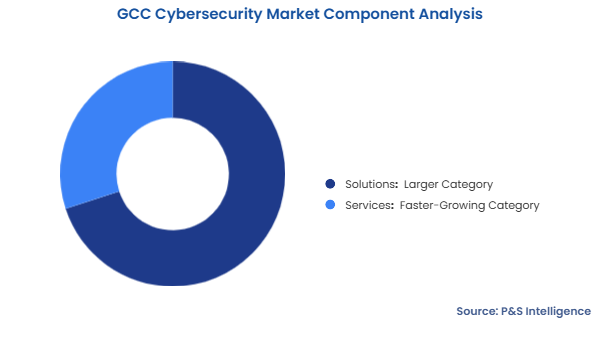
The solutions category holds the larger market share, of 70%, in 2025, as organizations prioritize deploying comprehensive security technologies to address escalating threats against expanding digital infrastructure. This category includes identity and access management platforms, network security appliances, endpoint protection software, cloud security tools, and enterprise security management systems serving as the core technological foundation of cybersecurity programs.
The services category will have the higher CAGR, of 7.6%, driven by the acute shortage of qualified cybersecurity professionals across the region and the increasing complexity of threat landscapes. Managed security services are experiencing particularly strong uptake as organizations seek expert capabilities for 24/7 security operations center functions, threat hunting, and incident response. Saudi Arabia's National Cybersecurity Authority issued Tier 1 licenses to six managed security operations center providers in 2024, including SITE, Sirar by STC, Haboob, and Cyberani by Aramco Digital, formalizing the managed services ecosystem.
The components analyzed in this report are:
Solutions (Larger Category)
Services (Faster-Growing Category)
Security Type Analysis
The network security category holds the largest market share, of 30%, in 2025, as organizations prioritize protecting the fundamental communication infrastructure connecting distributed operations. Network security encompasses firewalls, intrusion detection and prevention systems, secure web gateways, and network access control solutions that monitor and control traffic across increasingly complex hybrid IT environments. The proliferation of remote work, cloud migrations, and IoT device deployments is expanding network perimeters and creating heightened demand for advanced network protection capabilities.
The cloud security category will have the highest CAGR during the forecast period, driven by the region's rapid cloud adoption trajectory. Saudi Arabia's National Cybersecurity Authority issued Cloud Cybersecurity Controls in October 2020 to bolster the reliability of cloud services. Cloud security encompasses cloud access security brokers, cloud workload protection platforms, cloud security posture management, and identity federation solutions addressing the unique challenges of securing distributed cloud infrastructures.
The security types analyzed in this report are:
Application Security
Network Security (Largest Category)
Endpoint Security
Cloud Security (Fastest-Growing Category)
Enterprise Security
Deployment Type Analysis
The cloud category holds the larger market share, of 55%, in 2025, and it will have the higher CAGR during the forecast period. Government agencies, financial institutions, and critical infrastructure operators often maintain on-premises security infrastructure to ensure direct control over security operations and compliance with data localization requirements. Saudi Arabia's Essential Cybersecurity Controls previously mandated in-country data hosting for certain entities, although data localization authority has been transferred to the National Data Management Office. Legacy IT systems and existing investments in on-premises infrastructure sustain demand for traditional deployment models.
The deployment types analyzed in this report are:
On-Premises
Cloud (Larger and Faster-Growing Category)
Enterprise Size Analysis
The large enterprises category holds the larger market share, of 60%, in 2025, reflecting their substantial IT infrastructure footprints, regulatory compliance obligations, and sophisticated security requirements. Large organizations typically operate complex hybrid environments spanning on-premises data centers, multiple cloud platforms, and distributed branch networks that demand comprehensive security architectures. These enterprises face heightened regulatory scrutiny, manage sensitive customer and operational data, and represent high-value targets for advanced threat actors, driving substantial security investments across technology, services, and personnel.
The small and medium enterprises category will have the higher CAGR, of 7.5%, as SMEs increasingly recognize cybersecurity as business-critical rather than optional. The democratization of security technologies through cloud delivery models is making enterprise-grade protection accessible to resource-constrained organizations. Regulatory compliance requirements apply uniformly, regardless of organization size, compelling SMEs to implement robust security controls.
The enterprise sizes analyzed in this report are:
Large Enterprises (Larger Category)
Small and Medium Enterprises (Faster-Growing Category)
Use Case Analysis
The security monitoring category holds the largest market share, of 30%, in 2025, representing the foundational capability for detecting and responding to threats across organizational IT environments. Security monitoring encompasses security information and event management systems, log management, security analytics, and continuous monitoring solutions that provide visibility into security events and potential incidents.
The threat hunting category will have the highest CAGR, of 7.4%, driven by the increasing sophistication of attacks that evade traditional signature-based detection. Threat hunting involves proactive searching for indicators of compromise and adversary tactics, techniques, and procedures using advanced analytics, behavioral analysis, and threat intelligence. Organizations are recognizing that reactive security postures are insufficient against advanced persistent threats and nation-state actors, driving investments in threat hunting platforms and specialized expertise.
The use cases analyzed in this report are:
Security Monitoring (Largest Category)
Network Traffic Analysis
Threat Hunting (Fastest-Growing Category)
Incident Response
Data Exfiltration Protection
Industry Vertical Analysis
The BFSI category holds the largest market share in 2025, reflecting the sector's high-value assets, stringent regulatory requirements, and intense targeting by threat actors. Cyberattacks target financial institutions 300 times more frequently than other sectors, with an average data breach cost reaching USD 6.08 million in 2024. Financial institutions must protect sensitive customer financial data, maintain transaction integrity, and ensure business continuity for critical payment and settlement systems. Regulatory frameworks impose specific cybersecurity requirements on financial institutions, including the Dubai International Financial Center’s stringent policies based on GDPR principles.
The healthcare category has the highest CAGR, of XX%. The GCC healthcare sector is rapidly adopting cybersecurity solutions to safeguard sensitive patient data, ensure regulatory compliance, and protect critical infrastructure from evolving cyber threats. With the rise of digital health records, telemedicine, and interconnected medical devices, healthcare providers face increasing risks from ransomware, phishing, and data breaches. Cybersecurity tools such as endpoint protection, identity and access management, and threat detection systems are being deployed to secure networks and patient information. The sector also relies on secure cloud environments and encrypted communications to maintain data integrity and confidentiality, especially in smart hospitals and national health information exchanges across the GCC.
The industrial verticals analyzed in this report are:
Drive strategic growth with comprehensive market analysis
GCC Cybersecurity Market Regional Outlook
Saudi Arabia Cybersecurity Market Size
Saudi Arabia holds the largest market share, of 40%, in 2025, due to the ambitious Vision 2030 transformation program, massive digital infrastructure investments, and comprehensive regulatory framework. Large-scale projects such as the Line, and expansive 5G deployments are generating unprecedented cybersecurity demands
The regulatory environment provides strong market tailwinds. The National Cybersecurity Authority issued updated Essential Cybersecurity Controls in 2024, applicable to government entities and organizations operating critical national infrastructure. Saudi Arabia's Personal Data Protection Law became fully enforceable in September 2024 following a one-year grace period, compelling organizations to implement comprehensive data protection measures. The December 2024 National Cybersecurity Authority Regulations established enforcement mechanisms with fines reaching SAR 25 million for non-compliance.
UAE Cybersecurity Market Size
UAE will have the highest CAGR, of 7.3%, as the UAE's cybersecurity challenges position it as the region's most threatened nation. The country's advanced digital economy, concentration of multinational corporations, and smart city initiatives create both heightened exposure and strong demand for sophisticated security solutions.
Regulatory developments are strengthening compliance drivers. Federal Decree-Law No. 45 of 2021 regarding personal data protection came into force on January 2, 2022, establishing comprehensive data protection requirements mirroring GDPR principles. The Dubai International Financial Centre and Abu Dhabi Global Market maintain independent data protection regimes aligned with international standards, with the DIFC Data Commissioner having discretion to award unlimited fines for violations.
The countries of the market are as follows:
Saudi Arabia (Largest Country)
UAE (Fastest-Growing Country)
Kuwait
Qatar
Oman
Bahrain
GCC Cybersecurity Market Share
The market is fragmented due to the presence of numerous players, including large enterprises, specialized solution providers, and emerging startups. Diverse offerings, varying capabilities, and differing regional focus result in multiple point solutions rather than unified platforms. Rapid technology adoption and evolving threats further diversify service and solution providers across the region. Additionally, varying regulatory requirements across GCC countries and sector-specific cybersecurity needs contribute to market dispersion, limiting the dominance of any single provider.
Key GCC Cybersecurity Companies:
Palo Alto Networks, Inc.
Check Point Software Technologies Ltd.
Fortinet, Inc.
Cisco Systems, Inc.
Trend Micro Incorporated
IBM Middle East FZ-LLC
DarkMatter Group
Group 42 Holding Ltd (G42)
AIQ LLC / Presight AI Holding
Humain
Mozn
NeuralSpace FZ-LLC
GCC Cybersecurity Market News
In April 2025, Microsoft Corporation and Emirates Integrated Telecommunications Company PJSC formed a strategic partnership to build and operate a new hyperscale data center in Dubai, enhancing regional cloud infrastructure and expanding cybersecurity service capabilities.
In February 2025, Accenture PLC collaborated with Google Cloud to accelerate the adoption of generative AI and cloud solutions in Saudi Arabia, emphasizing digital transformation and strengthening enterprise security solutions.
In August 2023, Oracle Corporation announced plans to launch a new cloud region in Saudi Arabia, aimed at improving local data residency, enhancing security capabilities, and supporting government and enterprise digital transformation initiatives.
Want a report tailored exactly to your business need?
Leading companies across industries trust us to deliver data-driven insights and innovative solutions for their most critical decisions. From data-driven strategies to actionable insights, we empower the decision-makers who shape industries and define the future. From Fortune 500 companies to innovative startups, we are proud to partner with organisations that drive progress in their industries.
Client Testimonials
Working with P&S Intelligence and their team was an absolute pleasure – their awareness of timelines and commitment to value greatly contributed to our project's success. Eagerly anticipating future collaborations.
McKinsey & Company
India
Unmatched Standards
Our insights into the minutest levels of the markets, including the latest trends and competitive landscape, give you all the answers you need to take your business to new heights
Complete Data Security
We take a cautious approach to protecting your personal and confidential information. Trust is the strongest bond that connects us and our clients, and trust we build by complying with all international and domestic data protection and privacy laws