This Report Provides In-Depth Analysis of the GCC Cyber Insurance Market Report Prepared by P&S Intelligence, Segmented by Policy (Data Breach, Identify Theft, Malware Attack, Phishing, Email Spoofing), Product Type (Standalone, Integrated), Service (Insurance, Claims, Risk Consulting), Enterprise Size (Large Enterprises, Small and Medium Enterprises), End User (BFSI, IT & Telecom, Healthcare, Government, Retail and E-commerce, Manufacturing), and Geographical Outlook for the Period of 2019 to 2032
Explore the market potential with our data-driven report
GCC Cyber Insurance Market Outlook
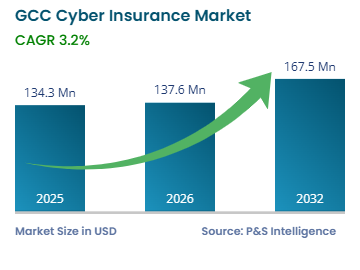
The GCC cyber insurance market size will be an estimated USD 134.3 million for 2025, and it will grow by 3.2% during 2026–2032, to reach USD 167.5 million by 2032.
The market growth is primarily driven by the escalating frequency and sophistication of cyberattacks targeting critical infrastructure, mandatory regulatory requirements for cyber insurance coverage in financial institutions, and the rapid digital transformation initiatives under national vision programs across all GCC countries. The surge in ransomware attacks targeting critical infrastructure sectors has emerged as a pivotal catalyst driving cyber insurance adoption across the GCC region.
Digital transformation initiatives across GCC nations are fundamentally reshaping the cyber insurance landscape, creating both opportunities and vulnerabilities that insurers must address. The World Bank reports that digital adoption in the GCC has accelerated post-pandemic, with countries implementing comprehensive strategies for smart cities, e-government services, and digital payment systems. This digital evolution has expanded the attack surface exponentially, driving demand for specialized cyber insurance products that address emerging risks associated with cloud computing, artificial intelligence, and Internet of Things deployments across critical sectors.
GCC Cyber Insurance Market Growth Factors
Integration of AI and MLIs Key Trend
The incorporation of artificial intelligence and machine learning technologies into cyber insurance operations is revolutionizing how insurers assess risks, price policies, and manage claims across the GCC market.
Leading insurance providers are leveraging AI-powered analytics to evaluate cyber risks more accurately, with machine learning algorithms analyzing threat patterns, organizational vulnerabilities, and historical incident data to create personalized premium structures.
AI applications in cybersecurity can enable real-time threat detection and automated response mechanisms, capabilities that insurers are now integrating into their risk assessment frameworks to provide more accurate pricing models.
The deployment of AI-driven monitoring systems integrated with cyber insurance policies is providing continuous surveillance of insured assets, enabling immediate response to potential breaches and reducing claim severity by up to 40% across the Gulf region.
Insurance technology companies operating in the GCC are developing sophisticated platforms that combine predictive analytics with real-time threat intelligence, allowing insurers to offer dynamic pricing models that adjust premiums based on an organization's current security posture.
This technological transformation is particularly valuable in the energy sector, where cyberattacks per week per energy organization have increased dramatically, necessitating more sophisticated risk assessment tools to accurately price coverage for critical infrastructure protection.
The convergence of AI technology with traditional insurance practices is creating new opportunities for preventive risk management and proactive security enhancement.
Smart contract integration through blockchain technology is enabling automated claim settlements when predefined breach conditions are met, revolutionizing the traditional insurance process across Gulf markets.
Insurers are also utilizing AI to identify emerging threat patterns specific to the GCC region, such as attacks targeting oil and gas infrastructure or Islamic banking systems, allowing for more tailored policy development.
Mandatory Regulatory Requirements Are Biggest Driver
The implementation of stringent regulatory frameworks mandating cyber insurance coverage for financial institutions represents the most significant driver propelling market expansion across the GCC region.
The regulatory shift follows the SAMA Cybersecurity Framework which emphasizes robust risk management practices and financial resilience against cyber incidents.
The cascading effect of regulatory compliance extends beyond traditional banking institutions to encompass fintech companies, payment service providers, and digital banking platforms operating within the GCC ecosystem.
The regulatory landscape continues to evolve rapidly, with the UAE's Central Bank introducing the New CBUAE Law in September 2025, which expanded licensing requirements to include technology-enabled providers and mandated cyber insurance as a prerequisite for operational licenses.
The harmonization of regulatory standards across GCC nations is creating a unified approach to cyber risk management, fostering market growth through standardized coverage requirements and compliance protocols.
GCC Cyber Insurance Market Segmentation Analysis
Policy Analysis
The data breach category holds the largest market share in 2025, and it will have the highest CAGR, of 3.4%, because data breaches cause significant financial losses, including costs related to data recovery, legal penalties, and business interruptions. Rising cyberattacks targeting sensitive data, especially in sectors like banking and healthcare, and stringent regional data protection regulations compel organizations to adopt comprehensive breach coverage. Additionally, the increasing use of cloud services and BYOD policies heightens vulnerability, driving demand for data breach insurance.
The policies analyzed in this report are:
Data Breach (Largest and Fastest-Growing Category)
Identity Theft
Malware Attack
Phishing
Email Spoofing
Product Type Analysis
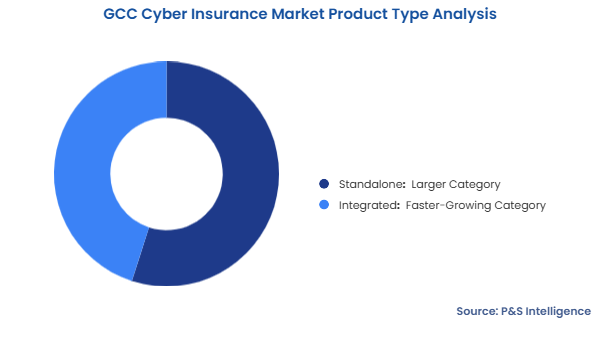
The standalone category holds the largest market share, of 55%, in 2025, driven by organizations’ demand for comprehensive, dedicated coverage for their expanding digital operations. Standalone policies offer specialized protection tailored to cyber-specific risks, including data breaches, ransomware attacks, business interruption, and regulatory compliance costs, providing coverage limits and terms specifically designed for digital threats rather than traditional property and liability risks. The preference for standalone policies is particularly pronounced among large enterprises in the financial services and energy sectors, where potential cyber losses can exceed traditional insurance policy limits and require specialized underwriting expertise.
The integrated category will have the highest CAGR, of 3.5%, as organizations increasingly recognize the interconnected nature of cyber risks with traditional business operations. Integrated policies embed cyber coverage within broader commercial insurance packages, offering streamlined administration and potentially lower total premiums for small and medium enterprises that may not require extensive standalone coverage. This growth is fueled by insurance carriers developing innovative products that seamlessly combine cyber protection with general liability, professional indemnity, and property insurance, addressing the holistic risk management needs of digitally transformed businesses.
The product types analyzed in this report are:
Standalone (Larger Category)
Integrated (Faster-Growing Category)
Service Analysis
The insurance category holds the largest market share, of 60%, in 2025, as organizations prioritize risk transfer mechanisms to protect against potentially catastrophic cyber losses. Insurance services encompass the core underwriting, policy issuance, and claims management functions that form the foundation of cyber risk protection, with carriers expanding their capacity to meet growing demand across all industry sectors. The dominance of insurance services reflects the market's maturity in recognizing cyber threats as fundamental business risks requiring dedicated financial protection, particularly following high-profile incidents affecting regional critical infrastructure.
The risk consulting category will have the highest CAGR, of 3.6%, driven by organizations' need for expert guidance in navigating complex cyber threats and regulatory requirements. The World Bank's Digital Progress Report emphasizes that successful digital transformation requires comprehensive risk assessment and mitigation strategies, positioning cyber risk consulting as an essential complement to insurance coverage. Consulting services help organizations identify vulnerabilities, implement security frameworks, develop incident response plans, and optimize their insurance coverage, creating a proactive approach to cyber risk management that reduces both the likelihood and severity of potential claims.
The services analyzed in this report are:
Insurance (Largest Category)
Claims
Risk Consulting (Fastest-Growing Category)
Enterprise Size Analysis
The large enterprises category holds the largest market share, of 70%, in 2025, reflecting their substantial digital assets, complex IT infrastructures, and heightened exposure to sophisticated cyber threats. These organizations face significant operational and financial risks in the event of a cyber incident, which has led to a strong preference for comprehensive cyber-insurance solutions. Insurers are increasingly offering tailored policies that include risk assessment, incident response planning, and coverage for business interruption and reputational losses.
The small and medium enterprises category will have the highest CAGR, of 3.7%, driven by increasing digitalization, regulatory pressure, and growing awareness of cyber vulnerabilities. According to the report, SMEs are rapidly adopting digital technologies to remain competitive, simultaneously expanding their cyber risk exposure without proportional investments in security infrastructure. Insurance carriers are responding by developing tailored cyber insurance products for SMEs, featuring simplified underwriting processes, affordable premiums, and bundled risk management services that address the unique challenges faced by smaller organizations with limited IT security resources.
The enterprise sizes analyzed in this report are:
Large Enterprises (Largest Category)
Small and Medium Enterprises (Fastest-Growing Category)
End User Analysis
The BFSI category holds the largest market share in 2025, driven by stringent regulatory requirements, high-value digital transactions, and elevated threat profiles. The implementation of mandatory cyber insurance requirements across GCC financial regulators has created a captive market where coverage is not optional but essential for operational licensing, resulting in premium concentrations within this sector.
The IT & telecom category will have the highest CAGR, reflecting the sector's critical role in enabling regional digital transformation while facing escalating cyber threats. The rapid deployment of 5G networks, cloud services, and digital infrastructure across the GCC has exponentially increased the attack surface for IT and telecom providers, who must protect not only their own operations but also ensure service continuity for millions of customers.
The end users analyzed in this report are:
BFSI (Largest Category)
IT & Telecom (Fastest-Growing Category)
Healthcare
Government
Retail and E-Commerce
Manufacturing
Drive strategic growth with comprehensive market analysis
GCC Cyber Insurance Market Regional Outlook
Saudi Arabia Cyber Insurance Market Size
Saudi Arabia holds the largest market share, of 40%, in 2025, propelled by the Kingdom's ambitious Vision 2030 digital transformation initiatives and stringent regulatory frameworks. The implementation of mandatory cyber insurance requirements by SAMA for all financial institutions has created a robust foundation for market growth, with over 200 banks, insurance companies, and financial technology firms required to maintain comprehensive cyber coverage. Saudi Arabia experienced 88 ransomware incidents in 2024, with the manufacturing sector accounting for 25.41% of attacks, driving unprecedented demand for cyber insurance across industrial segments.
The Kingdom's massive investments in smart city projects, particularly NEOM and the Red Sea development, are creating new cyber risk exposures that traditional insurance models struggle to address, spurring innovation in policy design and coverage options. The convergence of regulatory mandates, digital infrastructure investments, and elevated threat levels positions Saudi Arabia to maintain its market leadership through 2032.
UAE Cyber Insurance Market Size
The UAE will have the highest CAGR, of 3.3%, driven by its status as a regional financial hub and aggressive digital innovation agenda. The UAE Cybersecurity Council's implementation of enhanced Information Assurance Regulations has mandated comprehensive cyber protection for critical infrastructure providers, expanding the addressable market beyond traditional financial services to encompass energy, healthcare, and telecommunications sectors.
The introduction of the UAE's National Cybersecurity Strategy 2024-2030 has established clear frameworks for cyber resilience, with mandatory insurance requirements for organizations handling critical data or providing essential services. The country's free zones, particularly the Dubai International Financial Centre and Abu Dhabi Global Market (ADGM), have implemented specialized cyber insurance requirements aligned with international standards, attracting global insurers and fostering product innovation tailored to the region's unique risk profile.
The countries of the market are as follows:
Saudi Arabia (Largest Regional Market)
UAE (Fastest-Growing Regional Market)
Qatar
Kuwait
Oman
Bahrain
GCC Cyber Insurance Market Share
The market is semi-consolidated, reflecting the specialized nature of cyber risk underwriting and the capital requirements for assuming large-scale technology risks. The market's consolidated nature benefits large enterprise customers who require substantial coverage limits and sophisticated risk management services, while potentially limiting options for smaller businesses seeking affordable cyber protection.
The competitive landscape is witnessing a strategic transformation as insurtech companies enter the GCC market with innovative distribution models and AI-powered underwriting platforms. Local insurance champions such as Saudi National Cooperative Insurance Company and Abu Dhabi National Insurance Company are investing heavily in digital capabilities and cyber expertise to capture market share from international competitors. These regional players leverage their understanding of local business practices, regulatory relationships, and cultural nuances to develop tailored cyber insurance solutions for GCC enterprises.
Key GCC Cyber Insurance Companies:
AIG
Chubb Limited
AXA XL
Allianz SE
Zurich Insurance Group Ltd.
Beazley Plc
Hiscox
Emirates Insurance Company
Saudi Arabian Insurance Company (SAIC)
Qatar Insurance Company
Aon plc
Marsh & McLennan
GCC Cyber Insurance Market News
In November 2024, Qatar Insurance Group and Ooredoo Group signed an MoU, agreeing to develop and offer integrated insurance products. The collaboration aims to leverage Ooredoo’s telecom / digital infrastructure with QIC’s underwriting capability to develop new cyber-insurance and digital-risk offerings.
In October 2024, the DFSA signed an MoU with Moro Hub at GITEX 2024 to strengthen financial-sector IT and cybersecurity resilience, a regulatory/industry collaboration that directly affects insurers and the cyber-insurance ecosystem in the DIFC/GCC.
Want a report tailored exactly to your business need?
Leading companies across industries trust us to deliver data-driven insights and innovative solutions for their most critical decisions. From data-driven strategies to actionable insights, we empower the decision-makers who shape industries and define the future. From Fortune 500 companies to innovative startups, we are proud to partner with organisations that drive progress in their industries.
Client Testimonials
Working with P&S Intelligence and their team was an absolute pleasure – their awareness of timelines and commitment to value greatly contributed to our project's success. Eagerly anticipating future collaborations.
McKinsey & Company
India
Unmatched Standards
Our insights into the minutest levels of the markets, including the latest trends and competitive landscape, give you all the answers you need to take your business to new heights
Complete Data Security
We take a cautious approach to protecting your personal and confidential information. Trust is the strongest bond that connects us and our clients, and trust we build by complying with all international and domestic data protection and privacy laws