GCC Corporate Training Market Size & Share Analysis - Emerging Trends, Growth Opportunities, Competitive Landscape, and Forecasts (2026 - 2032)
This Report Provides In-Depth Analysis of the GCC Corporate Training Market Report Prepared by P&S Intelligence, Segmented by Training Type (Technical, Soft Skills, Compliance, Leadership & Management, Language & Communication), Delivery Mode (Classroom/Instructor-Led Training, Online/E-Learning, Blended Learning, Virtual Instructor-Led Training (VILT)), Industry Vertical (BFSI, IT & Telecommunication, Healthcare & Pharmaceuticals, Oil & Gas, Manufacturing, Retail & E-commerce, Government & Public Sector, Hospitality & Tourism), and Geographical Outlook for the Period of 2019 to 2032
Explore the market potential with our data-driven report
GCC Corporate Training Market Analysis
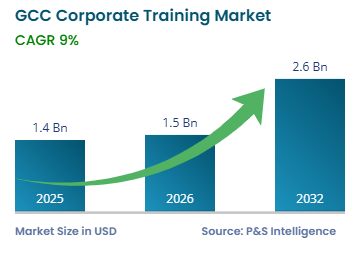
The GCC corporate training market size will be an estimated USD 1.4 billion for 2025, and it will grow by 9.0% during 2026–2032, to reach USD 2.6 billion by 2032.
The significant expansion of this market is primarily driven by the rapid digital transformation initiatives across the Gulf countries, increasing emphasis on workforce localization policies, and the growing recognition of continuous learning as a strategic imperative for organizational competitiveness.
The corporate training landscape in the GCC has undergone a fundamental shift from traditional classroom-based instruction to sophisticated blended learning approaches that incorporate artificial intelligence, virtual reality, and personalized learning pathways. The market's robust growth trajectory is further supported by the demographic dividend of the region, where more than 50% of the population was under 25 years of age as of 2021, creating an unprecedented demand for comprehensive skills development programs that prepare young professionals for the evolving workplace dynamics.
GCC Corporate Training Market Emerging Trends
Rising Demand for Soft Skills and Leadership Development Programs Is Key Trend
The paradigm shift toward comprehensive soft skills development is driven by the recognition that technical competencies alone are insufficient for organizational success in an increasingly complex business environment.
Organizations across the region are investing in sophisticated leadership development programs that combine traditional management training with contemporary topics, such as digital leadership, agile methodologies, and inclusive team management.
The demand for soft skills training is particularly pronounced in customer-facing industries such as hospitality, retail, and financial services, where employee interactions directly impact customer satisfaction and brand reputation.
Furthermore, the multicultural nature of the GCC workforce, with professionals from diverse backgrounds working together, necessitates specialized training in cultural intelligence, conflict resolution, and effective communication across linguistic and cultural boundaries.
This trend is reinforced by the increasing participation of GCC nationals in private sector roles, requiring comprehensive preparation for leadership positions traditionally held by expatriate professionals.
Rising Investment in Human Capital Development Drives Market
The alignment of corporate training initiatives with national transformation agendas has emerged as a powerful catalyst for market growth across the GCC.
Saudi Arabia's Waad National Training Initiative achieved a 129% overachievement in training opportunities during its first phase, collaborating with 14 private sector entities.
Its second phase seeks to deliver three million training opportunities by 2028.
These government-backed programs are fundamentally reshaping the training ecosystem by providing substantial funding, establishing quality standards, and creating clear pathways for career progression across critical sectors.
Vision 2030's Human Capability Development Program aims to increase the private sector's share of the economy, boosting Saudi nationals in high-skill private-sector roles, and raising women's participation from under 20% to over 30%.
The comprehensive nature of these initiatives extends beyond mere skills training to encompass leadership development, entrepreneurship programs, and specialized technical certifications that align with the region's economic diversification objectives.
In the first quarter of 2025, female workforce participation in Saudi Arabia reached 36.3%, up from just 19.7% in 2018, demonstrating the tangible impact of these training and development initiatives on workforce composition.
GCC Corporate Training Market Segmentation Analysis
Training Type Analysis
The technical category holds the largest market share, of 40%, in 2025, driven by the accelerating pace of technological adoption across industries and the critical need for specialized digital skills. Organizations are investing heavily in technical training programs covering areas such as cloud computing, cybersecurity, data analytics, artificial intelligence, and enterprise software systems to ensure their workforce can effectively leverage new technologies for competitive advantage. The rapid evolution of technology platforms and the introduction of industry-specific solutions require continuous technical upskilling, making this category essential for organizational transformation initiatives.
The leadership & management category will have the highest CAGR during the forecast period, reflecting the strategic importance of developing local leadership capabilities aligned with national workforce development objectives. As GCC organizations transition from operational excellence to innovation-driven growth models, the demand for sophisticated leadership development programs that combine strategic thinking, digital fluency, and cultural intelligence has intensified significantly. The emphasis on developing national talent for senior management positions, coupled with the expansion of local organizations into international markets, drives substantial investment in comprehensive leadership development initiatives.
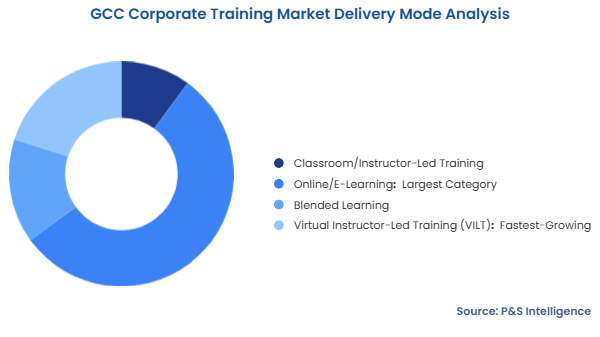
The online/e-learning category holds the largest market share, of 55%, in 2025, due to its scalability, cost-effectiveness, and ability to provide consistent training experiences across geographically dispersed workforces. The widespread adoption of digital learning platforms has been accelerated by technological infrastructure improvements across the GCC, including high-speed internet connectivity, cloud computing capabilities, and mobile device penetration that enables learning anytime and anywhere. Organizations are leveraging sophisticated learning management systems that incorporate gamification, microlearning modules, and social learning features to enhance engagement and knowledge retention among learners.
The virtual instructor-led training category will have the highest CAGR, of 9.3%, driven by its flexibility, scalability, and cost-effectiveness. VILT enables real-time, interactive sessions for employees across multiple locations without travel. Its digital accessibility and ability to replicate classroom engagement make it ideal for organizations adopting modern, tech-driven learning strategies.
The delivery modes analyzed in this report are:
Classroom/Instructor-Led Training
Online/E-Learning (Largest Category)
Blended Learning
Virtual Instructor-Led Training (VILT) (Fastest-Growing Category)
Industry Vertical Analysis
The BFSI category holds the largest market share, of 35%, in 2025, driven by stringent regulatory requirements, rapid digitalization of financial services, and the critical importance of maintaining customer trust through exceptional service delivery. Major global banks and insurance companies utilize GCCs for tasks such as risk management, data analysis, and intricate financial modeling to stay ahead in the international market. Financial institutions across the GCC are investing substantially in comprehensive training programs covering regulatory compliance, anti-money laundering procedures, cybersecurity awareness, digital banking technologies, and customer relationship management to ensure their workforce can navigate the complex and evolving financial landscape effectively.
The IT & telecommunications category will have the highest CAGR, of 9.1%, propelled by the sector's role as the backbone of digital transformation initiatives across all industries. The exponential growth in data generation, cloud adoption, artificial intelligence implementation, and cybersecurity threats necessitates the continuous upskilling of IT professionals to maintain technological competitiveness. Telecommunications companies are particularly focused on training programs related to 5G technology deployment, Internet of Things integration, and network security, positioning themselves as enablers of the region's smart city initiatives.
The industry verticals analyzed in this report are:
BFSI (Largest Category)
IT & Telecommunications (Fastest-Growing Category)
Healthcare & Pharmaceuticals
Oil & Gas
Manufacturing
Retail & E-commerce
Government & Public Sector
Hospitality & Tourism
Others
Drive strategic growth with comprehensive market analysis
GCC Corporate Training Market Geographical Analysis
Saudi Arabia Market Size
Saudi Arabia holds the largest market share, of 45%, in 2025, driven by the kingdom's comprehensive Vision 2030 transformation agenda that positions human capital development as a national priority. Vision 2030's Human Capability Development Program aims to align education with industry requirements, preparing youth for careers in key sectors through practical skills and soft skills training. The Saudi government's substantial investments in training infrastructure, including the establishment of specialized academies, centers of excellence, and partnerships with global training providers, have created a robust ecosystem for corporate learning and development.
The Skill Accelerator Program targets the upskilling and reskilling of over 300,000 Saudis by 2027, demonstrating the scale and ambition of the kingdom's workforce development initiatives. The market benefits from a particularly strong demand in mega-projects, such as NEOM, Red Sea Development, and Qiddiya. They require specialized skills in areas ranging from sustainable tourism and renewable energy to advanced manufacturing and smart city technologies. NEOM, initially funded by USD 500 billion from the Public Investment Fund; and Alat, with a planned USD 100 billion investment aiming to create 39,000 direct jobs by 2030; exemplify the massive scale of training requirements driven by these transformative initiatives.
UAE Market Size
UAE will have the highest CAGR, of 9.2%, driven by its advanced digital infrastructure, diverse economy, and strategic focus on becoming a global hub for innovation and technology. The UAE National Strategy for Artificial Intelligence 2031 emphasizes building a global reputation as a hub for AI, with initiatives including free courses to raise AI awareness and skills among residents. The Emirates' corporate training market benefits from the presence of numerous multinational corporations' regional headquarters, creating sophisticated demand for world-class training solutions that meet international standards.
The partnership between UAE's AI Office and UiPath focuses on developing AI-powered automation solutions across government entities and creating automation and AI training programs for up to 100 government employees or students. The UAE's emphasis on public-private partnerships in skills development, combined with initiatives such as the Emirates Skills national framework and the National Program for Coders, creates a dynamic environment for innovative training solutions. Dubai's position as a regional business hub, coupled with Abu Dhabi's focus on technology and innovation through initiatives like Hub71 and the Abu Dhabi Investment Office, drives continuous demand for specialized training across sectors including fintech, healthcare technology, and sustainable energy.
The countries of the market are as follows:
Saudi Arabia (Largest Country Market)
UAE (Fastest-Growing Country Market)
Kuwait
Qatar
Bahrain
Oman
GCC Corporate Training Market Share
The market is fragmented, with numerous international training providers, regional specialists, and emerging digital learning platforms competing for market share. This fragmentation is driven by the diverse training needs across industries, varying organizational sizes, and the broad spectrum of delivery methodologies required to serve the heterogeneous market effectively. The competitive intensity has increased with the entry of global e-learning platforms and technology-enabled training providers who leverage artificial intelligence, virtual reality, and adaptive learning technologies to differentiate their offerings.
Local and regional players maintain competitive advantages through their deep understanding of cultural nuances, established relationships with government entities, and ability to deliver programs in Arabic alongside English. International training providers have strengthened their market position through strategic partnerships with local institutions, obtaining necessary accreditations from regional authorities, and establishing physical presence in key markets. The emergence of corporate universities and in-house training academies by large organizations represents both competition and collaboration opportunities for external training providers.
Key GCC Corporate Training Companies:
Talent Arabia
Franklin Covey Co.
Corpoladder
Learners Point Academy
Atton Institute
DeANTS
NLP Limited
Optimizer Middle East
HNI (Human Network International)
LEORON Institute
Simplilearn Solutions Private Limited
Zabeel International Institute of Management & Technology LLC
GCC Corporate Training Market News
In October 2024, Microsoft Corporation partnered with government entities in Abu Dhabi, Dubai, and Sharjah to launch the AI National Skills Initiative. The aim is to train 100,000 government employees in artificial intelligence over 12 months and position the UAE as one of the world’s most AI-ready governments.
In July 2025, Saudi Arabia launched Skills Week under the Ministry of Human Resources and Social Development, marking the second phase of the Waad National Training Initiative. The program targets three million training opportunities by 2028 through collaborations with over 65 public and private sector organizations across seven key GDP-driving sectors.
In April 2025, Speeki Pte. Ltd., a Singaporean software company, launched a global ESG and sustainability training hub for corporate clients in the GCC, to the increasing demand for training in environmental, social, and governance compliance.
In November 2024, the 7th GCC eHealth Workforce Development Conference in Dubai brought together government, academia, and industry stakeholders to develop competency-based frameworks for digital health professionals, addressing the critical need for specialized training in healthcare technology and digital transformation.
Want a report tailored exactly to your business need?
Leading companies across industries trust us to deliver data-driven insights and innovative solutions for their most critical decisions. From data-driven strategies to actionable insights, we empower the decision-makers who shape industries and define the future. From Fortune 500 companies to innovative startups, we are proud to partner with organisations that drive progress in their industries.
Client Testimonials
Working with P&S Intelligence and their team was an absolute pleasure – their awareness of timelines and commitment to value greatly contributed to our project's success. Eagerly anticipating future collaborations.
McKinsey & Company
India
Unmatched Standards
Our insights into the minutest levels of the markets, including the latest trends and competitive landscape, give you all the answers you need to take your business to new heights
Complete Data Security
We take a cautious approach to protecting your personal and confidential information. Trust is the strongest bond that connects us and our clients, and trust we build by complying with all international and domestic data protection and privacy laws