GCC Construction Market Size & Opportunities Analysis - Growth Strategies, Competitiveness, and Forecasts (2026 - 2032)
This Report Provides In-Depth Analysis of the GCC Construction Market Report Prepared by P&S Intelligence, Segmented by Sector (Public Infrastructure, Residential, Commercial, Industrial, Energy & Utilities), Construction Type (New Construction, Renovation/Retrofit), Construction Method (Conventional On-site Construction, Modular/Prefabricated Construction, Precast Concrete Construction, 3D-Printed Construction, Steel Frame Construction), End User (Public Sector, Private Sector), and Geographical Outlook for the Period of 2019 to 2032
Explore the market potential with our data-driven report
GCC Construction Market Future Outlook
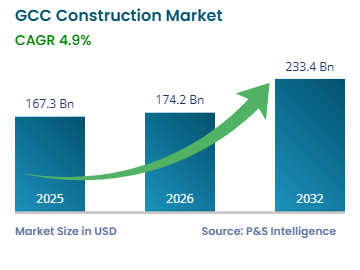
The GCC construction market size will be an estimated USD 167.3 billion for 2025, and it will grow by 4.9% during 2026–2032, to reach USD 233.4 billion by 2032.
The market expansion is primarily driven by large-scale infrastructure investments aligned with national economic diversification programs, rapid urbanization across member states, and increasing government spending on mega-projects spanning residential, commercial, and transportation sectors.
Saudi Arabia continues to spearhead regional construction activity through its Vision 2030 initiative, which encompasses transformative projects, including NEOM, the Red Sea Project, and Qiddiya. The kingdom awarded approximately USD 55 billion worth of construction projects in 2023 alone, representing the highest value among GCC nations. Similarly, the UAE maintains robust construction momentum with significant investments in infrastructure development for Expo City Dubai and various smart city initiatives.
Rapid urbanization represents another critical growth catalyst for the GCC construction sector. The urban population in the region is projected to surge by 30% between 2020 and 2030, with nearly 84% of GCC residents expected to live in urban settings by 2030. This demographic shift creates sustained demand for residential housing, commercial spaces, transportation networks, and utility infrastructure, positioning the construction industry as a cornerstone of regional economic transformation.
GCC Construction Market Trends & Drivers
Adoption of Advanced Construction Technologies Is Key Trend
The GCC construction sector is witnessing accelerated adoption of innovative building methods and digital technologies to enhance project efficiency, reduce costs, and improve sustainability performance.
Modular and prefabricated construction techniques are gaining significant traction, particularly for large-scale residential and commercial developments.
These methods reduce construction timelines by 30% to 50% compared to conventional approaches while minimizing material waste and improving quality control.
Building information modeling implementation has become standard practice among leading contractors and developers across the region.
BIM technology enables comprehensive project visualization, clash detection, and collaborative planning, reducing design errors and construction delays.
The UAE and Saudi Arabia have mandated BIM adoption for major public sector projects, accelerating technology integration across the industry.
Artificial intelligence and robotics are emerging as transformative forces in GCC construction operations.
Autonomous construction equipment, drone-based site surveying, and AI-powered project management platforms improve productivity and safety metrics.
3D printing technology is being deployed for specialized applications, including affordable housing development and architectural components.
Sustainability considerations are reshaping construction practices across the GCC region.
Green building certifications, including LEED and Estidama, are increasingly required for commercial and government projects.
Developers are incorporating renewable energy systems, water conservation technologies, and sustainable materials to meet evolving regulatory standards and stakeholder expectations.
This sustainability focus aligns with broader national climate commitments and positions the GCC construction sector for long-term environmental compliance.
Government-Led Infrastructure Investment Programs Are Biggest Drivers
Government initiatives focused on economic diversification away from oil dependency serve as the primary driver for construction market expansion across the GCC region.
Across the GCC, USD 67 billion in contracts were awarded in the first five months of 2025, though down from USD 110 billion in 2024.
The construction sector contributed nearly USD 141 billion to GCC GDP in 2023, with Saudi Arabia accounting for USD 56 billion—up from USD 51 billion the previous year.
Saudi Arabia aims to develop 58.7 GW of renewable energy capacity by 2030, including the NEOM Green Hydrogen project designed to produce 1.2 million tons of green hydrogen annually.
In 2024, Saudi Arabia issued contracts worth USD 146.8 billion, including USD 28.4 billion in construction alone.
In Q3 2025, it secured USD 28.1 billion in new awards—over half of the GCC’s USD 54.8 billion total for that quarter.
The U.A.E. has similarly prioritized infrastructure modernization through its national development agenda, allocating substantial resources toward transportation networks, smart city technologies, and sustainable urban development.
Qatar continues post-FIFA World Cup infrastructure enhancement, focusing on transportation corridors and hospitality sector expansion.
These coordinated national strategies ensure consistent project pipelines, providing long-term visibility and growth opportunities for construction sector participants.
Kuwait, Oman, and Bahrain have also implemented economic reform programs featuring significant construction components.
Kuwait's Vision 2035 emphasizes infrastructure development to position the country as a regional financial and commercial hub.
Oman's Vision 2040 prioritizes logistics infrastructure, tourism facilities, and industrial diversification projects. Bahrain focuses on affordable housing development and transportation network expansion to support population growth and economic competitiveness.
GCC governments continue to invest heavily in construction, with Saudi Arabia leading the region.
GCC Construction Market Segmentation Analysis
Sector Analysis
The residential category holds the largest market share, of 35%, in 2025, driven by rapid population growth, increasing household formation rates, and government-led affordable housing initiatives. The UAE and Qatar are similarly implementing affordable housing programs to address growing demographic needs and social development objectives.
The public infrastructure category will have the highest CAGR during the forecast period, due to the massive government investments in transportation networks essential for economic diversification and urban connectivity. Saudi Arabia's railway expansion program, including the 450-kilometer high-speed rail linking Mecca and Medina, represents a flagship infrastructure initiative. The UAE’s Etihad Rail network, designed to connect all seven emirates and link with neighboring GCC countries, demonstrates regional commitment to transportation infrastructure modernization.
The sectors analyzed in this report are:
Public Infrastructure (Fastest-Growing Category)
Residential (Largest Category)
Commercial
Industrial
Energy & Utilities
Construction Type Analysis
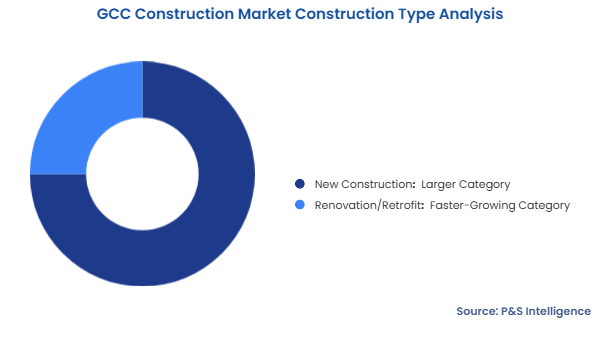
The new construction category holds the larger market share, of 75%, in 2025, due to the prevalence of greenfield mega-projects, urban expansion initiatives, and new infrastructure networks. Major developments, including NEOM, Qiddiya, and The Red Sea Project in Saudi Arabia, along with numerous new city developments across the UAE and Qatar, ensure sustained new construction activity throughout the forecast period.
The renovation/retrofit category will have the higher CAGR, of 5.2%, driven by growing emphasis on existing asset optimization and circular economy principles. Older commercial buildings and residential complexes require modernization to meet current energy efficiency standards and technological expectations. Government buildings and public facilities are undergoing systematic renovation programs to incorporate smart building technologies and reduce operational costs.
The construction types analyzed in this report are:
New Construction (Larger Category)
Renovation/Retrofit (Faster-Growing Category)
Construction Method Analysis
The conventional on-site construction category holds the largest market share, of 90%, in 2025, driven by large-scale infrastructure projects, high-rise developments, and complex architectural designs requiring specialized engineering solutions. The established contractor base, proven track record, and flexibility for design modifications during construction support continued conventional method prevalence.
The modular/prefabricated construction category will have the highest CAGR, of 5.3%, due to accelerated project delivery timelines, labor efficiency improvements, and enhanced quality control driving modular construction adoption. Saudi Arabia and the UAE are actively promoting prefabricated methods for affordable housing, labor accommodation, and certain commercial applications. Major contractors are establishing regional manufacturing facilities to support modular construction demand.
The construction methods analyzed in this report are:
Conventional On-site Construction (Largest Category)
Modular/Prefabricated Construction (Fastest-Growing Category)
Precast Concrete Construction
3D-Printed Construction
Steel Frame Construction
End User Analysis
The public category holds the larger market share, of 55%, in 2025, as government entities at federal and municipal levels drive construction activity through national development programs, infrastructure investments, and public facility development. Saudi Arabia's Public Investment Fund, with assets exceeding USD 700 billion, serves as the primary vehicle for mega-project financing and execution. The UAE's government entities similarly spearhead major infrastructure and urban development initiatives.
The private category will have the higher CAGR, of 5.1%, driven by increasing developer confidence, foreign direct investment, and public-private partnership expansion. Private sector construction encompasses residential developments, commercial real estate, hospitality projects, and industrial facilities. Regulatory reforms across GCC countries have improved business environments and encouraged private sector participation in traditionally government-dominated sectors.
The end users analyzed in this report are:
Public Sector (Larger Category)
Private Sector (Faster-Growing Category)
Drive strategic growth with comprehensive market analysis
GCC Construction Market Regional Outlook
Saudi Arabia Construction Market Size
Saudi Arabia holds the largest market share, of 45%, in 2025, and it will have the highest CAGR, of 5.0%. The kingdom's construction sector is fundamentally driven by Vision 2030 implementation, which encompasses transformative mega-projects across multiple sectors. The Public Investment Fund's extensive project portfolio, including NEOM (USD 500 billion planned investment), the Red Sea Project (USD 28 billion), and Qiddiya (USD 8 billion), ensures sustained construction activity through 2032 and beyond.
Infrastructure development represents a strategic priority for Saudi Arabia, with the kingdom investing heavily in transportation networks, utilities, and telecommunications infrastructure. The Riyadh Metro, one of the world's largest metro systems under construction, will span six lines covering 176 kilometers. The kingdom is also developing multiple economic cities and special zones to diversify economic activity and reduce regional development disparities. These initiatives create sustained demand across all construction categories and methods.
Qatar Construction Market Size
Qatar's construction market is transitioning from FIFA World Cup delivery mode to sustained long-term development aligned with Qatar National Vision 2030. The country successfully delivered extensive infrastructure for the 2022 World Cup, including stadia, metro systems, highway networks, and hospitality facilities. This infrastructure foundation now supports broader economic development and quality of life enhancement initiatives.
Post-World Cup construction activity focuses on leveraging legacy infrastructure while addressing ongoing needs in residential, commercial, and industrial sectors. Qatar's emphasis on education, healthcare, and cultural infrastructure generates consistent construction demand. The country's growing population, driven by economic expansion and expatriate workforce requirements, necessitates continued residential and commercial development. Industrial construction is supported by Qatar's position as a leading liquefied natural gas producer and its diversification efforts in manufacturing and logistics.
Kuwait Construction Market Size
Kuwait's construction market is driven by Vision 2035 implementation, which aims to transform the country into a regional financial and commercial center. Major infrastructure projects include the Kuwait International Airport expansion, to accommodate 25 million passengers annually; and the Kuwait Metro system, planned to span multiple lines across Kuwait City and surrounding areas. Northern Kuwait development initiatives focus on creating integrated economic zones with industrial, residential, and commercial components.
The countries of the market are as follows:
Saudi Arabia (Largest and Fastest-Growing Country)
UAE
Kuwait
Qatar
Oman
Bahrain
GCC Construction Market Share
The market is fragmented because it comprises a large number of regional and local players operating across various sectors such as residential, commercial, industrial, and infrastructure construction. Differences in regulatory frameworks, economic priorities, and project funding across countries further diversify market operations. Many firms specialize in specific project types or services, limiting their geographic and sectoral reach. Moreover, the absence of major cross-border mergers or consolidations prevents any single company from achieving a dominant market share across the region.
Key GCC Construction Companies:
Arabtec Construction LLC
Al Habtoor Group
Arabian Construction Company (ACC)
Al Naboodah Construction Group (L.L.C.)
ALEC Engineering & Contracting LLC
Khansaheb Civil Engineering LLC
Saudi Binladin Group
Saudi Oger Ltd.
Almabani General Contractors
Airolink Building Contracting LLC
Al Futtaim Carillion LLC
Hassan Abdul Company Ltd.
GCC Construction Market News
In October 2025, Nemetschek Group entered into a partnership with WakeCap Technologies on sensor-driven, real-time project management systems. This collaboration harnesses the Nemetschek Group's software and WakeCap's sensor-based project control platform, which provides immediate workforce visibility and comprehensive site intelligence.
In October 2025, Saif Bin Darwish, a construction & contracting firm in the UAE, announced its acquisition of Gulf Precast, a producer of precast concrete, to enhance its presence in road, bridge, airport, and tunnel projects.
In March 2025, Technicas Reunidas & Orascom secured a USD 2.6 billion contract to expand a 3-GW combined cycle gas-fired power plant in Saudi Arabia, including carbon capture infrastructure and a 380-kV electrical substation.
In January 2024, Oman's Ministry of Housing and Urban Planning announced collaboration with international technology providers to implement smart city solutions in new urban development projects, focusing on energy efficiency and digital infrastructure integration.
Want a report tailored exactly to your business need?
Leading companies across industries trust us to deliver data-driven insights and innovative solutions for their most critical decisions. From data-driven strategies to actionable insights, we empower the decision-makers who shape industries and define the future. From Fortune 500 companies to innovative startups, we are proud to partner with organisations that drive progress in their industries.
Client Testimonials
Working with P&S Intelligence and their team was an absolute pleasure – their awareness of timelines and commitment to value greatly contributed to our project's success. Eagerly anticipating future collaborations.
McKinsey & Company
India
Unmatched Standards
Our insights into the minutest levels of the markets, including the latest trends and competitive landscape, give you all the answers you need to take your business to new heights
Complete Data Security
We take a cautious approach to protecting your personal and confidential information. Trust is the strongest bond that connects us and our clients, and trust we build by complying with all international and domestic data protection and privacy laws