This Report Provides In-Depth Analysis of the GCC Cold Chain Market Report Prepared by P&S Intelligence, Segmented by Type (Storage, Transportation, Monitoring), Application (Fruits & Vegetables, Dairy Products, Fish, Meat, & Seafood, Processed Food, Pharmaceuticals, Bakery & Confectionery), and Geographical Outlook for the Period of 2019 to 2032
Explore the market potential with our data-driven report
GCC Cold Chain Market Outlook
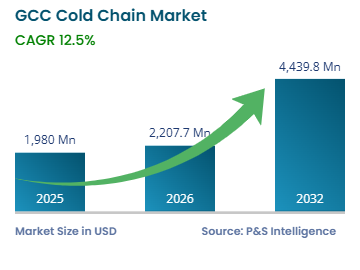
The GCC cold chain market size will be an estimated USD 1,980.0 million for 2025, and it will grow by 12.5% during 2026–2032, to reach USD 4439.8 million by 2032.
The major factors responsible for the growth of the market include rising food import dependency, expanding pharmaceutical sector, government investments in food security infrastructure, and increasing consumer demand for fresh and frozen products. Government-led initiatives targeting food security and sustainability, such as Vision 2030 in Saudi Arabia and the UAE’s National Food Security Strategy 2051, are creating substantial opportunities for investment in advanced cold storage infrastructure, smart logistics, and last-mile distribution networks.
Moreover, the e-commerce boom and rising penetration of online grocery and quick-commerce platforms are intensifying the need for efficient last-mile cold chain solutions. Sustainability initiatives, including energy-efficient refrigeration, solar-powered storage units, and eco-friendly transportation, are becoming critical considerations for new developments, aligning the sector with global environmental standards. Furthermore, the GCC cold chain market presents a unique combination of growth opportunities stemming from food security priorities, pharmaceutical sector expansion, technological advancements, and sustainability-driven logistics investments.
GCC Cold Chain Market Growth Factors
Pharmaceutical Sector Expansion Is Key Trend
The expanding pharmaceutical industry across GCC nations represents a significant growth trend for the cold chain market.
The region's increasing focus on healthcare quality and accessibility drives demand for temperature-sensitive medications, vaccines, and biological products.
Specialty pharmaceuticals, including biologics and biosimilars, require precise temperature maintenance throughout storage and distribution.
The COVID-19 pandemic highlighted the critical importance of pharmaceutical cold chains, particularly for vaccine distribution.
This experience accelerated investments in ultra-low temperature storage facilities and specialized transportation vehicles across GCC countries.
Healthcare providers and pharmaceutical distributors are now prioritizing cold chain reliability as a competitive differentiator.
Public health initiatives, including national vaccination programs and chronic disease management efforts, further amplify pharmaceutical cold chain requirements.
The aging population in certain GCC nations and rising prevalence of lifestyle-related diseases increase the consumption of temperature-controlled medications.
This trend is expected to sustain long-term growth in the pharmaceutical cold chain segment.
Pharma in the Middle East is rapidly shifting from import dependence to local production and innovation. Saudi Arabia now hosts 206 pharma & medical device factories, including 56 pharma plants; and it has reduced its import reliance.
The UAE is boosting R&D, digital health, and domestic manufacturing.
Clinical trials are on the rise—with over 250 drugs under trial in the GCC.
Government Food Security Initiatives Are Biggest Drivers
The key driver for the GCC cold chain market is the strategic focus on food security by regional governments.
The GCC countries import approximately 85% to 90% of their food requirements, making efficient cold chain infrastructure essential for maintaining product quality and reducing spoilage.
Vision 2030 programs across Saudi Arabia and the UAE prioritize investments in temperature-controlled logistics and storage facilities.
Governments are establishing public-private partnerships to develop advanced cold storage warehouses, particularly in major ports and distribution centers.
Advanced technologies, including automated storage, real-time temperature tracking, and energy-efficient refrigeration, are increasingly being implemented in these facilities.
The regulatory environment is also evolving to support cold chain development.
Authorities across GCC countries have implemented stringent food safety standards aligned with international best practices.
These regulations mandate proper temperature control throughout the supply chain, from import terminals to retail outlets.
Compliance with these standards necessitates significant investments in cold chain infrastructure, creating sustained market growth opportunities.
GCC nations face food security challenges due to arid climates and limited arable land.
Over 85% of food is imported, making the region vulnerable to global supply shocks.
In 2023, the UAE ranked 35th in the Global Food Security Index, while Saudi Arabia was 29th, reflecting ongoing efforts and vulnerabilities.
GCC Cold Chain Market Segmentation Analysis
Type Analysis
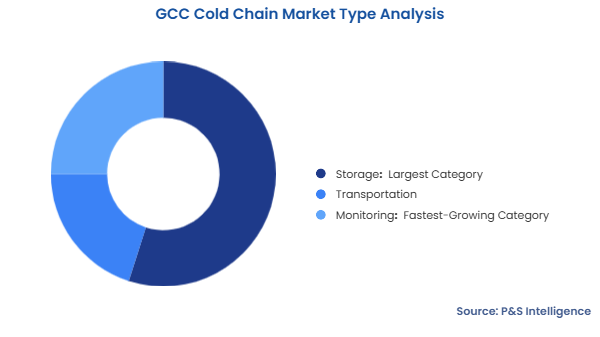
The storage category holds the largest market share, of 55%, in 2025, attributed to the region's heavy dependence on food imports, requiring extensive cold storage facilities at ports and distribution centers. The GCC countries' strategic location as trade hubs necessitates substantial warehousing infrastructure to manage temperature-sensitive imports before distribution to retail and food service channels.
The monitoring category will have the highest CAGR, due to the integration of internet of things devices, blockchain technology, and artificial intelligence-powered analytics. Real-time temperature tracking systems and automated alert mechanisms ensure compliance with food safety regulations and pharmaceutical storage requirements. The increasing regulatory scrutiny and consumer awareness about product quality drive the adoption of sophisticated monitoring solutions across the cold chain network.
The types analyzed in this report are:
Storage (Largest Category)
Transportation
Monitoring (Fastest-Growing Category)
Application Analysis
The fish, meat, & seafood category holds the largest market share, of 30%, in 2025, driven by the high per capita consumption across GCC countries. The region's diverse expatriate population and cultural preferences for various protein sources create sustained demand for temperature-controlled storage and distribution of these products. Halal certification requirements add complexity to the supply chain, necessitating specialized facilities and processes.
Additionally, the GCC’s reliance on imports for seafood and meat due to limited domestic production further reinforces the need for robust cold chain infrastructure. Stringent quality and safety standards, combined with growing awareness of food hygiene, also contribute to this category’s dominant position in the market. In 2023, Saudi Arabia’s poultry meat per‑capita consumption was around 43.4 kg/year, while red meat stood at 10.8 kg/year. GCC seafood consumption averages 14.4 kg per year per person, with the UAE and Oman recording consumption of 28.6 kg per year.
The pharmaceuticals category will have the highest CAGR, due to the expanding healthcare sector, increasing prevalence of chronic diseases, and growing demand for specialty medications requiring temperature control. The rise of biological products, vaccines, and biosimilars necessitates ultra-low temperature storage and distribution capabilities. Healthcare infrastructure development across GCC nations and government initiatives to enhance pharmaceutical access drive cold chain investments in this application segment. The increasing prevalence of chronic diseases, coupled with the region's growing healthcare infrastructure investments, continues to drive the need for reliable pharmaceutical cold chain solutions.
The applications analyzed in this report are:
Fruits & Vegetables
Dairy Products
Fish, Meat, & Seafood (Largest Category)
Processed Food
Pharmaceuticals (Fastest-Growing Category)
Bakery & Confectionery
Drive strategic growth with comprehensive market analysis
GCC Cold Chain Market Geographical Analysis
Saudi Arabia Cold Chain Market Size
Saudi Arabia holds the largest market share, of 40%, in 2025. This is primarily attributed to the kingdom's Vision 2030 initiatives prioritizing food security, substantial investments in logistics infrastructure, and the largest population in the region, creating a significant demand for temperature-controlled products. The country is developing mega logistics parks with advanced cold storage facilities in key cities, including Riyadh, Jeddah, and Dammam.
These projects integrate automated warehousing systems, solar-powered refrigeration, and digital tracking technologies. The kingdom's food security initiatives drive public sector investments in cold chain infrastructure. The Ministry of Environment, Water, and Agriculture actively promote projects to reduce food waste and enhance storage capacity for agricultural and imported products. Strategic grain reserves and national food stockpiling programs necessitate extensive cold and controlled atmosphere storage facilities.
Moreover, the pharmaceutical sector's expansion in Saudi Arabia further amplifies cold chain requirements. The country is developing local pharmaceutical manufacturing capabilities as part of economic diversification efforts, creating demand for domestic cold chain networks supporting both production and distribution. The National Transformation Program targets healthcare sector development, including infrastructure for temperature-sensitive medical products.
UAE Cold Chain Market Size
UAE will have the highest CAGR, of approx. 13.0%, driven by Dubai and Abu Dhabi's positions as global trade hubs, the rapid expansion of e-commerce and online grocery platforms, and aggressive investments in smart logistics infrastructure incorporating advanced technologies. The UAE's strategic geographic position and world-class port facilities make it a critical re-export center for temperature-sensitive products destined for the broader Middle East, Africa, and South Asia regions. Jebel Ali Port and Abu Dhabi Ports operate sophisticated cold chain terminals handling perishables, pharmaceuticals, and specialty chemicals. The country's free trade zones offer integrated cold storage solutions, attracting international food and pharmaceutical companies.
With leading e-commerce penetration in the GCC, major UAE platforms are investing significantly in cold chain infrastructure to enhance grocery delivery services. Quick-commerce startups are establishing networks of micro-fulfillment centers equipped with advanced refrigeration systems across Dubai, Abu Dhabi, and Sharjah. These facilities enable rapid delivery of fresh and frozen products, driving innovation in last-mile cold chain solutions.
The UAE government actively promotes food security through the National Food Security Strategy 2051, which emphasizes developing robust storage and distribution infrastructure. Investments in controlled-environment agriculture and food technology innovation hubs create additional demand for cold chain services. The country's focus on becoming a global logistics hub for temperature-controlled products sustains long-term growth prospects.
Qatar Cold Chain Market Size
Qatar demonstrates strong cold chain market growth driven by preparations for major international events, government food security initiatives, and investments in local food production capabilities. The country's National Food Security Strategy focuses on developing comprehensive cold storage networks to support both domestic production and strategic reserves of imported products.
The establishment of large-scale logistics parks and food hubs in Qatar creates centralized facilities for temperature-controlled storage and distribution. These projects integrate advanced technologies, including automated storage and retrieval systems, real-time monitoring, and energy-efficient refrigeration powered by renewable energy sources. The focus on sustainability aligns with Qatar's environmental objectives while reducing operational costs.
Qatar's efforts to enhance domestic agricultural production, particularly dairy, poultry, and vegetables, require sophisticated post-harvest cold chain infrastructure. The country is developing greenhouse farming and controlled-environment agriculture facilities that depend on efficient cold storage and distribution networks to deliver fresh produce to consumers and food service establishments.
The countries of the market are as follows:
Saudi Arabia (Largest Country)
UAE (Fastest-Growing Country)
Kuwait
Qatar
Oman
Bahrain
GCC Cold Chain Market Share
The market is fragmented due to the presence of numerous small and medium-sized regional players alongside global logistics giants. Many local companies operate with limited geographic coverage, infrastructure capacity, and technological capabilities, resulting in varying service quality across the region. While top players account for a portion of the market, a large number of smaller providers compete for niche segments like fresh produce, dairy, and last-mile delivery.
This diverse mix of operators creates a fragmented market structure. Additionally, differences in regulatory standards across GCC countries, varying levels of investment in cold chain infrastructure, and the reliance on manual processes in some regions further contribute to fragmentation. High entry barriers for advanced temperature-controlled facilities, coupled with fluctuating demand for seasonal products, also prevent consolidation, allowing numerous small players to coexist alongside large multinational companies.
Key GCC Cold Chain Companies:
Aramex
Barakat Quality Plus
DHL Supply Chain
CEVA Logistics
DSV
Kuehne + Nagel
Mohebi Logistics
RSA Logistics
Gulf Agency Company (GAC)
Global Shipping & Logistics LLC
Emirates SkyCargo
Agility Logistics
GCC Cold Chain Market News
In October 2025,Blackstone Inc. and Lunate Holding RSC Limited announced a strategic partnership to invest in high-quality logistics infrastructure in the GCC. Their joint venture, GLIDE, aims to develop and acquire warehouse assets worth up to USD 5 billion, focusing on greenfield developments and selective acquisitions to accelerate logistics infrastructure growth in the region.
In February 2025, Asyad Express, a subsidiary of Asyad Group, expanded its partnership with Amazon.com Inc. to enhance last-mile delivery services in Oman. This collaboration aims to improve e-commerce logistics, including the transportation of temperature-sensitive goods, thereby strengthening the cold chain infrastructure in the GCC.
Want a report tailored exactly to your business need?
Leading companies across industries trust us to deliver data-driven insights and innovative solutions for their most critical decisions. From data-driven strategies to actionable insights, we empower the decision-makers who shape industries and define the future. From Fortune 500 companies to innovative startups, we are proud to partner with organisations that drive progress in their industries.
Client Testimonials
Working with P&S Intelligence and their team was an absolute pleasure – their awareness of timelines and commitment to value greatly contributed to our project's success. Eagerly anticipating future collaborations.
McKinsey & Company
India
Unmatched Standards
Our insights into the minutest levels of the markets, including the latest trends and competitive landscape, give you all the answers you need to take your business to new heights
Complete Data Security
We take a cautious approach to protecting your personal and confidential information. Trust is the strongest bond that connects us and our clients, and trust we build by complying with all international and domestic data protection and privacy laws