This Report Provides In-Depth Analysis of the GCC Cloud Security Market Report Prepared by P&S Intelligence, Segmented by Deployment Type (Private, Hybrid, Public), Enterprise Size (Large Enterprises, SMEs), End Use (BFSI, Retail & E-commerce, IT & Telecom, Healthcare, Manufacturing, Government, Aerospace & Defense, Energy & utilities, Transportation & Logistics), Security Type (Network Security, Endpoint Security, Application Security, Cloud Identity & Access Management (IAM), Data Loss Prevention (DLP), Security Information & Event Management (SIEM)), and Geographical Outlook for the Period of 2019 to 2032
Explore the market potential with our data-driven report
GCC Cloud Security Market Outlook
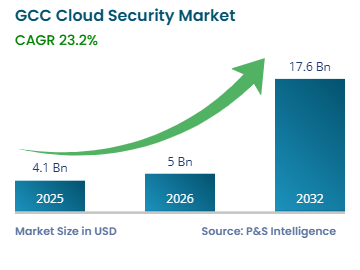
The GCC cloud security market size will be an estimated USD 4.1 billion for 2025, and it will grow by 23.2% during 2026–2032, to reach USD 17.6 billion by 2032.
The market growth is primarily driven by governments in many GCC countries by accelerating cloud adoption across the Gulf region, increasingly stringent data protection regulations, and rising geopolitical and data‑sovereignty concerns. These rules are prompting organizations to demand cloud security solutions that not only guard against cyber threats but also provide compliance, control, and visibility over sensitive workloads.
Moreover, as global cloud providers expand their infrastructure in the region with new data centers in Saudi Arabia, the UAE, Qatar, and Bahrain, enterprises are now able to operate in sovereign or hybrid cloud architectures that reconcile flexibility with regulatory compliance. This convergence of technological innovation, strategic regulation, and sovereign infrastructure has positioned cloud security as an indispensable component of the GCC’s digital resilience agenda. As businesses and governments increasingly rely on cloud-native applications, connected infrastructure, and identity-driven architectures, the demand for comprehensive cloud security is surging, making cloud security not merely a tool, but a critical enabler of the Gulf’s economic transformation.
GCC Cloud Security Market Emerging Trends
Hybrid and Sovereign Cloud Deployments Are Key Trends
The rise of sovereign and hybrid cloud deployments is a key trend in the market, driven by regulatory compliance, data residency requirements, and the need for flexible, secure workload management across public and private cloud environments.
While public cloud adoption is strong, there is a growing preference for hybrid cloud models and sovereign cloud architectures, driven by data residency, regulatory compliance, and geopolitical considerations.
This trend is fueled by regulatory directives, e.g., localization mandates and strategic national cloud programs.
For example, GCC governments are increasingly requiring that critical data, especially in finance, government, and defense, remain within national borders or under local control.
The hybrid/sovereign model offers enhanced local control, regulatory compliance, and flexible scalability.
To support this trend, cloud security vendors are offering cloud workload protection platforms, cloud security posture management (CSPM), and identity services that operate across hybrid and sovereign cloud environments.
This trend reflects a broader shift from simply securing cloud workloads to enabling secure cloud adoption, ensuring compliance while maintaining operational flexibility.
Regulatory Compliance and Data Protection Is Biggest Driver
One of the most significant drivers propelling the GCC cloud security market is stringent regulatory compliance and data protection requirements.
As GCC governments digitize and modernize, they have implemented robust cybersecurity and data protection frameworks that enforce security controls.
In its Essential Cybersecurity Controls (ECC 2, 2024), the Saudi National Cybersecurity Authority (NCA) has established baseline requirements across domains including cloud.
The Personal Data Protection Law (PDPL, 2024) of Saudi Arabia mandates strong data security measures, breach notification, and compliance with cross-border data transfer rules.
The National Cloud Security Policy (2023) of the UAE sets security standards for cloud service providers and users.
Additionally, the Telecommunications and Digital Government Regulatory Authority (TDRA) enforces Information Assurance Regulations, requiring adherence to international frameworks such as ISO 27001 and NIST.
These regulations create a dual impact: they compel enterprises to invest in cloud security to meet compliance obligations, and simultaneously create market opportunities for security vendors, who can offer solutions aligned with regulatory mandates and risk management frameworks.
GCC Cloud Security Market Segmentation Analysis
Deployment Type Analysis
The public category holds the largest market share, of 60%, in 2025, driven by widespread enterprise migration to cloud-native environments for scalability, cost-efficiency, and operational flexibility. Organizations across BFSI, government, and manufacturing sectors increasingly prefer public cloud deployments, leveraging built-in security services and reducing on-premise overheads, making it the dominant choice in regional cloud security spending. This adoption is widely supported by government cloud-first policies, compliance frameworks, and increasing availability of sovereign and regional data centers, allowing organizations to meet data residency requirements while benefiting from the efficiency of public cloud.
The hybrid category will have the highest CAGR, of 23.4%, due to rising regulatory requirements for data localization, sovereign cloud mandates, and the need for flexible workload distribution. By combining private and public cloud environments, hybrid solutions offer better control over sensitive data, compliance alignment, and scalability, prompting organizations to adopt this model rapidly, especially in sectors handling critical or regulated information.
The deployment types analyzed in this report are:
Private
Hybrid (Fastest-Growing Category)
Public (Largest Category)
Enterprise Size Analysis
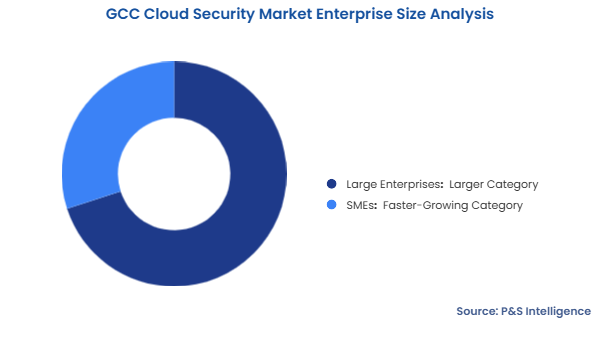
The large enterprises category holds the largest market share, of 70%, in 2025. This is due due to its complex IT infrastructures, regulatory scrutiny, and higher cyber risk exposure, which drive significant investments in cloud security solutions. With robust budgets, these organizations implement comprehensive IAM, SIEM, network, and endpoint protection across multi-cloud and hybrid environments to maintain compliance and secure sensitive data. Large enterprises are increasingly adopting regulatory-aligned cloud security frameworks, integrating continuous monitoring, automated compliance checks, and advanced threat detection to meet national and sector-specific cybersecurity mandates.
The SMEs category will have the highest CAGR, of 23.5%, as digital adoption expands and cloud security becomes more affordable via SaaS solutions like CSPM, IAM, and DLP. National digitization initiatives encourage SMEs to migrate workloads to cloud platforms, increasing demand for accessible, scalable security tools that protect data and meet regulatory obligations without heavy infrastructure investment.
The enterprise sizes analyzed in this report are:
Large Enterprises (Larger Category)
SMEs (Faster-Growing Category)
End Use Analysis
The BFSI category holds the largest market share in 2025, due to strict regulatory compliance, highly sensitive financial data, and the critical need for cyber resilience. Banks and insurers are accelerating cloud adoption while investing heavily in network, IAM, and threat detection tools to secure multi-cloud environments and mitigate financial and reputational risk. BFSI growth is reinforced by regional regulations such as PDPL (UAE), and mandatory data residency laws, which drive enterprises to implement advanced cloud security controls, including CSPM, CWPP, and IAM solutions.
The government category will have the highest CAGR, due to the accelerated e-governance programs, smart city projects, and the digitalization of public services are driving cloud adoption, increasing regulatory compliance requirements, and creating demand for robust cloud security solutions to safeguard critical data, infrastructure, and citizen services across the region. Cloud adoption in government is further accelerated by national digital transformation strategies, data localization mandates, and the need to secure citizen data, public services, and critical infrastructure.
The end uses analyzed in this report are:
BFSI (Largest Category)
Retail & E-commerce
IT & Telecom
Healthcare
Manufacturing
Government (Fastest-Growing Category)
Aerospace & Defense
Energy & Utilities
Transportation & Logistics
Others
Security Type Analysis
The network security category holds the largest market share, of 45%, in 2025, driven by foundational solutions that protect multi-cloud and hybrid architectures from unauthorized access and cyberattacks. Enterprises prioritize network security as the first line of defense, ensuring secure connectivity, policy enforcement, and regulatory compliance across complex regional digital infrastructures.
The cloud identity & access management category will have the highest CAGR, driven by rising adoption of public and hybrid cloud workloads. Identity management, workload protection, and CSPM tools address regulatory compliance, zero-trust architectures, and internal access control. As organizations expand cloud operations, these solutions are increasingly critical to ensure secure application access, data protection, and threat monitoring in dynamic cloud environments.
Drive strategic growth with comprehensive market analysis
GCC Cloud Security Market Geographical Analysis
Saudi Arabia Cloud Security Market Size
Saudi Arabia holds the largest market share, of 40%, in 2025, driven by the country’s ambitious Vision 2030 initiative, which emphasizes digital transformation, cloud adoption, and the modernization of public and private sector infrastructure. Large-scale cloud adoption across key sectors, supported by regulatory frameworks enforcing cloud security standards, continues to drive market growth. The Communications, Space & Technology Commission (CST) also regulates data center and cloud services, ensuring data localization and cyber resilience, which further propels demand for cloud security solutions.
Complementing these controls, the CST Data Center Services Regulations require all data centers to register and classify their facilities into four tiers, Qualifying, Limited, Standard, and Advanced, based on technical capability, sustainability, and certification levels. Advanced-tier data centers must meet strict environmental and disaster recovery standards, enabling them to host highly sensitive cloud workloads.
UAE Cloud Security Market Size
UAE will have the highest CAGR, of 23.3%, driven by strong government support for cloud adoption, digital transformation, and smart city initiatives. The country’s aggressive e-governance programs and increasing cyber threats are driving enterprises and government entities to adopt advanced cloud security solutions at a rapid pace. Furthermore, the UAE Cybersecurity Council’s National Cloud Security Policy enforces governance, identity management, data-lifecycle protection, incident response, and data localization controls, ensuring enterprises and government entities maintain secure cloud environments. The TDRA’s Information Assurance Regulation requires risk governance, incident reporting, and adherence to ISO/NIST frameworks across telecom and cloud providers.
The countries of the market are as follows:
Saudi Arabia (Largest Country)
UAE (Fastest-Growing Country)
Kuwait
Qatar
Bahrain
Oman
GCC Cloud Security Market Share
The market is fragmented due to the presence of numerous global and regional vendors, including Microsoft, Amazon Web Services (AWS), Cisco, IBM, Dell Technologies, Elm, Advanced Electronics Company, Zenlayer, and STC solutions, each catering to different deployment types, enterprise sizes, and sector-specific requirements. Additionally, market fragmentation is driven by strict regulatory mandates, data localization requirements, and sector-specific compliance standards, prompting organizations to adopt multiple specialized solutions. The rise of hybrid and sovereign cloud models, cloud-native security tools, and advanced identity and threat management solutions further diversifies the competitive landscape.
Key GCC Cloud Security Companies:
Microsoft Corporation
Amazon Web Services (AWS)
Cisco Systems
IBM
Dell Technologies
Check Point Software Technologies
Commvault Systems
CloudSEK Technologies
Fortinet, Inc.
Advanced Electronics Company (AEC)
Zenlayer, Inc.
stc Solutions
GCC Cloud Security Market News
In November 2025, CloudSEK Technologies Pvt. Ltd. partnered with Seed Group in the UAE to provide advanced AI-powered threat intelligence services for cloud and hybrid environments, enhancing visibility into attack surfaces and improving cyber resilience.
In October 2025, Commvault Systems, Inc. signed an MoU with SAAED (UAE) to strengthen data protection and cloud security for smart city and infrastructure projects, providing tailored cloud backup and resilience solutions.
In May 2025, Check Point Software Technologies Ltd. acquired Veriti Cybersecurity, a cloud exposure management startup focused on threat surface hardening.
In October 2024, Saudi Arabia’s National Cybersecurity Authority (NCA) updated its Essential Cybersecurity Controls (ECC‑2), reinforcing cloud security mandates and requiring that cybersecurity roles be filled by full-time, qualified Saudi professionals.
Want a report tailored exactly to your business need?
Leading companies across industries trust us to deliver data-driven insights and innovative solutions for their most critical decisions. From data-driven strategies to actionable insights, we empower the decision-makers who shape industries and define the future. From Fortune 500 companies to innovative startups, we are proud to partner with organisations that drive progress in their industries.
Client Testimonials
Working with P&S Intelligence and their team was an absolute pleasure – their awareness of timelines and commitment to value greatly contributed to our project's success. Eagerly anticipating future collaborations.
McKinsey & Company
India
Unmatched Standards
Our insights into the minutest levels of the markets, including the latest trends and competitive landscape, give you all the answers you need to take your business to new heights
Complete Data Security
We take a cautious approach to protecting your personal and confidential information. Trust is the strongest bond that connects us and our clients, and trust we build by complying with all international and domestic data protection and privacy laws