This Report Provides In-Depth Analysis of the GCC Brick Reinforcement Mesh Market Report Prepared by P&S Intelligence, Segmented by Material (Galvanized Steel Wire, Stainless Steel Wire, Polymer-based, Composite), Product (Ladder, Truss, Flat Panel, Coil), Application (Masonry Wall, Concrete Block, Cavity Wall, Partition Wall, Retaining Wall), End Use (Residential, Commercial, Industrial, Infrastructure Projects), and Geographical Outlook for the Period of 2019 to 2032
Explore the market potential with our data-driven report
GCC Brick Reinforcement Mesh Market Future Outlook
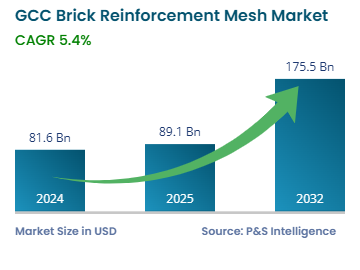
The GCC brick reinforcement mesh market size was USD 81.6 billion in 2024, and it will grow by 5.4% during 2025-2032, to reach USD 175.5 billion by 2032.
The market growth is driven by the rising construction activity across the GCC region, especially Saudi Arabia and the U.A.E., where mega infrastructure projects and large-scale urban development programs are creating constant demand for structural masonry reinforcement solutions. They support multiple sectors, especially residential and infrastructural, by improving structural performance and preventing cracks in masonry walls. This region's particular focus on sustainable construction practices and the utilization of advanced building technologies is further accelerating the demand for high-quality reinforcement solutions.
Moreover, the market is experiencing an increasing utilization of galvanized steel and stainless steel mesh products for superior corrosion resistance, which is essential in the GCC's harsh climate. Expanded metal brick reinforcement mesh provides good adhesion properties and superior tensile strength for concrete to prevent brick and masonry wall cracking and make cement walls more stable, and serve as an indispensable component in modern construction projects across the region.
Technological Advancement in Manufacturing Is Key Trend
The utilization of advanced manufacturing technologies is a key trend in the market.
Modern production facilities are applying automated welding systems and precision coating technologies to create mesh products with consistent quality and enhanced performance characteristics.
These technological advancements have introduced innovative construction methods, such as 3D printing and building information modelling, boosting efficiency and sustainability in the field.
These technological improvements are used in the manufacturing of brick reinforcement mesh, where computer-controlled production lines help to produce mesh with proper dimensions and consistent coating thickness.
Statistically, the integration of advanced reinforcement mesh can improve a wall's load-bearing capacity by up to 40%.
Crack resistance is also enhanced, with studies showing a 60–75% reduction in crack propagation in walls using reinforced mesh compared to non-reinforced counterparts.
In seismic zones, reinforced masonry with mesh reinforcement has demonstrated up to a 50% reduction in lateral displacement, helping structures better withstand earthquakes.
Furthermore, the use of precision-engineered meshes ensures uniform stress distribution, reducing localized stress concentrations by over 30%.
This translates into fewer repairs over time and lower long-term maintenance costs.
The manufacturers involved in construction materials in the U.A.E. and Saudi Arabia are actively using Industry 4.0 technologies, such as CNC mesh cutting machines, to meet the rising need from megaprojects, such as NEOM.
GCC countries are focusing on manufacturing construction materials domestically under Vision 2030, especially after COVID, and are upgrading the local factories with advanced technologies.
Rapid Infrastructure Development Is Major Driver
The vast infrastructure development initiatives are the key drivers for the brick reinforcement mesh market growth.
These large-scale developments require constant quantities of brick reinforcement mesh for various applications, from residential complexes to commercial buildings and infrastructure facilities.
Saudi Arabia leads in this area, setting records for the second consecutive year with contract awards reaching USD 146.8 billion in 2024, up from USD 118.7 billion in 2023.
One rail line of 1,970 km is planned to connect all the GCC countries, representing a significant example of the mega infrastructure projects driving market demand.
This growth shows the rising focus of the government towards developing new cities and mega projects, including The Line and Red Sea, which create a sustained demand for dependable construction materials.
Saudi Arabia is focusing on rail infrastructure development within the Saudi Vision 2030 plan, with projects, such as the Riyadh Metro, requiring broad use of reinforcement materials.
In the U.A.E., infrastructure investment is projected at roughly USD 500 billion over the next decade, including Etihad Rail’s USD 11 billion national network linking ports and industrial centers.
Qatar has earmarked around USD 15 billion in infrastructure spending through 2029, with major programs including a drainage-network expansion and utility projects alongside its Ras Abu Fontas USD 3.7 billion power-and-water plant.
Kuwait plans approximately USD 150 billion in construction over the coming decade; landmark efforts include the USD 132 billion Silk City development and the USD 3–3.6 billion Sheikh Jaber Al-Ahmad Al-Sabah Causeway.
In Oman, infrastructure awards jumped to USD 5.5 billion in 2024—a 120% rise—with major projects like the Marsa LNG terminal and Etihad Rail packages B and C (~USD 1 billion).
Bahrain saw contract awards of about USD 1.4 billion in 2024, part of its broader USD 30 billion Strategic Projects Plan, including the King Hamad Causeway (~USD 3.5 billion) and the new King Abdullah Medical City (~USD 129 million).
The galvanized steel wire category held the largest market share, of 45%, in 2024, due to its affordable solutions and anti-corrosion properties. It is made of high-quality galvanized steel or stainless steel sheet that has been slit and stretched, which provides the durability required for harsh environmental conditions. Additionally, the established supply chains for galvanized steel products throughout the region have ensured consistent availability.
The polymer-based mesh category will have the highest CAGR, of 5.5%, due to the material's corrosion-resistant properties and suitability for specialized construction applications, especially in chemical plants, water treatment facilities, and food processing units across the region. PVC-coated mesh currently controls the market due to its established market presence and cost advantage.
The materials analyzed in this report are:
Galvanized Steel Wire (Largest Category)
Stainless Steel Wire
Polymer-Based (Fastest-Growing Category)
PVC-coated
HDPE-based
Composite
Product Analysis
The ladder category held the largest market share, of 40%, in 2024, because of its extensive application in standard masonry construction across the region. These ladders are placed above the brick and become integrated into the wall layer once the mortar layer is added. This traditional design provides reliable performance for cavity walls and standard brick constructions, making it the go-to choice for contractors familiar with conventional building methods.
The coil category will have the highest CAGR, due to the product's flexibility and ease of installation, especially in the complex architectural designs increasingly common in the GCC. It is supplied in coils to enable workers to use it during construction, and it is also known as a brick reinforcement coil. The ability to cut and shape coil mesh on-site minimizes material waste and supports efficient coverage of irregular wall configurations.
The products analyzed in this report are:
Ladder (Largest Category)
Truss
Flat Panel
Coil (Fastest-Growing Category)
Others
Application Analysis
The masonry wall category held the largest market share, of 35%, in 2024, as it represents the most common application for brick reinforcement mesh in both residential and commercial construction projects. The segment's dominance is attributed to the widespread use of masonry construction in the GCC region and the critical need to prevent cracking in load-bearing walls.
The concrete block category will have the highest CAGR, as hollow concrete blocks can be used as both structural and non-structural components in various construction companies in Saudi Arabia. The increasing utilization of these blocks in GCC construction, propelled by their thermal insulation properties and construction speed advantages, and associated with the growing demand for specialized reinforcement mesh products.
The applications analyzed in this report are:
Masonry Wall (Largest Category)
Concrete Block (Fastest-Growing Category)
Hollow concrete block structure
Solid concrete block walls
Precast concrete units
Cavity Wall
Partition Wall
Retaining Wall
Gravity
Reinforced
End Use Analysis
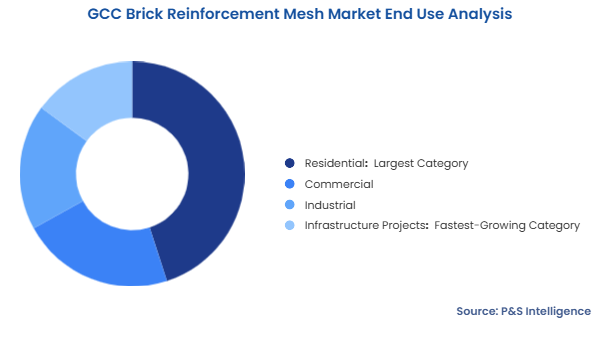
The residential category held the largest market share, of 45% in 2024, due to the massive housing development projects across the GCC countries. The Middle Eastern residential construction industry is witnessing significant growth due to the rising urban population, technological innovation, and government support. Studies predict the urban population of GCC countries to grow from 43.3 million in 2015 to 54.6 million by 2030, in turn, creating constant demand for brick reinforcement mesh products. Moreover, the rising government initiatives providing affordable housing for citizens, and combined with luxury villa developments serving foreign communities, create consistent demand for brick reinforcement mesh products.
The infrastructure projects category will have the highest CAGR, of 6%, driven by the region's broad infrastructure development plans. These projects require constant quantities of reinforcement mesh for various applications, from bridge abutments to utility buildings. As per the Emirates News Agency, construction spending in GCC countries could cross USD 540 billion in FY 2025.
Saudi Arabia held the largest market share, of 35% in 2024, because of the kingdom's massive construction and Vision 2030 initiatives. These large-scale developments require constant quantities of brick reinforcement mesh for various applications, from residential complexes to commercial buildings and infrastructure facilities. Saudi Readymix opened its first concrete block factory in Jubail in 1980, only two years after its founding. This established manufacturing base for concrete products creates a robust ecosystem for reinforcement mesh applications. Moreover, the kingdom's focus on developing new cities like NEOM and expanding existing urban centers also generates constant demand for masonry reinforcement products.
The Saudi market is characterized by increasing adoption of advanced reinforcement materials, particularly in mega-projects where durability and longevity are paramount. The Line’s population target of 1.5 million by 2030 has been scaled back to under 300,000 residents, narrowing the scope of near-term demand. Such ambitious projects require innovative reinforcement solutions capable of withstanding extreme environmental conditions while maintaining structural integrity for extended periods.
U.A.E. will have the highest CAGR. This growth is driven by the country's continued investment in infrastructure modernization and sustainable construction practices. The presence of established manufacturing, such as YKM Middle East LLC, ensures reliable supply chains for the growing construction sector.
The country continues to be a regional leader in construction, with total planned and ongoing spending exceeding USD 850 billion as of mid-2024. Beyond Etihad Rail, major developments include the Dubai Urban Master Plan 2040, which integrates housing, transit, and green space across five key urban centers. Abu Dhabi's Zayed City is another major undertaking, envisioned as a new administrative capital. The Dubai South Residential District and Reem Mall in Abu Dhabi also contribute to the country’s urban expansion. These projects span commercial, residential, and civic infrastructure, reinforcing the UAE’s long-term vision for sustainable and diversified growth.
This market is moderately fragmented, with numerous regional and international players competing across different product segments and geographical markets. The diverse product requirement across different construction applications and the presence of numerous small to medium-sized local manufacturers serving specific regional demands contribute to the fragmentation.
Key GCC Brick Reinforcement Mesh Companies:
YKM Middle East LLC
BRC Arabia LLC
E-Mesh Metal Manufacturing LLC
SRK Metals U.A.E.
Al Rabt Steel Co. LLC
Hazz Building Materials Trading LLC
Quality Wire Products W.L.L
Building System Integration W.L.L
Al Muhaidib Metal Industries Co. Ltd.
Madar Building Materials Trading LLC
Seven Seas Steel Industries LLC
Al Ittihad Reinforcement Steel Fabrication Factory L.L.C.
GCC Brick Reinforcement Mesh Market News
In June 2024, SRK Metals U.A.E. announced the launch of a next-generation welded wire mesh with enhanced security features for industrial, commercial, and residential sectors. The mesh is modified for high durability and flexibility, and it is available in stainless steel, galvanized steel, and PVC coatings.
Want a report tailored exactly to your business need?
Leading companies across industries trust us to deliver data-driven insights and innovative solutions for their most critical decisions. From data-driven strategies to actionable insights, we empower the decision-makers who shape industries and define the future. From Fortune 500 companies to innovative startups, we are proud to partner with organisations that drive progress in their industries.
Client Testimonials
Working with P&S Intelligence and their team was an absolute pleasure – their awareness of timelines and commitment to value greatly contributed to our project's success. Eagerly anticipating future collaborations.
McKinsey & Company
India
Unmatched Standards
Our insights into the minutest levels of the markets, including the latest trends and competitive landscape, give you all the answers you need to take your business to new heights
Complete Data Security
We take a cautious approach to protecting your personal and confidential information. Trust is the strongest bond that connects us and our clients, and trust we build by complying with all international and domestic data protection and privacy laws