GCC 3D Printing Market Size & Share Analysis - Emerging Trends, Growth Opportunities, Competitive Landscape, and Forecasts (2026 - 2032)
This Report Provides In-Depth Analysis of the GCC 3D Printing Market Report Prepared by P&S Intelligence, Segmented by Product Type (Printer, Software, Material, Service), Process (Powder Bed Fusion, Binder Jetting, Direct Energy Deposition, Sheet Lamination, Vat Photopolymerization, Material Extrusion, Material Jetting), Technology (Stereolithography (SLA), Fused Deposition Modeling (FDM), Selective Laser Sintering (SLS), Laminated Object Manufacturing (LOM), Digital Light Processing (DLP), PolyJet Printing, Inkjet Printing, Direct Metal Laser Sintering (DMLS), Electron Beam Melting (EBM), Laser Metal Deposition (LMD)), Application (Prototyping, Product Development, Innovation, Efficiency Increment, Cost Reduction, Supply Chain Improvement), Industry (Aerospace & Defense, Healthcare, Jewelry, Automotive, Industrial, Architecture & Construction, Energy), and Geographical Outlook for the Period of 2021 to 2032
Explore the market potential with our data-driven report
GCC 3D Printing Market Future Outlook
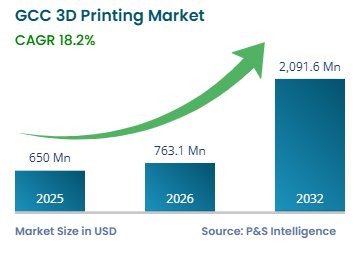
The GCC 3D printing market size will be an estimated USD 650.0 million for 2025, and it will grow by 18.2% during 2026–2032, to reach USD 2,091.6 million by 2032.
The major factors responsible for the growth of the market include rising government initiatives supporting advanced manufacturing technologies, increasing adoption across healthcare and construction sectors, and growing demand for localized production capabilities.
The increasing emphasis on economic diversification across GCC nations is the key factor driving the adoption of 3D printing technologies. Major initiatives such as Saudi Vision 2030, the UAE's Dubai 3D Printing Strategy, and Qatar National Vision 2030 are actively promoting additive manufacturing to reduce dependency on oil revenues and establish the region as a global hub for advanced technologies.
According to the Dubai 3D Printing Strategy, the emirate aims to target 25% of all new buildings constructed using 3D printing technology by 2030, positioning Dubai as a global leader in the construction 3D printing sector. Moreover, investments in research centers and specialized zones, coupled with strategic partnerships with global technology leaders, are creating a robust ecosystem for 3D printing innovation across the GCC region.
GCC 3D Printing Market Dynamics
Growing Adoption in Healthcare Sector Is Key Trend
The healthcare industry's increasing adoption of 3D printing for patient-specific solutions is a key trend significantly contributing to market growth across the GCC region.
Saudi Arabia's healthcare 3D printing initiatives under Vision 2030 include establishing regional manufacturing centers for prosthetics and dental implants.
Qatar's Sidra Medicine utilized 3D printing technology for complex surgical planning, including the first conjoined twins surgery in the country.
The regulatory support from authorities such as the Saudi Food and Drug Authority (SFDA) and UAE's Ministry of Health and Prevention is facilitating faster adoption of 3D printed medical devices.
These authorities have developed specific guidelines for point-of-care manufacturing, enabling hospitals to produce customized medical solutions on-site.
In October 2024, the Saudi Food and Drug Authority (SFDA) launched an initiative to develop diagnostic lab equipment and support 3D printing in hospitals, aimed at fostering innovation, reducing costs, and strengthening local medical technology ecosystems.
The UAE official government science & technology platform lists 3D printing for medical applications (teeth, bones, artificial organs, medical devices, surgical devices) as a priority area within national technology development policies.
Government Initiatives and Strategic Visions Are Biggest Drivers
The key driver for the GCC 3D printing market is the comprehensive support from government initiatives aligned with national transformation visions.
Saudi Arabia's Vision 2030 has allocated significant funding for advanced manufacturing, with the National Industrial Development and Logistics Program (NIDLP) specifically targeting 3D printing as a priority technology.
The UAE government has established the Dubai 3D Printing Strategic Alliance, bringing together government entities, academic institutions, and private companies to accelerate technology adoption.
Qatar's investment in 3D printing infrastructure includes the world's largest 3D construction printer installation in 2025, demonstrating a commitment to large-scale implementation.
According to the Investment Promotion Agency Qatar, the country's 3D printing market share exceeds USD 100 million in the MENA region, supported by policies allowing 100% foreign ownership.
These government-backed programs are not limited to funding but include comprehensive support through training initiatives, regulatory frameworks, and infrastructure development.
The establishment of innovation hubs, research centers, and specialized manufacturing zones dedicated to additive manufacturing is creating an environment conducive to rapid market growth and technology advancement.
GCC 3D Printing Market Segmentation Analysis
Product Type Analysis
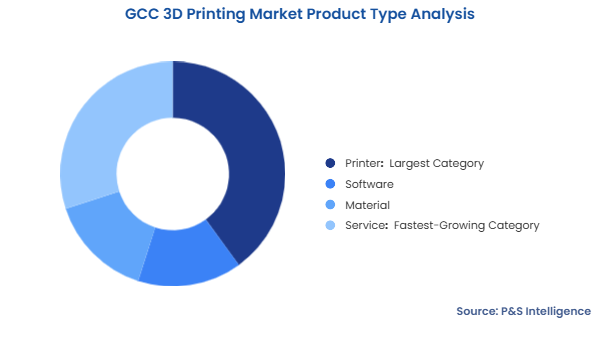
The printer category holds the largest market share, of 40%, in 2025, driven by the increasing investments in establishing local manufacturing capabilities, government procurement programs, and the need for industrial-grade printers across various sectors. The continuous technological advancement in printer capabilities, including larger build volumes and multi-material printing, is driving hardware adoption.
The service category will have the highest CAGR of 18.4%, owing to the growing demand for specialized expertise, training programs, and post-processing services. The increasing complexity of 3D printing applications requires professional services for design optimization, material selection, and quality certification. Additionally, the emergence of 3D printing service bureaus in the region is making the technology accessible to smaller enterprises without capital investment in hardware.
The product types analyzed in this report are:
Printer (Largest Category)
Software
Material
Service (Fastest-Growing Category)
Process Analysis
The powder bed fusion category holds the largest market share of 30% in 2025, driven by its widespread adoption in aerospace, automotive, and industrial applications for producing complex metal components. This process offers superior mechanical properties and design flexibility, making it ideal for critical applications requiring high strength and precision.
The material extrusion category will have the highest CAGR, during the forecast period, attributed to its cost-effectiveness, ease of use, and versatility in materials. The accessibility of desktop FDM printers and the growing ecosystem of compatible materials are democratizing 3D printing across educational institutions, small businesses, and research facilities in the GCC region.
The processes analyzed in this report are:
Powder Bed Fusion (Largest Category)
Binder Jetting
Direct Energy Deposition
Sheet Lamination
Vat Photopolymerization
Material Extrusion (Fastest-Growing Category)
Material Jetting
Others
Technology Analysis
The fused deposition modeling category holds the largest market share in 2025, owing to its accessibility, affordability, and widespread adoption across various industries. FDM technology's ability to work with diverse thermoplastic materials and its suitability for both prototyping and functional part production make it the preferred choice for many GCC businesses entering the 3D printing market.
The digital light processing category will have the highest CAGR, of 18.3%, driven by its superior speed, precision, and surface finish quality. The technology's increasing adoption in dental applications, jewelry manufacturing, and high-detail prototyping is accelerating market growth. The declining costs of DLP printers and the expanding availability of advanced photopolymer resins are further supporting this growth trajectory across the GCC region.
Digital Light Processing (DLP) (Fastest-Growing Category)
PolyJet Printing
Inkjet Printing
Direct Metal Laser Sintering (DMLS)
Electron Beam Melting (EBM)
Laser Metal Deposition (LMD)
Application Analysis
The prototyping category holds the largest market share, of 30%, in 2025, as it remains the primary entry point for most organizations adopting 3D printing technology. The ability to rapidly iterate designs, test functionality, and validate concepts before committing to traditional manufacturing methods provides significant time and cost advantages. This is particularly crucial in the GCC's growing industrial sector, where reducing time-to-market is essential for competitiveness.
The supply chain improvement category will have the highest CAGR, of 18.5%, driven by the region's strategic focus on reducing import dependency and localizing production. The COVID-19 pandemic highlighted vulnerabilities in global supply chains, prompting GCC industries to invest in on-demand manufacturing capabilities. This is further strengthened by national localization initiatives, such as Saudi Arabia’s Vision 2030 and the UAE’s industrial strategies, which prioritize additive manufacturing to enhance supply chain resilience and operational flexibility.
The healthcare category holds the largest market share, of 20%, in 2025, driven by increasing demand for personalized medical solutions, government healthcare initiatives, and growing investments in medical infrastructure. The ability to produce patient-specific implants, surgical guides, and anatomical models is revolutionizing medical procedures across the GCC region.
The architecture & construction category will have the highest CAGR, fueled by ambitious government targets for 3D printed buildings. Qatar's large-scale construction printing projects are creating unprecedented demand. The technology's ability to reduce construction time by 50-70% and labor costs by 50-80% makes it particularly attractive in the region's challenging climate conditions.
The industries analyzed in this report are:
Aerospace & Defense
Healthcare (Largest Category)
Jewelry
Automotive
Industrial
Architecture & Construction (Fastest-Growing Category)
Energy
Others
Drive strategic growth with comprehensive market analysis
GCC 3D Printing Market Geographical Analysis
UAE 3D Printing Market Size
UAE holds the largest market share, of 45%, in 2025. This is majorly ascribed to the Dubai 3D Printing Strategy, comprehensive regulatory framework supporting innovation, and the presence of numerous innovation hubs and research centers. The emirate's ambition to become a global 3D printing hub by 2030 is backed by substantial investments in infrastructure and technology partnerships. The Dubai Municipality's adoption of 3D printing for construction projects, including early landmark 3D-printed office developments, demonstrates practical implementation at scale.
Furthermore, the UAE's strategic location as a regional hub, combined with its business-friendly policies, including 100% foreign ownership in manufacturing sectors, is attracting global 3D printing companies to establish regional headquarters.
Saudi Arabia 3D Printing Market Size
Saudi Arabia will have the highest CAGR, of 18.6%. The growth of the market can be mainly attributed to Vision 2030's emphasis on industrial diversification, the National Industrial Development and Logistics Program (NIDLP), and significant investments in localizing manufacturing capabilities. The Saudi Industrial Development Fund is providing financing support for companies adopting 3D printing technologies, with allocated budgets exceeding SAR 500 million for additive manufacturing projects.
Moreover, NEOM's smart city project includes dedicated zones for advanced manufacturing, with 3D printing playing a central role in construction and industrial applications. The establishment of partnerships between Saudi universities and global technology leaders is creating a skilled workforce, addressing one of the key challenges in technology adoption.
The countries of the market are as follows:
Saudi Arabia (Fastest-Growing Country)
UAE (Largest Country)
Kuwait
Qatar
Bahrain
Oman
GCC 3D Printing Market Share
The market is fragmented due to the presence of global players providing technology and expertise, while local companies focus on service delivery and application development. The coexistence of numerous small and mid-sized service bureaus, startups, and specialized solution providers operating across diverse end-use sectors such as healthcare, construction, aerospace, education, and industrial manufacturing, further reinforced the market fragmentation. The project-based nature of 3D printing adoption in the GCC, particularly in government-led pilots and customized applications, limits long-term vendor exclusivity and enables multiple suppliers to compete simultaneously. Additionally, varying material requirements, printer technologies, and application-specific standards across industries prevent market dominance by a single player, sustaining a fragmented competitive landscape despite the presence of established international technology providers.
Key GCC 3D Printing Companies:
National Additive Manufacturing Innovation Company (NAMI)
3D Systems Corporation
Stratasys Ltd.
Immensa Technology Labs
EOS GmbH Electro Optical Systems
HP Inc.
General Electric Company (GE Additive)
Materialise NV
Generation 3D
3DVinci Creations
ICON Technology
Apis Cor Inc.
Vertico
3D Printhuset
XtreeE
GCC 3D Printing Market News
In October 2025, NAMI announced strategic milestones and partnerships to expand additive-manufacturing services for the energy and defence sectors in Saudi Arabia, reporting capacity and collaboration updates tied to its regional rollout.
In September 2024, EOS expanded its MEA go-to-market presence through a channel partnership with Phillips Machine Tools to improve regional access to high-end metal and polymer AM systems and service support.
In July 2024, NAMI (the 3D Systems–Dussur joint venture) selected 3D Systems’ metal and polymer solutions as core technology for its Saudi operations to support localized production and qualification of AM parts.
Want a report tailored exactly to your business need?
Leading companies across industries trust us to deliver data-driven insights and innovative solutions for their most critical decisions. From data-driven strategies to actionable insights, we empower the decision-makers who shape industries and define the future. From Fortune 500 companies to innovative startups, we are proud to partner with organisations that drive progress in their industries.
Client Testimonials
Working with P&S Intelligence and their team was an absolute pleasure – their awareness of timelines and commitment to value greatly contributed to our project's success. Eagerly anticipating future collaborations.
McKinsey & Company
India
Unmatched Standards
Our insights into the minutest levels of the markets, including the latest trends and competitive landscape, give you all the answers you need to take your business to new heights
Complete Data Security
We take a cautious approach to protecting your personal and confidential information. Trust is the strongest bond that connects us and our clients, and trust we build by complying with all international and domestic data protection and privacy laws