This Report Provides In-Depth Analysis of the Gallium Market Report Prepared by P&S Intelligence, Segmented by Product Type (Low-Purity, High-Purity, Primary, Secondary), Application (Semiconductors, Optoelectronics), End-Use Industry (Electronics & Semiconductors, Telecommunications, Automotive, Aerospace & Defense, Energy & Power, Healthcare), and Geographical Outlook for the Period of 2019 to 2032
Explore the market potential with our data-driven report
Gallium Market Analysis
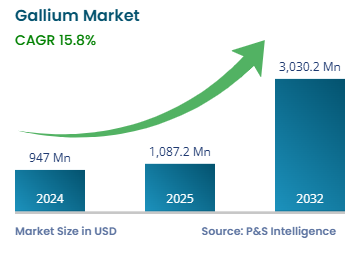
The gallium market size was USD 947 million in 2024, which is predicted to reach USD 3030.2 million by 2032, growing at a CAGR of 15.8% during 2025–2032.
The significant growth of the market is primarily attributed to the surging demand for gallium-based semiconductors in 5G telecommunications infrastructure, rapid adoption of electric vehicles requiring gallium nitride power electronics, and increasing deployment of gallium arsenide components in defense and aerospace applications.
The semiconductor industry continues to be the dominant consumer of gallium, through applications in integrated circuits and optoelectronic devices. According to the U.S. Geological Survey, about 79% of the gallium consumed in the U.S. is in the form of gallium arsenide (GaAs), gallium nitride (GaN), and gallium phosphide (GaP) wafers. The transition from silicon-based to gallium-based semiconductors is accelerating as manufacturers seek materials capable of operating at higher frequencies, voltages, and temperatures. This shift is particularly evident in power electronics for electric vehicles and data centers, where GaN devices offer superior efficiency and reduced energy losses compared to traditional silicon components.
Gallium Market Emerging Trends & Growth Drivers
Electric Vehicle Revolution Is a Key Trend
The rapid growth in EVs sales is significantly increasing the demand for compound semiconductors made from GaN and GaAs in power electronics and high-frequency devices.
GaN is increasingly being used in the onboard chargers, inverters, and DC–DC converters of EVs due to its higher energy efficiency, smaller size, and better thermal performance compared to traditional silicon components.
EVs contain GaAs-based sensors and systems in radars, advanced driver-assistance systems (ADAS), and LiDAR, which require high-frequency, high-speed communication and signal processing.
According to the IEA, global electric car sales reached 17 million units in 2024, accounting for over 20% of total car sales, the demand for high-performance semiconductors like GaN is set to rise.
The global push for carbon neutrality via government incentives, such as the U.S. Inflation Reduction Act, FAME III, and the EU’s 2035 ICE ban, are indirectly escalating gallium demand from the increasing EV adoption.
With China accounting for more than 50% of global EV stock and being the largest producer of gallium, the country plays a critical role in both the supply and demand dynamics of the gallium market.
The growing shift toward solid-state batteries and higher voltage platforms (800V) in EVs is further amplifying the role of GaN in thermal and energy management systems.
Rising Demand in 5G Infrastructure Is Accelerating Market Growth
GaN and GaAs are essential materials in RF power amplifiers, microwave devices, and high-frequency transceivers—core components in 5G base stations and smartphones.
GaN enables high-efficiency, high-power, and high-frequency performance, which is critical for massive MIMO, beamforming, and mmWave technologies in 5G networks.
The number of 5G base stations globally exceeded 5 million in 2023, with China leading the rollout and contributing to a sharp increase in demand for GaN-based RF front-end modules.
In 5G mmWave frequencies (24 GHz and above), GaAs and GaN devices outperform silicon, offering higher gain, wider bandwidth, and better thermal performance, making them preferred materials for 5G RF applications.
GaN transistors used in 5G power amplifiers can achieve up to 60% power-added efficiency, significantly reducing heat and energy consumption in telecom equipment.
Gallium Market Segmentation Analysis
Product Type Analysis
The high-purity gallium category dominated the market in 2024, accounting for 45% value share, driven by its essential role in advanced semiconductor and optoelectronic applications. High-purity gallium, typically refined to 99.999% (5N) or higher purity levels, is crucial for manufacturing compound semiconductors including gallium arsenide and gallium nitride. The stringent quality requirements of semiconductor fabrication processes necessitate ultra-pure materials to ensure device performance and reliability. Leading semiconductor manufacturers continue to increase their consumption of high purity gallium as they expand production capacity for 5G infrastructure components and power electronics.
The secondary gallium category is experiencing the fastest growth, during 2025–2032, as sustainability concerns and supply chain resilience drive increased recycling activities. Recovery of gallium from manufacturing waste, end-of-life electronics, and LED scrap provides an environmentally responsible alternative to primary production. Advanced recycling technologies are improving recovery rates and material quality, making secondary gallium increasingly competitive with primary sources. The development of efficient separation and purification processes enables the production of high-grade gallium from recycled materials, supporting circular economy initiatives in the electronics industry.
These product types are covered:
Low-Purity
High-Purity (Largest Category)
Primary
Secondary (Fastest-Growing Category)
Application Analysis
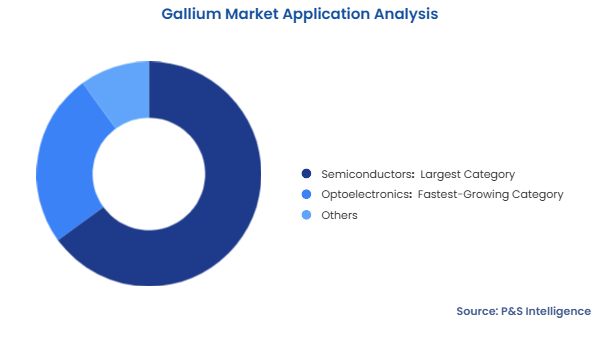
The semiconductors category held the largest market share in 2024, of 65%, attributed to the extensive use of GaAs and GaN in the manufacturing of high-performance semiconductors. These materials are widely used in integrated circuits (ICs), power electronics, RF devices, 5G infrastructure, satellite systems, and defense electronics, all of which require superior thermal stability, high-frequency operation, and power efficiency—features provided by gallium-based compounds. As per studies, semiconductor foundries will generate USD 268.3 billion by 2032.
The optoelectronics category is projected to witness the highest growth rate during the forecast period. This growth is driven by the increasing adoption of LED lighting, laser diodes, photodetectors, and solar cells that incorporate GaAs. The global shift toward energy-efficient lighting solutions, particularly gallium-based LEDs, and the rising deployment of gallium-containing photovoltaic technologies in the renewable energy sector are key drivers of this category's acceleration. Studies predict LED light sales to be worth USD 152.0 billion by 2032.
These applications are covered:
Semiconductors (Largest Category)
Optoelectronics (Fastest-Growing Category)
Others
End-Use Industry Analysis
The electronics & semiconductors industry dominated the gallium market in 2024 with a 30% share, reflecting the widespread integration of gallium-based components across consumer electronics, computing, and communication devices. The industry's continuous innovation in chip design and manufacturing processes drives consistent demand for high-quality gallium materials. Major semiconductor foundries are expanding their GaN production capabilities to meet growing demand from data center, artificial intelligence, and high-performance computing applications.
The automotive sector is emerging as the fastest-growing category, during 2025–2032, primarily driven by the global shift toward vehicle electrification, automation, and connectivity. The rapid adoption of EVs has significantly increased the demand for gallium-based semiconductors, particularly GaN and GaAs. GaN is widely used in critical EV power electronics such as onboard chargers, inverters, and DC–DC converters due to its superior efficiency, compact size, and high thermal performance compared to traditional silicon-based components. Additionally, GaAs is essential in advanced driver assistance systems (ADAS), LiDAR, and radar technologies, which require high-frequency performance and precision signal processing.
These end-use industries are covered:
Electronics & Semiconductors (Largest Category)
Telecommunications
Automotive (Fastest-Growing Category)
Aerospace & Defense
Energy & Power
Healthcare
Others
Drive strategic growth with comprehensive market analysis
Gallium Market Regional Market Performance
Asia-Pacific Gallium Market Share
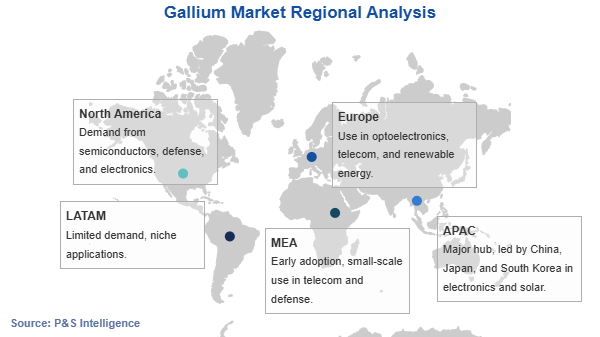
Asia-Pacific held the largest share of the global gallium market in 2024, of 40%, primarily due to its dominance in electronics manufacturing, semiconductor production, and gallium refining capacity. Countries like China, Japan, South Korea, and Taiwan play a central role in the global electronics supply chain, where gallium-based compounds such as gallium arsenide (GaAs) and gallium nitride (GaN) are extensively used in high-performance semiconductors, LEDs, and optoelectronic devices.
China Gallium Market Share
China, in particular, is both the largest producer and consumer of gallium globally. The country accounts for more than 90% of global primary gallium production, according to the U.S. Geological Survey. It also leads in downstream processing, including wafer fabrication and device manufacturing. Furthermore, China's aggressive rollout of 5G infrastructure and rapid adoption of electric vehicles (EVs) significantly boost domestic demand for gallium-based semiconductors used in power electronics and communication systems.
North America Gallium Market Outlook
North America is experiencing the fastest growth, with a projected CAGR of approx. 16.0% during 2025–2032, primarily driven by the rapid expansion of advanced technologies, reshoring of semiconductor manufacturing, and increasing adoption of electric vehicles (EVs). The region, particularly the U.S., is witnessing a surge in demand for gallium-based compound semiconductors, such as gallium nitride (GaN) and gallium arsenide (GaAs), which are essential for high-frequency, high-power, and high-efficiency applications across sectors like automotive, defense, aerospace, telecommunications, and consumer electronics.
U.S. Gallium Market Share
One of the key growth drivers is the U.S. government's strategic push to strengthen domestic semiconductor capabilities through major legislative initiatives like the CHIPS and Science Act, which allocates over USD 50 billion to support local semiconductor production and R&D. This includes investments in compound semiconductor technologies where gallium is a critical input. Additionally, the Inflation Reduction Act and other EV-focused policies are accelerating the adoption of electric vehicles, which increasingly rely on GaN-based power electronics for onboard chargers, inverters, and high-efficiency thermal systems.
Europe Gallium Market Size
Europe represents a significant growth market for gallium, driven by ambitious renewable energy targets and automotive electrification initiatives. The region's commitment to carbon neutrality by 2050 necessitates widespread adoption of gallium-based technologies in solar energy systems and power electronics. European semiconductor manufacturers are expanding GaN production capacity to support the automotive industry's transition to electric vehicles. Strategic initiatives to reduce dependency on imported semiconductor materials encourage regional gallium recycling and recovery projects.
The regions and countries analyzed in this report are:
North America (Fastest-Growing Regional Market)
U.S. (Larger Country Market)
Canada (Faster-Growing Country Market)
Europe
Germany (Largest Country Market)
U.K. (Fastest-Growing Country Market)
France
Italy
Spain
Rest of Europe
Asia-Pacific (Largest Regional Market)
Japan
China (Largest Country Market)
India (Fastest-Growing Country Market)
South Korea
Australia
Rest of APAC
Latin America
Brazil (Largest Country Market)
Mexico (Fastest-Growing Country Market)
Rest of LATAM
Middle East and Africa
Saudi Arabia (Largest Country Market)
South Africa
U.A.E. (Fastest-Growing Country Market)
Rest of MEA
Gallium Market Share Analysis
The global gallium market is largely fragmented, owing to the wide variety of industries utilizing gallium-based materials. These include semiconductors, optoelectronics, telecommunications, defense, automotive, and photovoltaics, each with distinct technical requirements and a broad mix of manufacturers involved in device production. This diversity leads to a competitive and segmented landscape, particularly in downstream activities such as GaAs and GaN device fabrication, which are widespread across the Asia-Pacific region and other industrial hubs.
However, the market is more consolidated on the supply side. A significant portion of global primary gallium production is concentrated in a few countries, with China alone accounting for over 90% of global output. This creates a highly centralized upstream category, where only a small number of producers are capable of supplying high-purity gallium for commercial applications. As a result, while the demand side of the market remains fragmented due to its wide range of applications and participants, the supply side exhibits consolidated characteristics due to limited sourcing and production capacity.
Key Gallium Companies:
American Elements
NEO
NICHIA Corporation
Reade Advanced Materials
Aluminium Corporation of China Ltd.
East Hope Group
Infineon Technologies AG
NXP Semiconductors
Qorvo Inc.
GEO Gallium
Nalco
Sumitomo Electric Device Innovations Inc.
Texas Instruments Incorporated
STMicroelectronics N.V.
Toshiba Corporation
Gallium Market Developments
In December 2024, Rio Tinto plc commenced the assessment of gallium extraction technology at its Saguenay-Lac-Saint-Jean alumina refinery in Quebec, with plans for a demonstration plant capable of producing 3.5 tonnes annually, supported by CAD 7 million from the Quebec government.
In November 2024, MACOM Technology Solutions Inc. was selected by the U.S. Department of Defense, through the CHIPS and Science Act, to lead a development project for GaN-on-SiC semiconductor technology, backed by a year‑one award of USD 3.4 million. This initiative aims to enhance high-voltage and millimeter-wave RF component manufacturing.
In March 2024, 5N Plus Inc. commercialized its gallium nitride-on-silicon (GaN-on-Si) patent portfolio, covering key innovations for vertical GaN-on-Si power devices suited for high-voltage applications in EVs, AI servers, and high-power electronics.
In October 2023, Guizhou Qiya Group successfully produced its first batch of qualified gallium and announced plans for a significant production expansion in 2024.
In June 2023, Qorvo Inc. released its QPB3810, a gallium nitride (GaN)-based power amplifier module for 5G massive MIMO base stations—which includes integrated bias control and comes in a compact surface-mount package, targeting improved performance for RF infrastructure.
Want a report tailored exactly to your business need?
Leading companies across industries trust us to deliver data-driven insights and innovative solutions for their most critical decisions. From data-driven strategies to actionable insights, we empower the decision-makers who shape industries and define the future. From Fortune 500 companies to innovative startups, we are proud to partner with organisations that drive progress in their industries.
Client Testimonials
Working with P&S Intelligence and their team was an absolute pleasure – their awareness of timelines and commitment to value greatly contributed to our project's success. Eagerly anticipating future collaborations.
McKinsey & Company
India
Unmatched Standards
Our insights into the minutest levels of the markets, including the latest trends and competitive landscape, give you all the answers you need to take your business to new heights
Complete Data Security
We take a cautious approach to protecting your personal and confidential information. Trust is the strongest bond that connects us and our clients, and trust we build by complying with all international and domestic data protection and privacy laws