This Report Provides In-Depth Analysis of the Fuel Cell Powertrain Market Report Prepared by P&S Intelligence, Segmented by Component (Fuel Cell Stack & Hydrogen Storage System, Motor/Generator, Inverter/Converter, Controller, Battery & Battery Management System (BMS), Power Distribution Module (PDM)), Vehicle Type (Passenger Cars, Light Commercial Vehicles, Heavy Commercial Vehicles), Power Output (Less than 150 kW, 150, More than 250 kW), Drive Type (Rear-Wheel Drive (RWD), Front-Wheel Drive (FWD), All-Wheel Drive (AWD)), and Geographical Outlook for the Period of 2021 to 2032
Explore the market potential with our data-driven report
Fuel Cell Powertrain Market Analysis
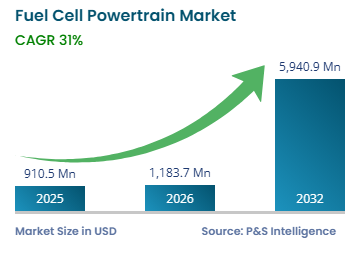
The global fuel cell powertrain market value stood at USD 910.5 million in 2025 and is projected to reach USD 5940.9 million by 2032, expanding at a CAGR of 31.0% over 2026–2032. Accelerating regulatory mandates for zero-emission transportation are reshaping procurement timelines across commercial fleet operators globally. Rapid advances in polymer electrolyte membrane (PEM) fuel cell stack design have simultaneously reduced system costs and extended operational durability, broadening the commercially viable application range.
Key Market Insights
Fuel cell stacks & hydrogen storage systems command the largest share, of 35%.
Heavy commercial vehicles are expected to register the highest CAGR, of 31.2%.
The less than 150 kW category accounted for the largest share in 2025, of 60%.
AWD is anticipated to experience the highest CAGR during 2026–2032, of 31.4%.
APAC has the largest share, of 45%, and also, the highest CAGR, of 31.5% CAGR.
Hydrogen refueling infrastructure is expanding across key economies in Asia-Pacific, North America, and Europe, providing the distribution backbone that underpins fleet-scale adoption. Fuel cell powertrains convert stored hydrogen into electricity to drive traction motors, delivering refueling times under five minutes and ranges exceeding 450 miles for heavy-duty platforms. Superior payload capacity relative to battery-electric alternatives positions the technology as a structurally differentiated solution for commercial and heavy-duty transport segments.
Government programs are providing quantifiable momentum, with China accounting for nearly 95% of the global fuel cell commercial vehicle stock. The U.S. Department of Energy Hydrogen and Fuel Cell Technologies Office has committed sustained research, development, and demonstration funding targeting cost reduction, durability improvements, and heavy and medium-duty vehicle applications as strategic priorities.
The U.S. Congress directed about USD 170 million in funding for HFTO for FY2024, representing most of its appropriations within the Office of Energy Efficiency and Renewable Energy’s hydrogen portfolio. The U.S. Department of Energy’s Hydrogen and Fuel Cell Technologies Office offered up to USD 46 million in funding in October 2024 for R&D and demonstration of clean hydrogen and fuel cell technologies for heavy- and medium-duty vehicles. OEM investment commitments and supply-chain scaling across the value chain are following directly from these policy signals.
Fuel Cell Powertrain Market Trends & Drivers
Shift in Deployment from Cars to Heavy-Duty Vehicles Is Major Market Trend
The fuel cell powertrain market is undergoing a structural reorientation, with heavy-duty transport displacing passenger cars as the primary growth vector. Class 8 trucks, municipal buses, and freight rail are now the segments defining product roadmaps, capital allocation, and infrastructure investment priorities across the industry. An identifiable techno-economic logic underpins this shift. The value proposition of hydrogen powertrains strengthens as payload, range, and refueling frequency requirements increase — conditions that are inherently more pronounced in commercial operations than in personal mobility. Battery-electric systems impose weight penalties at the energy capacities required for long-haul freight. Fuel cell systems separate power output from energy storage, enabling operators to scale range without proportional weight increases.
Toyota Motor Corporation's third-generation fuel cell system, which debuted at ACT Expo 2025, is explicitly designed for both heavy-duty trucks and passenger vehicles with a projected 600,000-mile service life for trucks. Hyundai Motor Company's XCIENT Fuel Cell Class 8 tractor, introduced at ACT Expo 2025 with a 450-mile range and 20-minute refueling capability, targets North American fleet operators. The IEA Global Hydrogen Review 2025 notes that heavy trucks remain the only fast-growing market for fuel cell electric vehicles globally despite broader FCEV adoption headwinds. Long-term fleet procurement contracts and OEM capital commitments to heavy-duty platforms are locking the market's innovation cycle and cost curve to commercial vehicle requirements rather than passenger car benchmarks.
Zero-Emission Regulatory Mandates and Government Incentives Drive Market
Globally, the transport sector is responsible for approximately 15% of total CO₂ emissions, with road transport accounting for the largest share, roughly 74% of all transport-related CO₂, according to the IEA. Within road transport, passenger cars contribute about 45% of emissions, while heavy-duty trucks and buses make up around 20–25%, based on IEA and Global Carbon Project assessments.
Binding emissions legislation is the most direct external force propelling fuel cell powertrain adoption. The European Union's CO₂ mandate requires more than four-fifths reduction in new heavy-duty truck emissions by 2040, creating a hard regulatory ceiling that eliminates diesel as a long-term solution for fleet operators. California's Advanced Clean Cars II rule requires complete zero-emission light-duty vehicle sales by 2035, further compressing the commercial window for combustion alternatives. The policy certainty these mandates provide is what justifies multi-year capital commitments in fuel cell platform development and hydrogen supply chain construction — translating directly into OEM investment decisions.
Government funding programs are reducing technology risk in parallel. The IEA Global Hydrogen Review 2024 documented nearly USD 100 billion in public funds announced, entering force, or allocated to hydrogen projects in a single year, with 60 national hydrogen strategies now published covering countries that account for over 84% of global energy-related CO₂ emissions. Nine countries introduced manufacturing incentives specifically targeting electrolyzer and fuel cell production. In Asia-Pacific, government subsidies covering up to 40% of vehicle cost in China and South Korea are shortening fleet payback windows and anchoring regional demand. OEM roll-outs are accelerating at a pace that performance mandates and direct financial support together are sustaining, beyond what pure market forces alone would produce.
In the United States, the federal government has allocated USD 7.5 billion for EV charging infrastructure nationwide, including USD 5 billion through the National Electric Vehicle Infrastructure (NEVI) program and USD 2.5 billion via the Charging and Fueling Infrastructure Discretionary Grants over fiscal years 2022–2026. Additional federal grants totalling USD 635 million were awarded in 2025 for EV and alternative fuel infrastructure deployment, with several billion dollars more supporting low- and zero-emission buses, heavy-duty trucks, and transit electrification.
In the European Union, the European Commission approved EUR 600 million under the Alternative Fuels Infrastructure Facility to deploy EV and hydrogen refuelling infrastructure, alongside over EUR 2.5 billion in grants since 2021 to decarbonise transport infrastructure. The EU also announced a EUR 4.6 billion Innovation Fund supporting EV batteries, hydrogen projects, and broader transport decarbonisation initiatives, including public transport electrification and zero-emission vehicle deployment.
In China, public investment in electrified transport reached a majority of the estimated USD 397.5 billion invested in 2024, covering passenger EVs, commercial vehicles, and public transit electrification. The government is supporting the rapid expansion of charging networks with 73,000 new public stations and over 1 million new charging devices planned in 2025, as well as funding for hydrogen refuelling networks, pilot projects, and regional green transport initiatives.
In India, total public investment in electric transport from 2020–2025 is INR 2.23 lakh crore (USD 25.6 billion), including INR 18,251 crore (USD 2.09 billion) for EV subsidies and INR 1,980 crore (USD 2.36 billion) for public charging infrastructure. Additionally, the government is piloting INR 600 crore (USD 68.6 million) green hydrogen refuelling projects along national highways, while state-level investments support electrification of buses, three-wheelers, and two-wheelers to accelerate transport decarbonisation.
High System Costs and Inadequate Refueling Infrastructure Hamper Market Growth
Despite strong policy tailwinds, the fuel cell powertrain market faces material structural restraints that are moderating near-term penetration rates. Upfront system costs remain substantially higher than incumbent diesel powertrains. Fuel cell systems represent approximately 60% of total FCEV cost, and at current production volumes, the per-kilowatt cost has not yet reached competitive parity with either diesel or battery-electric alternatives for light-duty applications.
At current low production volumes, a typical FCEV drivetrain for a passenger vehicle includes a 100-kW fuel cell stack costing USD 12,000–14,000, balance-of-plant components around USD 6,000, electric motor and inverter at USD 8,000, hydrogen storage at USD 8,000–10,000, and a small battery at USD 2,000, with the vehicle glider adding roughly USD 10,000, bringing the total base vehicle cost to about USD 50,000. Fuel cell stacks alone account for 30–35% of the drivetrain cost, and when dealer mark-ups and full cost recovery are included, the incremental retail price for the end buyer can be around USD 14,000 higher than a comparable conventional drivetrain.
The limited hydrogen refueling network compounds this cost disadvantage. H2Stations.org reported approximately 1,160 hydrogen refueling stations in operation globally at the end of 2024, compared to roughly 4.5 million EV charging points. The IEA Global Hydrogen Review 2025 notes that signed offtake agreements for low-emissions hydrogen covered only 1.7 Mtpa in 2024, down from 2.4 Mtpa in 2023, with just 20% constituting firm commitments. Supply-side investment is running ahead of confirmed demand. Cold-start performance limitations and durability concerns under extreme duty cycles add further complexity. The still-evolving global standards framework across SAE, ISO, and NHTSA increases certification costs and deployment timelines. These barriers will moderate adoption, particularly in light-duty segments, even as heavy-duty commercial applications progress toward commercial viability.
Fuel Cell Powertrain Market Segmentation Analysis
Component Analysis
The fuel cell stack & hydrogen storage system category commanded the largest revenue share in 2025, of 35%. Its structural centrality to every FCEV platform places it in an unchallengeable revenue position relative to balance-of-plant items. The fuel cell stack alone is the electrochemical core where hydrogen and oxygen react across PEMs to generate electricity. High-pressure hydrogen storage tanks, typically Type IV composite cylinders rated at 700 bars, determine vehicle range and are engineered and validated alongside the stack as the primary powertrain investment by OEMs. The Toyota Mirai's 128 kW stack and Hyundai NEXO's architecture both create switching barriers that reinforce incumbent supplier positions across procurement cycles.
The inverter/converter category is expected to register the highest growth rate during 2026–2032. High-power commercial vehicle platforms, requiring sophisticated DC–DC conversion and three-phase inverter systems to interface the fuel cell's direct current output with traction motors, are proliferating rapidly. As heavy-duty applications scale toward 250 kW and multi-stack configurations exceed 350 kW, the power electronics content per vehicle increases disproportionately.
The U.S. Department of Energy Fuel Cell Technologies Office highlights power electronics integration as a critical pathway for improving system efficiency and reducing balance-of-plant costs. The transition to silicon carbide (SiC) switching devices is enabling higher switching frequencies and reduced thermal losses. More compact inverter form factors are emerging from this materials shift, meeting the packaging constraints of commercial vehicle platforms where space and weight margins are tightly governed.
The market segments into the following components:
Fuel Cell Stack & Hydrogen Storage System (Largest Category)
Motor/Generator
Inverter/Converter (Fastest Growing Category)
Controller
Battery & Battery Management System (BMS)
Power Distribution Module (PDM)
Vehicle Type Analysis
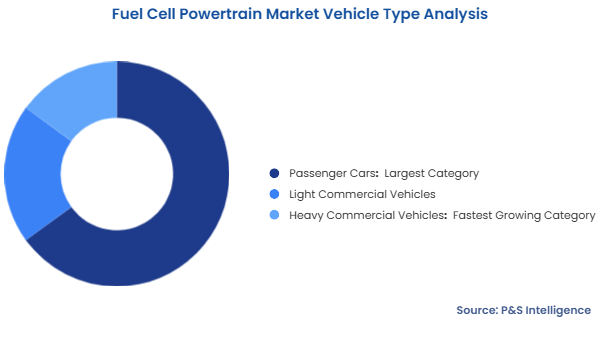
Passenger cars held the largest share, of 65%, due to the commercial momentum built by Toyota Mirai and Hyundai NEXO in established FCEV markets in Japan, South Korea, and California. These vehicles represent the only commercially available mass-produced fuel cell passenger platforms with functioning retail hydrogen infrastructure, while other vehicle categories are still largely in pilot or pre-commercial phases. The installed base of passenger FCEVs drives aftermarket parts and service revenue, while also providing OEMs with real-world operational data that informs next-generation stack development. Government purchase incentives in Japan and South Korea have been specifically calibrated to support passenger FCEV demand.
Heavy commercial vehicles are expected to register the highest CAGR during 2026–2032, due to the structural alignment between fuel cell capabilities and commercial fleet requirements. Regulatory pressure to decarbonize logistics and the operational economics of hydrogen in high-utilization, fixed-route deployments drive this category. Hyundai's XCIENT has accumulated over 8 million miles in commercial service in Europe, establishing a real-world durability record that fleet procurement teams can evaluate against diesel benchmarks. Toyota's Class 8 heavy-duty program targeting North American logistics corridors extends this commercial validation into the world's largest freight market, together demonstrating the segment's maturation from demonstration projects toward genuine fleet procurement.
The market segments into the following vehicle types:
Passenger Cars (Largest Category)
Light Commercial Vehicles
Heavy Commercial Vehicles (Fastest Growing Category)
Power Output Analysis
The less than 150 kW category accounted for the largest revenue share in 2025, of 60%, because most fuel cell cars operate under 150 kW of power. Toyota Mirai's powertrain delivers 128 kW, and the Hyundai NEXO operates at comparable output levels, placing both squarely within this bracket. Light-duty personal mobility places well-defined performance demands around acceleration and highway capability, and the sub-150 kW power envelope meets these requirements without over-engineering the drivetrain. The category also benefits from the most mature manufacturing ecosystem in the industry. Stack designs and thermal management systems have been optimized for this output range. Power electronics packages are following the same refinement curve.
The more than 250 kW category is projected to demonstrate the highest CAGR during 2026–2032. Heavy-duty commercial vehicle platforms are scaling rapidly, and fuel cell powertrains must match or exceed the performance of diesel drivetrains rated at 400–600 horsepower. Multi-stack configurations in commercial deployment now exceed 350 kW. Cellcentric's platform targeting series production delivers 350 kW with 25,000 hours of rated life.
The market segments into the following power output categories:
Less than 150 kW (Largest Category)
150–250 kW
More than 250 kW (Fastest Growing Category)
Drive Type Analysis
RWD held the largest share of the fuel cell powertrain market in 2025, of 65%, as these drivetrains are preferred for trucks. These architectures naturally accommodate fuel cell stacks, hydrogen storage tanks, and battery buffers in the rear powertrain layout, making RWD the path of least resistance for heavy vehicle integration. Heavy commercial vehicles represent the largest deployed fleet of fuel cell powertrains by volume in China, and their reliance on RWD is rooted in engineering fundamentals.
Torsional rigidity and the high torque delivery required for gradeability under maximum payload are inherent advantages of rear-drive driveline packaging in these applications. OEM investment in optimizing chassis layouts and thermal routing for rear-drive architectures has compounded over successive platform generations, with hydrogen plumbing integration now reaching a level of maturity that further consolidates RWD's segment leadership.
AWD is anticipated to experience the highest CAGR during 2026–2032. In passenger SUVs and premium performance platforms, traction stability and all-weather reliability are preferred, and RWD cannot satisfy this. The rising demand for off-road capability is further driving the demand for AWD fuel cell platforms. BMW's planned third-generation fuel cell system, developed in collaboration with Toyota Motor Corporation for series production in 2028, targets a front–rear e-axle combination for premium passenger FCEVs. AWD dual-motor configurations also unlock regenerative braking on both axles. The resulting improvement in overall system efficiency reinforces the performance narrative for hydrogen powertrains in premium segments where total cost of ownership calculations extends beyond fuel economy alone. The IEA Advanced Fuel Cells TCP Annual Report 2024 confirms continued expansion of fuel cell vehicle deployment and infrastructure development across the key FCEV markets where premium passenger adoption is most concentrated.
The market segments into the following drive types:
Rear-Wheel Drive (RWD) (Largest Category)
Front-Wheel Drive (FWD)
All-Wheel Drive (AWD) (Fastest Growing Category)
Drive strategic growth with comprehensive market analysis
Fuel Cell Powertrain Market Geographical Analysis
Asia-Pacific Fuel Cell Powertrain Market Outlook
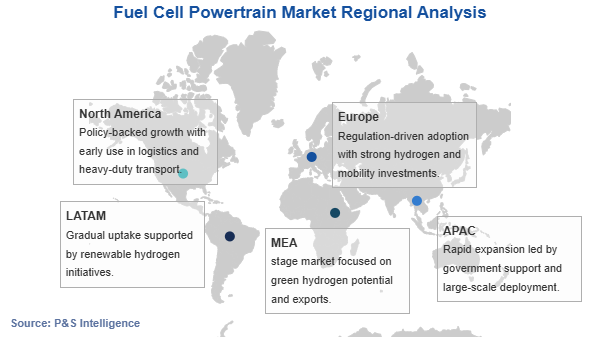
Asia-Pacific held the largest regional share in the global fuel cell powertrain market in 2025, of 45%, and it is also the fastest-growing market, with 31.5% CAGR. This is due to China’s global lead, FCEV commercialization ecosystem of Japan, and South Korea's government-directed hydrogen economy buildout. In China, provincial subsidies covering up to 40% of vehicle acquisition costs have compressed fleet payback windows. A vertically integrated supply chain spanning membrane electrode assemblies, stack manufacturing, and hydrogen production has enabled domestic manufacturers to scale rapidly.
Japan contributes through decades of foundational R&D investment and the world's most developed light-duty FCEV retail infrastructure. Government targets of 200,000 FCEVs and 320 hydrogen refueling stations by 2025 under its Strategic Roadmap sustain Toyota and Honda's domestic commercialization programs.
South Korea is the Fastest Growing country market in the region. Hyundai Motor Company's XCIENT commercial fleet programs and government fleet procurement mandates are the primary demand mechanisms, supported by a hydrogen economy roadmap that envisions multiple FCEV models and supporting infrastructure through 2040. The IEA Korea Hydrogen Economy Roadmap 2040 reflects a policy architecture that integrates production, distribution, and end-use demand stimulation in a manner that sustains stack factory utilization and drives continuous cost reduction. Government commitments compound with OEMs’ manufacturing scale.
China Fuel Cell Powertrain Market Analysis
China held the largest country market share within Asia-Pacific in 2025, representing the single largest national deployment of fuel cell commercial vehicles globally. The Chinese government's cluster-based hydrogen city program has concentrated refueling infrastructure and fleet procurement in designated corridors. This enables hydrogen supply for viable commercial operations without requiring nationwide network buildout. Domestic manufacturers have leveraged provincial subsidies and vertically integrated supply chains to scale low-cost truck platforms. Value-priced fuel cell trucks targeted at logistics operators in Hebei, Guangdong, and Shandong provinces have rapidly expanded unit share for domestic players.
Toyota Motor Corporation announced USD 139 million investment to construct a fuel cell manufacturing base in Chengdu in 2025. The IEA Global Hydrogen Review 2024 documented that China is deploying competitive bidding mechanisms and direct incentives for fuel cell manufacturing. This creates a policy environment that rewards scale and accelerates cost reduction. China's market is increasingly supplemented by technology upgrades, as domestic stack manufacturers close performance gaps with their Japanese and South Korean counterparts.
The regions and countries analyzed in this report include:
North America
U.S. (Largest Country Market)
Canada (Fastest Growing Country Market)
Europe
Germany (Largest Country Market)
U.K.
France (Fastest Growing Country Market)
Italy
Spain
Rest of Europe
Asia-Pacific (Largest and Fastest Growing Region)
China (Largest Country Market)
Japan
South Korea (Fastest Growing Country Market)
India
Australia
Rest of Asia-Pacific
Latin America
Brazil (Largest Country Market)
Mexico
Rest of Latin America
Middle East & Africa (Fastest Growing Region)
Saudi Arabia
U.A.E. (Largest Country Market)
South Africa (Fastest Growing Country Market)
Rest of Middle East & Africa
Fuel Cell Powertrain Market Share Analysis
The global fuel cell powertrain market is moderately consolidated, shaped by high technology barriers, proprietary stack architectures, and the capital intensity of hydrogen vehicle platform development. Vertically integrated OEMs form the core, competing alongside specialized fuel cell technology developers. Tier-1 automotive suppliers compete as systems integrators, while powertrain engineering firms address the commercial vehicle transition from the drivetrain side.
Decades of PEMFC stack R&D investment and certified hydrogen storage system designs sustain the structural barriers that define this concentration. Regulatory certification costs and the supply chain relationships required to source platinum group metal catalysts and specialty membrane electrode assemblies at commercial volumes further raise the entry threshold for new competitors. Chinese market participants have built cost competitiveness in domestic commercial truck segments through provincial subsidies and vertically integrated supply chains, and are beginning to expand their competitive presence in export markets.
Major Players in the Fuel Cell Powertrain Market :
Toyota Motor Corporation
Hyundai Motor Company
Ballard Power Systems Inc.
Robert Bosch GmbH
Cummins Inc.
Honda Motor Co. Ltd.
DENSO Corporation
General Motors Company
Plug Power Inc.
Nikola Corporation
Daimler Truck AG
FEV Europe GmbH
PowerCell Sweden AB
Shanghai Hydrogen Propulsion Technology Co. Ltd.
Weichai Power Co. Ltd.
BorgWarner Inc.
Magna International Inc.
Fuel Cell Powertrain Market News
In April 2025, Honda Motor Co. Ltd. unveiled its next-generation fuel cell module at ACT Expo 2025 in North America, developed independently with a rated output of 150 kW. The new module delivers 50% lower cost and double the durability compared to the current-generation unit, with triple the volumetric power density, enabling more compact integration across commercial vehicle architectures. A licensing pathway for third-party commercial truck builders extends Honda's fuel cell technology reach into heavy-duty commercial vehicles.
In April 2025, Hyundai Motor Company introduced the updated XCIENT Fuel Cell Class 8 heavy-duty tractor at ACT Expo 2025, featuring a 180 kW fuel cell system with two 90 kW stacks and a 72 kWh battery pack. A maximum range of 450 miles with 20-minute refueling capability tailors the platform specifically for the North American market. The launch advances Hyundai's hydrogen business expansion in the U.S. logistics corridor.
In April 2025, Toyota Motor Corporation debuted its Generation 3 fuel cell system in North America at ACT Expo 2025, delivering 20% higher efficiency and power than the previous generation and a projected 600,000-mile service life for truck applications. Modular scalability across heavy-duty trucks and passenger vehicles extends the system's addressable range beyond any single vehicle category. Toyota also announced plans to deploy hydrogen-powered Class 8 fuel cell trucks in its North America Parts Center California logistics operations, converting diesel tractor-trailers to zero-emission platforms.
In September 2024, BMW Group and Toyota Motor Corporation expanded their collaboration to develop third-generation hydrogen powertrains, confirming BMW's first series-production fuel cell electric vehicle for 2028.
In February 2024, Honda Motor Co. Ltd. launched the plug-in hydrogen FCEV 2025 CR-V e:FCEV in North America. It features a powertrain co-developed with General Motors Company.
Frequently Asked Questions About This Report
What will be the fuel cell powertrain market 2032 size?+
In 2032, the market for fuel cell powertrains will value USD 5940.9 million.
Which component leads the fuel cell powertrain industry?+
Fuel cell stacks & hydrogen storage systems dominate the fuel cell powertrain industry with 35% revenue.
Which is the largest region in the fuel cell powertrain market?+
APAC is the largest market for fuel cell powertrain, with 45% share.
What are the key fuel cell powertrain industry drivers?+
The global fuel cell powertrain industry is driven by accelerating regulatory mandates for zero-emission transportation, advances in PEM technology, reducing system costs, and extending operational durability.
What is the fuel cell powertrain market nature?+
The market for fuel cell powertrain is consolidated.
Want a report tailored exactly to your business need?
Leading companies across industries trust us to deliver data-driven insights and innovative solutions for their most critical decisions. From data-driven strategies to actionable insights, we empower the decision-makers who shape industries and define the future. From Fortune 500 companies to innovative startups, we are proud to partner with organisations that drive progress in their industries.
Client Testimonials
Working with P&S Intelligence and their team was an absolute pleasure – their awareness of timelines and commitment to value greatly contributed to our project's success. Eagerly anticipating future collaborations.
McKinsey & Company
India
Unmatched Standards
Our insights into the minutest levels of the markets, including the latest trends and competitive landscape, give you all the answers you need to take your business to new heights
Complete Data Security
We take a cautious approach to protecting your personal and confidential information. Trust is the strongest bond that connects us and our clients, and trust we build by complying with all international and domestic data protection and privacy laws