
- Published: July 2021
- Report Code: 12198
- Available Format: PDF
- Report Description
- Table of Contents
- Market Segmentation
- Request Free Sample
Market Overview
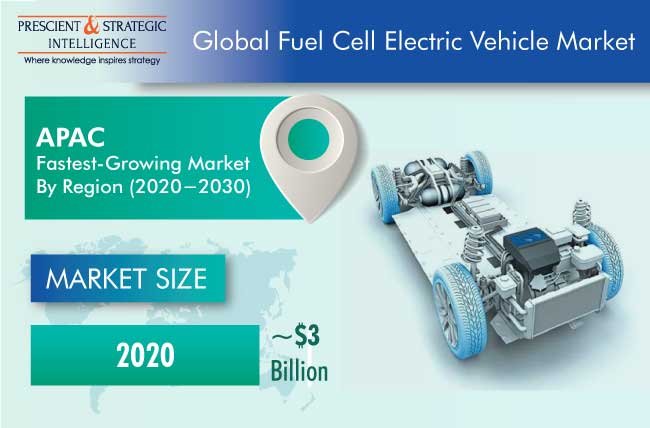
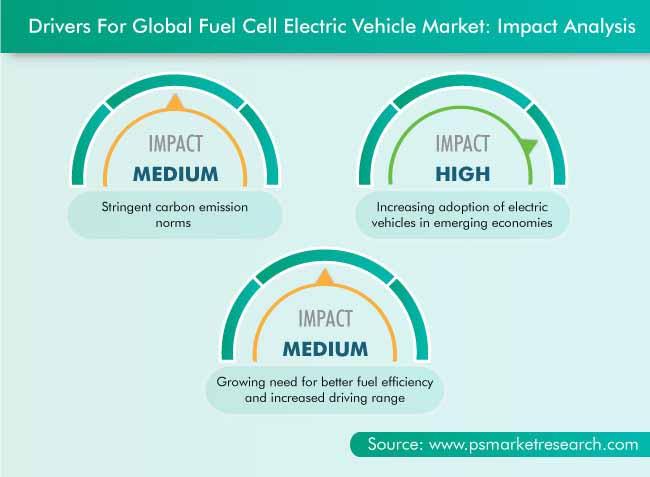
The global fuel cell electric vehicle market was valued at ~$3 billion in 2020. The major influencers for the growth of the market are the strict norms for carbon emissions, increasing adoption of electric vehicles in emerging economies, longer drive range offered by these vehicles, and growing need for better fuel efficiency.
The market has been negatively impacted by the epidemic of COVID-19. With lockdowns implemented globally, manufacturing facilities were shut down. The effects were observable in the crude prices as well, which went historically low, into negatives. Thus, the high prices of FCEVs, along with the low prices of crude oil, discouraged people from adopting FCEVs.
Due to Stringent Norms to Curb Vehicular Pollution, Passenger Vehicle Category Accounted for Larger Share in 2020
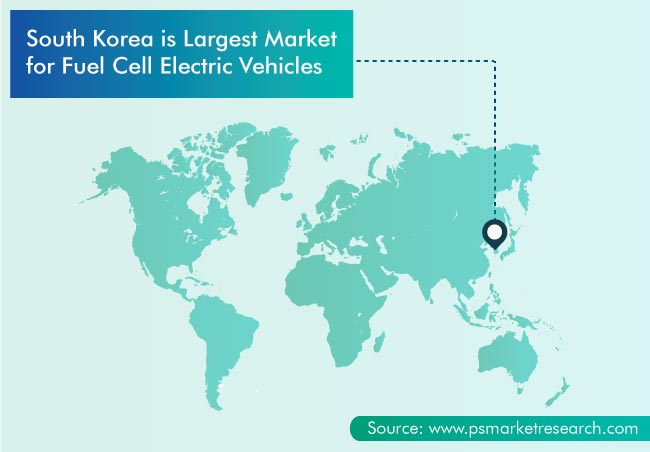
The passenger vehicle category held the larger share in the fuel cell electric vehicle market in 2020, on the basis of vehicle type. This can be attributed to the rising per capita income in the developing markets, high demand for clean personal mobility, and stringent government norms to curb vehicular pollution. Moreover, many countries are planning the conversion of taxi and cab fleets into FCEVs. For instance, South Korea is targeting to deploy approximately 120,000 fuel cell vehicles by the end of 2040.
Short Range Category To Witness Faster Growth owing to Rising Demand for Low-Emission Vehicles for Everyday Commute
The short category is projected to witness the faster growth in the market during the forecasted period, based on range. This can be attributed to the rising demand for low-emission vehicles for short-distance travel or commuting. Moreover, such vehicles are being increasingly used across diverse applications, including transportation of goods within ports and airports and by e-commerce companies to reduce their carbon footprint, which renders a positive market outlook.
Fastest Growth of APAC Supported by Stringent Emission Norms of Regional Governments
The presence of stringent government regulations is one of the main factors responsible for the fastest growth of the Asia-Pacific (APAC) market for fuel cell electric vehicle, globally. In addition, the major countries in the region have been investing heavily for the development of hydrogen fuel cell vehicles. Toyota Motor Corporation and Hyundai Motor Company offer fuel cell passenger cars, buses, and logistical vehicles in the region.
Technological Advancements for Improved Range and Efficiency Are Major Trends
Fuel cell vehicles have gained popularity in recent years as a result of their improved performance, shorter refueling time, and longer range. Other than these advantages and reduced emissions, the technology results in superior power and higher torque. Furthermore, a fuel cell vehicle has a driving range of 300 to 380 miles. Moreover, recent catalyst developments are key for the future of the fuel cell technology, as they will improve durability through innovative catalyst layer designs. Thus, the continuous technological advancements in the fuel cell technology can be viewed as a major trend in the market for fuel cell electric vehicle.
Stringent Carbon Emission Norms and Rising Adoption of Zero-Emission Vehicles To Drive Market for Fuel Cell Electric Vehicle
Stringent carbon emission regulations, including those with respect to fuel efficiency, implemented at the international and country levels continue to drive the growth of the fuel cell electric vehicle market. The mounting concerns over carbon dioxide emissions globally are leading to the reducing demand for conventional vehicles, ultimately benefiting the market for fuel cell electric vehicle. For instance, the U.S. Environmental Protection Agency (EPA) emphasizes the usage of FCEVs to reduce carbon dioxide emissions. Furthermore, the European Union is dedicated to reducing vehicular emissions by 80% by the year 2050 from the 1990 levels, by promoting the adoption of green vehicles.
| Report Attribute | Details |
Historical Years |
2015-2020 |
Forecast Years |
2021-2030 |
Base Year (2020) Market Size |
~$3 Billion |
Report Coverage |
Market Trends, Revenue Estimation and Forecast, Segmentation Analysis, Regional and Country Breakdown, Competitive Analysis, Companies’ Strategic Developments, Impact of COVID-19, Company Profiling |
Market Size by Segments |
Type, Vehicle Type, Range, Region |
Market Size of Geographies |
U.S., Canada, Germany, U.K., France, Italy, Spain, China, Japan, India, Australia, South Korea, Brazil, Mexico, Saudi Arabia, South Africa |
Secondary Sources and References (Partial List) |
American Trucking Associations (ATA), Association for the Advancement of Artificial Intelligence (AAAI), Automotive Parts Manufacturer's Association (APMA), Bureau of Transportation Statistics (BTS), European Association for Artificial Intelligence (EurAI), European Automobile Manufacturers Association (ACEA), Institute of Electrical and Electronics Engineers (IEEE), Insurance Regulatory and Development Authority of India (IRDAI), Mobile Technology Association of Michigan (MTAM), National Highway Traffic Safety Administration (NHTSA), Society of Automotive Engineers (SAE) |
Explore more about this report - Request free sample
Market Players Are Involved in Collaborations and Partnerships
The key strategies adopted by the manufacturers of FCEVs are partnerships and collaborations with other automobile original equipment manufacturers (OEMs).
- In June 2020, Toyota formed a joint venture in China with five other companies for the development of fuel cells. Named United Fuel Cell System R&D, the joint venture fetched an initial investment of $46 million. The companies involved in the joint venture are Dongfeng Motor Corp., Guangzhou Auto, China FAW Corp., Beijing Automobile Group Co., and Beijing SinoHytec Co.
- In April 2020, Daimler AG formed a $1.3-billion hydrogen fuel cell Joint venture with Volvo Group. The two auto manufacturers are expected to bring out hydrogen-fuel-powered commercial vehicles in the future.
Key Players in Fuel Cell Electric Vehicle Market Include:
-
Honda Motor Co.
-
Toyota Motor Corporation
-
Hyundai Motor Company
-
Daimler AG
-
Tata Motors Limited
-
Ashok Leyland Ltd.
-
Nikola Corporation
-
Solaris Bus & Coach sp. z o.o.
-
SAIC Motor Corporation Limited
Market Size Breakdown by Segments
The fuel cell electric vehicle market report offers comprehensive market segmentation analysis along with market estimation for the period 2015-2030.
Based on Type
- Polymer Electrolyte Membrane Fuel Cell (PEMFC)
- Phosphoric Acid Fuel Cell (PAFC)
Based on Range
- Short
- Long
Based on Vehicle Type
- Passenger Vehicle
- Commercial Vehicle
Geographical Analysis
- North America
- U.S.
- Canada
- Europe
- Germany
- France
- U.K.
- Italy
- Spain
- Asia-Pacific (APAC)
- Japan
- China
- India
- Australia
- South Korea
- Latin America (LATAM)
- Brazil
- Mexico
- Middle East and Africa (MEA)
- Saudi Arabia
- South Africa
Market Segment Analysis of Countries
- Further breakdown of 16 listed countries will be provided as per below segmentation:
- By type
- By range
- By vehicle type
Want a report tailored exactly to your business strategy?
Request CustomizationWant an insight-rich discussion with the report author?
Speak to Analyst
Our dedication to providing the most-accurate market information has earned us verification by Dun & Bradstreet (D&B). We strive for quality checking of the highest level to enable data-driven decision making for you

Our insights into the minutest levels of the markets, including the latest trends and competitive landscape, give you all the answers you need to take your business to new heights

With 24/7 research support, we ensure that the wheels of your business never stop turning. Don’t let time stand in your way. Get all your queries answered with a simple phone call or email, as and when required

We take a cautious approach to protecting your personal and confidential information. Trust is the strongest bond that connects us and our clients, and trust we build by complying with all international and domestic data protection and privacy laws