France Autonomous Delivery Robots Market Size & Share Analysis - Trends, Drivers, Competitive Landscape, and Forecasts (2026 - 2032)
This Report Provides In-Depth Analysis of the France Autonomous Delivery Robots Market Report Prepared by P&S Intelligence, Segmented by Type (Outdoor, Hybrid, Indoor), Component (Hardware, Software, Services), Payload (Light (?10 kg), Medium (10, Heavy (>30 kg)), End User (Retail & E-Commerce, Food & Beverage, Medical Devices & Pharmaceuticals, Logistics & Warehousing, Hospitality, Industrial Manufacturing), and Geographical Outlook for the Period of 2019 to 2032
France Autonomous Delivery Robots Market Growth Potential
Key Highlights
Study Period
2019 - 2032
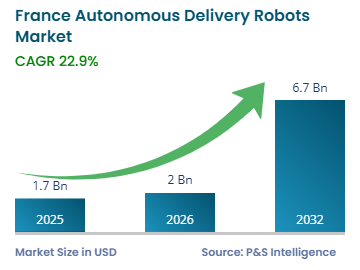
Market Size in 2025
USD 1.7 Billion
Market Size in 2026
USD 2.0 Billion
Market Size by 2032
USD 6.7 Billion
Projected CAGR
22.9%
Largest Emirate
Ile-de-France
Fastest-Growing Emirate
Auvergne–Rhone–Alps
Market Structure
Moderately Fragmented
Market Size
Explore the market potential with our data-driven report
France Autonomous Delivery Robots Market Overview
The French autonomous delivery robots (ADR) market valued USD 1.7 billion in 2025, and it will reach USD 6.7 billion by 2032, witnessing a CAGR of 22.9% during the forecast period (2026–2032). The market advance is supported by a maturing regulatory environment, rising e-commerce penetration, accelerating urban logistics demands, and integration of AI, LiDAR-enabled navigation, and 5G connectivity into last-mile delivery infrastructure.
Key Market Insights
Hardware commanded the largest share in 2025, of 60%.
Software will register the fastest growth during 2026–2032, at 30.3% CAGR.
The light category dominates the French ADR market in 2025 with 65% share.
The food & beverage category is projected to demonstrate the highest growth rate during 2026–2032, of 30.1%.
Île-de-France represents the largest market, with 45% share.
Auvergne–Rhône–Alpes constitutes the fastest-growing market, with 30.5% CAGR.
The French e-commerce ecosystem provides a critical structural driver for ADR adoption. According to Fédération du e-commerce et de la vente à distance (FEVAD), France recorded EUR 175.3 billion in e-commerce revenue in 2024, with 2.6 billion transactions conducted by approximately 41.6 million online buyers. This represented 73.3% of the population aged 15 and above—a 9.6% year-on-year increase. This sustained volume of parcel demand, particularly in metropolitan corridors, is encouraging retailers and logistics operators to invest in scalable, contactless autonomous platforms for last-mile deliveries.
France Autonomous Delivery Robots Market Emerging Trends
Regulatory Evolution Is Major Trend in Market
France's progressive regulatory framework is actively shaping market maturation by enabling commercial ADR deployments beyond the experimental phase. The French Ministry of Ecological Transition's National Strategy for Automated and Connected Road Mobility (2025–2027) outlines structured action areas across regulatory harmonization, connectivity infrastructure, and AI validation. It allocated approximately EUR 95 million to autonomous mobility projects through programs including France 2030. France was the first European country to implement a comprehensive legal framework for autonomous vehicles on public roads.
In 2021, the French Ministry of Ecological Transition established operational conditions, safety standards, and authorization procedures for autonomous delivery systems. This was further strengthened by Décret n° 2024-1063 of November 2024, specifically governing automated road transport of goods, enabling commercial-scale deployment beyond experimental frameworks. It directly expands the legal operating scope for ADR companies seeking commercial licenses. This regulatory clarity reduces investment risk, shortens time-to-deployment for operators, and signals institutional commitment to embedding autonomous logistics within France's broader smart city and green mobility agenda.
Labor Shortage in Logistics Driving Demand for Autonomous Delivery Solutions
The persistent labor shortage across France's transport and logistics sector are a primary structural catalyst propelling demand for autonomous delivery robots. As per European Employment Services (EURES), more than 6 out of 10 French employers anticipated recruitment difficulties in 2024. The transportation and logistics sector—encompassing drivers, logistics chain managers, and warehouse operators—was explicitly identified among the highest-shortage occupational sectors.
This structural gap is exacerbated by an aging workforce and insufficient pipeline of new entrants into physically demanding delivery roles. As of early 2025, France had about 14.57 million people aged 65 and over, representing roughly 22 % of its total population of around 66.35 million. The number of people aged 65 and older in metropolitan France is expected to increase by around 36 % by 2050. The median age in France is approximately 42.3 years, with the share of those aged 80 and above rising, reflecting longer life expectancies, as per the UNECE Ageing Policies database. This demographic shift has also contributed to more deaths than births for the first time since World War II in 2025.
Urban delivery volumes continue to be fueled by France's 41.6 million active online buyers. Thus, the inability to scale human labor cost-effectively is accelerating the adoption of ADRs for last-mile order fulfilment. This is particularly true for high-density urban corridors, where demand–density economics make robot deployment commercially viable.
Regulatory Complexity and Urban Infrastructure Gaps Restraining Rapid Scale-Up
Despite progressive national-level legislation, France's ADR market faces meaningful near-term restraints from fragmented municipal authorization processes and uneven urban infrastructure compatibility. Individual city administrations retain authority over sidewalk access, speed limits, and operational zone designations for delivery robots. This creates varying compliance complexity across Paris arrondissements, Lyon districts, and provincial municipalities. Additionally, the narrow cobblestone streets, dense pedestrian traffic in historic city centers, and inconsistent pavement maintenance in secondary cities present operational challenges. This is because most current-generation outdoor ADR platforms are optimized for uniform surfaces. These infrastructure and regulatory fragmentation challenges elevate per-city entry costs and extend deployment timelines, thereby limiting commercial scaling for international ADR operators across France.
France Autonomous Delivery Robots Market Segmentation Analysis
Type Analysis
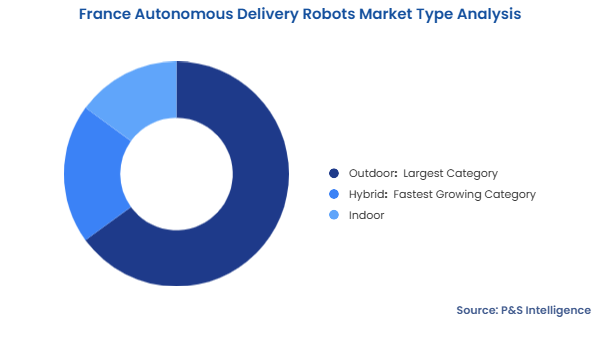
Outdoor autonomous delivery robots accounted for the dominant share of the French ADR market in 2025, of 65%, driven by the sector's fundamental use case in public road and sidewalk last-mile delivery. France's regulatory framework was specifically designed to authorize autonomous systems operating on predefined public road routes and zones. Early commercial deployments by international operators concentrated exclusively in outdoor environments across Paris and Lyon, accumulating operational data and regulatory approvals that reinforce outdoor robot maturity. The hardware robustness required for outdoor weather variability, pedestrian interaction, and multi-terrain navigation further reinforces established supply chains favoring this category.
Hybrid delivery robots are expected to register the fastest growth during 2026–2032, of 22.7%, as they easily transition between indoor and outdoor operational environments. Retail and logistics operators are seeking unified platforms capable of completing end-to-end delivery from warehouse interiors to public sidewalks without robot handoffs. The category’s growth is essentially driven by the expanding use cases in mixed-use logistics hubs, university campuses, and hospital complexes where indoor-to-outdoor continuity is operationally essential.
The market segments into the following types:
Outdoor (Largest Category)
Hybrid (Fastest Growing Category)
Indoor
Component Analysis
Hardware commanded the largest share of the French ADR market in 2025, of 60%, reflecting the capital-intensive reality of building and deploying commercial physical robot fleets. The dominance of hardware also stems from the manufacturing complexity of integrating LiDAR arrays, camera systems, ultrasonic sensors, GPS navigation modules, and weatherproofed chassis into outdoor autonomous robots for operation on varied urban surfaces.
Fleet expansion economics require continuous hardware investment as ADR operators scale from pilot deployments to city-wide commercial coverage. The government's France 2030 program has allocated approximately EUR 60 million to autonomous connected mobility projects by 2024, with a significant portion directed toward hardware R&D and validation infrastructure.
Software is expected to register the fastest growth during 2026–2032. The integration of AI-powered navigation, fleet management systems, and real-time route optimization algorithms improves delivery efficiency without proportional hardware cost increase. As deployed robot fleets accumulate operational mileage in French urban environments, ML systems trained on traffic patterns, pedestrian behavior, and regulatory zone constraints could offer cost-savings and new capabilities.
The market segments into the following components:
Hardware (Largest Category)
Software (Fastest Growing Category)
Services
Payload Analysis
The light (≤10 kg) category dominated the French ADR market in 2025 with 65% share, as the primary ADR applications in France are food delivery, small parcel delivery, and convenience retail fulfilment. The dominance of light-payload platforms reflects established product-market fit. For instance, Starship Technologies' 6-wheeled sidewalk robots have payload capacities optimized for grocery and meal delivery. Such robots have accumulated millions of real-world deliveries across European markets. Transportation and logistics firms in France face significant labor shortages, reinforcing the demand for light-payload delivery robots for food and convenience goods, where robot economics are most favorable.
Heavy payload autonomous delivery systems (>30 kg) are projected to register the fastest growth during 2026–2032, of 30.5%, driven by expanding usage in pharmaceutical logistics, medical equipment transport, and industrial parcel delivery. Here, a greater cargo capacity enables cost-competitiveness with human-operated delivery vans. Recent government policies governing automated road transport of goods provide clearer commercial operating parameters for heavier autonomous freight systems. This is encouraging investment from logistics operators seeking to automate higher-margin B2B delivery routes in France's secondary city corridors.
The market segments into the following payloads:
Light (≤10 kg) (Largest Category)
Medium (10–30 kg)
Heavy (>30 kg) (Fastest Growing Category)
End User Analysis
The retail & e-commerce category held the largest share in the French ADR market in 2025, of 35%, driven by the structural necessity of automating last-mile e-commerce order fulfilment. The booming e-commerce industry of France creates sustained pressure on retail delivery networks, forcing them to purchase to autonomous platforms to reduce per-delivery costs and meet consumer expectations for rapid fulfilment. Major retail operators and third-party logistics providers in Paris and Lyon have pioneered ADR pilot programs precisely because of the high order density here enables robot deployment economics to achieve positive unit margins.
The food & beverage category is projected to demonstrate the highest growth rate during 2026–2032, as it encompasses quick service restaurants, grocery delivery, and meal kit platforms. International platform operators are expanding autonomous delivery partnerships across European markets, with France specifically identified as a near-future target market by many. The concentration of quick-service restaurant density in Paris's metropolitan core, combined with consumers’ preference for sub-30-minute deliveries of prepared food, creates favorable conditions for ADR penetration.
The market segments into the following end users:
Retail & E-Commerce (Largest Category)
Food & Beverage (Fastest Growing Category)
Medical Devices & Pharmaceuticals
Logistics & Warehousing
Hospitality
Industrial Manufacturing
Others
Drive strategic growth with comprehensive market analysis
France Autonomous Delivery Robots Market Regional Outlook
Île-de-France, encompassing the Paris metropolitan area, represents the largest market, with 45% share, as it is the most-advanced and commercially successful ADR deployment zone in France. The region boasts the highest population density in France, exceeding 1,000 inhabitants per km², witnesses the highest e-commerce order volume, and houses major international logistics hubs surrounding Charles de Gaulle and Orly airports. Paris hosts the earliest commercial ADR pilots conducted by international operators, benefiting from established regulatory authorization pathways and urban mobility programs integrated with the city's Grand Paris Express transit expansion. The region's sophisticated digital infrastructure, including a dense 5G network, offers real-time connectivity for outdoor ADR platforms for navigation and fleet management.
Auvergne–Rhône–Alpes, centered on Lyon, constitutes France's fastest-growing ADR market during 2026–2032, with 30.5% CAGR. Lyon's strategic position at the intersection of major north–south and east–west European freight corridors—combined with its status as France's second-largest metropolitan economy—drives ADR deployment for food delivery and logistics applications. Auvergne–Rhône–Alpes is among France's most-economically active regions, but with significant transport and logistics labor shortages, reinforcing the automation investment case.
The regions analyzed in this report include:
Île-de-France (Largest Region)
Auvergne-Rhône-Alpes (Fastest-Growing Region)
Provence-Alpes-Côte d'Azur
Hauts-de-France
Rest of France
France Autonomous Delivery Robots Market Share
The France autonomous delivery robots market exhibits a fragmented competitive structure, with no single operator holding dominant market share. This is because the industry is transitioning from pilot-stage deployments to early commercial-scale operations, encouraging new players to emerge. The commercial maturity of the French ADR market is nascent relative to in the United Kingdom and Northern Europe. Moreover, obtaining municipal operating authorizations across France's decentralized city administrations is complex. Additionally, the capital-intensive nature of fleet deployment limits the number of operators capable of scaling beyond single-city pilots. International players with established European operational credentials dominate France's competitive landscape, as no major domestically headquartered ADR manufacturer has yet achieved meaningful commercial presence.
France Autonomous Delivery Robots Market Producers:
Starship Technologies
Delivers.ai
Cartken
Ottonomy
Piaggio & C. SpA
Aito
KEENON Robotics
Serve Robotics
Goggo Network
TwinswHeel
Kiwibot
Nuro
Robby Technologies
TeleRetail
France Autonomous Delivery Robots Market News
In November 2025, Starship Technologies announced a global autonomous delivery partnership with Uber Technologies targeting multiple European countries in 2026. With 9+ million deliveries completed and 2,700+ robots operating across 270+ locations in seven countries, the collaboration enables Uber Eats to integrate Starship's Level-4 autonomous sidewalk robots into its food delivery network.
In October 2025, Starship Technologies completed a USD 50-million Series C funding round led by Plural, bringing the total capital raised to over USD 280 million. The funding will allow Starship to scale its autonomous delivery fleet from 2,700 robots to over 12,000 by 2027.
In February 2024, Starship Technologies raised USD 90 million (EUR 83.6 million) in a funding round co-led by Plural and Iconical, bringing the total funding to USD 230 million. The investment was directed toward AI and ML development, wireless charging infrastructure rollout, and international market expansion. The company's Delivery as a Service (DaaS) product integrates Starship robots into partner delivery infrastructure, targeting European markets, including France.
Frequently Asked Questions About This Report
What was France autonomous delivery robot market size in 2025?+
In 2025, the autonomous delivery robot market in France size was USD XX million.
Which type has largest France autonomous delivery robot industry share?+
The outdoor type have the largest France autonomous delivery robot industry share, of XX%.
Which end user has the highest France autonomous delivery robot market CAGR?+
F&B has the highest CAGR in autonomous delivery robot market of France, of XX%.
What are the key France autnonomous delivery robot industry drivers?+
The major drivers for the France autonomous delivery robot market are the maturing regulatory environment, rising e-commerce penetration, accelerating urban logistics demands, and integration of AI, LiDAR-enabled navigation, and 5G connectivity into last-mile delivery infrastructure.
What is the France autnonomous delivery robot market nature?+
The autnonomous delivery robot market in France is moderately fragmented.
Want a report tailored exactly to your business need?
Leading companies across industries trust us to deliver data-driven insights and innovative solutions for their most critical decisions. From data-driven strategies to actionable insights, we empower the decision-makers who shape industries and define the future. From Fortune 500 companies to innovative startups, we are proud to partner with organisations that drive progress in their industries.
Client Testimonials
Working with P&S Intelligence and their team was an absolute pleasure – their awareness of timelines and commitment to value greatly contributed to our project's success. Eagerly anticipating future collaborations.
McKinsey & Company
India
Unmatched Standards
Our insights into the minutest levels of the markets, including the latest trends and competitive landscape, give you all the answers you need to take your business to new heights
Complete Data Security
We take a cautious approach to protecting your personal and confidential information. Trust is the strongest bond that connects us and our clients, and trust we build by complying with all international and domestic data protection and privacy laws