Key Highlights
| Study Period | 2021 - 2032 |
| Market Size in 2025 | USD 60.0 Billion |
| Market Size in 2026 | USD 62.8 Billion |
| Market Size by 2032 | USD 86.9 Billion |
| Projected CAGR | 5.7% |
| Largest Region | Europe |
| Fastest-Growing Region | APAC |
| Market Structure | Fragmented |

| Study Period | 2021 - 2032 |
| Market Size in 2025 | USD 60.0 Billion |
| Market Size in 2026 | USD 62.8 Billion |
| Market Size by 2032 | USD 86.9 Billion |
| Projected CAGR | 5.7% |
| Largest Region | Europe |
| Fastest-Growing Region | APAC |
| Market Structure | Fragmented |
Explore the market potential with our data-driven report
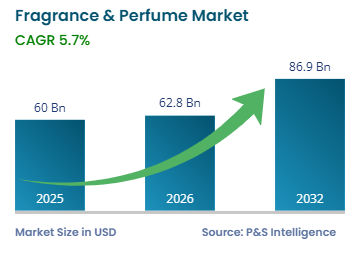
The global fragrance & perfume market valued USD 60.0 billion in 2025, and it is projected to reach USD 86.9 billion by 2032, expanding at a compound annual growth rate of 5.7% over 2026–2032.
Fragrance occupies a significant position within the broader beauty and personal care industry. The International Fragrance Association (IFRA) estimates that fragrance ingredients are present in more than 90% of all cosmetics and personal care products globally. This underscores the category’s foundational role in consumer goods well beyond fine perfumery. Market growth is driven by the proliferation of niche and artisanal fragrance houses, expansion of e-commerce and direct-to-consumer (D2C) distribution channels, and advancement of AI-driven scent personalization platforms. The niche and artisanal fragrance houses cater to consumers seeking individuality and olfactory storytelling. E-commerce and D2C channels eliminate barriers to global fragrance discovery. Moreover, advanced AI-driven scent personalization platforms replicate the in-store consultation experience in digital environments.
Regulatory compliance costs and ingredient volatility are shaped by EU REACH standards and progressive IFRA amendment cycles, restricting key aromatic materials. This represents a persistent structural challenge for manufacturers, particularly smaller independent houses that lack centralized regulatory infrastructure.
Premiumization and the rise of gender-neutral fragrance identities are altering the product development and commercial strategies of both established houses and emerging independent brands. Consumers across North America, Europe, and urban Asia-Pacific are migrating from lower-concentration body sprays and eau de toilette toward eau de parfum and extrait de parfum. This shift is driven by a preference for longevity, olfactory depth, and the perceived quality signal associated with higher-concentration formulations. The popularity of eau de parfum is credited to its positioning as the optimal intersection of premium experience and accessible price relative to pure parfum concentrations.
Simultaneously, the popularity of gender-neutral and unisex perfumes is driven by the evolving social attitudes toward personal expression among Millennial and Gen Z consumers, who reject binary fragrance categorization. Major houses, including Hermès, Chanel, Maison Francis Kurkdjian, and LVMH’s Dior, have repositioned significant portions of their portfolios around gender inclusion. This dual trend drives higher average selling prices across portfolios, creating favorable economic margins for brands executing credible premiumization strategies across both traditional and gender-neutral product lines. Niche and artisanal fragrances extend this dynamic further, with independent houses pricing products at over EUR 300 per 50 ml, attracting consumers seeking exclusivity and provenance.
The rising disposable income and expanding middle class are the most important drivers for the global fragrance and perfume market. As purchasing power increases, consumers allocate a greater share of household spending to discretionary lifestyle products, such as fragrances, cosmetics, and personal care items. According to the World Bank, global household final consumption expenditure exceeded USD 60 trillion in 2023, highlighting the rapid expansion of global consumer purchasing power and discretionary spending capacity. The Brookings Institution’s Global Economy and Development program estimates that Asia will account for nearly 65% of the global middle-class population by 2030, representing more than 3.5 billion consumers with increasing purchasing power.
China remains one of the most influential markets benefiting from rising income levels. As per the National Bureau of Statistics of China, urban per-capita disposable income exceeded RMB 50,000 in recent years. As incomes rise, fragrance adoption is increasing among younger consumers, who increasingly treat perfumes as daily grooming products rather than occasional luxury items.
India’s fragrance market is also expanding rapidly due to the increasing income and household spending capacity. According to the World Bank, India’s GDP per capita increased from roughly USD 1,600 in 2012 to more than USD 2,700 in recent years. Additionally, the Reserve Bank of India indicates that per-capita disposable income rose from approximately INR 44,000 in FY2014–15 to over INR 1.0 lakh in recent years.
The United Nations Department of Economic and Social Affairs (UN DESA) report a median age of around 28 years and more than 650 million people under the age of 35 in India. This means a large consumer base increasingly willing to spend on grooming and lifestyle products. The expansion of organized retail and e-commerce in Tier-2 and Tier-3 cities, along with new affordable premium fragrance launches by domestic brands, is further supporting fragrance adoption.
Across Southeast Asia too, the rising incomes are supporting fragrance demand. Household consumption expenditure across emerging Asian economies has been growing steadily due to rising wages, urbanization, and expanding middle-income populations. Indonesia, Vietnam, Thailand, and the Philippines are witnessing an increasing consumer spending on beauty and personal care products as disposable income levels improve.
In Gulf Cooperation Council (GCC) countries, the high purchasing power continues to sustain strong fragrance demand. Data from the International Monetary Fund (IMF) indicates that several GCC economies maintain GDP per capita levels exceeding USD 40,000. Combined with a deep cultural affinity for perfumes, oud, and fragrance oils, these income levels support extremely high per-capita fragrance spending. As millions of consumers move into higher income brackets each year, the demand for both mass and premium fragrance products is expected to grow steadily worldwide.
The shift toward digital commerce and AI-enabled fragrance discovery is eliminating one of the most persistent barriers to online perfume purchasing: the inability to smell a product before buying. Virtual scent profiling platforms, AI-driven recommendation engines, and digital fragrance consultations can map consumer olfactory preferences to curated product selections based on mood, occasion, and personal chemistry inputs. This enables confident online purchase decisions, which previously required physical retail interaction. This technology-driven shift enables brands and retailers to reach consumers in geographies and demographics previously inaccessible through physical stores.
The growth in online fragrance sales is supported, in part, by TikTok and Douyin-driven fragrance discovery trends, accelerating consumer experimentation among the Gen Z in China, South Korea, and the USA. D2C brands and independent niche houses that lack the capital for comprehensive brick-and-mortar retail infrastructure are the primary beneficiaries of this shift. The reduced distribution cost enables premium positioning at price points that would otherwise require department store margin concessions. India’s e-commerce sector is projected to reach USD 385.2 billion by 2032, with beauty and personal care among the fastest-growing categories. This reflects substantial infrastructure for the penetration of e-commerce for fragrance purchasing across both metro and non-metro areas.
Eau de parfum commanded the largest share, of 35%, in 2025. Its optimal aromatic compound concentration of 15–20% delivers 6–8 hours of longevity on skin within budget. EDP occupies the commercial sweet spot for both everyday wear and gifting across all major consumer income brackets. This makes it the default format for flagship launches by major houses, from Chanel and Dior through Ajmal and Amorepacific. EDP in premium branded packaging is widely gifted across holidays, Valentine’s Day, and Eid season, globally.
Extrait de parfum is projected to register the highest growth rate during 2026–2032, driven by the global premiumization trend. Affluent consumers in North America, Europe, and the GCC are increasingly picking ultra-concentrated, 25–45% aromatic compound formulations. These fragrances last for up to 24 hours and offer the olfactory complexity unavailable at lower concentrations. The niche and artisanal fragrance movement has significantly accelerated the sale of extrait de parfum products from independent houses, including Maison Francis Kurkdjian, Roja Parfums, and Clive Christian.
The market segments into the following product types:
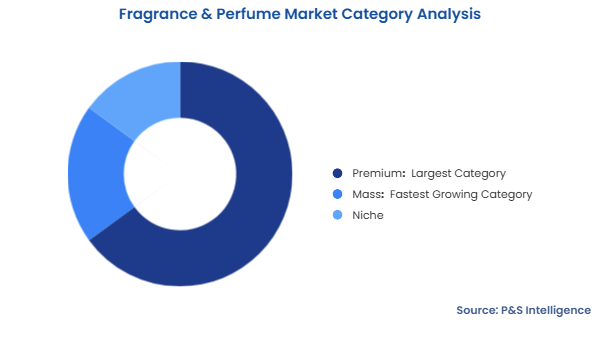
The premium category captured the largest share, of 65%, in 2025. This is due to the scale and distribution depth of multinational conglomerates, including LVMH, L'Oréal, Coty, and The Estée Lauder Companies across department stores, specialty retail, duty-free channels, and branded boutiques globally. Many middle-class consumers globally treat designer fragrance as an accessible luxury, sustaining consistent demand round the year. Established fashion houses, including Ralph Lauren, Hugo Boss, and Dolce & Gabbana, now sell prestige fragrances via department stores, as well as online D2C channels.
The mass category is anticipated to register the highest growth rate during 2026–2032. The rising disposable income across India, Southeast Asia, Latin America, and Sub-Saharan Africa is bringing first-time fragrance consumers into organized market channels at accessible price points. ITC Limited’s Engage brand in India and Unilever’s Axe and Rexona deodorant–fragrance formats across emerging markets exemplify the mass category’s growth. High-volume, TV-advertised, nationally distributed products convert daily hygiene behavior into fragrance consumption habits at scale. The World Bank confirms that the global middle class is projected to rise by 1 billion by 2030, predominantly in Asia and Africa.
The market segments into the following categories:
Women held the largest share, of 60%, in 2025, sustained by the broadest product assortment for them, their higher purchase frequency relative to men, and deeply embedded cultural associations between fragrance use and femininity. American women purchase new fragrances almost monthly, compared to the male average of 1–2 times annually. Major houses, including Chanel, Dior, Hermès, and Lancôme, allocate the largest share of their new product development and marketing budgets to women’s launches. This reflects both the commercial scale and the role of these products in prestige brand storytelling and heritage positioning.
The unisex category is projected to experience the highest growth rate during 2026–2032. Millennial and Gen Z consumers are rejecting binary fragrance categorization in favor of scent-driven personal expression independent of gender. Hermès, Chanel, Byredo, and Maison Francis Kurkdjian have repositioned their new and upcoming products around gender-inclusive formats. While, independent niche brands are increasingly making unisex perfumes their default market entry strategy.
The market segments into the following end users:
The 26–40 years category commands the largest share, of 45%, due to their high purchasing power, high fragrance use and purchase frequency, and brand engagement. Millennials consider fragrance a daily personal care essential rather than an occasional gifting luxury. Their spending patterns are reinforced by established careers, dual-income households, and deep brand loyalty cultivated through years of active fragrance purchasing. This group drives the bulk of eau de parfum and premium product revenue globally. Further, their product preferences—longevity, olfactory complexity, niche-origin narratives, and sustainable ingredient positioning—define the commercial requirements for new launches across major houses.
The under-25 years category is the fastest-growing in the global fragrance market. The U.S. Chamber of Commerce reports that Gen Z consumers spent 26% more on fragrance and perfume in 2024 than in 2023. Unisex and gender-neutral formats represent the fastest-growing category. They engage in fragrance wardrobing, which means maintaining multiple scents for different moods and social contexts, rather than committing to a single signature fragrance. TikTok-driven discovery has eliminated the in-store testing barrier, enabling purchase decisions based on influencer sensory storytelling rather than physical trial. As Gen Z consumers age into higher-earning brackets, they will spend even more on fragrances.
The market segments into the following age groups:
Specialty stores accounted for the largest share, of 35%, in 2025. The sensory and experiential nature of fragrance purchasing inherently favors physical retail environments, where consumers can test the scents on skin, receive expert consultation, and access curated brand assortments. Dedicated fragrance and beauty specialty retailers, including Sephora (LVMH), Ulta Beauty, Nocibé, and Douglas, provide the in-store infrastructure to premium and luxury fragrance houses to effectively translate brand storytelling into sales. The specialty store channel is also the primary destination for sampling new releases, a behavior that remains resistant to digital substitution despite the advances in virtual scent profiling technology.
Online is projected to register the highest growth rate during 2026–2032, driven by the improving AI-driven scent recommendation engines, virtual fragrance discovery platforms, and influencer-driven social commerce on TikTok, Instagram, and Xiaohongshu (RED). Additionally, online D2C models enable independent and niche fragrance brands to reach global audiences without wholesale margin concessions.
Around one-third of the world’s population (approximately 2.8 billion people) shops online. A significant portion of these consumers make purchases frequently, with more than a third shopping at least once per week and others buying at least once per month. Mobile devices play a central role in online shopping, making e-commerce more accessible and convenient, and contributing to the ongoing expansion of digital consumer engagement globally.
The market segments into the following distribution channels:
Drive strategic growth with comprehensive market analysis
Europe is the largest regional market, with 45% share in 2025, due to its unparalleled concentration of prestige fragrance heritage and high per-capita fragrance expenditure. France alone is home to Chanel, Hermès, LVMH’s principal fragrance brands, and L’Oréal’s luxury perfume portfolio. The European Union’s Cosmetics Regulation (EC) No 1223/2009 mandates comprehensive ingredient disclosure and safety assessments. This sets the global benchmark for fragrance regulatory compliance, effectively raising entry barriers for undercapitalized market participants, while reinforcing the premium product positioning that European heritage brands command.
The United Kingdom is the fastest-growing market within Europe, demonstrating robust demand for both luxury and niche fragrance formats through Harrods, Liberty, and the expanding network of independent perfumery boutiques.
France is both the largest consumer of fragrances in Europe and the industry’s most historically significant production and innovation hub. The Grasse region in Provence has supplied prestigious natural aromatic ingredients—including Grasse rose, jasmine, and iris—for over three centuries. LVMH Moët Hennessy Louis Vuitton, Chanel, L’Oréal, and Hermès International collectively generate a disproportionate share of global luxury fragrance revenue from their Parisian headquarters. This is because Paris functions as the world’s primary capital for fine perfumery brand storytelling, retail experience design, and nose-led innovation.
France’s Ministry for the Economy and Finance recognizes cosmetics and perfumery as a strategic national industry. This is because the French fragrance sector generates significant export revenue and employment in both the luxury conglomerate tier and the independent perfumery craftsman tier centered in Grasse. French consumers reflect the highest fragrance cultural penetration globally. The expansion of niche and artisanal houses, including Diptyque, Maison Margiela’s Replica line, and Etat Libre d’Orange, drives premiumization, while generating a growing international demand for French indie fragrances.
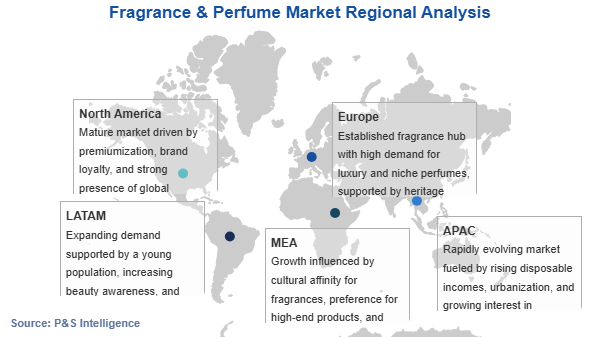
North America’s market is driven predominantly by the United States. American consumers’ spending on premium and luxury fragrances reflects their high disposable income and a maturing cultural relationship with fine perfumery, which has expanded beyond occasional gifting into everyday self-care. The U.S. Bureau of Labor Statistics Consumer Expenditure Survey recorded average household expenditure on personal care products at USD 833 per consumer unit in 2023.
Canada is the fastest-growing market within North America, propelled by the strong urban consumer spending in Toronto, Vancouver, and Montreal and growing multicultural demographics with elevated fragrance affinity. Moreover, premiumization is hastening as Canadian consumers shift from mass to prestige brands. The U.S. Food and Drug Administration’s Modernization of Cosmetics Regulation Act of 2022 (MoCRA) has introduced expanded ingredient transparency and safety reporting obligations across the North American market. This adds compliance investment requirements for fragrance manufacturers, while reinforcing consumer trust through enhanced regulatory standards.
Asia-Pacific is the fastest-growing regional fragrance & perfume market over 2026–2032, with 6.5% CAGR, driven by shifting demographics, rising income, and evolution of consumers from just deodorants to multiple products.
India is the fastest-growing, supported by a consumer base exceeding 1.4 billion people, a median age below 30, and vigorous domestic brand development. Japan and South Korea house highly sophisticated premium fragrance consumers, with Shiseido and Amorepacific leveraging established domestic distribution networks and J-beauty and K-beauty brand equity. Australia demonstrates growing niche fragrance consumption, particularly in Sydney and Melbourne, reflecting alignment with global premiumization trends.
Fragrance adoption in China is accelerating as Chinese consumers increasingly incorporate fine fragrance into daily personal expression routines. Domestic niche brands, including Scent Library and Proya, are gaining traction alongside international conglomerates, positioning cultural provenance and locally inspired scent compositions against Western heritage fragrances. China’s National Bureau of Statistics reported that urban per-capita disposable income reached CNY 51,821 (approximately USD 7,200) in 2023, reflecting sustained income growth. This supports the aspirational consumption of premium fragrance products across China’s expanding urban middle class.
The cross-border e-commerce infrastructure particularly through Tmall Global, JD Worldwide, and Little Red Book (Xiaohongshu) continues to accelerate international fragrance brand penetration. China’s National Medical Products Administration (NMPA)’s Cosmetics Supervision and Administration Regulation (CSAR) has introduced comprehensive registration and ingredient filing requirements for imported fragrances. This creates compliance obligations, which has accelerated the localization of fragrance production and regulatory strategy among major international brands.
Latin America represents a commercially significant and rapidly evolving fragrance & perfume market. Brazil’s market is characterized by strong direct-selling heritage and growing organized retail and e-commerce penetration, which is broadening consumer access to international and premium domestic brands. Natura & Co. was the first to distribute fragrances in the country through its direct sales network. Mexico is the fastest-growing market within Latin America, driven by its large young population, rising urban middle-class incomes, expanding organized beauty retail chains, and accelerating online sales through MercadoLibre and domestic e-commerce platforms.
The Middle East and Africa region sustains a high per-capita fragrance expenditure globally, led by Saudi Arabia and the UAE. Fragrance is deeply embedded in the Middle Eastern culture and society, led by oud-based formulations, attar concentrates, and bakhoor incense fragrances. These products are bought year-round, well beyond the seasonal gifting patterns prevalent in Western markets. Regional heritage brands, such as Ajmal Perfumes, Al Haramain Perfumes, Arabian Oud Company, and Rasasi Perfumes Industry, possess extensive GCC retail networks and growing international distribution across Europe, South Asia, and North America.
Saudi Vision 2030 includes the development of a domestic luxury goods and cultural industries sector, which will help formalize and internationally scale Saudi fragrance brands. Dubai is a global fragrance trading hub, while the government’s Make it in the Emirates initiative incentivizes domestic manufacturing investment, including in the fragrance and personal care industries. South Africa represents the most developed sub-Saharan African fragrance market, propelled by rapid urbanization and rising incomes.
The regions and countries analyzed in this report include:
The global fragrance & perfume market is moderately fragmented, characterized by a concentrated luxury and premium tier dominated by a small number of multinational conglomerates operating extensive brand portfolios. Beneath it are independent fashion houses, regional fragrance specialists, and emerging domestic brands competing across the mass, affordable premium, and niche categories. The luxury tier requires sustained investment in heritage storytelling, high-quality ingredient sourcing, prestige retail placement, and celebrity and fashion relationships, which creates significant barriers to entry. While, the mass and mid-market tiers reward distribution scale, television and digital advertising reach, and price-point accessibility, which favors both multinational FMCG players and well-capitalized regional brands.
Want a report tailored exactly to your business need?
Request CustomizationLeading companies across industries trust us to deliver data-driven insights and innovative solutions for their most critical decisions. From data-driven strategies to actionable insights, we empower the decision-makers who shape industries and define the future. From Fortune 500 companies to innovative startups, we are proud to partner with organisations that drive progress in their industries.

Working with P&S Intelligence and their team was an absolute pleasure – their awareness of timelines and commitment to value greatly contributed to our project's success. Eagerly anticipating future collaborations.
McKinsey & Company
India
Our insights into the minutest levels of the markets, including the latest trends and competitive landscape, give you all the answers you need to take your business to new heights

We take a cautious approach to protecting your personal and confidential information. Trust is the strongest bond that connects us and our clients, and trust we build by complying with all international and domestic data protection and privacy laws


Customize the Report to Align with Your Business Objectives

Request the Free Sample Pages